
Decentralized finance has evolved significantly beyond simple token swaps and basic holding strategies. As the ecosystem matures, sophisticated investors seek ways to stabilize returns and manage risk with greater precision. The volatility inherent in cryptocurrency markets often makes it difficult to predict future values or secure consistent income streams. However, by combining advanced financial tools, users can construct products that offer more predictable outcomes. This involves utilizing derivatives to manage price exposure and insurance protocols to mitigate systemic risks.
The creation of structured yield products in a decentralized environment places the power of financial engineering into the hands of the individual. Unlike traditional finance, where structured notes are sold by banks with opaque fees, DeFi allows users to build these positions transparently. This process usually involves locking in rates or hedging exposure using fixed-income derivatives or perpetual futures. By doing so, an investor can isolate specific sources of yield while neutralizing unwanted market noise.
To execute this effectively, one must understand the underlying components. These include derivative contracts that track asset prices and insurance mechanisms that protect capital. The interplay between these elements allows for the creation of a "structured product" that acts somewhat like a bond or a hedged dividend stock. The goal is to generate a return that is distinct from the directional movement of the market. This article explores the specific mechanisms, tools, and strategies required to build such positions using decentralized protocols.
The Fundamentals of DeFi Derivatives
Derivatives serve as the foundational building blocks for structured financial products in the crypto economy. In the context of decentralized finance, these are financial contracts that derive their value from an underlying cryptocurrency or digital asset. They differ fundamentally from spot trading. When a user buys a digital asset on the spot market, they own the actual token and express an implicit view that its value will rise. Derivatives, conversely, offer the flexibility to express views on both upward and downward price movements without necessarily holding the asset itself.
These financial instruments provide access to leverage, which is a critical component in capital efficiency. Leverage increases purchasing ability, allowing traders to manage larger positions with smaller amounts of collateral. While this increases risk, it is essential for structuring yield products where capital efficiency determines the overall return on investment. Trading these instruments on decentralized protocols offers distinct advantages over centralized alternatives.
Decentralized derivative platforms protect users from opaque operational risks. Centralized exchanges have occasionally engaged in fraudulent behavior or suffered from poor internal risk management. Decentralized applications run on smart contracts, ensuring that the rules of the trade are enforced by code rather than human intermediaries. This transparency is vital when building long-term structured positions. Users interact directly with the protocol, maintaining control over their funds until the trade is executed.
Mechanics of Perpetual Futures
Perpetual futures are the most common form of derivative used in these strategies. Unlike traditional futures contracts, perpetuals do not have an expiration date. They can be held indefinitely, provided the trader maintains sufficient margin. This feature is what allows them to be used for long-term yield structuring. Users do not need to constantly "roll over" contracts or manage expiration dates, which simplifies the management of the position.
The trading process involves two primary directions: long and short. Going long signifies a belief that the underlying asset will rise in value. This is achieved by buying a perpetual contract. Conversely, going short expresses the view that the asset will fall in value. This is done by selling the contract. In a structured yield product, the short position often serves as a hedge rather than a speculative bet. It neutralizes the price movement of a held asset.
Platforms like dYdX exemplify this technology. As a layer-2 decentralized exchange, dYdX offers rapid transaction speeds and reduced costs while settling on Ethereum. This efficiency is necessary for sophisticated strategies that may require frequent adjustments. The platform operates on smart contracts, removing central third parties from the equation. This infrastructure supports the reliable execution of the perpetual contracts necessary for rate locking and yield generation.
Understanding Funding Rates as Yield
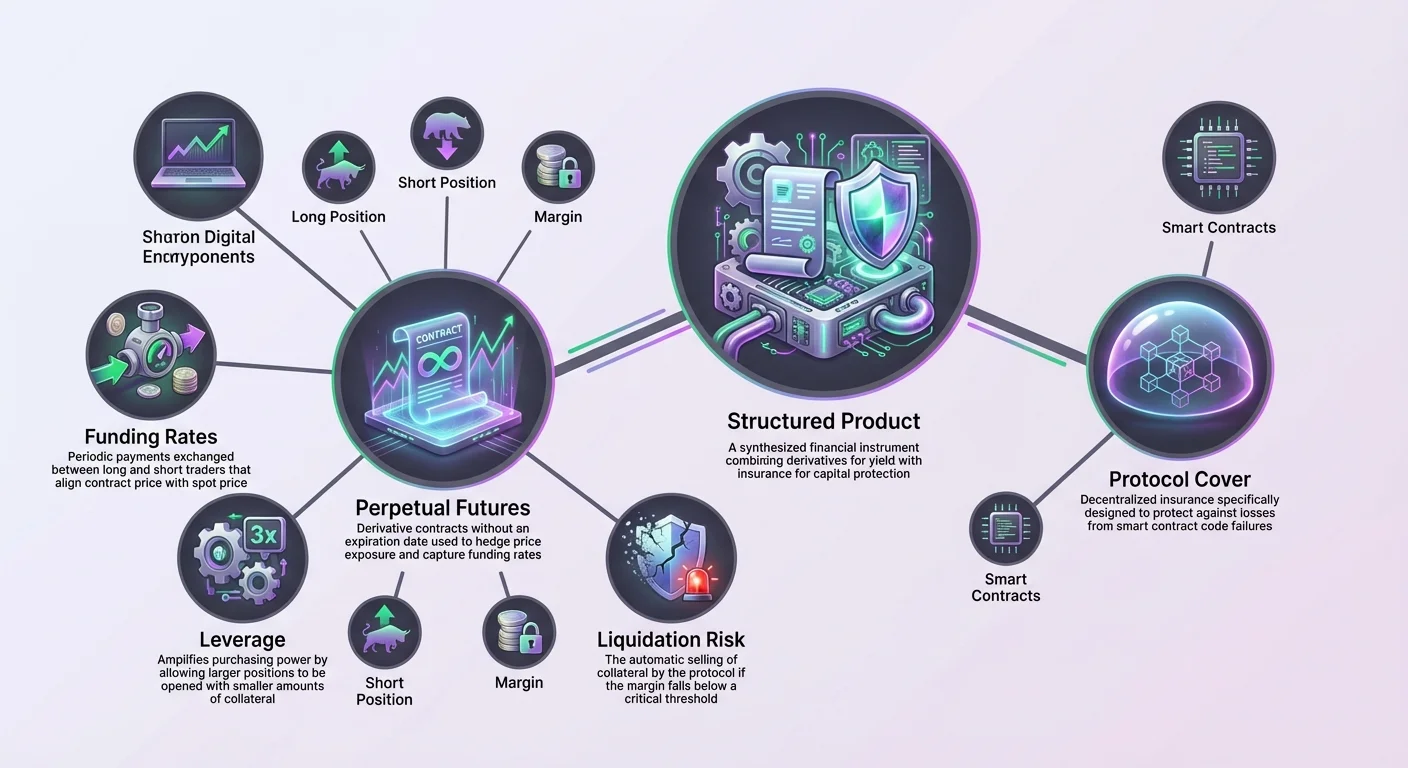
The engine that drives yield in many structured derivative products is the funding rate mechanism. Since perpetual futures have no expiration date, they require a mechanism to keep the contract price aligned with the spot price of the underlying asset. Funding rates serve this purpose. They are periodic payments exchanged between traders holding long positions and those holding short positions.
When the price of the perpetual contract is higher than the underlying spot price, the market sentiment is considered bullish. In this scenario, traders holding long positions pay a fee to those holding short positions. This payment incentivizes arbitrageurs to sell contracts, driving the price down toward the spot. Conversely, when the contract trades below the spot price, shorts pay longs. This encourages buying pressure to push the price back up.
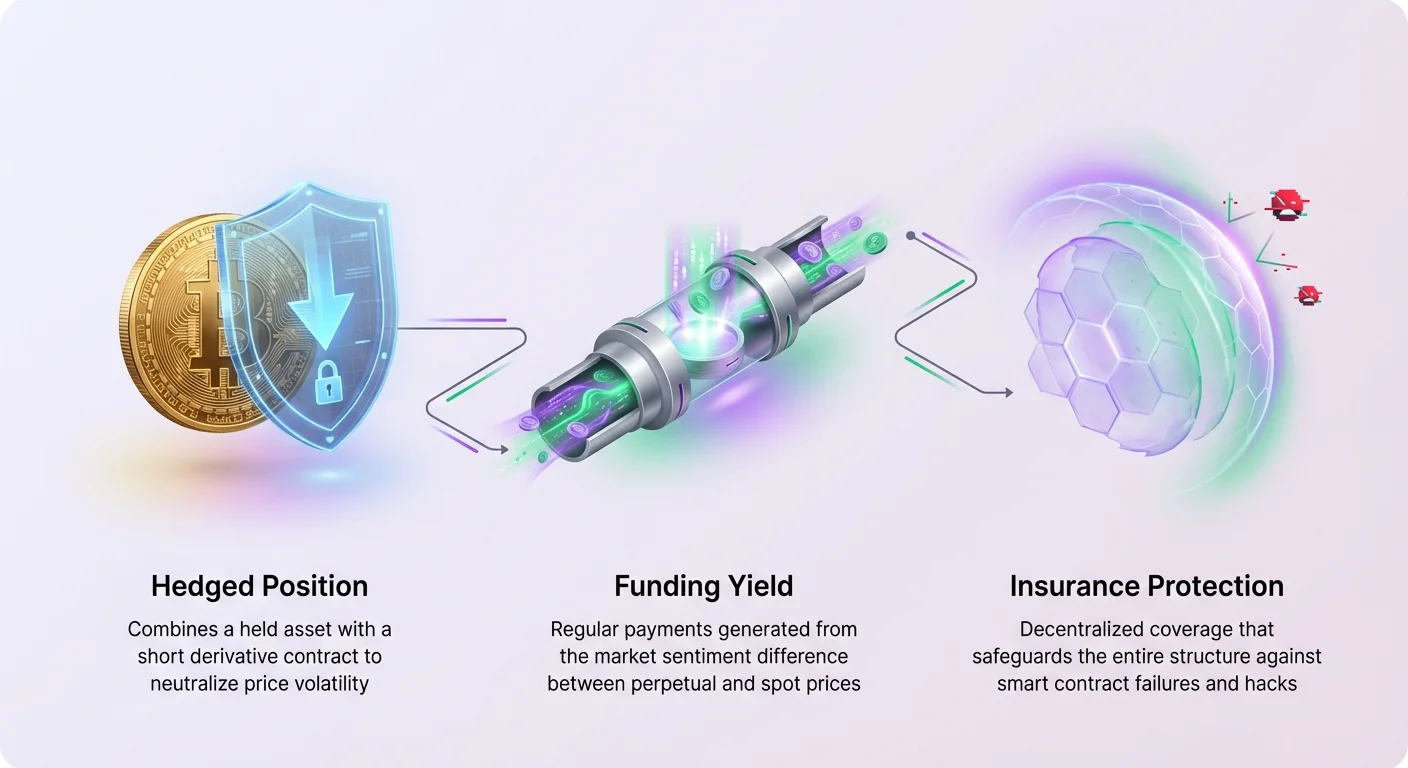
For a structured product creator, this funding rate represents a yield stream. In a typically bullish crypto market, funding rates are often positive. This means short sellers receive regular payments from long traders. By holding a short position, an investor can collect this "tax" on bullish sentiment. If the position is hedged against a spot holding, this funding income becomes a net profit, independent of whether the market goes up or down.
Capital Efficiency Through Leverage
Leverage allows investors to amplify the effectiveness of their capital within a structured product. It enables the purchase or sale of more contracts than the collateral would normally permit. For instance, depositing 100 USDC with 3x leverage allows for a theoretical position size of 300 USDC. This amplification is useful for maximizing the yield generated from funding rates. However, it introduces significant risks that must be managed carefully.
The use of leverage relates directly to the concept of margin. Margin acts as the collateral necessary to open and maintain a trade. It is categorized into initial margin and maintenance margin. Initial margin is the amount required to open the position. Maintenance margin is the minimum amount required to keep the position open. If the value of the collateral falls below this threshold due to adverse price movements, the protocol will liquidate the position.
In a structured yield scenario, leverage is typically used conservatively. High leverage increases the probability of liquidation, which would destroy the structure of the product. For new users or those seeking stable yields, using leverage of 1x or less is often recommended. This reduces the risk of liquidation to near zero while still allowing the user to participate in the derivatives market. The goal is to maintain the position long enough to collect yield, not to gamble on short-term price spikes.
Risk Management and Liquidation
Liquidation is the primary threat to any derivative-based strategy. It occurs when the trader runs out of margin. In a decentralized environment, this process is automated. Smart contracts monitor the value of the position relative to the collateral. If the maintenance margin requirement is breached, the protocol automatically sells the collateral to cover the position, often charging a liquidation fee in the process.
Understanding the liquidation price is crucial for stability. For a long position, the liquidation price is below the entry price. For a short position, it is above the entry price. For example, if a trader shorts Bitcoin at 20,000 USD with 2x leverage, the liquidation price might be around 29,400 USD. If Bitcoin rises to that level, the position is wiped out. Lower leverage results in a liquidation price that is further away from the current market price, providing a wider safety buffer.
To build a robust product, one must monitor the "health" of the position. This involves ensuring that there is always enough collateral to withstand market volatility. In DeFi, where markets run 24/7 and can experience rapid double-digit percentage moves, conservative margin management is non-negotiable. The stability of the yield depends entirely on the position remaining open and solvent during turbulent market conditions.
Executing the Strategy: Wallets and Deposits
The practical execution of these strategies begins with a digital wallet. A self-custodial wallet is the gateway to decentralized applications. Unlike custodial accounts where a third party holds the keys, self-custody grants the user full control over their assets. This is a prerequisite for interacting with protocols like dYdX or Nexus Mutual. The wallet acts as both the identity and the bank account for the user.
To trade, the wallet must hold cryptocurrency to pay for transaction fees and serve as collateral. Fees are paid in the native currency of the blockchain, such as ETH for Ethereum-based transactions. Before entering a position, the user must ensure they have sufficient funds to cover these network costs. Additionally, the specific assets required for the derivative trade, such as USDC or other stablecoins, must be available in the wallet.
Derivatives platforms often use layer-2 solutions or separate chains to improve performance. This requires depositing assets into the specific DApp. The user connects their wallet to the site, approves the connection, and initiates a deposit transaction. This moves funds from the main blockchain into the smart contracts of the trading platform. Once the transaction clears, the funds are available for trading. This step moves assets from a generic wallet state to a specific trading balance.
Order Types and Position Entry
Opening a position involves selecting the correct market and order type. The two primary methods are market orders and limit orders. A market order executes immediately at the best available current price. This ensures the position is opened instantly but offers no price guarantees. In volatile markets, the execution price might differ slightly from the display price, a phenomenon known as slippage.
Limit orders offer more precision. A user specifies the exact price at which they are willing to execute the trade. The order will only fill if the market reaches that price or better. For a structured product where entry price dictates the efficiency of the hedge, limit orders are often preferred. They allow the creator to be precise about their entry, ensuring the math of the yield strategy holds up.
To execute, the user selects the market (e.g., BTC-USD), inputs the position size, and chooses the direction (buy or sell). If using leverage, the slider or input field is adjusted to the desired multiplier. Once the details are confirmed, the "Place Order" button is clicked. The wallet will verify the transaction (if it's an on-chain order) or sign a message (for layer-2 matching), and the position becomes active.
Securing the Structure: The Role of Insurance
While derivatives allow for the construction of yield, they do not eliminate technical risks. The DeFi ecosystem relies on smart contracts, which are essentially code. Code can contain bugs, and platforms can be vulnerable to hacks. To create a truly "structured" product that rivals traditional finance in safety, one must mitigate these platform-specific risks. This is where decentralized insurance comes into play.
Decentralized insurance platforms allow users to purchase cover for various on-chain risks. This increases efficiency and transparency compared to traditional insurance. Assessments are performed by the community, and the entire process is governed by smart contracts. There are no business hours or holidays; protection is available 24/7. This aligns perfectly with the always-on nature of derivative trading.
By purchasing cover, an investor protects the capital deployed in the derivative strategy. If the derivatives exchange were to suffer a smart contract failure or a hack that resulted in a loss of funds, the insurance policy would provide a payout. This creates a "principal protected" structure where the market risk is hedged via the derivative, and the platform risk is hedged via the insurance.
Coverage Types and Selection
Platforms like Nexus Mutual offer specific types of coverage tailored to DeFi users. The most relevant for this strategy is Protocol Cover. This protects against financial losses resulting from failures in the smart contract code of a specific protocol. If an investor is using dYdX to generate yield, they would purchase Protocol Cover specifically for dYdX. This ensures that the specific venue housing their funds is insured.
When selecting cover, the user acts as a member of a risk-sharing pool. The process is transparent and community-driven. Users holding the platform's governance token often participate in risk assessment and claims assessment. This decentralized approach ensures that the incentives of the insurers and the insured are aligned. The capital backing the insurance comes from a shared pool of funds provided by members who earn rewards for underwriting the risk.
To buy cover, the user connects their wallet to the insurance application. They browse for the specific protocol they wish to insure. Once selected, they input the amount of cover required (usually matching the size of their derivative position) and the duration of the policy. A premium is calculated based on these factors. If the user accepts the quote, they pay the premium in crypto, and the cover becomes active immediately.
| Feature | Traditional Insurance | DeFi Insurance |
|---|---|---|
| Governance | Centralized Company | Decentralized DAO |
| Operations | Business Hours | 24/7 Smart Contracts |
| Assessment | Internal Adjusters | Community Voting |
The Claims Process
The value of insurance lies in the ability to make a claim. In decentralized insurance, the claims process is designed to be rigorous yet accessible. If an incident occurs, such as a hack of the derivative platform, the cover holder can submit a claim. This must be done within the specific timeframe outlined in the policy, usually during the cover period or shortly after.
Submitting a claim requires connecting the wallet to the platform. The user navigates to their active covers and selects the option to file a claim. They must provide details of the incident and proof of loss. Since the blockchain is a public ledger, proof of loss is often verifiable on-chain. The user points to the transactions showing they held funds on the compromised platform at the time of the hack.
Once submitted, the claim is reviewed. On platforms like Nexus Mutual, this review is conducted by other members who act as claims assessors. They vote on the validity of the claim based on the evidence and the policy wording. If the consensus is to approve the claim, the payout is authorized. The funds are then sent directly to the user's wallet. This process removes the arbitrary denial risk often associated with centralized insurers, provided the loss falls clearly within the defined terms.
Synthesizing the Product
Creating the final structured yield product involves combining the derivative position with the insurance wrapper. The investor starts by acquiring the spot asset or stablecoin. They then deposit this collateral into the derivative protocol. A short position is opened to neutralize the price exposure of the asset, effectively locking in the dollar value of the portfolio. This step converts a volatile asset into a stable, yield-bearing instrument via funding rates.
Simultaneously, the investor purchases insurance cover for the derivative protocol. The cost of this insurance (the premium) is a drag on the yield. However, it transforms the risk profile. The net yield of the structured product is the funding rate income minus the insurance premium. If the funding rate is 10% annually and the insurance cost is 2% annually, the investor creates a net 8% yield that is hedged against price crashes and platform hacks.
This synthesis effectively creates a "fixed-income" style derivative. While the rate isn't mathematically fixed—funding rates fluctuate—it provides a cash-flow positive stance that is uncorrelated with the market's direction. This is the essence of financial engineering in DeFi: taking raw primitives like perps and cover to build something greater than the sum of its parts.
Monitoring and Adjustment
Once the product is created, it requires active monitoring. Funding rates are dynamic. In a strong bear market, funding can turn negative, meaning shorts pay longs. If this persists, the strategy loses money. The investor must be ready to close the position if the market environment shifts unfavorably. Unlike a passive bond, this structured product is a living strategy that reacts to market sentiment.
Additionally, the insurance cover has a fixed duration. If the strategy is meant to be long-term, the user must renew the cover before it expires. Allowing coverage to lapse exposes the principal to smart contract risk. Managing these timelines is part of the administrative overhead of running a self-structured product.
Users must also keep an eye on their margin ratio. Even with a delta-neutral hedge, extreme volatility can affect the liquidation price. Adding collateral during periods of high stress ensures the structure remains intact. This maintenance is the trade-off for accessing high, transparent yields without an intermediary.
Conclusion
Creating structured yield products using fixed-income derivatives and insurance in DeFi represents a significant leap in personal financial management. By utilizing perpetual futures, investors can isolate funding rates as a source of income, separating yield from asset appreciation. The integration of decentralized insurance further refines this strategy by mitigating the unique technical risks associated with blockchain protocols.
This approach empowers individuals to act as their own financial engineers. They can customize the level of leverage, the duration of insurance coverage, and the specific assets involved to tailor a product that meets their risk tolerance. While it requires more active management than traditional banking products, the transparency and potential for higher returns make it a compelling alternative for the sophisticated crypto investor.
By combining short derivative positions to capture funding rates with comprehensive smart contract insurance, investors can engineer stable, protected yield streams in decentralized markets.