
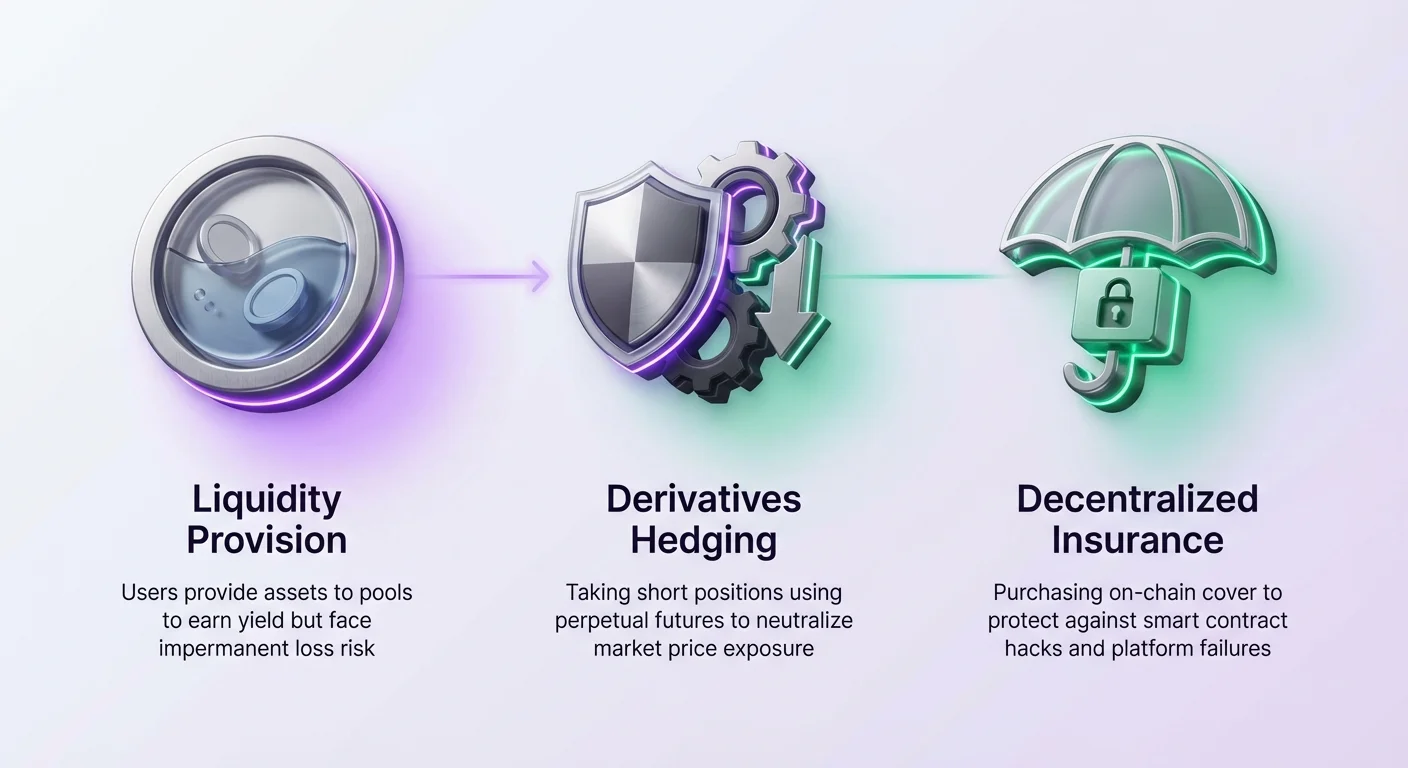
Decentralized finance offers opportunities to earn yield through liquidity provision, but this activity comes with inherent market risks. When asset prices change significantly, liquidity providers often face a reduction in value compared to simply holding the tokens, a phenomenon known as impermanent loss. To combat this, sophisticated participants turn to financial derivatives. These instruments allow users to neutralize their market exposure. By combining these trading tools with decentralized insurance, investors can create a more robust strategy that addresses both market volatility and smart contract risks.
Derivatives markets in DeFi have evolved to offer perpetual futures and other contract types that settle on-chain or via layer-2 solutions. These protocols enable users to express granular views on price direction without needing to own the underlying asset physically. This capability is essential for hedging. When a user holds a spot position in a liquidity pool, they are implicitly long the asset. Using derivatives to take an opposing short position can flatten this exposure, protecting the principal value in dollar terms regardless of market movement.
The Fundamentals of DeFi Derivatives
DeFi allows users to deposit collateral and trade financial contracts that derive their value from underlying cryptocurrencies. Unlike buying a cryptoasset on a spot exchange, which represents immediate ownership, a derivative contract is an agreement based on the future price of that asset. This distinction is critical for hedging strategies. Spot ownership only allows for profit when prices rise. Derivatives enable traders to profit when prices fall, which is the mechanism used to offset losses in a liquidity pool during a downturn.
Leading decentralized applications (DApps) for derivatives often operate on layer-2 networks. For example, platforms like dYdX function as a layer-2 Ethereum decentralized exchange specializing in perpetual futures. This architecture offers significant improvements in transaction speed and reduces costs compared to layer-1 execution. Importantly, trades are still settled on the base layer, providing security guarantees. These platforms utilize smart contracts to manage positions, removing the need for central intermediaries or opaque order books found on traditional exchanges.
Mechanics of Long and Short Positions
Understanding the specific directional views available through derivatives is necessary for constructing a hedge. Perpetual trading consists of either going long or going short on an underlying asset. Going long signifies a belief that the asset's value will increase. This is achieved by buying a perpetual contract. For a liquidity provider who already owns the tokens in a pool, they are already effectively long. Adding a long derivative position would only increase their risk exposure.
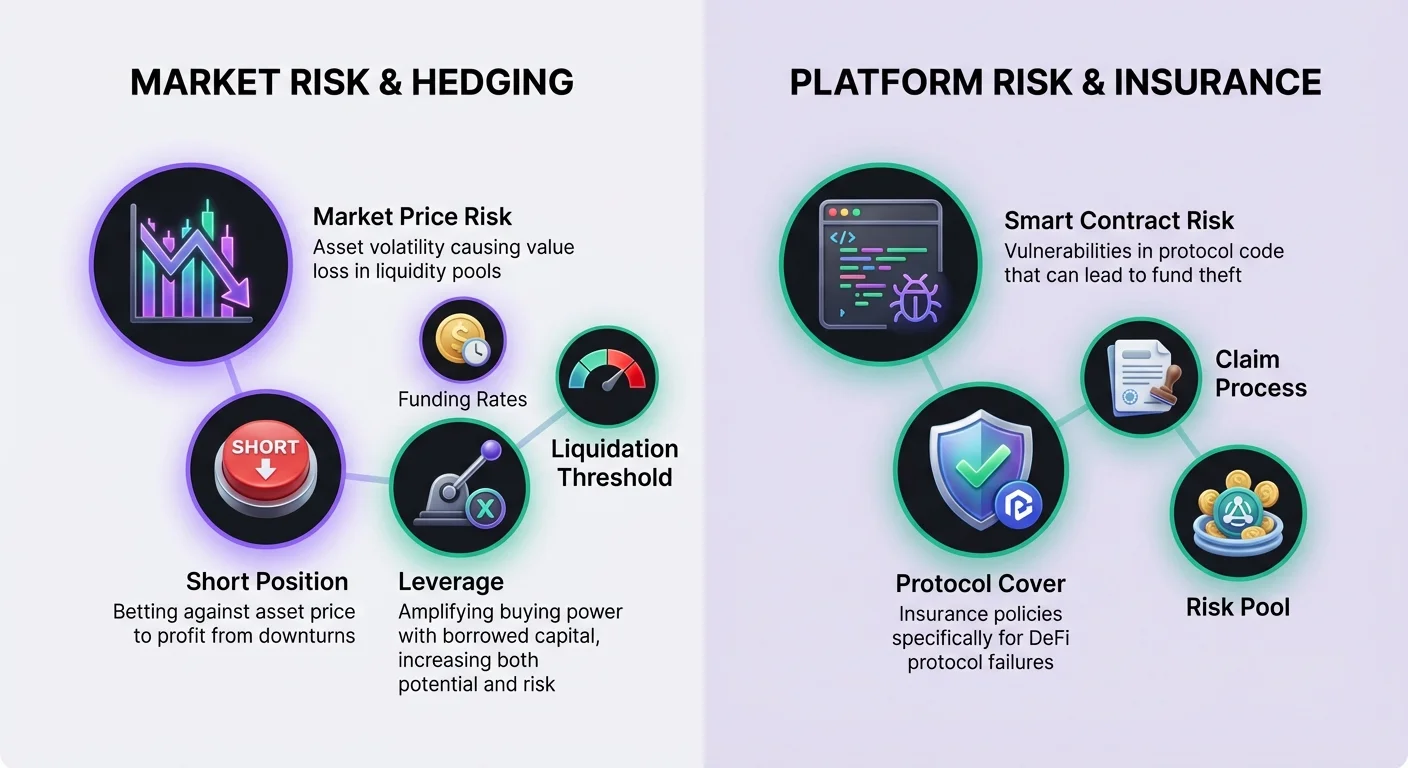
To neutralize exposure, a liquidity provider would focus on the short side. Going short means betting that the underlying asset will fall in value. This is executed by selling a perpetual contract. If the market price of the asset drops, the value of the tokens in the liquidity pool decreases. However, the short position in the derivatives market gains value. Ideally, the profit from the short hedge offsets the decline in the portfolio's spot value. This balance preserves the total dollar value of the capital deployed.
Leverage and Capital Efficiency
One of the primary advantages of using derivatives over spot selling is the access to leverage. Leverage allows a trader to purchase or sell more contracts than their deposited collateral would normally permit. This acts as a multiplier for purchasing ability. In the context of hedging, leverage allows a user to protect a large liquidity position with a relatively small amount of capital set aside for the hedge. This capital efficiency is vital for maintaining a high yield on the main portfolio.
However, leverage introduces significant risks that must be managed carefully. It exposes the trader to liquidation if the market moves against the position. Platforms define a maximum leverage for different markets. For instance, a BTC-USD market might offer up to 20x leverage, while an AVAX-USD market might be capped at 10x. The risk increases as the position size grows relative to the collateral. A highly leveraged hedge requires less upfront capital but demands strict monitoring to prevent the position from being wiped out during volatility.
Calculating Leverage Ratios
It is helpful to visualize how leverage impacts purchasing power. If a trader deposits 100 USDC as collateral, different leverage settings drastically change the theoretical maximum position size. At 1x leverage, the user can buy or sell 100 USDC worth of contracts. This is effectively a fully collateralized position with no added leverage risk. At 10x leverage, that same 100 USDC controls 1,000 USDC worth of contracts.
Pushing the limits further dramatically increases exposure. At 20x leverage, the 100 USDC deposit controls 2,000 USDC worth of contracts. While this allows for aggressive hedging with minimal capital, it leaves very little room for price fluctuations. New users or those using derivatives strictly for insurance-like hedging are often encouraged to use 1x leverage or less to minimize liquidation risks.
Understanding Liquidation Thresholds
Liquidation occurs when the trader runs out of margin to support their position. When this happens, the protocol automatically closes the position, and the trader pays a liquidation fee. The liquidation price depends heavily on the leverage used. Consider a scenario where a trader wants to long Bitcoin at 20,000 USD with 100 USD of collateral. Using 1x leverage, the liquidation price might be as low as 600 USD, providing immense safety.
As leverage increases, the liquidation price moves much closer to the entry price. With 2x leverage on the same trade, the liquidation price might jump to roughly 10,600 USD. At 10x leverage, the liquidation price could be around 18,600 USD. In this high-leverage scenario, a mere 7% drop in the asset price would wipe out the collateral. For short positions used to hedge, the risk is inverted; a sharp rise in price can trigger liquidation.
Funding Rates and Maintenance Margin
Maintaining a derivatives position involves understanding two key financial concepts: margin and funding. Margin is the collateral necessary to keep a trade open. It is categorized into initial margin and maintenance margin. Initial margin is the amount required to open the position. Maintenance margin is the minimum amount required to keep the position open and prevent liquidation. If the account value falls below the maintenance margin, the protocol liquidates the position to ensure solvency.
Funding is a mechanism unique to perpetual futures that tethers the contract price to the spot price. It acts as a periodic payment between traders. When the perpetual contract price is below the underlying spot price, shorts pay longs. This typically occurs when there is bearish sentiment and more traders are shorting. Conversely, when the perpetual price is above the underlying asset, longs pay shorts. This indicates bullish sentiment.
For a hedger holding a short position, funding rates represent a variable cost or rebate. In a bull market where longs pay shorts, the hedger effectively gets paid to maintain their protection. However, in a bear market where the crowd is shorting, the hedger may have to pay funding fees. This can be viewed as a tax on the majority sentiment paid to the minority. Hedgers must account for this potential cost when calculating the net yield of their liquidity provision strategy.
Executing the Hedge
To implement a hedge, users must interact with the derivatives DApp interface. There are two primary ways to open a position: market orders and limit orders. Market orders execute immediately at the current prices offered in the order book. This ensures the hedge is placed instantly but offers less control over the specific entry price. Limit orders execute only at a specified price or better. This offers price certainty but risks the order not being filled if the market moves away from the target.
Before trading, assets must be deposited into the protocol. Platforms like dYdX require users to move cryptoassets from their self-custodial wallet into the DApp to reduce transaction costs and improve speed. Other platforms may allow trading directly from a wallet without a dedicated deposit step. Users connect their web3 wallet, select the asset to deposit, and wait for the transaction to clear on the blockchain. Once funded, they can select the market that corresponds to their LP position and sell contracts to initiate the hedge.
Closing the position is the final step in the cycle. This action converts unrealized gains or losses into realized outcomes. If the hedge was successful during a market downturn, the short position will have accumulated unrealized gains. Closing the position adds these gains to the account balance, offsetting the losses incurred in the liquidity pool. Users generally navigate to their open positions tab and select the option to close, fully exiting the trade.
Managing Smart Contract and Platform Risk
While derivatives manage market price risk, using them introduces a new layer of risk: platform failure. Decentralized finance relies on smart contracts, which are code-based agreements on the blockchain. These contracts can contain bugs or vulnerabilities that hackers might exploit. Additionally, the DApps used for hedging are distinct entities from the liquidity pools. This means a user is exposing capital to two different protocols simultaneously.
To mitigate this operational danger, users can purchase decentralized insurance. Blockchain technology allows for insurance efficiency by reducing overhead and increasing transparency. Decentralized insurance platforms replace traditional corporate structures with code and community governance. Assessments are performed by on-chain members, and claims are often voted on by the community. This creates a transparent process compared to the opaque decision-making of centralized insurers.
The Role of Protocol Cover
In the context of DeFi, insurance is often referred to as "cover." A specific type of policy relevant to hedgers is "protocol cover." This protects against financial losses resulting from failures within specific DApps. For a user hedging on a derivatives platform, buying protocol cover for that specific exchange protects their margin collateral. If the derivatives platform suffers a hack or a smart contract failure, the insurance policy is designed to reimburse the lost funds.
This type of protection is essential for a complete risk management strategy. Without it, a user might successfully neutralize their impermanent loss only to lose their hedging capital in a protocol exploit. Major decentralized insurance platforms, such as Nexus Mutual, offer coverage for a wide variety of leading DeFi protocols. They operate as a discretionary mutual where members hold a token, such as NXM, which is used to purchase cover and participate in risk assessment.
Purchasing and Claiming Insurance
To buy protection, a user needs a digital wallet and cryptocurrency to pay for the premium. The process involves connecting a self-custodial wallet to the insurance application. The user selects the specific protocol they wish to insure—in this case, the derivatives exchange hosting their short position. They then specify the amount of cover, typically denominated in ETH or stablecoins, and the duration of the policy. A premium is calculated based on these inputs.
If an incident occurs, the user must file a claim. A claim is a formal request for payment based on the terms of the cover. Unlike traditional insurance which may require lengthy investigations, DeFi claims are often streamlined because the loss event is verifiable on-chain. The user submits proof of loss, and the claim is reviewed by the community or claims assessors. If approved, the payout covers the losses up to the policy limit.
Where Insurance Applies in DeFi
Insurance is not limited to just the hedging venue. A comprehensive strategy might involve buying cover for multiple points of failure in the DeFi ecosystem. Since the user is engaging in several activities to construct this hedge, each step carries its own profile of risk that can be insured.
Key areas where cover is applicable include:
- Trading derivatives: Protecting the collateral deposited on platforms like dYdX.
- Lending or borrowing: Protecting assets supplied to money markets like Aave.
- Yield farming: Protecting the principal tokens deposited in the DEX liquidity pool itself.
- Custody: Protecting assets if they must be held on centralized services, though self-custody is preferred.
Prerequisites for DeFi Hedging
Executing a strategy that combines liquidity provision, derivatives hedging, and insurance requires specific tools and assets. The foundation of all these interactions is the digital wallet. These are often called web3 wallets. The most secure option is a self-custodial wallet. Self-custody means the user retains full control over the private keys and the contents of the wallet. This contrasts with custodial wallets where a third party controls the funds.
The wallet serves as the passport to connect to various decentralized applications via protocols like WalletConnect. Whether accessing a derivatives exchange or an insurance provider, the connection process is similar. The user approves the DApp to interact with their wallet, allowing them to sign transactions and move funds. This interoperability is what makes composable DeFi strategies possible.
Gas and Transaction Fees
Every action taken to set up a hedge requires cryptocurrency to pay for transaction fees. These fees pay for the changes made to the blockchain ledger. They are always paid in the native currency of the blockchain being used. For example, interacting with Ethereum-based protocols like Nexus Mutual or layer-2 settlements for dYdX requires ETH.
Users must ensure their wallet contains sufficient native currency to cover these costs in addition to the capital used for the hedge itself. Running out of gas prevents the user from adjusting a hedge or buying cover, potentially leaving them exposed at critical moments. Transaction costs should be factored into the overall profitability calculation of the strategy.
Selecting the Right Platforms
Success depends on choosing reputable platforms. For derivatives, liquidity is a primary concern. A platform must have a sufficient number of liquid markets to ensure the user can enter and exit hedges without significant price slippage. dYdX is noted for being a leading DApp in this sector, offering deep liquidity on perpetual futures. This depth ensures that the short hedge tracks the spot price accurately.
For insurance, the size of the risk pool is critical. The platform must have enough capital backing the pool to pay out claims if a major event occurs. Nexus Mutual is structured as a DAO owned by its members, with funds held in a risk-sharing pool. This structure aligns incentives, as the community is involved in assessing risks and accepting coverage proposals. Using established platforms mitigates the risk that the counterparty (the protocol) fails to perform its function.
Conclusion
Neutralizing exposure in liquidity provision requires a combination of financial instruments and protective measures. By utilizing perpetual futures, investors can take short positions that profit when asset prices drop, effectively balancing the losses incurred in their spot holdings. This creates a delta-neutral state where dollar value is preserved despite market volatility. Leverage allows this to be done efficiently, though it requires careful management of margin and funding rates.
However, financial hedging only addresses market risk. To build a truly resilient strategy, users must also address smart contract risk. Decentralized insurance protocols provide the necessary layer of security, allowing users to buy cover for the platforms they use. By combining short hedges with protocol cover, investors can participate in DeFi yield opportunities while minimizing the two largest threats to their capital: price crashes and code exploits.
Derivatives offset market drops while insurance protects against platform hacks, creating a complete safety net for crypto capital.