
The landscape of cryptocurrency investment has shifted dramatically from its early days of peer-to-peer experimentation to a sophisticated arena dominated by large-scale capital. For institutional investors, family offices, and corporate treasuries, the process of acquiring Bitcoin differs fundamentally from the retail experience. Moving millions of dollars into a digital asset requires precision, security, and a deep understanding of market mechanics. It is not merely about pressing a buy button on a standard exchange interface.
Large orders executed on open order books can destabilize prices and erode value before a transaction is even complete. This reality necessitates specialized execution strategies that prioritize liquidity and discretion. The primary vehicle for these high-volume transactions is the Over-The-Counter (OTC) trading desk. Understanding when and how to utilize these desks is critical for any entity looking to allocate significant capital to the digital asset class.
The Mechanics of OTC Trading
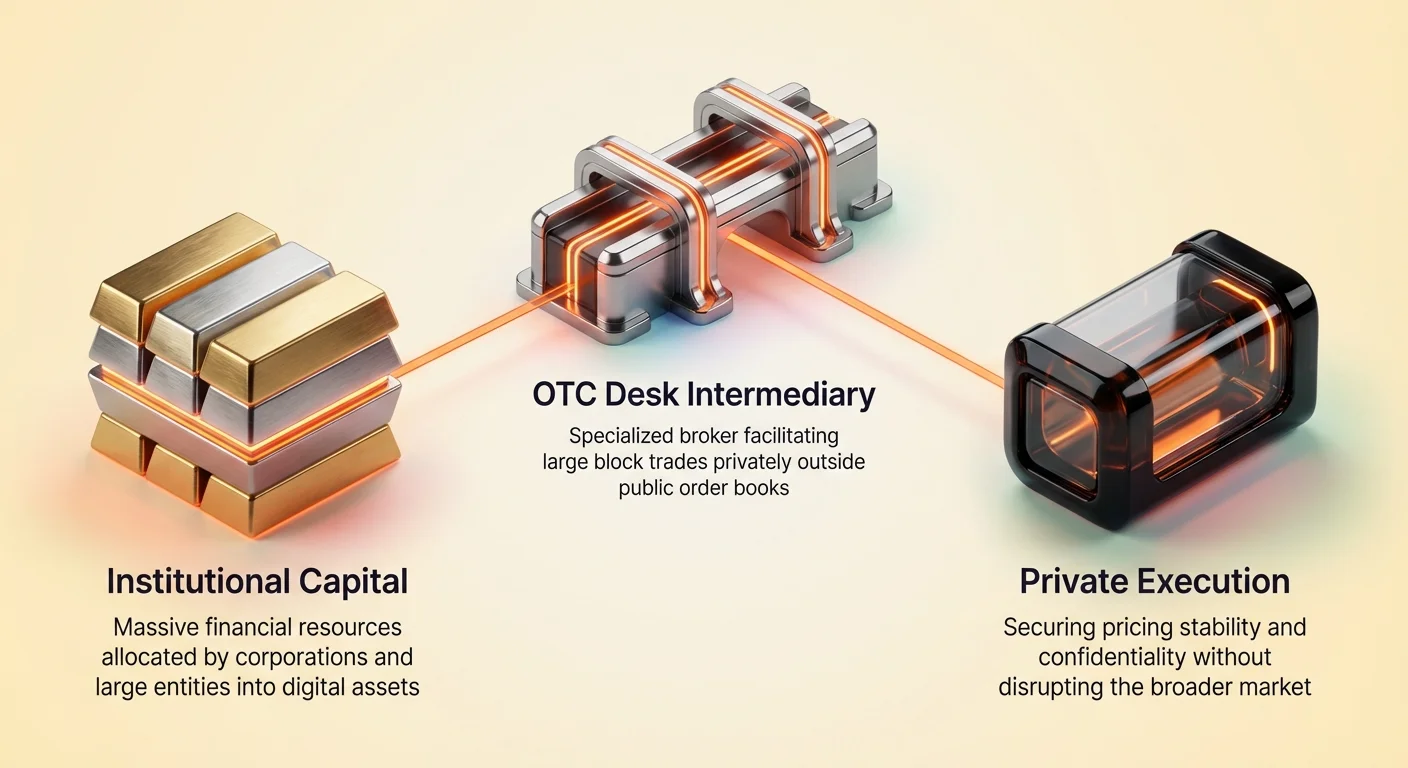
Over-The-Counter trading in the cryptocurrency sector functions as a private market for large block trades. Unlike traditional exchanges where buy and sell orders are matched publicly in an order book, OTC trades occur directly between two parties. This process is typically facilitated by a specialized broker or a trading desk. The broker acts as an intermediary who sources liquidity from a vast network of buyers and sellers to fulfill specific volume requirements.
The process begins when an institution expresses interest in buying or selling a substantial amount of Bitcoin. Instead of broadcasting this intent to the entire market, the investor contacts an OTC desk. The desk then works to find a counterparty willing to take the other side of the trade. This search is conducted quietly to prevent market participants from front-running the order or reacting preemptively to the impending volume.
Once a match is found or the desk agrees to act as the principal counterparty, a price is negotiated. This price is often fixed for a short window, allowing the institution to execute the entire block at a predictable rate. Settlement follows, involving the transfer of fiat currency and cryptocurrency. This stage often utilizes escrow services or trusted settlement layers to ensure that both assets change hands securely and simultaneously.
The Role of Intermediaries
In this ecosystem, the OTC broker is more than just a matchmaker. They serve as a shield against volatility and a guide through the complexities of settlement. Top-tier OTC desks maintain relationships with miners, early adopters, and other large holders, often referred to as whales. These connections allow them to source liquidity that is simply not available on public spot exchanges.
Brokers also provide advisory services. They offer market insights, helping institutions gauge the right moment to enter or exit positions based on current liquidity conditions. This human element distinguishes OTC trading from the algorithmic matching engines of centralized exchanges. It provides a layer of personalized service that is essential when managing transactions that could fundamentally alter a portfolio's composition.
The Strategic Necessity for Whales
In the cryptocurrency lexicon, a "whale" is an entity holding a significant amount of Bitcoin. When these large holders decide to move funds, the market notices. For institutions that effectively become whales upon entry, the primary challenge is avoiding "slippage." Slippage occurs when the size of an order exceeds the available liquidity at a specific price point, forcing the buyer to pay more or the seller to accept less as they move through the order book.
Mitigating Market Impact
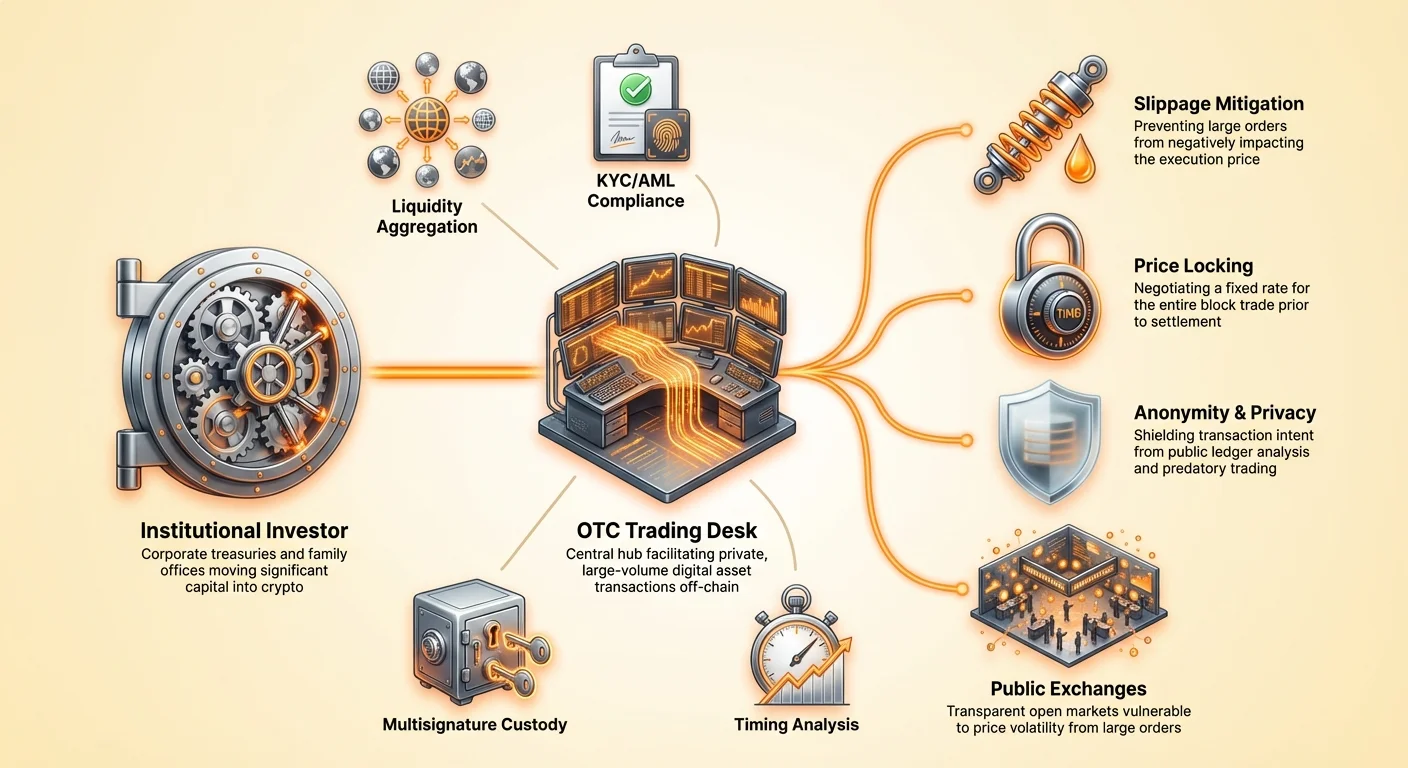
When a massive buy order hits a public exchange, it eats through the sell orders at the current price and begins consuming higher-priced orders. This drives the price up immediately, meaning the investor ends up paying a higher average price for their accumulation. Conversely, a large sell order can crash the price, reducing the total return. OTC desks solve this by locking in a price for the entire block.
By taking the trade off the public order book, the immediate supply and demand dynamics of the open market remain undisturbed. The price of Bitcoin on public exchanges might remain stable even as millions of dollars worth of coins change hands privately. This separation of liquidity pools is vital for institutions that need to enter or exit positions without signaling their moves to the broader market.
Preserving Anonymity
Privacy is another cornerstone of institutional execution. In a transparent ledger system like Bitcoin, wallet addresses can often be scrutinized by blockchain analysts. If a known corporate wallet sends a large sum to a public exchange, it signals a potential sell-off. This can trigger panic selling among retail traders and algorithms, driving the price down before the institution can execute its trade.
OTC trading offers a cloak of invisibility for these maneuvers. Because the trade is settled privately, the transfer of funds does not appear on public exchange order books. While the final settlement transaction will eventually appear on the blockchain, the intent to buy or sell is hidden until the deal is done. This opacity protects the institution from predatory trading behaviors and market manipulation.
Timing and Market Analysis
Determining when to execute a large trade is just as important as choosing the method. Institutional investors must analyze market cycles, volatility trends, and macroeconomic factors to time their entry. Bitcoin's price history is characterized by distinct cycles of expansion and correction, often influenced by the four-year halving event which reduces the new supply of coins.
Navigating Volatility Cycles
Volatility is a double-edged sword. High volatility can present buying opportunities during dips, but it also increases the risk of price fluctuations during the execution window. Institutions often look for periods of consolidation or lower volatility to execute large OTC trades. During these times, the price is relatively stable, making it easier for brokers to quote a tight spread.
However, some strategies involve buying into weakness. If the market is experiencing a downturn due to temporary negative sentiment, an institution might view this as a discount window. OTC desks are particularly valuable here, as they can help navigate the chaotic liquidity conditions that often accompany market corrections.
Analyzing Liquidity Conditions
Before executing, treasurers and fund managers assess the depth of the market. Metrics like Bitcoin dominance—the ratio of Bitcoin's market cap to the rest of the crypto market—can signal capital flow trends. A rising dominance often suggests a "flight to quality" where capital moves from riskier altcoins back into Bitcoin. This can create a liquidity rich environment for acquiring BTC.
Conversely, when dominance falls, liquidity might be fragmented across various assets. An OTC desk helps aggregate this liquidity. They can tap into global pools, sourcing coins from different regions and time zones to fulfill an order. This global reach is crucial for ensuring that an institution is not limited by the liquidity constraints of a single geographic market or exchange.
Corporate Treasury Management
The rise of the "Bitcoin Corporate Treasury" has introduced a new class of institutional buyer. Companies are increasingly holding Bitcoin on their balance sheets as a reserve asset. This strategy is driven by the desire to hedge against inflation and diversify holdings away from depreciating fiat currencies. Since Bitcoin has a fixed supply of 21 million coins, it offers a scarcity model similar to digital gold.
For a corporation, the decision to allocate treasury funds to Bitcoin involves rigorous internal governance. The execution phase is the culmination of months of board approvals and risk assessments. Unlike a trading firm that might flip assets for profit, a corporate treasury typically acquires Bitcoin for long-term holding. This long-time horizon influences the execution strategy.
Corporations like MicroStrategy and Tesla have pioneered this approach, navigating the complex accounting standards required for digital assets. In many jurisdictions, Bitcoin is treated as an indefinite-lived intangible asset. This means price drops can trigger impairment charges on financial statements, while price rises are not recognized until the asset is sold. Efficient execution via OTC minimizes the initial cost basis, which is crucial for accounting purposes.
Operational Risks and Solutions
While OTC trading mitigates market impact, it introduces other risks that institutions must manage. The most prominent is counterparty risk. In a direct trade, there is a theoretical risk that one party delivers the asset while the other fails to send payment. In the early days of crypto, this was a significant concern.
Managing Counterparty Risk
Modern OTC desks mitigate this through rigorous vetting and settlement protocols. Reputable desks conduct extensive Know Your Customer (KYC) and Anti-Money Laundering (AML) checks on all participants. They function as trusted intermediaries, ensuring that both the fiat and the crypto components of the trade are verified before final settlement occurs.
For institutions, choosing a regulated and established OTC partner is the first line of defense. Many desks are now subsidiaries of larger, regulated financial entities or qualified custodians. This institutional pedigree provides the legal and financial assurances that corporate boards require. Escrow services further reduce risk by holding assets in a neutral state until both parties have satisfied their obligations.
Regulatory Considerations
Regulatory compliance is non-negotiable for institutional players. The OTC market, while private, is not a lawless zone. Participants must adhere to local regulations regarding capital controls, tax reporting, and financial conduct. Institutions must ensure that the OTC desk they utilize is fully compliant with the jurisdictions in which they operate.
This compliance extends to the source of funds. Institutions need to ensure that the Bitcoin they purchase has a "clean" history and is not tainted by illicit activities. OTC desks often employ blockchain analytics firms to verify the provenance of the coins they trade. This ensures that corporate treasuries do not accidentally acquire assets linked to hacks or money laundering operations.
Securing Institutional Assets
Once the execution is complete, the focus shifts immediately to custody. For an institution, leaving millions of dollars in Bitcoin on an exchange or with a broker is rarely an acceptable long-term strategy. Self-custody or the use of qualified third-party custodians becomes the next critical step in the process.
Multisignature Protocols
Security standards for institutions often mandate the use of multisignature (multisig) wallets. A multisig wallet requires multiple private keys to authorize a transaction. For example, a corporate treasury might set up a "3-of-5" wallet, where five distinct keys are generated, but at least three are required to move funds.
| Security Model | Requirements | Typical Use Case |
|---|---|---|
| Standard Wallet | 1 Private Key | Retail / Small Amounts |
| 2-of-3 Multisig | 2 Signatures | Small Business / Partnership |
| 3-of-5 Multisig | 3 Signatures | Corporate Treasury / Board |
This structure eliminates the risk of a single point of failure. If one key is lost or a single executive is compromised, the funds remain secure. It also enforces internal governance, ensuring that no single individual can embezzle funds or make unilateral decisions regarding the company's assets.
Governance and Access Control
Beyond the technical setup, institutions need robust governance protocols. This involves defining who holds the keys, where they are stored, and the specific procedures for authorizing a transaction. Key holders might be geographically distributed, ensuring that physical threats or local disasters cannot compromise the entire wallet.
Cold storage solutions are typically employed in conjunction with multisig setups. Cold storage involves keeping the private keys completely offline, disconnected from the internet. This renders the funds immune to online hacking attempts. For a corporate treasury, this combination of cold storage and multisignature governance represents the gold standard of asset protection.
Comparing Execution Vehicles
While OTC desks are the premier choice for direct acquisition, the emergence of Bitcoin ETFs (Exchange-Traded Funds) has offered an alternative path. An ETF allows investors to gain exposure to Bitcoin's price movements without handling the underlying asset. This eliminates the need for wallets, private keys, and specialized security protocols.
For some institutions, the simplicity of an ETF is attractive. It fits neatly into existing brokerage accounts and traditional portfolio management systems. However, it comes with management fees and introduces a layer of separation from the asset. The investor owns shares in a fund, not the Bitcoin itself. This means they cannot use the asset for transactions or benefit from the censorship resistance that physical Bitcoin ownership provides.
Direct OTC execution remains the preferred route for entities that want full control. Owning the underlying asset eliminates the counterparty risk associated with the ETF provider and avoids annual management fees. It also allows the institution to engage in advanced strategies, such as lending their Bitcoin to generate yield or using it as collateral in decentralized finance (DeFi) protocols.
Conclusion
Institutional execution of Bitcoin trades is a discipline that balances speed, privacy, and price efficiency. The OTC desk remains the cornerstone of this process, providing the necessary infrastructure to move large blocks of capital without disrupting the broader market. By leveraging these private liquidity pools, institutions can acquire significant positions while minimizing slippage and maintaining confidentiality.
The integration of Bitcoin into corporate treasuries and institutional portfolios is no longer a fringe theory but a documented financial trend. As this adoption grows, the sophistication of OTC services and custody solutions will continue to evolve. Success in this arena requires not just capital, but a rigorous approach to timing, security, and risk management.
For large-scale investors, utilizing an OTC desk is the most effective method to secure pricing stability and operational privacy.