
As digital assets like Bitcoin and Ethereum move from niche speculation to mainstream corporate treasuries, the question of how to account for them becomes paramount. For decades, traditional finance has relied on established rules—like Generally Accepted Accounting Principles (GAAP) in the U.S. and International Financial Reporting Standards (IFRS) globally—to ensure company finances are reported accurately and consistently.
However, cryptocurrencies don’t fit neatly into existing categories like cash, inventory, or physical assets. They behave like money, yet they are created and traded digitally. This mismatch created a significant roadblock for large companies and institutional investors: how can you confidently invest in volatile, high-growth assets if you cannot accurately report their true value?
This comprehensive guide breaks down the complex world of crypto accounting, focusing specifically on the landmark guidance provided by the Financial Accounting Standards Board (FASB) that fundamentally changes how digital assets are recorded on corporate balance sheets. Understanding these standards is not just about compliance; it is critical for firms seeking audit readiness and for investors evaluating crypto-holding companies accurately.
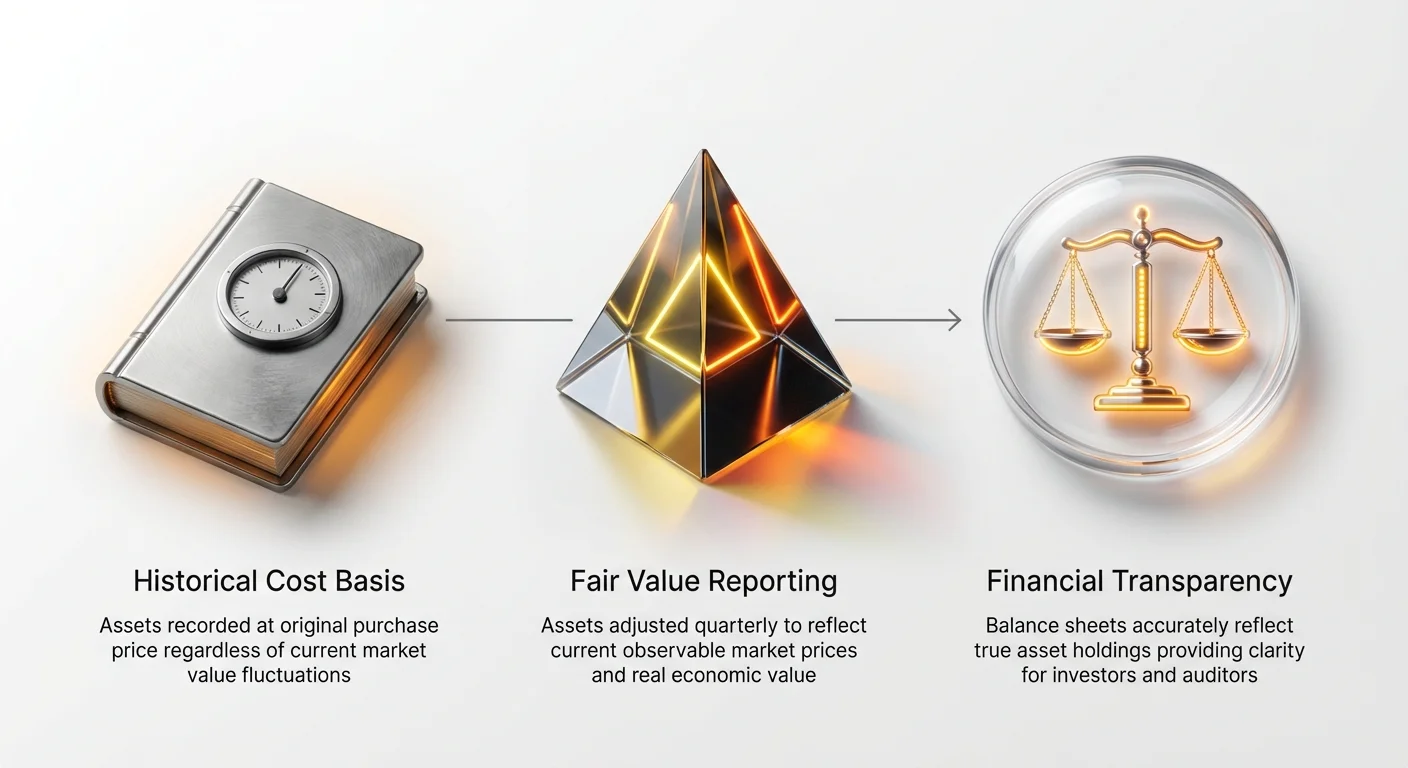
The Fundamental Problem: Classifying Crypto Assets
Before understanding the modern solution, it is essential to grasp the historical problem that plagued crypto investors and corporations for years. The challenge lay in fitting novel digital assets into rigid, pre-digital-era accounting buckets.
The Old Rule: Intangible Assets and Cost Basis
In the early days of corporate crypto adoption (before 2024), major accounting bodies often directed companies to treat cryptocurrencies not as currency or cash equivalents, but as indefinite-lived intangible assets.
An intangible asset is something valuable that you cannot touch—like a patent, trademark, or goodwill. The key characteristic of this classification is the cost basis model.
Under the cost basis model:
- Initial Recording: The asset is recorded on the balance sheet at its initial purchase price (its cost basis).
- No Increase: If the asset’s market value rises, the company is not allowed to report that increase (the "unrealized gain") on its balance sheet or income statement.
- Mandatory Decrease: If the market value drops below the cost basis, the company must perform an impairment test and write down the value of the asset, recording a loss.
Why the Intangible Classification Caused Issues
This "intangible asset" rule led to severe reporting issues that distorted the actual financial health of companies holding crypto.
The main issue was the asymmetry of value reporting. Consider a company that bought one Bitcoin for $10,000 (cost basis).
- If the price soared to $60,000, the balance sheet would still show the Bitcoin valued at $10,000.
- If the price temporarily crashed to $8,000, the company would have to immediately report a $2,000 loss on the income statement (impairment). Even if the price quickly recovered to $60,000, the company could never write the value back up above $8,000 without selling the asset.
This system created volatile income statements and dramatically understated the true value of crypto assets held by companies, making external auditing difficult and internal financial planning unreliable. Companies were forced to sell assets just to realize the true gains, a process called a "disposal event."
The Game Changer: Understanding the New FASB Standard
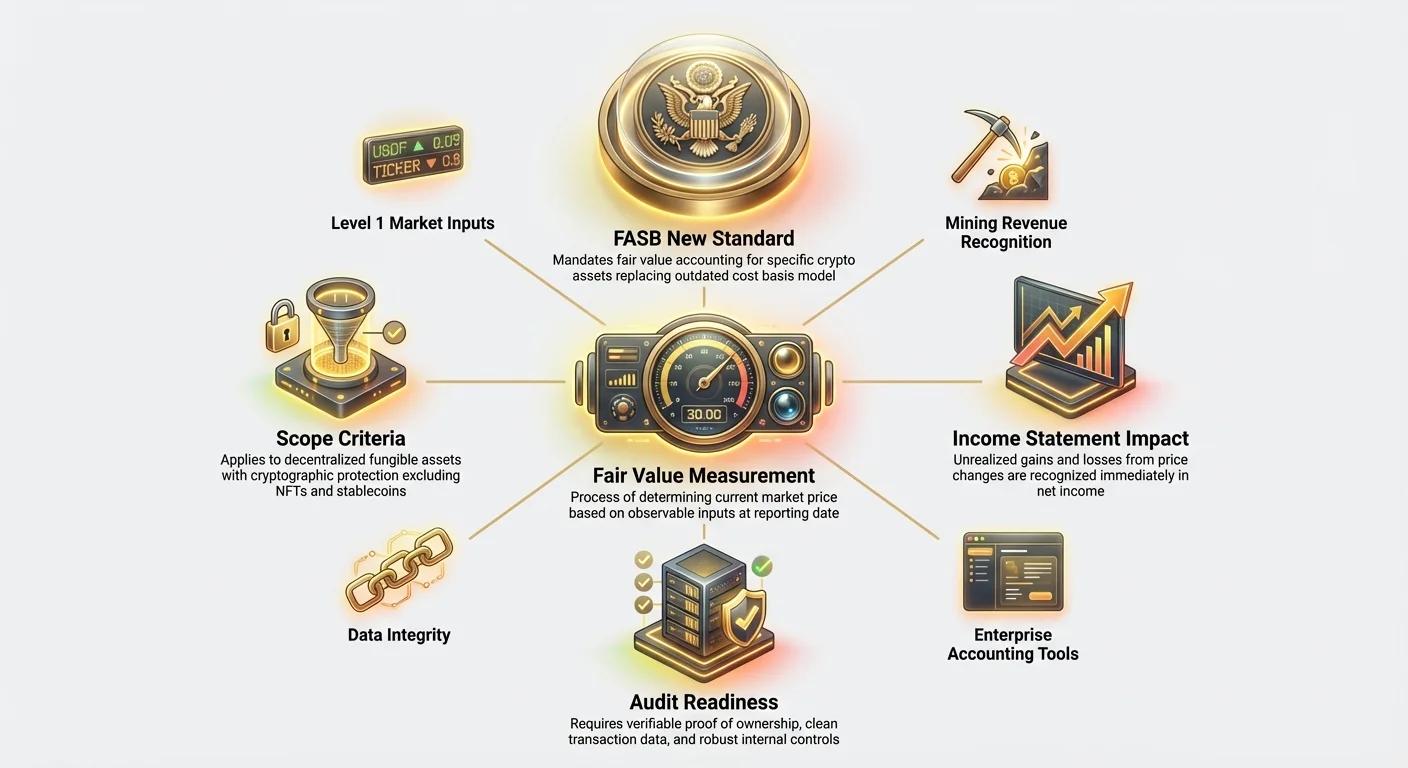
Recognizing that the traditional treatment of crypto was flawed and hampered institutional adoption, the Financial Accounting Standards Board (FASB) stepped in. FASB is the independent, private-sector organization that establishes and improves GAAP in the United States.
Who is FASB and Why Does Their Guidance Matter?
FASB sets the rules that publicly traded companies and most large private companies in the U.S. must follow when preparing financial reports. Its guidance is crucial because it determines whether a company's financial statements are considered credible and comparable by investors, regulators, and banks.
In late 2023, FASB issued new guidance (Accounting Standards Update, or ASU) specifically tailored for crypto assets, providing the clarity that companies had desperately sought. This guidance is seen as a major step toward normalizing digital assets within mainstream finance.
Moving to Fair Value Accounting
The core change introduced by FASB is the shift from the rigid, one-sided cost basis model to the more dynamic and realistic fair value model for crypto assets.
Fair Value Accounting dictates that assets must be reported on the balance sheet at their current, observable market price. This means if a company holds Bitcoin and the price rises, the company must now report that increase (the unrealized gain) in its financial statements.
The impact of Fair Value:
- Accuracy: Financial statements now reflect the true economic value of the company’s digital asset holdings.
- Symmetry: Companies must report both increases (unrealized gains) and decreases (unrealized losses), eliminating the lopsided impairment test requirement.
- Income Statement Impact: Gains and losses from changes in fair value are recognized in net income for the reporting period, potentially leading to more volatility but significantly improved transparency.
Scope of the New Rules
The new FASB rules apply specifically to assets that meet a strict definition, essentially covering the most common, well-established cryptocurrencies.
The assets covered must meet four criteria:
- Cryptographic Protection: Assets must use cryptography to secure transactions.
- Decentralized Nature: Assets must be recorded on a distributed ledger (blockchain).
- Non-Centralized Authority: Assets must not be created or controlled by a central party.
- Fungibility: The assets must be non-unique (i.e., interchangeable, excluding NFTs and other unique tokens).
What the rule covers: Bitcoin, Ethereum, Litecoin, and most major, highly liquid layer-1 tokens.
What the rule generally excludes: Non-fungible tokens (NFTs), certain utility tokens, and potentially stablecoins depending on their specific structure (some corporate treasury departments may classify specific dollar-pegged stablecoins like USDC as cash equivalents if held for liquidity, but the core guidance targets pure cryptocurrencies).
GAAP vs. IFRS: A Global Comparison
While FASB dictates GAAP (the rules for the U.S.), the majority of the world adheres to IFRS. Understanding both sets of standards highlights where global accounting practices are converging and where they still differ.
US GAAP Treatment (Post-FASB)
Under the new FASB guidance, U.S. GAAP firms holding in-scope crypto assets must use the fair value approach. This requires periodic (typically quarterly) adjustments to reflect current market price, with the gains and losses flowing directly through the income statement.
This standardized approach significantly reduces the audit complexity that U.S. firms previously faced. Previously, auditors often had to rely on a complex mix of interpretations and industry best practices. Now, they have clear, official guidance.
IFRS Approach (International Standard)
For companies outside the U.S. that follow IFRS, the accounting treatment remains more flexible, though often leading to similar results as the new FASB standard.
The primary guidance from the IFRS Interpretations Committee (IFRIC) suggests that cryptocurrencies, like Bitcoin, are treated as either:
- Intangible Assets: This is the default IFRS classification, similar to the old US approach. However, if the firm's business model is actively trading these assets (like a brokerage or an exchange), they can choose to apply the "Fair Value Through Other Comprehensive Income" (FVOCI) or "Fair Value Through Profit or Loss" (FVTPL) models.
- Inventory: If the company’s primary business is trading or selling crypto in the ordinary course of business (e.g., a crypto brokerage), the crypto may be classified as Inventory and measured at fair value less costs to sell.
The key difference is that IFRS allows companies that are actively trading crypto to elect fair value treatment, whereas the new FASB guidance mandates fair value for all in-scope crypto holdings, regardless of whether the company is primarily a trader or a long-term holder.
Convergence and Divergence
The new FASB guidance represents a significant move toward global convergence in crypto accounting. By mandating fair value, the U.S. system now aligns more closely with the economic reality reflected by international companies that were already leveraging IFRS exceptions to report assets closer to market value.
However, divergence still exists in the treatment of specific activities, such as mining rewards and custody arrangements, which often require nuanced interpretations under both frameworks depending on jurisdiction.
Handling Digital Assets on the Corporate Balance Sheet
For the finance department, handling crypto assets requires meticulous tracking of transactions, income generation, and subsequent balance sheet presentation.
Accounting for Purchases and Sales (Transactions)
When a company acquires or sells digital assets, the transaction must be carefully tracked, regardless of the accounting model used.
Acquisition: The company recognizes the asset at its cost basis (the fiat amount paid), and an equivalent reduction in the cash balance is recorded.
Under the New Fair Value Model:
- Valuation Adjustment: At each reporting date (e.g., end of the quarter), the company must calculate the difference between the current fair value and the original cost (or the last reported fair value).
- Recording the Adjustment: If the value increased, a debit to the Digital Asset account and a credit to "Unrealized Gain on Digital Assets" (Income Statement) are recorded. If the value decreased, the reverse happens.
This process ensures the Balance Sheet line item for "Digital Assets" always reflects the current market price.
The Impact of Mining and Staking Rewards
Cryptocurrency is often acquired through means other than direct purchase, such as receiving rewards for validating transactions (staking) or generating new blocks (mining). These activities represent immediate income for the company.
1. Revenue Recognition: When the new asset is received (mined or staked), the company must immediately recognize revenue equal to the fair market value of the asset on the date of receipt.
- Example: If a company successfully mines 1 ETH when ETH is trading at $3,000, the company records $3,000 in revenue and $3,000 as the cost basis of the new ETH asset.
2. Cost of Revenue: The costs associated with generating that asset (electricity, computing hardware depreciation, validator fees) must be accounted for as the Cost of Revenue against that income.
3. Subsequent Valuation: Once the asset is on the balance sheet, it is subject to the same FASB fair value rules. Its value will fluctuate quarterly based on market price.
Disclosure Requirements
Transparency is paramount. Even with clear valuation standards, companies must provide extensive footnotes and disclosures to help investors understand the inherent risks and volatility associated with digital assets.
Key disclosures required include:
- Valuation Methodology: Detailed explanation of how fair value was determined (which exchanges were used, which pricing inputs were utilized).
- Risk Factors: Discussion of market volatility, technological risks (hacks, network failure), and regulatory uncertainty.
- Reconciliation: A table showing the beginning balance, purchases, sales, and the total unrealized gains/losses for the period.
- Impairments (if applicable): If the company holds assets outside the scope of the new FASB rules (like certain NFTs), the old impairment rules still apply, and any write-downs must be disclosed.
From Cost Basis to Fair Value: Practical Application
The transition to fair value accounting is the most significant operational shift for corporate finance teams holding crypto. It requires sophisticated systems and a clear methodology for determining market price.
Defining 'Fair Value' for Crypto Assets
Fair value is defined as the price that would be received to sell an asset in an orderly transaction between market participants at the measurement date. Since cryptocurrencies trade 24/7 on numerous global exchanges, defining the single "fair value" requires establishing a clear policy.
Accountants typically rely on the FASB Fair Value Hierarchy, which classifies inputs used for valuation into three levels:
- Level 1 Inputs (Highest Reliability): Quoted prices for identical assets in active markets. For highly liquid assets like Bitcoin and Ethereum traded on major regulated exchanges (e.g., Coinbase, Binance), Level 1 inputs are generally used. This is the simplest and preferred method.
- Level 2 Inputs (Moderate Reliability): Prices for similar assets in active markets, or quoted prices for identical assets in inactive markets. This might be used for less liquid tokens or for averaging prices across several exchanges to mitigate volatility spikes.
- Level 3 Inputs (Lowest Reliability): Unobservable inputs (the company’s own assumptions). This is rarely used for major cryptocurrencies and is generally reserved for extremely illiquid tokens or bespoke crypto-financial products.
Calculating Unrealized Gains and Losses
The calculation of unrealized gains and losses is the core task performed quarterly under the fair value model.
Example Scenario: Corporate Bitcoin Holding
| Date | Transaction | BTC Quantity | USD Cost/Price | Balance Sheet Value (Old Cost Basis) | Balance Sheet Value (New Fair Value) | Income Statement Impact (New FASB) |
|---|---|---|---|---|---|---|
| Q1 Start | Initial Holding | 0 | - | $0 | $0 | $0 |
| Q1 Day 1 | Purchase | 10 BTC | $30,000 | $300,000 | $300,000 | $0 |
| Q1 End | Market Price | 10 BTC | $40,000 | $300,000 | $400,000 | $100,000 Unrealized Gain |
| Q2 End | Market Price | 10 BTC | $25,000 | $300,000 (if no impairment) or $250,000 (if impairment applied) | $250,000 | $(150,000)$ Unrealized Loss |
| Q3 End | Market Price | 10 BTC | $50,000 | $250,000 (stuck at impaired value) | $500,000 | $250,000 Unrealized Gain |
As the example shows, under the new FASB fair value rules, the Balance Sheet value continually adjusts to $500,000, accurately reflecting the company’s true wealth. Under the old rules, the value was artificially suppressed after the Q2 impairment, hiding $250,000 in actual gains from investors.
Accounting for Transaction Fees and Gas
Crypto transactions often incur network fees (gas) and exchange fees. These fees must be accounted for correctly to establish the true cost basis and to calculate taxable income (a separate, though related, requirement).
General Rule: Most accounting standards require that transaction costs (like exchange fees) are capitalized into the cost of the asset when purchased, meaning they are added to the initial recorded value. When sold, the fee reduces the proceeds of the sale. Gas fees associated with moving assets between wallets are typically treated as a direct expense.
Properly classifying these minor, yet frequent, costs requires automated software tools that can correctly categorize thousands of micro-transactions.
Audit Readiness and Compliance for Crypto Firms
Institutional adoption of digital assets depends entirely on audit readiness. If a company’s records cannot be reliably verified by independent auditors, traditional investors will shy away. The new FASB standard makes audit preparation clearer but also necessitates robust internal systems.
Ensuring Clean Transaction Data
The single greatest hurdle for crypto accounting teams is data integrity. Unlike traditional bank accounts, which issue standardized monthly statements, crypto transactions occur continuously across numerous wallets, blockchains, and centralized and decentralized exchanges.
To achieve audit readiness, companies must:
- Centralize Data: All on-chain transactions, exchange trades, lending activities, and staking rewards must be aggregated into a single, unified ledger.
- Traceability: Every asset on the balance sheet must be traceable back to its original acquisition event (purchase, mining, reward, etc.).
- Cost Basis Methodology: While fair value is used for reporting, the original cost basis of each "lot" of crypto must still be tracked meticulously for tax purposes and historical analysis.
Selecting Enterprise-Grade Accounting Tools
Given the complexity, manual spreadsheets are insufficient for any firm holding significant crypto assets. Enterprise-grade crypto tax and accounting software is now an essential tool.
These platforms automate several crucial functions:
- Integration: Connecting via API keys or wallet addresses to pull real-time data from all sources.
- Classification: Automatically categorizing transactions (e.g., differentiating between a trade, a transfer, a liquidity provision, and a fee).
- Valuation: Applying the FASB-compliant fair value methodology at specific reporting cut-off times, often relying on Level 1 market data feeds.
- Report Generation: Creating standardized GAAP and IFRS reports, including detailed ledgers and required disclosures, that are ready to be handed to external auditors.
Working with Auditors: Key Challenges
Even with clear standards, auditors face unique challenges when reviewing digital asset records. Companies must be prepared to address these key verification points:
- Proof of Ownership: Auditors must verify that the company legally controls the crypto assets reported. This involves reviewing the self-custody or third-party custodial agreements and verifying the private keys or multi-sig setups.
- Completeness of Data: Auditors need assurance that all of the company’s crypto activities (including obscure DeFi movements) have been captured and accounted for.
- Third-Party Dependence: Auditing often relies heavily on the data integrity provided by the chosen crypto accounting software and the market data feeds used for fair value measurement. Companies must demonstrate due diligence in selecting and testing these third-party tools.
Conclusion
The shift in crypto accounting standards—particularly the move to mandated fair value reporting under FASB—is arguably the most critical recent development supporting institutional integration of digital assets.
By replacing the punitive and misleading intangible asset classification, financial reporting for crypto-holding companies now accurately reflects their economic reality. This clarity provides confidence to investors and reduces the friction involved in audit and compliance processes.
While accounting for activities like DeFi, staking, and complex derivatives still presents specific challenges requiring careful interpretation, the foundation is now stable. As more large corporations add digital assets to their balance sheets, the clear, timely standards provided by FASB and refined under IFRS ensure that crypto is treated not as a side-note, but as a fully auditable, standardized component of modern global finance.