
Welcome to the world of Decentralized Finance (DeFi), a place where innovative technologies offer unprecedented opportunities for generating passive income. However, high returns often come packaged with high risks. In traditional finance, risk is managed through sophisticated structures, chief among them being insurance.
In the nascent crypto landscape, insurance is often treated as an afterthought or a complex niche topic reserved for advanced users. This perspective is fundamentally flawed. If you treat your DeFi portfolio as a business—a capital allocation strategy aimed at generating reliable returns—then paying a known, quantifiable cost to protect against a catastrophic, unknown loss is not optional; it is an essential operational expense.
This guide will move beyond simply defining crypto insurance. We will focus on the practical application of risk transfer: how to evaluate available coverage, understand the true cost of protection, and integrate insurance into your DeFi strategy to safeguard your principal capital. By the end of this article, you will view insurance premiums not as a sunk cost, but as the mandatory price of stability and resilience in a volatile ecosystem.
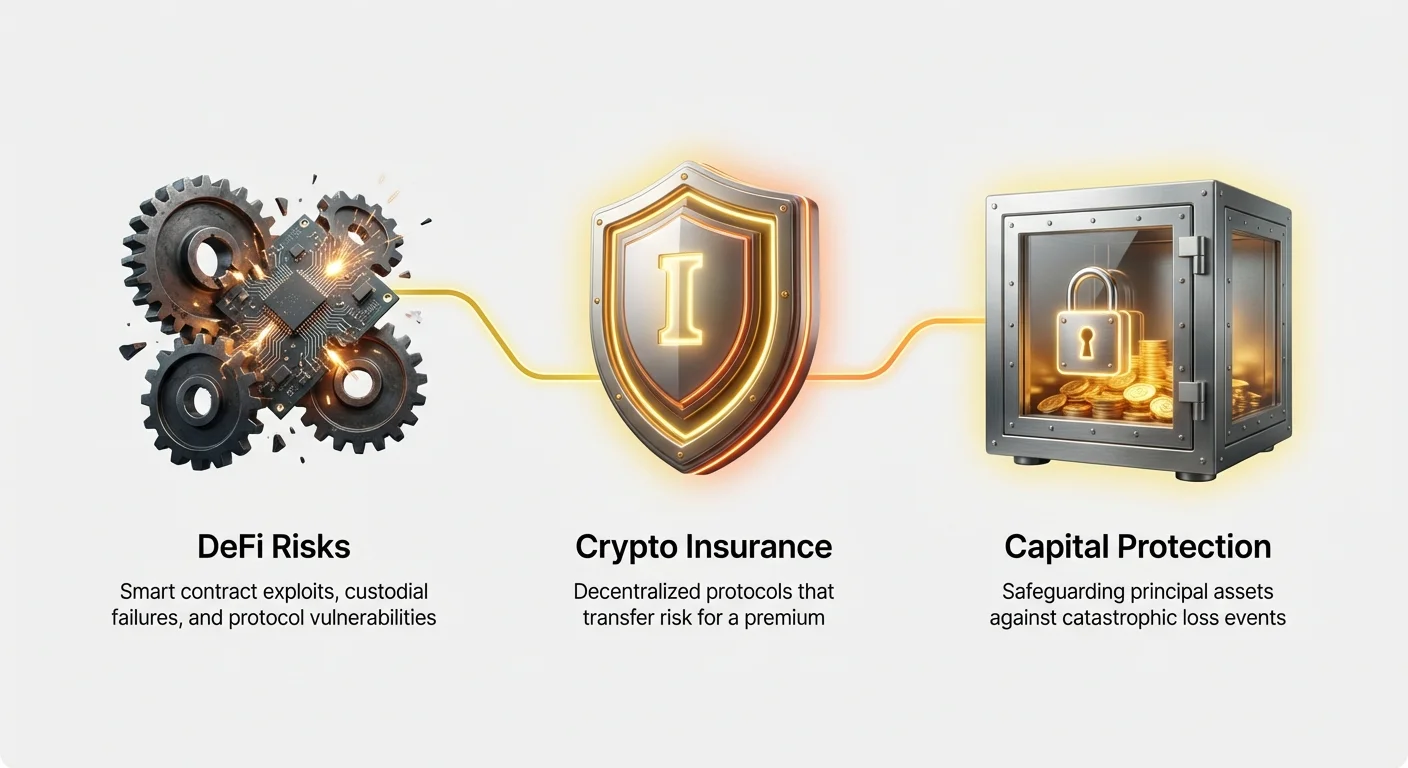
Understanding Risk in the Decentralized Ecosystem
Before we can insure against risk, we must define its source. In DeFi, the major risks are not typically related to human error or natural disaster, but rather to the technology itself, the centralized entities that interact with it, and the governance failures of the protocols.
Smart Contract Vulnerabilities
The foundation of DeFi is the smart contract—a self-executing computer program stored on the blockchain. When you stake assets, lend capital, or swap tokens, you are interacting directly with these contracts.
The primary risk in DeFi is a smart contract exploit. This occurs when a hacker finds a bug, loophole, or flaw in the underlying code and uses it to drain funds from the protocol’s liquidity pool or vault. Because smart contracts are immutable once deployed, fixing a vulnerability often requires complex governance decisions, and the capital lost is often gone forever.
For users engaging in high-yield activities—such as providing liquidity to a new decentralized exchange or utilizing leveraged staking protocols—exposure to smart contract failure is near 100%. Smart contract insurance is specifically designed to cover the loss of capital resulting from confirmed bugs or exploits in the insured protocol’s code base.
Custodial and Exchange Default Risks
While DeFi aims to be trustless (meaning you don't have to trust a middleman), many users still interact with centralized or semi-centralized entities, which introduces custodial risk.
- Centralized Exchanges (CEXs): If you leave your crypto on an exchange (like Binance or Coinbase), you do not control the private keys. The exchange is the custodian. If the exchange suffers a hack, experiences internal fraud, or becomes insolvent (a la FTX), your funds are at risk.
- Semi-Custodial Services: Some centralized entities offer staking or yield services where they handle the keys for you in exchange for a fee. While convenient, this reintroduces counterparty risk—the risk that the company holding your assets fails or mismanages them.
Crypto custody insurance specifically addresses these scenarios. It aims to protect user funds against external hacks of the centralized exchange's hot or cold storage, or against catastrophic operational failures or internal fraud that leads to a loss of customer assets. This type of coverage is crucial for retail investors who use a CEX as their primary gateway into crypto.
The Landscape of Crypto Insurance Coverage
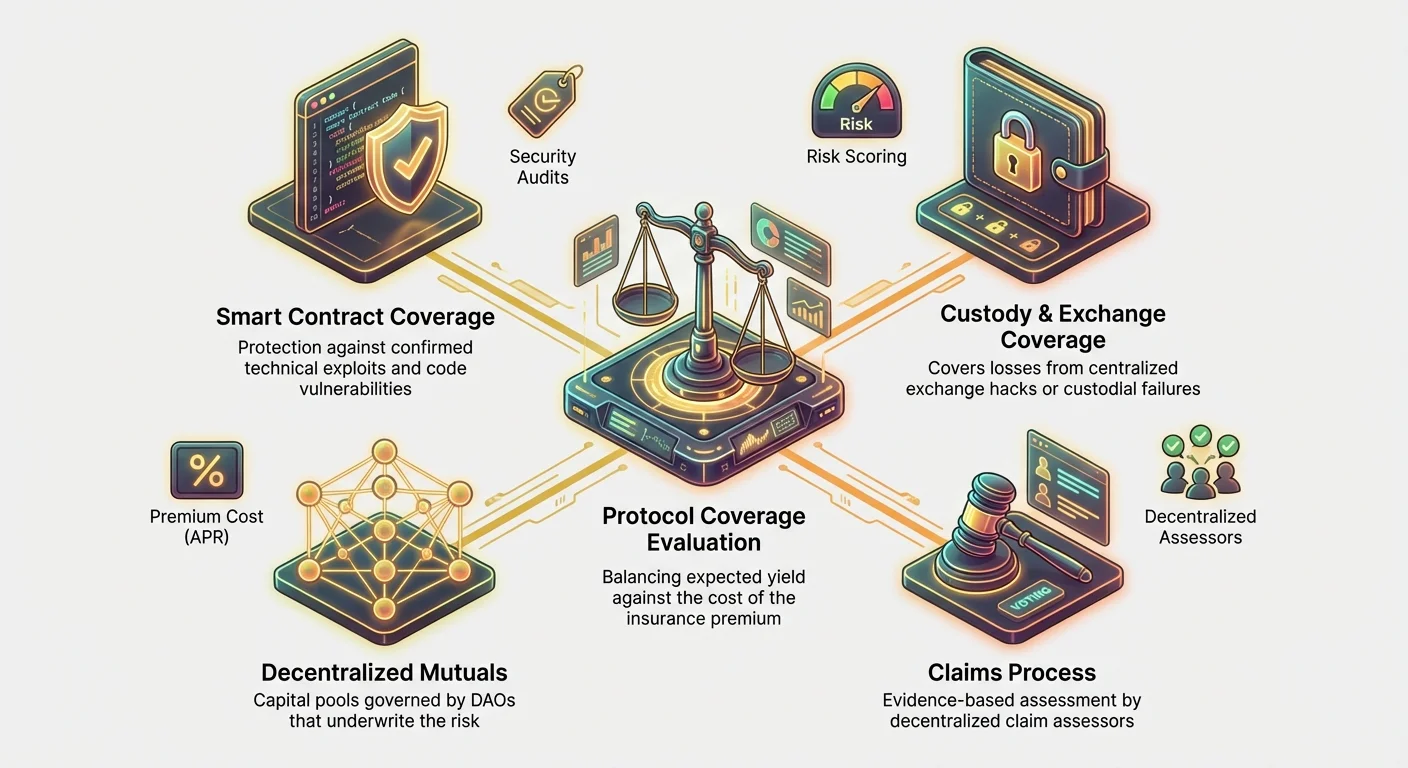
The crypto insurance market, primarily facilitated by DeFi risk transfer protocols, operates differently from traditional insurance companies. Instead of a single corporate entity bearing the risk, these protocols rely on large pools of capital contributed by underwriters (investors seeking premiums) and are governed by a decentralized autonomous organization (DAO).
If you decide to buy smart contract insurance, you are purchasing a policy from one of these decentralized mutuals, transferring your specific exposure risk to their capital pool.
Smart Contract and Protocol Coverage
This is the most common and vital type of DeFi insurance. It provides protection against confirmed security exploits, re-entrancy attacks, flash loan attacks, or other technical failures that lead to the loss of user funds locked within a specific, named protocol (e.g., insuring your assets deposited in a specific decentralized lending platform).
Key Features:
- Protocol Specificity: Policies are almost always tied to a single smart contract address or a defined set of contracts belonging to a specific project.
- Trigger Event: Payouts are triggered only by technical exploit, not by market downturns, impermanent loss, or macroeconomic events.
- Governance Mechanism: The payout decision is usually made by a group of decentralized claim assessors (token holders) who vote based on evidence provided by security auditors.
Custody and Exchange Default Coverage
As noted above, this coverage is essential for users of centralized platforms. While major exchanges often hold their own corporate insurance policies, retail users can purchase individual policies through DeFi protocols to add a layer of personal protection.
This coverage is complex because defining the "trigger event" often requires detailed forensic auditing of the centralized entity, which can be difficult to perform transparently. However, protocols offering this service typically define triggers broadly to include events like "confirmed insolvency" or "material operational failure resulting in asset loss."
Stablecoin Depeg and Oracle Failure Coverage
While less frequently purchased than smart contract insurance, these specialized coverages address two systemic risks in DeFi:
- Stablecoin Depeg Coverage: Stablecoins are cryptocurrencies designed to maintain a 1:1 peg with a fiat currency (like the US dollar). If a stablecoin's mechanism fails and its value drops significantly (a depeg), this coverage protects the holder against the loss of value. This became a critical consideration following the collapse of TerraUSD (UST).
- Oracle Failure Coverage: Oracles are services that feed real-world data (like asset prices) into smart contracts. If an oracle malfunctions or is manipulated, it can cause a lending platform to liquidate collateral incorrectly, leading to user loss. Some specialized protocols offer coverage against losses specifically resulting from confirmed oracle manipulation or failure.
Evaluating Premium Costs: The Risk Transfer Cost
The core of operationalizing capital protection is performing a protocol coverage evaluation that balances expected yield against the cost of the premium. Treating insurance as an operational expense means normalizing the risk cost against the gross APY (Annual Percentage Yield) you expect to earn.
The APY vs. Premium Equation
When you deposit capital into a DeFi protocol, you are typically chasing the highest possible APY. Let's assume you find a liquidity pool offering a 15% annual yield.
If you purchase insurance, you pay a premium, which is usually quoted as an Annual Percentage Rate (APR) based on the total capital insured. If the premium is 3% APR, your equation changes:
In this example: .
The mindset shift is crucial here. You are effectively paying 3% of your potential yield to guarantee that the remaining 100% of your principal is safe from a smart contract hack.
If a protocol offers 50% APY but its insurance costs 10%, your net return (40%) is still excellent, and the high premium signals that the market perceives the underlying protocol as high-risk—making the insurance even more valuable. Conversely, if a well-established, highly audited protocol offers 5% APY and the premium is only 0.5%, the protection cost is minimal relative to the stability gain.
Example Calculation: When Does Insurance Pay Off?
Let's use a practical scenario to illustrate the cost-benefit analysis of DeFi risk transfer protocols.
Scenario: You have $50,000 to allocate to a medium-risk DeFi lending protocol for one year.
| Metric | Insured Portfolio | Uninsured Portfolio |
|---|---|---|
| Initial Capital | $50,000 | $50,000 |
| Gross APY (Target Yield) | 12.0% | 12.0% |
| Annual Insurance Premium | 2.5% ($1,250) | 0% ($0) |
| Net Expected Yield | 9.5% ($4,750) | 12.0% ($6,000) |
| Security Event Risk | Protected | Exposed |
Outcome 1: No Security Event (Best Case) The insured portfolio earns $1,250 less than the uninsured portfolio. This $1,250 is the cost of peace of mind.
Outcome 2: Security Event Occurs (Worst Case) The protocol is hacked, and 80% of funds are drained.
- Uninsured Portfolio: Loss of $40,000 (80% of capital). Net result: -$40,000.
- Insured Portfolio: Loss is covered by the insurance protocol. You pay the $1,250 premium but receive a payout covering the lost principal. Net result: Approximately -$1,250 (the premium cost).
This example clearly shows that the small operational cost of the premium ($1,250) is infinitely preferable to the massive, unmitigated loss of principal ($40,000). For responsible capital managers, the decision to purchase insurance is simply a matter of prudent risk management.
Policy Duration and Coverage Limits
When you buy smart contract insurance, you must consider the duration of the policy. Most policies are sold in fixed terms (30, 60, 90, or 365 days). Short-term policies generally have higher effective APRs than long-term policies, but they offer flexibility if you plan to move your capital frequently.
You must also be mindful of the coverage limits.
- Individual Policy Limit: The maximum amount the policy will pay out to you, the policyholder. Ensure this matches or exceeds the capital you are insuring.
- Protocol Capacity Limit: Insurance protocols only have a finite amount of capital (capacity) available to underwrite risk for any single DeFi project. If a project is highly popular, its coverage capacity may be quickly filled, meaning you might not be able to buy coverage at all, or you might have to wait for capacity to refresh. This capacity constraint reflects the market's collective willingness to underwrite the risk of that specific protocol.
Choosing a Protocol: Assessing Risk and Reliability
A critical part of your protocol coverage evaluation is understanding how the market assesses the risk of the underlying DeFi project you plan to use. You cannot simply trust marketing claims; you must rely on objective metrics and community consensus.
Protocol Risk Scoring and Due Diligence
Leading DeFi insurance platforms often use risk modeling to determine the premium rate. A higher risk score translates directly into a higher premium cost. This score is typically based on several factors:
- Security Audits: Has the protocol undergone multiple, rigorous audits by reputable third-party security firms (e.g., Trail of Bits, CertiK)? Protocols that have passed multiple audits and made code improvements based on findings are viewed as safer.
- Time in Market (Longevity): Older, battle-tested protocols that have operated successfully through multiple market cycles without major exploits are generally considered safer and command lower premiums. Novel, unaudited protocols pose the highest risk and highest premiums.
- Total Value Locked (TVL): While high TVL can indicate trust, it also makes a protocol a larger target. High TVL combined with low audit scrutiny is a red flag.
- Bug Bounty Programs: Protocols that actively run bug bounty programs (e.g., using platforms like Immunefi) are demonstrating a proactive commitment to security, paying white-hat hackers to find flaws before malicious actors do. If the protocol you are using runs an active bug bounty, its risk score often improves.
Before you allocate capital, check the risk profile assigned by major insurance protocols. If multiple mutuals assign a high premium (e.g., over 5% APR) to a protocol, it is a strong signal that experts view it as dangerous, regardless of its promised APY.
Understanding Mutuals vs. Traditional Insurance Models
When purchasing crypto insurance, you are typically interacting with a decentralized mutual (e.g., Nexus Mutual, Cover Protocol predecessors). Understanding this structure is key to assessing the reliability of your coverage provider.
- Mutuals (Decentralized): In a mutual, the capital for covering claims comes from a pool of funds supplied by underwriters (investors who are paid premiums). The claim assessment is decided by a decentralized vote of token holders. This model is transparent but dependent on community governance. If a severe, wide-ranging exploit occurs, the mutual’s capital pool might be strained, potentially affecting payouts.
- Centralized Providers: Some centralized entities offer crypto insurance, often backed by traditional corporate reserves. While perhaps faster in claims processing, these solutions reintroduce counterparty risk and reliance on a centralized legal entity, which may or may not be transparent about its reserve assets.
When evaluating a DeFi risk transfer protocol, look at the size and capitalization of its underwriting pool. A robust pool means greater capacity to pay out large claims.
Vetting the Coverage Provider’s Liquidity
An insurance protocol is only as good as its ability to pay a claim. When researching a provider, you must assess its solvency and ability to manage catastrophic risk.
- Reserve Capital: How much capital (often stablecoins or native tokens) does the mutual hold to pay claims? This figure should be significantly larger than the total active coverage it has sold.
- Reinsurance Mechanisms: Does the mutual use traditional reinsurance markets or decentralized equivalents to offload some of its risk? Reinsurance protects the mutual itself from being wiped out by a single, massive claim.
- Diversification of Risk: Does the mutual focus all its coverage on one type of protocol (e.g., only lending platforms)? Or has it diversified its risk across different protocols, chains, and types of coverage (smart contract, custody, depeg)? Diversification enhances stability.
Treat the coverage provider itself as a protocol you are investing in, as your ability to recover funds depends entirely on its operational resilience.
Navigating the Claims Process
The claims process for DeFi insurance differs significantly from filing a claim with a typical auto or home insurance company. It is neither instantaneous nor guaranteed, and it relies heavily on objective, verifiable evidence of a contract breach.
Triggering Events and Payout Conditions
Payout is not based on "I lost money," but on "The insured smart contract failed according to the terms defined in the policy."
A successful claim typically requires:
- Confirmation of Exploit: Independent third-party security experts or auditors must confirm that an exploit occurred, identifying the specific bug or technical failure in the insured smart contract.
- Policy Terms Match: The loss must fall explicitly within the scope of the policy purchased (e.g., if you bought coverage for a smart contract exploit, you won't get paid if the loss was due to an oracle manipulation, unless you also bought oracle coverage).
- Evidence of Loss: You must provide clear, verifiable blockchain evidence showing that your insured assets were deposited in the compromised contract and were subsequently lost due to the confirmed exploit.
The claim process is often rigid to prevent fraudulent or subjective claims.
The Role of Decentralized Claim Assessors (DAOs)
In many decentralized insurance protocols, the decision to approve or deny a claim rests with a jury or panel of decentralized claim assessors (DCA), who are often token holders of the mutual.
- Assessment Process: DCAs review the evidence provided by the claimant and the findings of the security auditors. They then vote on whether the claim is valid under the policy terms.
- Incentives: Assessors are financially incentivized to vote honestly. If they vote against the consensus (either to approve a false claim or deny a valid one), they may face penalties or lose their staked tokens, ensuring a high degree of diligence.
While this decentralized approach provides transparency, it can also lead to delays. The process may take several weeks, depending on the complexity of the exploit and the required investigation. When budgeting for risk, assume that funds will be inaccessible and subject to a claims review period following a catastrophic event.
Actionable Tip: Document Everything
Because the claims process is purely evidence-based, meticulous documentation is your best defense.
- Record Transaction Hashes: Keep clear records of all transactions where you deposited capital into the insured protocol.
- Policy Documentation: Save a copy of your insurance policy details, including the exact smart contract addresses covered and the specific terms of the coverage.
- Monitor Security News: Following security researchers and the insured protocol's channels is essential to immediately know if a covered event has occurred.
Integrating Insurance into a Resilient DeFi Portfolio
The goal of insurance is not to eliminate risk entirely, but to ring-fence your principal capital, allowing you to participate in high-yield opportunities with manageable downside.
The Portfolio Diversification Rule
Insurance should be viewed alongside diversification as a key risk mitigation strategy. If you structure a resilient DeFi passive income portfolio, you should already be diversifying capital across:
- Chains: Don't keep all funds on Ethereum; use Solana, Polygon, Arbitrum, etc.
- Protocol Types: Mix lending, yield aggregation, and staking protocols.
- Risk Profiles: Balance established, low-yield protocols with newer, high-yield opportunities.
Insurance allows you to safely increase your exposure to higher-risk, higher-APY protocols without violating your overall risk tolerance. If Protocol A offers 25% APY but is relatively new, purchasing 5% premium insurance brings its risk profile down to a more manageable level, effectively making the insured 20% net APY worthwhile.
Insurance as a Hedge Against Tail Risk
The true value of insurance lies in protecting against "tail risk"—the extremely unlikely but highly catastrophic events (like a major chain-wide exploit or the failure of a fundamental DeFi primitive).
When performing a cost-benefit analysis, ask yourself: If this protocol is exploited, could I survive the loss of 100% of my capital allocated here?
- If the answer is Yes, the premium might not be necessary, provided the capital is fully expendable.
- If the answer is No (as is the case for most investors), then the premium is the required cost of business.
Treat insurance premiums as the equivalent of a monthly subscription fee for continuous capital protection. This ongoing operational cost is a small price to pay for securing the foundation of your long-term DeFi wealth.
Conclusion
Crypto insurance and DeFi risk transfer protocols represent the maturing infrastructure of decentralized finance. They provide the necessary tools for users to transition from being high-risk speculators to professional capital allocators.
By understanding the origins of risk—whether smart contract flaws, custodial defaults, or oracle failure—and by rigorously performing a protocol coverage evaluation, you can accurately assess the true cost of yield. When premiums are viewed as an essential operational expense that reduces catastrophic downside, the decision to buy smart contract insurance becomes self-evident.
Integrating risk transfer into your investment strategy is the final step in building a resilient, sustainable, and profitable DeFi portfolio. In the decentralized world, no regulatory body guarantees your capital; you must be your own risk manager, and insurance protocols are your most powerful defense.