
The history of cryptocurrency is often divided into two distinct eras: the period before 2013 and the period after. The first era was dominated by Bitcoin and the concept of decentralized money. The second began with the realization that the underlying technology, the blockchain, could serve a much broader purpose. This shift in perspective was driven by a young programmer named Vitalik Buterin. He saw limitations in the design of Bitcoin, specifically regarding its functionality beyond simple financial transactions. The philosophical split is often described by the fundamental differences in philosophy and purpose.
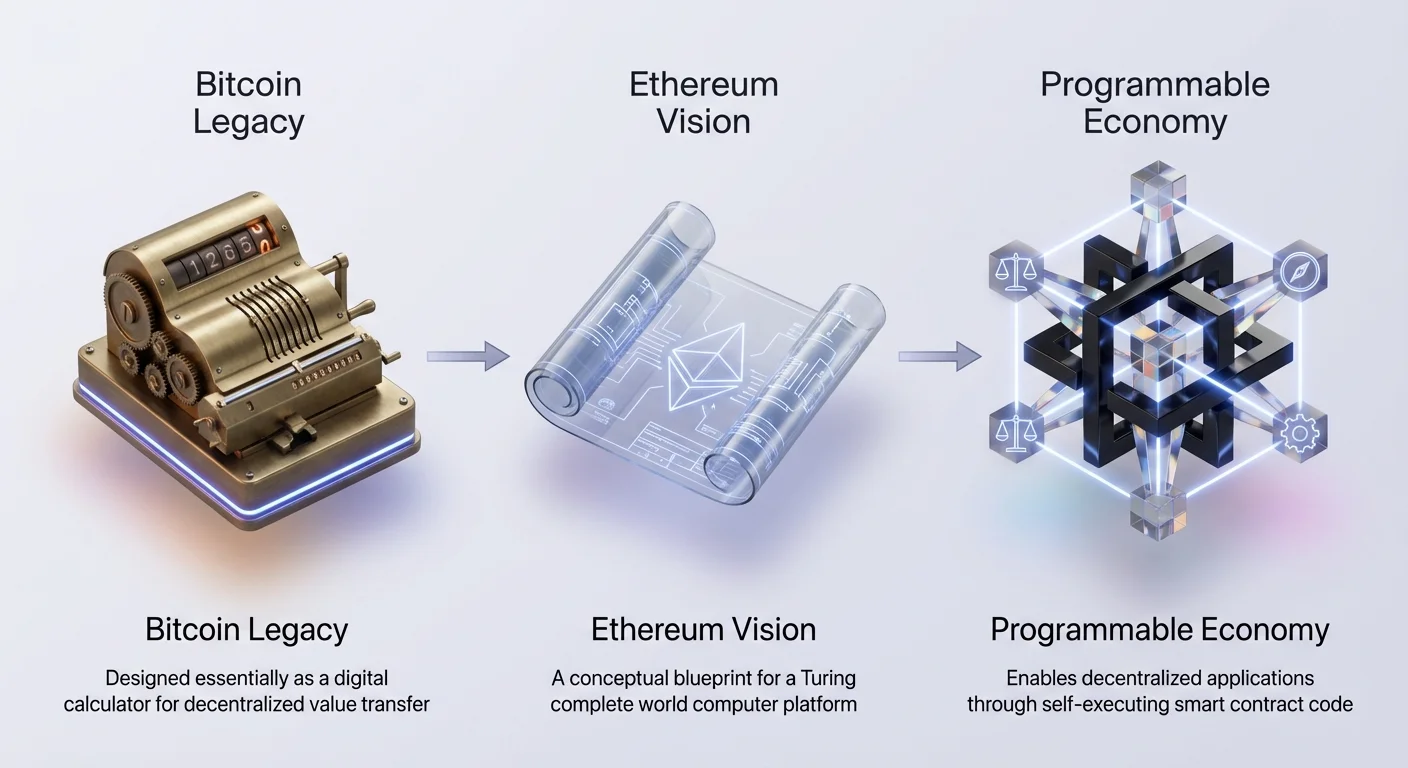
While Bitcoin was designed as a digital alternative to traditional currencies, aiming to provide a decentralized method of transferring value, it was intentionally limited in its programmability. It functioned primarily as a calculator, excellent for tracking balances but unable to run complex software. Buterin envisioned a platform that operated more like a smartphone or a global computer. This vision would eventually materialize as Ethereum, a protocol that introduced the world to smart contracts and decentralized applications.
The genesis of Ethereum was not just a technical milestone; it was a complex event involving a massive crowdfunding effort, a diverse team of co-founders, and a controversial initial distribution of tokens. Understanding how Ethereum began requires looking closely at the 2013 whitepaper, the formation of the founding team, and the mechanics of the 2014 crowdsale that funded the project. These events established the economic and technical foundation for what is now the second-largest cryptocurrency by market capitalization.
The Visionary and the 2013 Whitepaper
In late 2013, Vitalik Buterin published a blog post and whitepaper titled "Ethereum: The Ultimate Smart Contract and Decentralized Application Platform." This document laid the theoretical groundwork for a new blockchain. Unlike Bitcoin, which used a limited scripting language to ensure security for monetary transfers, Ethereum was designed to be "Turing complete," enabling complex smart contracts.
In computer science, a Turing complete system is one that can theoretically solve any computational problem, given enough time and memory. Buterin proposed a blockchain with a built-in programming language that would allow developers to write any type of application they desired. This was a radical departure from the "digital gold" narrative that surrounded Bitcoin at the time. The goal was to create a decentralized computer capable of running applications without the need for a central server or authority.

Assembling the Founding Team
The ambitious vision outlined in the whitepaper attracted a wide array of developers, mathematicians, and entrepreneurs. The official list of founders eventually included eight individuals: Vitalik Buterin, Anthony Di Iorio, Charles Hoskinson, Mihai Alisie, Amir Chetrit, Joseph Lubin, Gavin Wood, and Jeffrey Wilcke. This group brought together a mix of technical brilliance and business strategy.
However, the large number of founders and differing visions for the project led to early friction. Some viewed Ethereum as a commercial entity, while others, including Buterin, saw it as a non-profit, open-source protocol. These disagreements eventually led to a restructuring of the team. Notably, Charles Hoskinson parted ways with the project early on and went on to found Cardano, a competing smart contract platform with Cardano's long-term roadmap.
Formal development of the software began in early 2014. To manage the legal and financial aspects of the project, a company named EthSuisse was established in Zug, Switzerland. This entity was responsible for organizing the development efforts leading up to the launch. The diversity of the early team, despite the internal conflicts, was crucial in refining the technical specifications that would become the Ethereum Virtual Machine (EVM).
The 2014 Crowdsale Event
To finance the development of such a complex protocol, the team decided to conduct a public crowdsale. This fundraising model was relatively new at the time and served as a precursor to the Initial Coin Offering (ICO) boom that would follow years later. The crowdsale took place in July and August of 2014, inviting the public to support the project directly.
Participants in the crowdsale were required to send Bitcoin (BTC) to a specified address. In exchange, they received an Ethereum wallet address and a promise that they would receive Ether (ETH) when the network officially launched. The sale was open to anyone with Bitcoin, bypassing traditional venture capital routes and allowing for a grassroots base of supporters.
The pricing mechanism for the sale was set to incentivize early participation. Initially, the rate was set at 2,000 ETH per 1 BTC. The sale lasted for 42 days, and by the end, the price had shifted slightly. In total, the crowdsale raised over 31,000 Bitcoin. At the time of the sale, this capital was valued at approximately $18 million.
The Economics of the Initial Distribution
The crowdsale results determined the initial supply and distribution of Ether. When the network finally launched, the total supply was approximately 72 million ETH. The distribution of these tokens is a critical point of analysis for understanding the network's decentralization and economic history.
Breakdown of Initial Supply:
- Crowdsale Participants: Approximately 60 million ETH, representing 83% of the initial supply, was distributed to the people who purchased ETH during the 2014 sale.
- Early Contributors and Foundation: The remaining 12 million ETH, representing roughly 17%, was set aside. Half of this amount went to the 83 early contributors who helped build the protocol. The other half was allocated to the Ethereum Foundation.
The Ethereum Foundation was established as a non-profit organization tasked with overseeing the development, promotion, and adoption of the network. The funds allocated to the Foundation were intended to support long-term research and legal defense.
The decision to sell the vast majority of the initial supply to the public was significant. It meant that from day one, the ownership of the network's native currency was distributed among thousands of buyers rather than being held entirely by the founders. However, it also meant that the initial distribution was concentrated among those who had the foresight and capital to invest in 2014.
Wealth Concentration and Decentralization Implications
The concentration of tokens from the crowdsale has long been a subject of debate regarding the "credible neutrality" of the network. Credible neutrality refers to the idea that a protocol should not discriminate against or favor any specific group of users. Wide distribution of tokens is generally seen as a prerequisite for decentralization, as it prevents a small group of "whales" from exerting undue influence over the network's Ethereum governance and credible neutrality.
Because the crowdsale had a relatively small number of participants compared to the millions of crypto users today, the initial holdings were undeniably concentrated. Analytics from firms like Chainalysis in later years indicated that a small number of accounts held a significant portion of the supply.
However, the distribution of ETH has changed over time. As early buyers sold their holdings to new entrants and as new ETH was issued through mining rewards (and later staking rewards), the ownership of the asset became more widespread. The initial 72 million supply has grown, and the turnover of assets has diluted the dominance of the original genesis wallets.
The Core Innovation: Smart Contracts
The technology that these crowdsale participants were funding was the "smart contract." While the term was coined earlier, Ethereum was the first platform to make it a central feature of a public blockchain. A smart contract is essentially a computer program that lives on the network.
These contracts are "trustless," meaning that the validity of the information and the execution of the code can be verified by anyone on the network. In a traditional Web 2.0 environment, users rely on intermediaries like banks or tech giants to facilitate transactions and store data. These intermediaries act as gatekeepers.
In contrast, a smart contract executes automatically based on pre-defined rules. For example, a contract could be programmed to release funds to a freelancer only once a digital project is delivered. There is no need for an escrow agent or a lawyer to verify the exchange; the code enforces the agreement. This automation allows for the creation of Decentralized Applications (dApps).
The Ethereum Virtual Machine (EVM)
To run these smart contracts, the network relies on the Ethereum Virtual Machine (EVM). The EVM is a computation engine that acts like a decentralized computer. It interprets the bytecode of smart contracts and executes their instructions. A deeper understanding requires an EVM Execution Layer Deep Dive.
The EVM is described as a "sandboxed" environment. This means it is isolated from the main network's file system or other processes. This isolation is a critical security feature. It ensures that if a specific smart contract contains malicious code or a fatal error, it cannot crash the entire blockchain or access data it is not authorized to see.
Every node in the Ethereum network runs an instance of the EVM. This redundancy is what makes the network decentralized. It ensures that every transaction and smart contract execution is verified by thousands of computers around the world, making the system immutable and censorship-resistant.
Comparison of Genesis Models
The launch of Ethereum differed significantly from the launch of Bitcoin. While Bitcoin was released quietly by an anonymous creator with no pre-funding, Ethereum was a public, funded, and organizationally driven launch.
| Feature | Bitcoin Launch | Ethereum Launch |
|---|---|---|
| Creator | Anonymous (Satoshi Nakamoto) | Public Team (Vitalik Buterin et al.) |
| Funding | None (Self-funded/Community) | Public Crowdsale (~$18M raised) |
| Initial Distribution | Mining only (Proof of Work) | Pre-mine distributed to buyers/devs |
These differences reflect the differing goals of the projects. Bitcoin sought to be a pure, neutral money untouched by human institutions. Ethereum sought to be a robust platform requiring significant research and development resources to build the necessary infrastructure for a decentralized internet.
The Launch: From Frontier to Mainnet
Following the successful crowdsale in 2014, the development team spent roughly a year finalizing the protocol. The first live version of the Ethereum software, known as "Frontier," was released in July 2015. This was a bare-bones implementation intended primarily for developers and miners to get the network running.
The launch of the mainnet marked the official delivery of the ether purchased during the crowdsale. The genesis block was mined, and the 72 million ETH became movable on the blockchain. This moment transitioned Ethereum from a whitepaper and a promise into a functioning global network.
Over the following years, the network underwent several planned upgrades to improve usability and security. The "Frontier" phase eventually gave way to "Homestead," signaling that the network was safe for regular users. The ability to program money and build applications on top of a blockchain sparked an explosion of innovation, leading to the creation of entire sectors like Decentralized Finance (DeFi) and Non-Fungible Tokens (NFTs).
The Legacy of the Crowdsale Model
The 2014 crowdsale did more than just fund Ethereum; it validated a new model for capital formation. By selling tokens directly to future users, the project aligned the incentives of the developers with the community. If the network became useful, the value of the tokens would theoretically rise, benefiting both the creators and the early adopters.
This success inspired thousands of other projects to launch their own token sales, fundamentally changing how blockchain startups raise money. While this inevitably attracted regulatory scrutiny regarding securities laws, it also democratized access to early-stage technology investing, which had previously been the domain of accredited venture capitalists.
Web3 and the Elimination of Intermediaries
The ultimate goal of the initial distribution and the development of the EVM was to usher in the era of Web3. The current internet, or Web2, is dominated by centralized platforms that harvest user data and act as gatekeepers. In Web2, users must trust companies like Facebook or Google to manage their identities and information.
Ethereum's architecture was built to dismantle this model. As Vitalik Buterin noted, the goal is not just to replace the taxi driver with a robot, but to replace the ride-sharing company with a smart contract. This allows the drivers and the riders to interact directly.
In a Web3 environment powered by Ethereum, users own their data and assets. A decentralized social network, for instance, would allow users to monetize their own content without a platform taking a massive cut. This vision of user ownership and "credible neutrality" remains the guiding principle of the Ethereum community, rooted deeply in the decisions made during the genesis and initial distribution.
Conclusion
The story of Ethereum's genesis is a narrative of ambitious technical vision supported by a novel financial experiment. From the 2013 whitepaper that proposed a "world computer" to the 2014 crowdsale that raised millions in Bitcoin, the project broke new ground at every step. The decision to distribute the majority of the initial supply to the public helped bootstrap a passionate community of developers and users who were financially invested in the network's success.
While the concentration of wealth from the initial sale remains a historical footnote, the utility created by the platform has overshadowed these early concerns. By enabling smart contracts, DAOs, and decentralized finance, Ethereum fulfilled the promise of its whitepaper. It transformed blockchain from a technology for storing value into a technology for automating trust, laying the foundation for the decentralized internet of the future.
The shift from Bitcoin's digital calculator to Ethereum's world computer changed crypto from simple money into a programmable economy.