
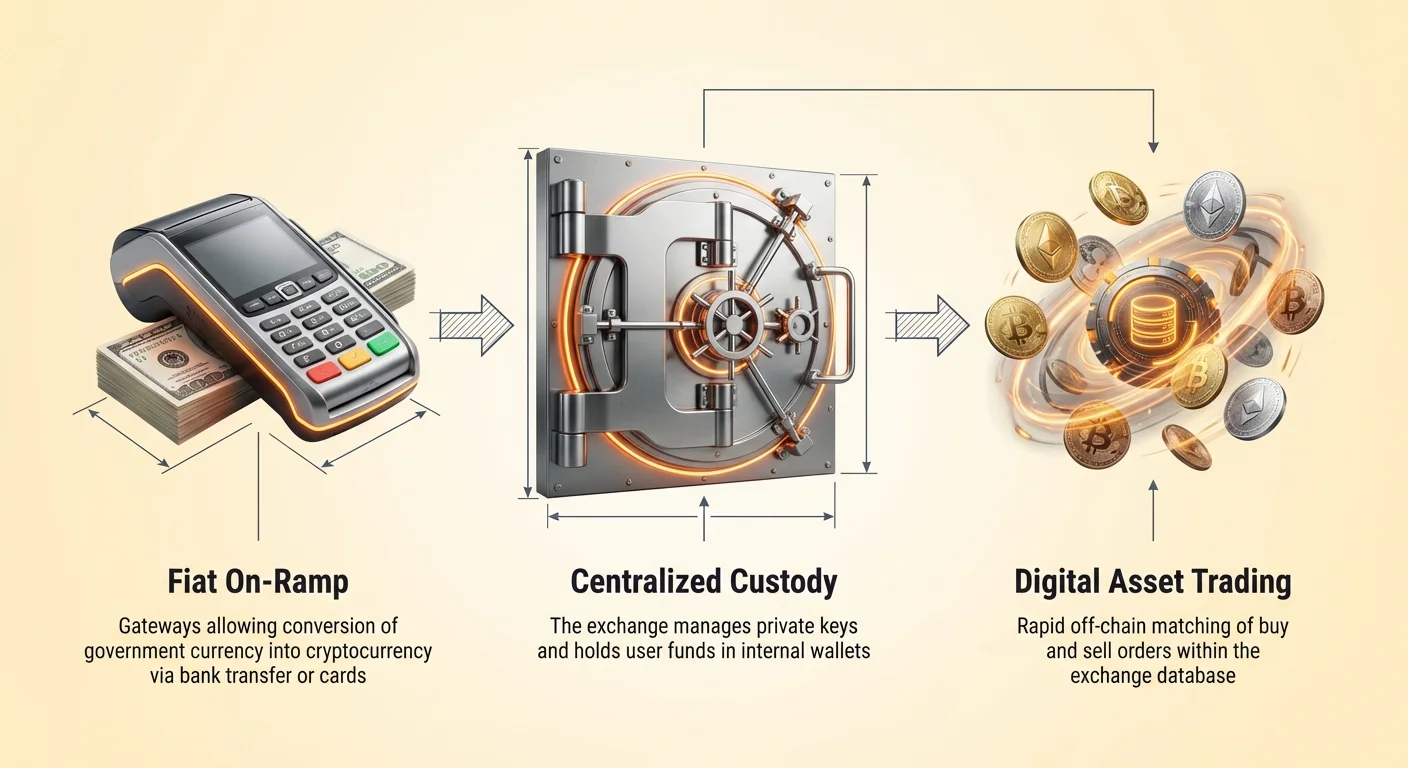
The landscape of digital asset trading is dominated by centralized exchanges, commonly referred to as CEXs. These platforms serve as the primary gateway for most investors entering the cryptocurrency market, acting as intermediaries that facilitate the buying, selling, and trading of digital currencies. Functioning similarly to traditional stock exchanges or brokerages, a centralized exchange operates as a trusted third party that manages the order book, executes trades, and holds custody of user funds.
For beginners and institutional investors alike, these platforms offer a familiar interface that mirrors traditional banking and investment apps. They provide high liquidity, meaning there are enough buyers and sellers to execute trades quickly at stable prices. This accessibility makes them the most popular entry point for converting government-issued fiat currency into digital assets like Bitcoin or Ethereum.
However, the convenience provided by centralized entities comes with specific trade-offs regarding control and security. When a user deposits funds into a CEX, they are essentially entrusting their private keys—and therefore ownership of their assets—to the exchange. This custodial model simplifies the user experience by removing the technical burden of managing cryptographic keys, but it introduces counterparty risk.
Understanding the intricate mechanics of how these platforms operate is essential for any participant in the crypto economy. From the way orders are matched in milliseconds to the complex security protocols protecting billions of dollars in assets, a deep dive into CEX architecture reveals both the robust infrastructure that powers the market and the critical considerations every trader must weigh.
The Mechanics of Order Books and Matching Engines
How Centralized Matching Works
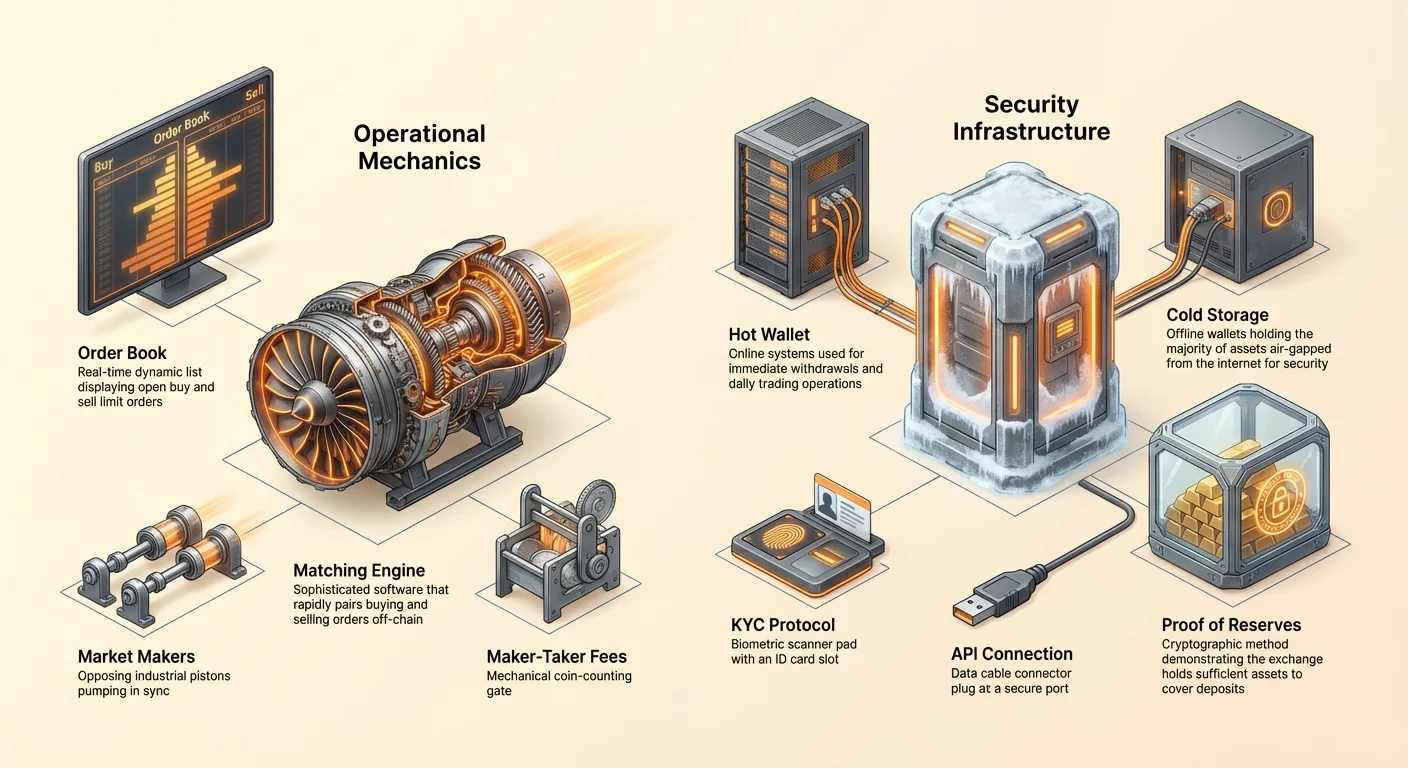
At the heart of every centralized exchange lies the matching engine, a sophisticated piece of software responsible for executing trades. Unlike decentralized platforms where trades occur directly on the blockchain, CEX transactions happen off-chain within the exchange's internal database. When a user places an order, the engine scans the order book to find a corresponding buy or sell offer.
This centralization allows for incredibly fast processing speeds, often capable of handling millions of transactions per second. Because the transactions are recorded on an internal ledger rather than the public blockchain, users do not have to wait for block confirmations or pay network gas fees for every single trade. Settlement on the actual blockchain typically occurs only when funds are deposited or withdrawn from the platform.
Understanding the Order Book
The order book is a dynamic, real-time list of all open buy and sell orders for a specific trading pair. It is divided into two sides: the "bid" side, which lists buy orders, and the "ask" side, which lists sell orders. The price difference between the highest bid and the lowest ask is known as the spread.
Market depth refers to the volume of orders available at different price levels within the book. A deep order book suggests that the market can absorb large orders without significant changes in price. Traders rely on visual representations of the order book to gauge market sentiment, looking for "buy walls" or "sell walls" that might indicate support or resistance levels.
The Role of Market Makers
To ensure smooth trading, exchanges rely on market makers—high-volume traders or institutions that provide liquidity to the order book. These participants place both buy and sell orders simultaneously to ensure there is always a counterparty available for retail traders. Without market makers, an exchange might suffer from low liquidity.
Low liquidity leads to slippage, where the final execution price of a trade differs significantly from the expected price. By constantly populating the order book, market makers reduce the spread and minimize slippage, creating a more efficient and stable trading environment for all users.
Custodial Models and Asset Security
The Implications of Custody
One of the defining characteristics of a centralized exchange is its custodial nature. In the context of cryptocurrency, custody refers to who holds the private keys that control access to the funds. On a CEX, the platform generates and manages these keys on behalf of the user. This means that the user has a claim to the assets, much like a bank deposit, rather than direct ownership on the blockchain.
This model simplifies account recovery. If a user loses their login credentials, the exchange can help restore access, a safety net that does not exist in self-custodial wallets. However, it also means that if the exchange halts withdrawals or faces insolvency, users may lose access to their funds. This reality is often summarized by the popular adage: "not your keys, not your crypto."
Hot vs. Cold Wallet Storage
To mitigate security risks, responsible exchanges employ a tiered storage strategy involving hot and cold wallets. Hot wallets are connected to the internet and are used to facilitate immediate withdrawals and daily trading operations. Because they are online, they are more vulnerable to cyberattacks and hacking attempts.
Cold storage involves keeping the vast majority of assets in offline wallets that are air-gapped from the internet. These might be hardware wallets or paper wallets stored in physical vaults. By keeping typically 95% or more of user funds in cold storage, exchanges ensure that even if their online systems are compromised, the bulk of the assets remain secure and inaccessible to attackers.
Proof of Reserves
In response to industry failures, many top-tier exchanges have adopted Proof of Reserves (PoR) protocols. This cryptographic method allows an exchange to publicly demonstrate that it holds sufficient assets to cover all user deposits 1:1. Through Merkle Tree structures, users can independently verify that their specific balance is included in the total reserve count without exposing their personal data.
While not a perfect solution, PoR adds a layer of transparency that was previously missing in traditional finance and early crypto platforms. It serves as a solvency check, assuring users that their funds have not been lent out or used for unauthorized speculative activities by the platform operators.
Comprehensive Guide to Order Types
Market Orders: Speed Over Price
A market order is the simplest and most common type of trade instruction. It tells the exchange to buy or sell an asset immediately at the best available current price. These orders are designed for speed and certainty of execution rather than price precision. They are typically used when a trader wants to enter or exit a position instantly, regardless of small price fluctuations.
Because market orders consume liquidity from the order book by matching with existing limit orders, they are classified as "taker" trades. Consequently, exchanges often charge higher fees for market orders. Traders should be cautious using market orders during periods of high volatility, as the final execution price may drift unfavorably due to slippage.
Limit Orders: Strategic Entry and Exit
Since limit orders add liquidity to the order book by sitting and waiting for a match, they are often rewarded with lower "maker" fees. However, there is no guarantee of execution; if the market price never reaches the limit price, the order will remain unfilled. This strategy requires patience and is favored by traders who refuse to pay a premium for immediate execution.
Since limit orders add liquidity to the order book by sitting and waiting for a match, they are often rewarded with lower "maker" fees. However, there is no guarantee of execution; if the market price never reaches the limit price, the order will remain unfilled. This strategy requires patience and is favored by traders who refuse to pay a premium for immediate execution.
Advanced Conditional Orders
For more sophisticated risk management, exchanges offer conditional orders like Stop-Loss and One-Cancels-the-Other (OCO). A Stop-Loss order becomes a market order once a specific "stop" price is reached, helping to limit potential losses on a position. It acts as an automated safety net for traders who cannot monitor the markets 24/7.
An OCO order combines a limit order with a stop-limit order. If one of the orders is executed, the other is automatically cancelled. This is particularly useful for setting a profit target and a stop-loss simultaneously, allowing a trader to automate their exit strategy regardless of which direction the market moves.
Fee Structures and Economic Incentives
The Maker-Taker Fee Model
Trading fees are the primary revenue source for centralized exchanges, and most utilize a maker-taker model. This structure differentiates between orders that provide liquidity and those that take it away. "Makers" are traders who place limit orders that sit on the order book, effectively "making" the market for others. To encourage this behavior, exchanges charge them lower fees.
"Takers" are traders who place market orders that match immediately with existing orders, removing liquidity from the book. Because they "take" what is available, they generally pay higher fees. This tiered system is designed to ensure there are always enough orders on the books to facilitate smooth trading. High-volume traders often receive further discounts on these rates.
Withdrawal and Deposit Costs
Beyond trading commissions, users must navigate various funding fees. While depositing cryptocurrency is often free, withdrawing digital assets to a private wallet typically incurs a fee. This fee is meant to cover the network transaction cost (gas) that the exchange pays to the blockchain, though some platforms add a markup.
Fiat currency transactions involve their own set of costs. Depositing money via bank transfer or wire might be free or low-cost, but using credit or debit cards usually comes with significant processing fees charged by payment providers. Users need to calculate the total cost of the "round trip"—depositing, trading, and withdrawing—to understand their true break-even point.
Hidden Costs: Spread and Conversions
Some exchanges advertise "zero-fee" trading, which can be misleading. In these models, the cost is often hidden in the spread—the difference between the buying and selling price offered by the platform. The exchange may quote a price for Bitcoin that is slightly higher than the actual market rate when you buy, and slightly lower when you sell.
Conversion services, often labeled as "Swap" or "Convert" features for beginners, frequently use this spread-based revenue model. While extremely convenient for quick swaps between assets, these services are usually more expensive than using the standard spot trading interface where fees and prices are transparent.
| Fee Type | Who Pays | Typical Structure |
|---|---|---|
| Maker Fee | Limit Order Placers | Low % (0.0% - 0.2%) |
| Taker Fee | Market Order Placers | Higher % (0.1% - 0.5%) |
| Spread | "Zero Fee" Traders | Built into asset price |
Regulatory Compliance and Identity Verification
Know Your Customer (KYC) Protocols
To operate legally in most jurisdictions, centralized exchanges must enforce Know Your Customer (KYC) protocols. These regulations require users to verify their identity by providing personal information, government-issued ID, and sometimes facial recognition scans. This process is mandatory to prevent fraud, identity theft, and unauthorized account access.
KYC is often tiered. A basic level of verification might allow for limited trading and small withdrawals. Higher tiers, which require more extensive documentation such as proof of address, unlock higher withdrawal limits and advanced features. While this friction can be frustrating, it adds a layer of accountability to the platform.
Anti-Money Laundering (AML) Standards
Alongside KYC, exchanges strictly adhere to Anti-Money Laundering (AML) laws. These systems monitor transactions for suspicious patterns that might indicate illicit activity, such as money laundering or terrorist financing. If an account triggers an AML flag, the exchange may freeze funds pending an investigation.
This regulatory compliance is what allows centralized exchanges to integrate with the traditional banking system. Banks will only process transfers to and from crypto entities that demonstrate robust AML controls. Consequently, compliant exchanges offer the most reliable fiat on-ramps and off-ramps for users looking to cash out their digital assets.
Privacy Considerations
The requirement for strict ID verification creates a privacy trade-off. Unlike decentralized exchanges or peer-to-peer platforms where users can often trade pseudo-anonymously, CEX users must dox themselves to the platform. This centralized collection of sensitive personal data creates a target for hackers.
Users should investigate an exchange's data protection policies and history. Reputable platforms invest heavily in cybersecurity to protect user data, but the risk of a data breach remains. Traders prioritizing absolute privacy often gravitate toward non-custodial solutions, accepting the trade-off of lower liquidity and higher complexity.
Advanced Trading Features and Derivatives
Margin Trading and Leverage
Centralized exchanges often provide margin trading, a feature that allows users to borrow funds from the exchange to trade larger positions than their account balance would normally permit. This is known as leverage. For example, with 10x leverage, a trader with $1,000 can open a position worth $10,000.
While leverage amplifies potential profits, it also magnifies risks. If the market moves against the trader's position, they risk liquidation, where the exchange automatically closes the trade to recover the borrowed funds. This can result in the total loss of the initial capital. Margin trading is a high-risk tool recommended only for experienced professionals.
Futures and Perpetual Contracts
Derivatives markets, such as futures and perpetual contracts, allow traders to speculate on the future price of an asset without actually owning it. In these contracts, two parties agree to exchange the difference in price of an asset at a future date. Perpetual contracts are a specific type of future that does not have an expiry date, allowing positions to be held indefinitely.
These instruments are crucial for hedging strategies. A holder of physical Bitcoin might open a short position in the futures market to protect against a potential price drop. Derivatives markets on major CEXs often command vastly higher trading volumes than the spot markets, indicating their importance to institutional strategy.
Copy Trading and Social Features
A growing trend in the CEX landscape is the integration of social trading features. Copy trading allows novice users to automatically replicate the trades of successful, experienced investors. Users can browse profiles, view historical performance metrics, and allocate a portion of their funds to mimic the strategies of top traders.
This democratizes access to complex trading strategies, but it requires due diligence. Past performance is not indicative of future results, and blindly following a high-risk trader can lead to significant losses. These features transform the solitary act of trading into a community-driven experience.
Banking Integration and Fiat Gateways
Fiat On-Ramps
The bridge between traditional finance and the crypto economy is built on fiat on-ramps. Centralized exchanges facilitate deposits via bank transfers (ACH, SEPA, SWIFT), wire transfers, and credit or debit cards. These integrations are vital for new capital entering the market. Each method comes with different processing times and fee structures.
Bank transfers are typically the slowest but cheapest method, suitable for large deposits. Card payments offer instant access but often incur fees ranging from 2% to 5%. Third-party payment processors and digital wallets like PayPal are also increasingly supported, offering users a variety of convenient ways to fund their accounts.
Crypto Debit Cards
To make digital assets spendable in the real world, many exchanges now offer branded crypto debit cards. These cards function on major networks like Visa or Mastercard, allowing users to spend their crypto balance anywhere credit cards are accepted. The exchange handles the conversion from crypto to fiat instantly at the point of sale.
These cards often come with perks similar to traditional rewards cards, such as cashback paid in cryptocurrency. They effectively solve the "medium of exchange" problem for crypto, allowing holders to use their investment for daily purchases like groceries or coffee without needing to manually sell and withdraw to a bank.
Withdrawal Protocols
Moving fiat currency off an exchange back to a bank account is known as off-ramping. Exchanges implement security protocols for these withdrawals, which can sometimes cause delays. Large withdrawals may trigger manual reviews or security holds to ensure the request is legitimate.
Batching is another common practice where exchanges group multiple withdrawal requests into a single transaction to save on network fees and improve efficiency. Understanding these operational procedures helps users manage their expectations regarding liquidity and access to cash.
Comparing Exchange Architectures
CEX vs. DEX
The distinction between Centralized Exchanges (CEX) and Decentralized Exchanges (DEX) is fundamental. A CEX is run by a company, holds user funds, and uses an off-chain order book. A DEX operates through smart contracts on a blockchain, allows users to retain custody of their keys, and executes trades on-chain.
CEXs generally offer superior speed, higher liquidity, and customer support, making them more user-friendly. DEXs offer enhanced privacy, censorship resistance, and zero counterparty risk, but often struggle with lower liquidity and complex user interfaces. The choice depends on the user's priority: convenience or control.
Peer-to-Peer (P2P) Platforms
Peer-to-Peer exchanges offer a third alternative, facilitating direct trades between users without an automated order book. The platform acts effectively as an escrow service and matchmaker. Buyers and sellers negotiate terms directly, and payment can be made via hundreds of methods, including local cash transfers or gift cards.
P2P trading is popular in regions with restrictive banking regulations or limited access to traditional financial infrastructure. While it offers high flexibility and privacy, it carries a higher risk of scams and usually involves wider price spreads than automated spot markets.
The Hybrid Approach
Hybrid exchanges attempt to combine the best of both worlds. They seek to offer the high-speed matching engine and user experience of a CEX while integrating the non-custodial security of a DEX. In this model, the exchange matches orders off-chain for speed but settles trades on-chain for transparency.
While still a developing sector, hybrid models represent the industry's evolution toward safer infrastructure. They aim to solve the "single point of failure" problem inherent in centralized systems without sacrificing the performance required by high-frequency traders.
Risk Management and Best Practices
Understanding Exchange Solvency
Exchange solvency refers to the platform's ability to meet all user withdrawal requests at any time. History has shown that poor financial management can lead to collapse. Users should look for exchanges that are transparent about their liabilities and assets, regularly publishing audited Proof of Reserves.
It is safer to view a CEX as a trading venue rather than a wallet. The golden rule of crypto security suggests keeping only the funds you are actively trading on an exchange. Long-term holdings should be moved to a self-custodial cold wallet where the user has exclusive control over the private keys.
Security Hygiene
Even the most secure exchange cannot protect a user who compromises their own account credentials. Enabling Two-Factor Authentication (2FA) is a non-negotiable security step. Using an authenticator app or a hardware security key is significantly safer than SMS-based 2FA, which is vulnerable to SIM-swapping attacks.
Whitelisting withdrawal addresses is another powerful feature. This prevents funds from being sent to any address that hasn't been previously approved by the user, usually requiring a waiting period to add new ones. This creates a critical time buffer in the event of an account breach.
Diversification of Platforms
Relying on a single exchange creates a single point of failure for a trader's activities. If that platform goes offline for maintenance, faces a regulatory halt, or suffers a hack, the trader is completely immobilized. Spreading activity across multiple reputable exchanges is a prudent strategy.
This approach not only mitigates risk but also allows traders to take advantage of different features, fee structures, and asset listings available on different platforms. No single exchange offers every token or every financial product, so a multi-exchange approach provides broader market access.
Conclusion
Centralized exchanges remain the cornerstone of the cryptocurrency ecosystem, bridging the gap between traditional finance and the digital asset world. They provide the necessary liquidity, speed, and user experience that allow millions of individuals to participate in the crypto economy. By offering custody, fiat integration, and advanced trading tools, they simplify what is otherwise a technically complex landscape.
However, this convenience requires users to navigate risks related to custody and security. The evolution of the industry toward transparency, through mechanisms like Proof of Reserves and stricter regulatory compliance, continues to improve the safety of these platforms. For any investor, the key to successfully using a CEX lies in balancing the platform's powerful trading utilities with robust personal security practices and a clear understanding of asset ownership.
Treat centralized exchanges as public marketplaces for trading, not private vaults for long-term storage.