
For years, the world of cryptocurrency trading was dominated by Centralized Exchanges (CEXs). Platforms like Coinbase and Kraken provided a familiar, user-friendly gateway for beginners to purchase Bitcoin or Ethereum using traditional currency. They served as trusted intermediaries, holding assets and facilitating transactions via traditional order books.
However, as the crypto ecosystem matured, decentralized finance (DeFi) emerged, offering powerful new ways to trade assets without relying on a third party. This shift introduced concepts like Automated Market Makers (AMMs) and Liquidity Pools, forming the foundation of Decentralized Exchanges (DEXs). While DEXs grant users true ownership and unparalleled access to new tokens, they present a new set of complexities, primarily concerning price execution, transaction costs, and efficiency.
This guide moves beyond the basics of centralized trading to explore the critical decisions you face when swapping assets directly on the blockchain. We will analyze the mechanics of Native Swaps (trading directly on one protocol) versus DEX Aggregators (platforms that search multiple protocols for the best deal). Mastering this choice is crucial for any serious retail investor aiming to minimize slippage, control gas fees, and achieve optimal trade execution in the decentralized world.
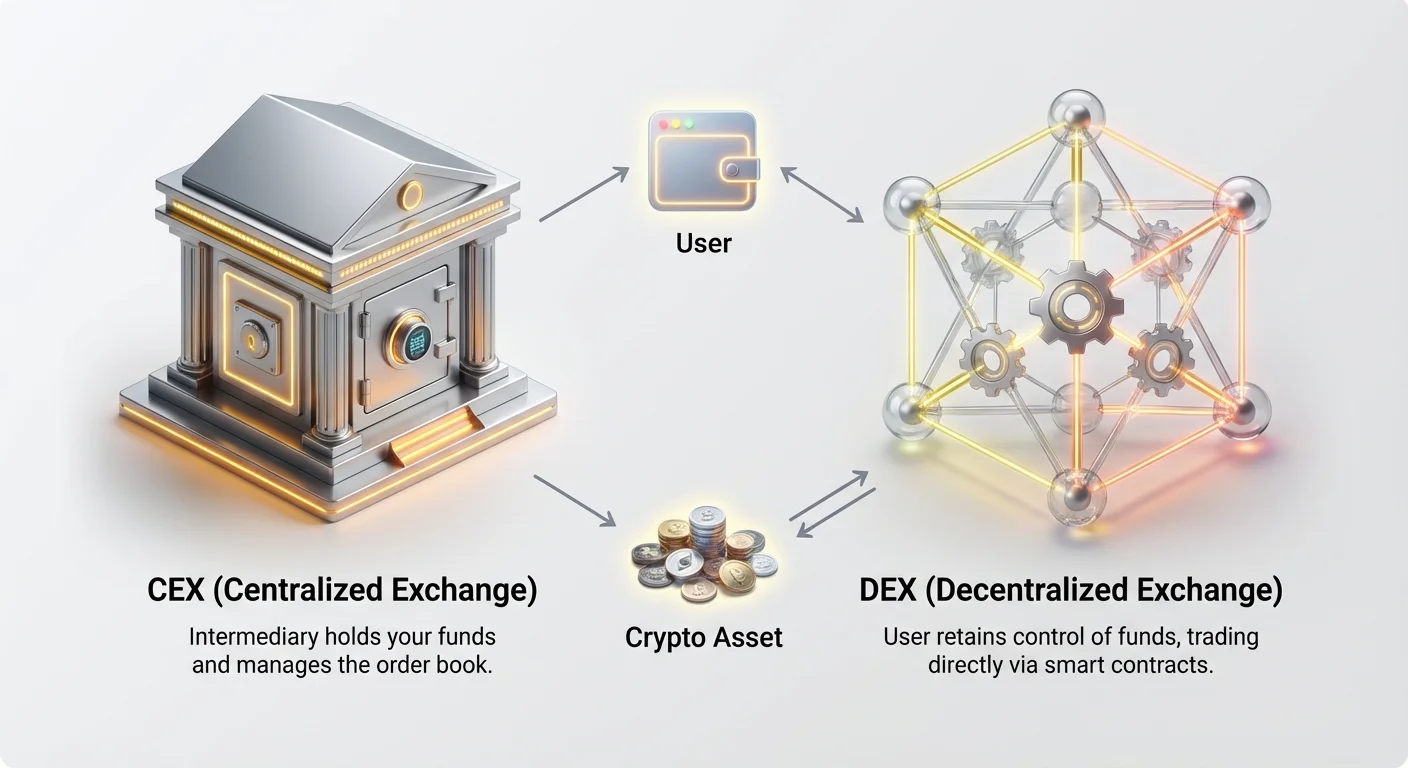
Understanding the Swap Ecosystem: CEX vs. Decentralized Trading
Before diving into optimization techniques, it is essential to understand the fundamental difference between the trading mechanisms used by centralized platforms and those used by decentralized protocols.
The CEX Model: Speed, Custody, and Order Books
Centralized Exchanges operate similarly to traditional stock exchanges. They use an order book where buyers place bids (offers to buy) and sellers place asks (offers to sell) at specific prices.
- Custody: The CEX holds your funds (you don't control the private keys).
- Speed: Transactions happen off-chain (inside the exchange’s database) and are nearly instant and free of network "gas" fees.
- Execution: When you click "Buy," the CEX matches your order with the best available price in its internal order book.
- The Catch: You rely entirely on the platform's security and liquidity.
The DEX Model: Automated Market Makers (AMM) and Liquidity Pools
Decentralized Exchanges (DEXs) completely remove the intermediary. Instead of relying on an order book managed by a company, they use smart contracts known as Automated Market Makers (AMMs).
The core concept of an AMM relies on Liquidity Pools—large reserves of two different tokens locked together by users (liquidity providers). When you execute a swap on a DEX (say, swapping ETH for DAI), you are not trading with another person; you are trading against the tokens in the pool.
The price of the assets in the pool is determined by a fixed mathematical formula. When you remove one asset from the pool (ETH) and deposit another (DAI), you change the ratio, which algorithmically adjusts the price.
- Custody: You control your funds (non-custodial trading).
- Network Fees: Transactions happen on-chain, requiring a network fee (gas) paid to the validators.
- Execution: Price is determined by the size of the swap relative to the size of the pool.
- The Catch: If the pool is small or your order is large, the price can move significantly during the transaction, leading to slippage.
Deep Dive into Native Swaps: Direct Protocol Trading
A Native Swap refers to executing a transaction directly on a single decentralized exchange protocol, such as Uniswap, Sushiswap, or Balancer. This is often the simplest way to trade on-chain, but it’s not always the most cost-effective.
How Native Swaps Work
Imagine you want to swap $1,000 worth of ETH for Token X. You connect your wallet directly to the Uniswap interface. Uniswap checks its internal ETH/Token X liquidity pool and calculates the price based on its fixed AMM formula.
The process is straightforward:
- Connect your wallet.
- Input the amount of ETH you want to sell.
- The platform shows how much Token X you will receive.
- You confirm the transaction and pay the network gas fee.
Pros and Cons: Simplicity vs. Price Discovery
Native swaps offer speed and simplicity, especially for common token pairs with high liquidity.
| Feature | Advantage | Disadvantage |
|---|---|---|
| Simplicity | Extremely user-friendly interface; one direct transaction. | Lacks the ability to compare prices across the entire ecosystem. |
| Gas Cost | Often slightly lower gas cost than an aggregator (one contract interaction). | You only get the price offered by that single pool. |
| Liquidity | Highly efficient if the pool is deep (e.g., ETH/USDC on Uniswap V3). | Terrible execution if the pool is small or new (high slippage risk). |
The Hidden Costs: Gas and Liquidity Depth
The major risk of native swapping, particularly for large orders or for tokens outside of the top 50, is that you might miss out on a better price located in another protocol’s pool.
Consider this scenario:
- Uniswap Pool: Offers 1,000 Token X for 1 ETH.
- Sushiswap Pool: Offers 1,010 Token X for 1 ETH.
If you trade directly on Uniswap (the native swap), you pay 1 ETH and receive 1,000 Token X. You just missed out on 10 free tokens because you didn't check the neighboring DEX. This inefficiency is what DEX aggregators were designed to solve.
The Power of Aggregation: How DEX Aggregators Work
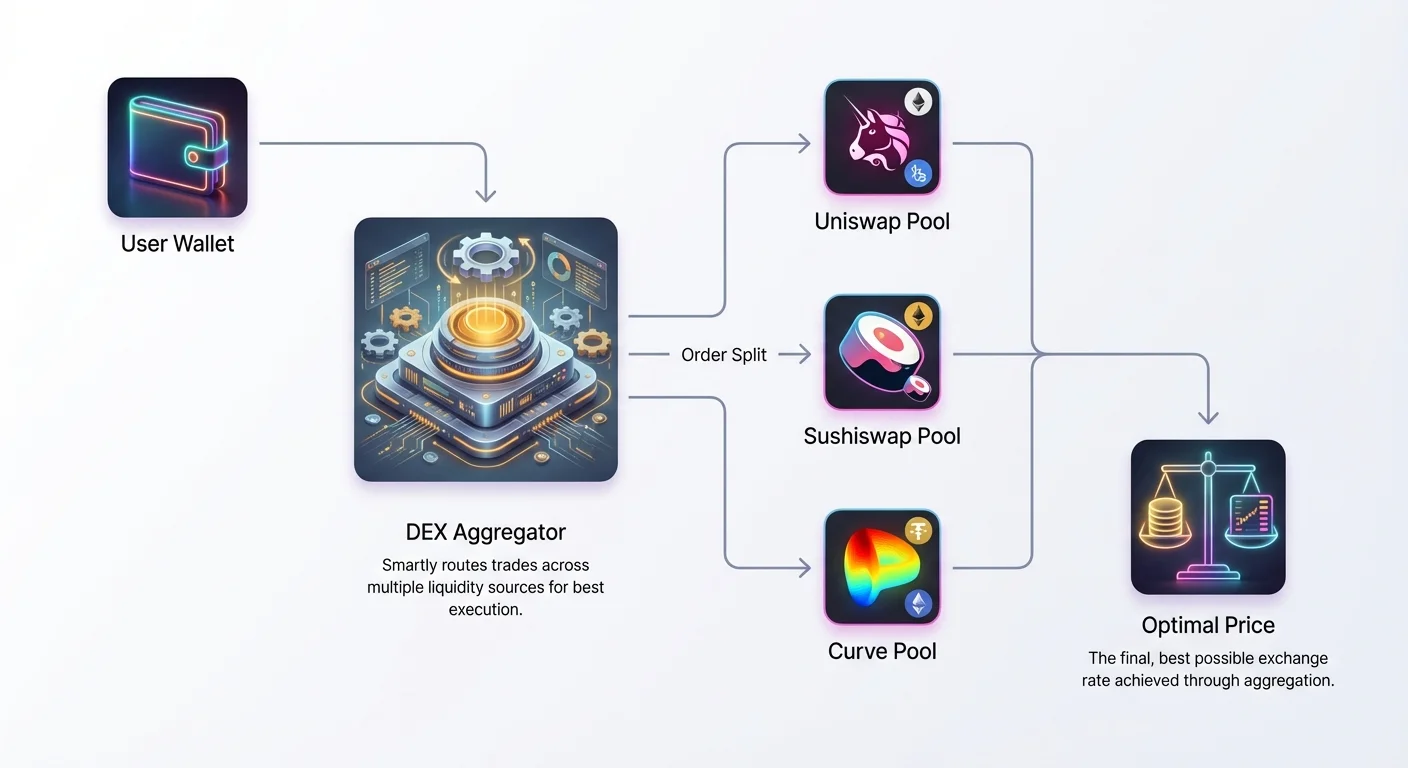
DEX Aggregators act as smart search engines for the decentralized finance landscape. Their primary goal is to find the most efficient route and the best overall price for your swap by scanning dozens of DEXs simultaneously.
What is a DEX Aggregator?
Think of a DEX aggregator (like 1inch, Paraswap, or Matcha) as a flight comparison website (like Kayak or Skyscanner). When you search for a flight, you don't check every airline's website individually; you use the aggregator to find the fastest, cheapest, or most convenient route.
Similarly, when you input a swap request on an aggregator, the platform immediately checks liquidity pools across all major DEXs (Uniswap, Sushiswap, Curve, Balancer, etc.) to determine where your trade can be executed most efficiently.
The Routing Mechanism: Finding the Best Path
The magic of the aggregator lies in its sophisticated smart contract routing. It doesn't just find the best single pool; it figures out if splitting your order will yield a better result.
For example, if you want to swap 100 ETH for DAI, the aggregator might calculate the optimal route like this:
- Route Split: Sell 40 ETH on Uniswap V3 (where liquidity is deepest).
- Route Split: Sell 30 ETH on Sushiswap.
- Intermediate Swap: Sell 20 ETH for USDC on Curve, then swap the USDC for DAI on Balancer (a two-step swap to bypass low direct liquidity).
- Final Split: Sell the remaining 10 ETH on a smaller, highly efficient pool.
By splitting the order across multiple pools, the aggregator significantly minimizes the price impact that one large order would have on a single pool, thereby securing a much better execution price for the user.
Aggregators vs. Native Swaps: Price vs. Gas
While aggregators nearly always guarantee a superior overall price execution due to optimal routing, they often require slightly higher gas fees. This is because interacting with the aggregator's smart contract to split the trade and route it through multiple protocols requires more computational steps than a simple native swap.
The Golden Rule: For large swaps, the savings gained from minimizing slippage via aggregation almost always outweigh the slightly increased gas cost. For very small swaps (under $100), the increased gas fee might consume the price improvement, making a simple native swap more practical.
The Execution Challenge: Slippage and Price Impact
Slippage is perhaps the most critical concept for achieving optimal trade execution in DeFi. It represents the difference between the price you expected to pay or receive when you submitted the transaction and the actual price at which the transaction was executed on the blockchain.
Defining Slippage: Expected vs. Actual Price
In the decentralized world, transactions are not instantaneous. After you sign a transaction, it must wait to be confirmed and included in the next block by network validators. During this delay, the price of the asset can change dramatically, especially if the asset is highly volatile or if another large trade moves the pool price right before yours executes.
Positive Slippage: You receive more tokens than expected (rare). Negative Slippage: You receive fewer tokens than expected (common and costly).
The Role of Order Size and Volatility
Slippage is not just caused by time delays; it is heavily influenced by Price Impact. Price impact is the amount your trade immediately shifts the price of the asset within the liquidity pool.
- If a pool holds 10,000 ETH and you try to swap 1 ETH, the price impact is negligible.
- If the pool holds 10 ETH and you try to swap 1 ETH, you are removing 10% of the entire supply, causing a massive price shift. This shift is the price impact, which translates directly into negative slippage for your transaction.
DEX aggregators excel at mitigating price impact by dividing that 1 ETH swap across five different 10,000 ETH pools, making the trade appear smaller and less disruptive to any single source of liquidity.
Practical Tips for Minimizing Slippage
Every DEX and aggregator interface allows you to set a Slippage Tolerance. This is the maximum percentage price deviation you are willing to accept before the transaction automatically fails.
1. Setting Appropriate Tolerance
- Low Volatility Assets (Stablecoins): Use a low tolerance (0.1% to 0.5%). If you are swapping USDC for DAI, the price should be nearly 1:1, and a low tolerance ensures you are protected from any momentary glitch or large arbitrage trade.
- High Volatility Assets (New Altcoins): Use a moderate tolerance (1% to 3%). If a new token is experiencing rapid movement, a very low tolerance will cause your transaction to fail frequently, wasting the gas fee you paid to try and execute it.
- Beware of High Tolerance (5%+): While a high tolerance ensures your transaction executes, it leaves you vulnerable to sandwich attacks (malicious bots executing trades before and after yours to profit from the price shift). Only use high tolerance when liquidity is extremely low and you absolutely need the trade to succeed.
2. Using Limit Orders (If Available)
Some advanced aggregators and DEXs allow you to set Limit Orders. Unlike a standard swap which executes immediately at the market price, a Limit Order executes only when the market price meets or beats a specified price you set. This completely eliminates negative slippage risk, though there is no guarantee the trade will ever be filled if the price moves away from your limit.
The Cost of Efficiency: Mastering Gas Fees
Decentralized trading is inherently tied to gas fees—the payment required to use the underlying blockchain (e.g., Ethereum, Polygon, Solana). While gas fees are not relevant on a CEX, they are a central component of swap execution in DeFi.
What are Gas Fees and Why Do They Fluctuate?
Gas is the unit of measure for the computational effort required to execute a transaction or smart contract on the blockchain. On networks like Ethereum, the fee (paid in ETH) depends on two primary factors:
- Complexity of the Transaction: A simple token transfer requires less gas than a complex swap routed through an aggregator's smart contract, which requires multiple internal steps.
- Network Congestion: When the network is busy (high demand for block space), the price of gas (Gwei) spikes, making all transactions more expensive.
Aggregator Tools for Gas Optimization
Aggregators offer key advantages in gas management, despite the fact that their complex routing can require slightly more gas volume than a native swap.
1. Gas-Aware Routing
The most sophisticated aggregators don't just find the route that provides the most tokens; they find the route that provides the most net value after accounting for the expected gas cost.
- Example: Route A offers 1,005 tokens but costs $5 in gas. Route B offers 1,000 tokens but costs $2 in gas. If the tokens are worth $1 each, Route A gives you a net value of $1,000, and Route B gives you a net value of $998. The aggregator will select Route A. They calculate this complex equation instantly.
2. Gas Price Estimation and Priority Fees
Modern DEX interfaces integrate real-time gas price estimation. They allow users to set a maximum Priority Fee (or "tip") to validators. If you are in a hurry, you can increase this priority fee to ensure your transaction is picked up quickly, reducing the chance of price slippage due to execution delays. If you are patient, you can reduce this fee and wait for a period of lower network congestion.
Best Practices for Timing Your Swap
Since network congestion dictates gas prices, timing your swap can result in significant savings.
- Avoid Peak Times: Ethereum gas fees are often highest during standard North American and European business hours (9 AM to 5 PM EST) and when major market news or events occur.
- Use Gas Trackers: Websites dedicated to tracking gas prices allow you to monitor the network in real time. Waiting for gas to drop below a certain threshold (e.g., waiting for Gwei to fall below 20 on Ethereum) can save hundreds of dollars on large, complex swaps.
- Leverage L2 Networks: If possible, execute swaps on Layer 2 (L2) solutions like Arbitrum, Optimism, or Polygon. These networks inherit the security of the main chain but offer transactions at a fraction of the cost, making small and frequent aggregation trades highly viable.
Navigating the Multi-Chain World: Cross-Chain Swaps and Security
The DeFi ecosystem is no longer confined to a single blockchain. Assets exist on Ethereum, Solana, Avalanche, Binance Smart Chain, and many others. A cross-chain swap is the process of moving an asset from one network to another, a feature increasingly being integrated into aggregator platforms.
Why Cross-Chain Swaps are Necessary
Imagine you hold USDC on the Polygon network, but you see a high-yield opportunity that requires staking ETH on the Arbitrum network. You need to:
- Swap USDC for ETH on Polygon.
- Move the ETH from Polygon to Arbitrum (a bridge).
- Execute the final trade or stake on Arbitrum.
Traditional methods require multiple, complex, and manual steps. Cross-chain aggregators seek to automate this entire process into a single transaction.
Security Risks of Cross-Chain Solutions
While immensely convenient, cross-chain swaps introduce significant security risks, primarily centered on Bridges.
A bridge locks your asset on the source chain and issues an equivalent wrapped token on the destination chain. These bridges are frequent targets for hackers because they often hold massive amounts of locked collateral. If a bridge is exploited, the wrapped tokens on the destination chain can become worthless.
Best Practice: When using a cross-chain swap feature embedded within an aggregator, always verify which underlying bridge protocol is being used (e.g., Hop, Multichain, Wormhole). Opt for established, audited bridges that have proven security records.
Aggregators Integrating Bridge Solutions
Some advanced aggregators now offer one-click cross-chain swaps. They execute the initial swap on the source chain, automatically send the resulting asset through a secured bridge, and often execute a final swap on the destination chain, all within one simplified interface.
This automation is powerful, but users must remain aware that they are interacting with multiple smart contracts (the aggregator, the DEXs, and the bridge protocols), increasing the surface area for potential risk if any single contract contains a vulnerability.
DEX Aggregator vs. Native Swap: Choosing Your Optimal Strategy
The ultimate decision between using an aggregator or a native swap comes down to a clear assessment of three factors: Order Size, Token Liquidity, and Execution Speed priority.
When to Use a Native Swap
Native swaps are best utilized when the primary goal is simplicity and minimizing the gas cost associated with smart contract complexity.
- Small Order Sizes (Under $1,000): For small retail trades, the complexity and slightly increased gas required by an aggregator often outweigh the fractional savings it might secure on the exchange rate. The price improvement on a $100 trade might be $0.50, but the extra gas might be $1.00.
- Highly Liquid, Common Pairs: If you are trading between major assets (e.g., ETH/USDC, BTC/ETH) on the most established DEX (like Uniswap V3), the price variance across other protocols will likely be minimal. The liquidity is so deep that splitting the order is unnecessary.
- New or Experimental Tokens: Tokens with extremely low liquidity often reside entirely on one specific DEX protocol. If the aggregator searches five DEXs but only finds the token on one, the aggregator route adds complexity without providing any real price improvement.
When to Use a DEX Aggregator
Aggregators are the professional tool for achieving maximum price efficiency.
- Large Order Sizes (Over $5,000): This is the sweet spot for aggregation. A large trade executed natively on a single pool will cause significant price impact. The aggregator's ability to split the trade dramatically reduces this impact, saving you potentially tens or hundreds of dollars, far offsetting the extra gas fee.
- Illiquid or Mid-Cap Tokens: For tokens that trade across many medium-sized pools, the aggregator is indispensable. It can tap into shallow liquidity pockets on different protocols, creating a deep aggregate pool for your trade.
- Priority on Best Price (Minimize Slippage Crypto): If your absolute highest priority is getting the best exchange rate possible, regardless of a slight delay or higher gas fee, the sophisticated routing of an aggregator is unmatched.
Security Checklist for Decentralized Swapping
Whether you use a native swap or an aggregator, certain security practices are non-negotiable in the non-custodial DeFi world: always verify the smart contract, never share your recovery phrase, and use a dedicated hardware wallet.
- Revoke Permissions: When you interact with a DEX or aggregator, you often grant permission for that smart contract to spend a certain amount of your tokens. Always use a token approval checker (like Etherscan's approval tool) to revoke unlimited spending allowances after large transactions, limiting the damage if that protocol were ever compromised.
- Verify the URL: Scammers frequently create sophisticated phishing sites that mimic major aggregators or DEXs. Always double-check that the URL is correct before connecting your wallet.
- Audit the Smart Contract: While advanced, check if the aggregator or protocol has been audited by reputable security firms (like Certik or ConsenSys Diligence). This confirmation provides assurance that the smart contract code has been rigorously tested for vulnerabilities.
- Check Liquidity Warnings: If the interface warns that there is very low liquidity for your desired token pair, proceed with extreme caution and set your slippage tolerance very high, or abort the trade entirely.
Conclusion
Moving beyond the structured, custodial environment of a Centralized Exchange (CEX) and into the decentralized world of swapping opens up massive opportunity, but it also shifts the responsibility for optimal trade execution squarely onto the user.
For the beginner starting with small trades of major assets, a simple Native Swap on a trusted DEX is often the most straightforward and least intimidating option.
However, as your trade size increases or your desire for efficiency intensifies, adopting a DEX Aggregator becomes essential. These sophisticated platforms are the key to optimizing your DeFi experience, offering protection against harmful price impact and gas inefficiency by scanning the entire market to secure the best possible trade route.
The modern decentralized trader is defined by their ability to manage complex variables—slippage, gas volatility, and multi-chain complexity. By understanding the core mechanics of aggregation and applying practical control measures, you can ensure your transactions are not only decentralized but also executed with the precision required for long-term success in the DeFi ecosystem.