
Navigating the cryptocurrency market requires understanding the two primary venues where digital assets are traded. These are centralized exchanges (CEXs) and decentralized exchanges (DEXs). While both platforms facilitate the buying, selling, and swapping of cryptocurrencies, they operate on fundamentally different infrastructures. They also offer distinct advantages regarding security, control, and user experience.
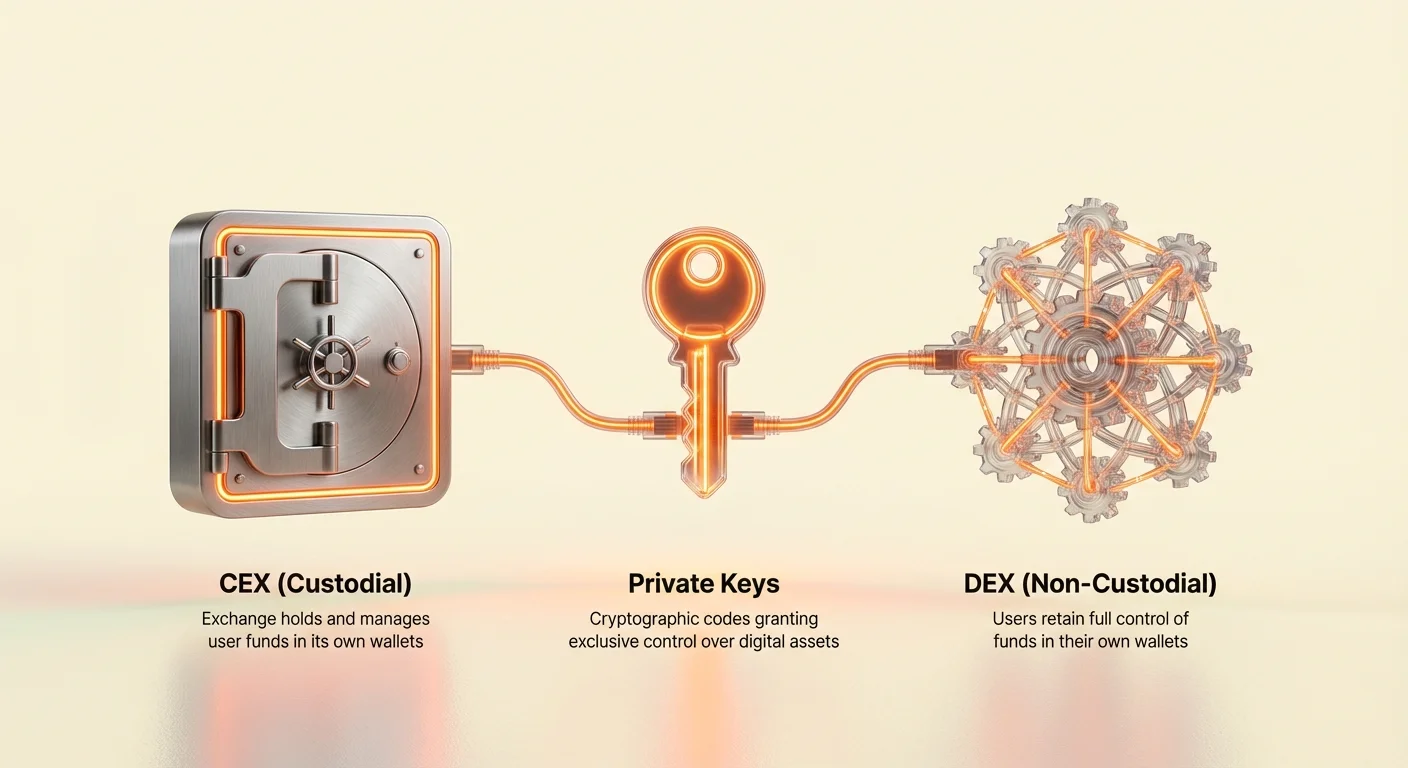
Choosing between a CEX and a DEX is not merely about preference. It is a decision that impacts the safety of funds, the privacy of the trader, and the cost of execution. A centralized exchange functions similarly to a traditional stock brokerage or bank. It acts as a trusted middleman that manages the order books and holds user funds in custody.
In contrast, a decentralized exchange operates through code and smart contracts on a blockchain. It eliminates the need for a central authority. This allows users to trade directly with one another or against liquidity pools without ever giving up control of their private keys. Understanding the nuances of these systems is essential for any market participant.
The Architecture of Centralized Exchanges
Centralized exchanges are currently the most common entry point for new investors. These platforms are businesses owned and operated by private companies. When you create an account on a CEX, you are entering into a custodial relationship. The exchange manages the technical complexities of blockchain interactions on your behalf.
The Custodial Model and Trust
The defining characteristic of a CEX is custody. When you deposit funds, you are transferring them to a wallet controlled by the exchange. The platform effectively issues you an IOU represented by the numbers on your screen. You do not hold the private keys to these assets. This model simplifies the user experience significantly.
If you forget your password, the exchange can help you recover your account. However, this convenience comes with a significant trade-off. You must trust the exchange to remain solvent and secure. If the platform faces financial difficulties or pauses withdrawals, you lose access to your assets. The history of crypto is dotted with examples of exchanges that failed to protect user deposits.
Order Books and Matching Engines
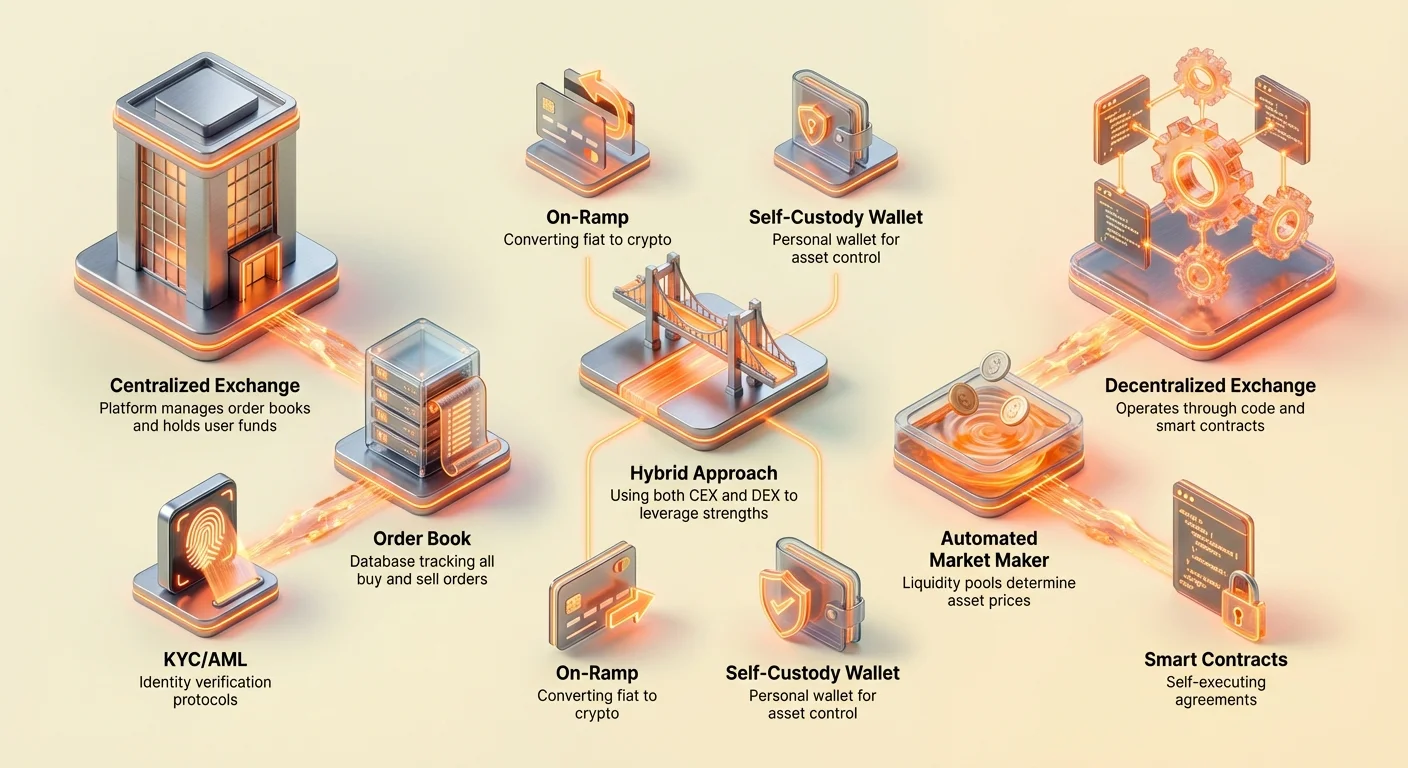
Mechanically, centralized exchanges rely on an order book system. This is a database that tracks all buy and sell orders placed by users. A high-speed matching engine pairs buyers with sellers based on price and time priority. This system allows for sophisticated trading types.
Traders can execute limit orders, stop-losses, and margin trades with precision. Because the transactions occur on the exchange's internal database rather than directly on the blockchain, they are incredibly fast. This "off-chain" processing avoids network congestion and gas fees for individual trades.
Makers, Takers, and Market Depth
Liquidity on a CEX is driven by market participants known as makers and takers. Makers are traders who place orders that do not fill immediately. They add depth to the order book. Takers are traders who accept existing orders at the current market price.
To incentivize liquidity, many exchanges use a tiered fee structure. Makers often pay lower fees because they provide the inventory that allows the market to function. Takers usually pay higher fees for the convenience of instant execution. This dynamic creates deep markets where large amounts of crypto can be traded without significantly impacting the price.
The Architecture of Decentralized Exchanges
Decentralized exchanges represent a shift toward disintermediation. These platforms are applications built on top of blockchains like Ethereum or Solana. They do not require a company to facilitate trades. Instead, they use smart contracts to automate the exchange of value.
Automated Market Makers (AMMs)
Most modern DEXs utilize a system called an Automated Market Maker. Unlike the order book model of a CEX, an AMM does not rely on matching a buyer with a specific seller. Instead, users trade against a pool of tokens known as a liquidity pool.
A mathematical formula determines the price of the assets based on the ratio of tokens in the pool. This innovation solved early liquidity issues in decentralized finance. It allows trading to occur 24/7 without the need for professional market makers to sit on the other side of the trade.
Permissionless Access and Self-Custody
A core tenet of DEX architecture is that it is permissionless. There is no sign-up process, no account creation, and no identity verification. Anyone with an internet connection and a compatible self-custodial wallet can interact with the contract.
This structure ensures that users maintain absolute control over their funds. You never transfer your assets to the exchange. Instead, you approve a smart contract to swap tokens directly from your wallet. If the DEX interface goes down, the assets remain safely in your possession because the exchange never actually held them.
Risks Unique to Code-Based Trading
While DEXs remove the risk of a CEO mismanaging funds, they introduce technical risks. Users must trust the code of the smart contract. If there is a bug or vulnerability in the contract, hackers can exploit it to drain the liquidity pools.
Furthermore, because transactions happen on-chain, they are irreversible. There is no customer support to call if you send funds to the wrong address or interact with a malicious token. The responsibility for security falls entirely on the user.
Comparing Security Protocols and Risks
Security in the cryptocurrency space is a multi-layered concept. It encompasses protection against theft, defense against fraud, and the reliability of the platform itself. CEXs and DEXs approach security from opposite ends of the spectrum.
Centralized platforms function as "honeypots" for hackers. Because they hold billions of dollars in user funds in centralized wallets, they are attractive targets. To combat this, reputable exchanges employ vast security teams. They use cold storage, where the majority of funds are kept offline in air-gapped devices.
They also use multi-signature wallets that require multiple approvals for withdrawals. Users are protected by features like two-factor authentication (2FA) and withdrawal whitelisting. However, the risk of insider theft or gross mismanagement remains a critical vulnerability of the custodial model.
Decentralized exchanges disperse the risk. There is no central wallet to hack in the traditional sense. However, the user is exposed to smart contract risk. If the code governing the swap logic has a flaw, funds can be lost.
Additionally, DEX users face high risks of phishing and social engineering. Scammers frequently create fake versions of popular DEX websites or fake tokens that mimic legitimate projects. Since there is no vetting process for listing tokens on many DEXs, users must conduct their own due diligence to ensure they are trading the correct asset.
| Security Feature | Centralized Exchange (CEX) | Decentralized Exchange (DEX) |
|---|---|---|
| Custody of Funds | Exchange controls funds | User controls funds |
| Primary Risk | Platform insolvency or hack | Smart contract bugs or user error |
| User Protection | 2FA, insurance (rarely), support | None (Code is law) |
Liquidity and Market Efficiency
Liquidity refers to the ease with which an asset can be bought or sold without affecting its price. It is a crucial factor for traders, especially those moving larger amounts of capital.
Liquidity in Centralized Venues
Centralized exchanges generally offer superior liquidity for major cryptocurrencies like Bitcoin and Ethereum. Because they aggregate millions of users and professional market makers in a single venue, the order books are deep.
This means a trader can sell a large position with minimal slippage. The gap between the buying price and the selling price is usually very narrow. For high-frequency traders and institutional investors, this efficiency is vital. The speed of the off-chain matching engine allows for strategies that are impossible on-chain due to latency.
Liquidity in Decentralized Protocols
Liquidity on a DEX is crowdsourced. Anyone can become a liquidity provider by depositing an equal value of two assets into a pool. In return, they earn a portion of the trading fees.
While popular pairs on major DEXs have become very liquid, smaller or newer tokens often suffer from high slippage. If a trader tries to buy a large amount of an illiquid token from an AMM, the price can spike dramatically.
However, DEXs are often the first place new assets are listed. Because there is no bureaucratic listing process, new tokens appear on DEXs long before they reach centralized platforms. This gives DEX users early access to emerging projects, albeit with higher volatility and liquidity risks.
The Cost of Trading: Fees and Expenses
The fee structures of CEXs and DEXs differ significantly in how they are calculated and who receives them. Understanding these costs is essential for profitability.
Fee Structures on CEXs
Centralized exchanges typically charge a percentage-based trading fee. This is often divided into maker and taker fees. These fees cover the exchange's operating costs and profit margins.
Users must also consider withdrawal fees. Moving crypto off a centralized platform often incurs a flat fee that is higher than the actual network cost. Some platforms also charge for deposits, though this is less common.
Hidden costs can also exist in the form of spreads. This is the difference between the buy and sell price. Some "zero-fee" brokers make their money by widening this spread, meaning you pay more than the market rate for the asset.
Fee Structures on DEXs
On a decentralized exchange, the user pays two types of fees. First is the protocol fee, which is usually a small percentage (e.g., 0.3%) that goes to the liquidity providers. Second is the network fee, or gas fee.
This network fee is paid to the miners or validators of the blockchain to process the transaction. It is not determined by the size of the trade but by the congestion of the network and the complexity of the transaction.
On networks like Ethereum, swapping tokens can be expensive during periods of high activity. A simple trade might cost $50 or more in gas, regardless of whether you are trading $10 or $10,000. This makes DEX trading on high-fee chains cost-prohibitive for smaller investors. However, on low-fee chains like Solana or Layer-2 solutions, these costs are negligible.
Regulatory Compliance and Anonymity
The intersection of cryptocurrency and regulation is a primary dividing line between centralized and decentralized platforms. This distinction dictates who can use the platform and what information they must provide.
KYC and AML on Centralized Platforms
Centralized exchanges function as regulated financial institutions. They must comply with local laws in the jurisdictions where they operate. This means they are required to enforce Know Your Customer (KYC) and Anti-Money Laundering (AML) protocols.
Users cannot trade anonymously. They must upload government-issued ID, proof of address, and sometimes even biometric data like a selfie. This creates a digital paper trail linking your real-world identity to your crypto holdings.
While this reduces the risk of illicit activity, it introduces privacy concerns. Data breaches at exchanges have exposed the personal information of millions of users. Additionally, regulators can order exchanges to freeze assets or block transactions from specific addresses.
Privacy and the Decentralized Ethos
DEXs operate without a central entity to enforce these checks. The interface is simply a portal to a smart contract. There is no database of user names or physical addresses.
This allows for financial privacy and inclusivity. Individuals in unbanked regions or countries with restrictive financial regimes can access global markets without barriers. They do not need a passport or a bank account.
However, this lack of oversight is a point of contention for regulators. The openness of DEXs means they can be used by bad actors to launder funds. Users should be aware that while the DEX itself does not collect data, the blockchain is a public ledger. Anyone can trace the flow of funds from one address to another.
User Experience and Accessibility
The barrier to entry varies greatly between the two types of exchanges. Design philosophies cater to different levels of technical proficiency.
The CEX Onboarding Experience
Centralized exchanges are designed for beginners. They offer a polished, intuitive user interface that mimics banking apps. They provide fiat on-ramps, meaning you can buy crypto directly with a credit card or bank transfer.
If you make a mistake, there is a customer support team available via email or live chat. Features like password recovery and fraud protection provide a safety net. They also offer educational resources and simplified tools to help new investors understand the market.
The Learning Curve of DEXs
Using a DEX requires a higher level of technical understanding. You cannot log in with an email address. You must first set up a Web3 wallet, secure your recovery phrase, and fund it with crypto bought elsewhere.
There are no fiat on-ramps on most DEXs. You must already own crypto to trade. Connecting a wallet to a decentralized application (dApp) can be intimidating for first-time users.
Furthermore, users must understand concepts like gas limits, slippage tolerance, and token contract addresses. Sending funds to the wrong network or address results in permanent loss. There is no help desk to reverse the transaction.
The Hybrid Approach: Using Both Venues
Many experienced crypto users do not choose one over the other exclusively. Instead, they utilize both CEXs and DEXs to leverage the strengths of each.
A common strategy involves using a centralized exchange as an on-ramp. This is where the user converts fiat currency into a digital asset like Bitcoin or stablecoins. The CEX offers the convenience of bank transfers and high liquidity for this initial purchase.
Once the assets are acquired, the user withdraws them to a self-custodial wallet. From there, they interact with DEXs to access a wider variety of tokens or to participate in decentralized finance activities like yield farming.
This hybrid approach mitigates the risk of leaving large sums on a centralized platform while avoiding the high fees of buying crypto directly through wallet providers. It requires managing multiple accounts and wallets, but it offers a balanced mix of security, access, and control.
Future Trends and Convergence
The line between centralized and decentralized services is beginning to blur. Centralized exchanges are integrating Web3 wallets and decentralized features into their apps. They are attempting to give users self-custody options within their trusted ecosystems.
Conversely, decentralized exchanges are improving their user interfaces. Aggregators are making it easier to find the best prices across multiple chains. Layer-2 solutions are reducing the gas fees that previously made DEXs expensive.
As the technology matures, the complexity of self-custody is decreasing. Innovations like account abstraction could eventually allow DEX users to recover accounts without needing to manage complex private keys. This would remove one of the biggest hurdles to mass adoption of decentralized trading.
Conclusion
The choice between a centralized and a decentralized exchange ultimately depends on your priorities as an investor. Centralized exchanges offer a familiar, user-friendly environment with high liquidity and recourse in case of errors. They are the easiest way to enter the market but require you to sacrifice privacy and control over your assets.
Decentralized exchanges embody the core philosophy of cryptocurrency by providing autonomy and open access. They eliminate the middleman, reduce counterparty risk, and preserve privacy. However, they demand personal responsibility and a steeper learning curve. For many, the optimal path involves utilizing both platforms to maximize flexibility and security.
True financial sovereignty begins when you take full responsibility for your own private keys.