
Crypto lending has emerged as a powerhouse for generating passive income in the digital asset space. It allows users to put their idle cryptocurrency to work, earning substantial yield—often significantly higher than traditional savings accounts. Whether you hold Bitcoin, Ethereum, or stablecoins like USDC, lending platforms offer a path to consistent returns.
However, the pursuit of high Annual Percentage Yields (APYs) often overshadows the critical topic of risk. Unlike traditional banking, crypto lending operates in a nascent, rapidly evolving environment, which introduces unique dangers. Yields that look too good to be true often hide fundamental risks related to platform security, insolvency, or technological failure.
This guide moves beyond simply comparing potential interest rates. We will establish a robust framework for assessing the security and sustainability of crypto lending platforms, transforming you from a yield chaser into a sophisticated risk manager. We will deeply analyze the fundamental differences between the two main pathways—Custodial (Centralized Finance or CeFi) and Decentralized Finance (DeFi)—to help you determine which approach aligns best with your personal risk tolerance and financial goals.
Understanding Crypto Lending Fundamentals
Before diving into risk analysis, it is essential to grasp what crypto lending is and how it functions structurally.
What is Crypto Lending and How Does It Generate Yield?
Crypto lending is fundamentally the act of supplying your digital assets to a platform or protocol so that other users can borrow them. The yield you receive (the interest) is the cost the borrower pays to access that liquidity.
The Role of the Lender: You are the provider of capital. You deposit your crypto (e.g., stablecoins or volatile assets) into a designated pool or account, and in return, you earn interest over time.
The Role of the Borrower: Borrowers typically fall into two categories:
- Traders/Investors: They borrow volatile assets (like Bitcoin) for speculation, short-selling, or leveraged trading.
- Those Needing Liquidity: They want to access cash (fiat or stablecoins) without selling their crypto holdings. They provide crypto as collateral to secure the loan.
The interest rates are driven by supply and demand. If many users want to borrow a specific asset (high demand), the APY for lending that asset goes up. Conversely, if supply is high, the APY tends to drop.
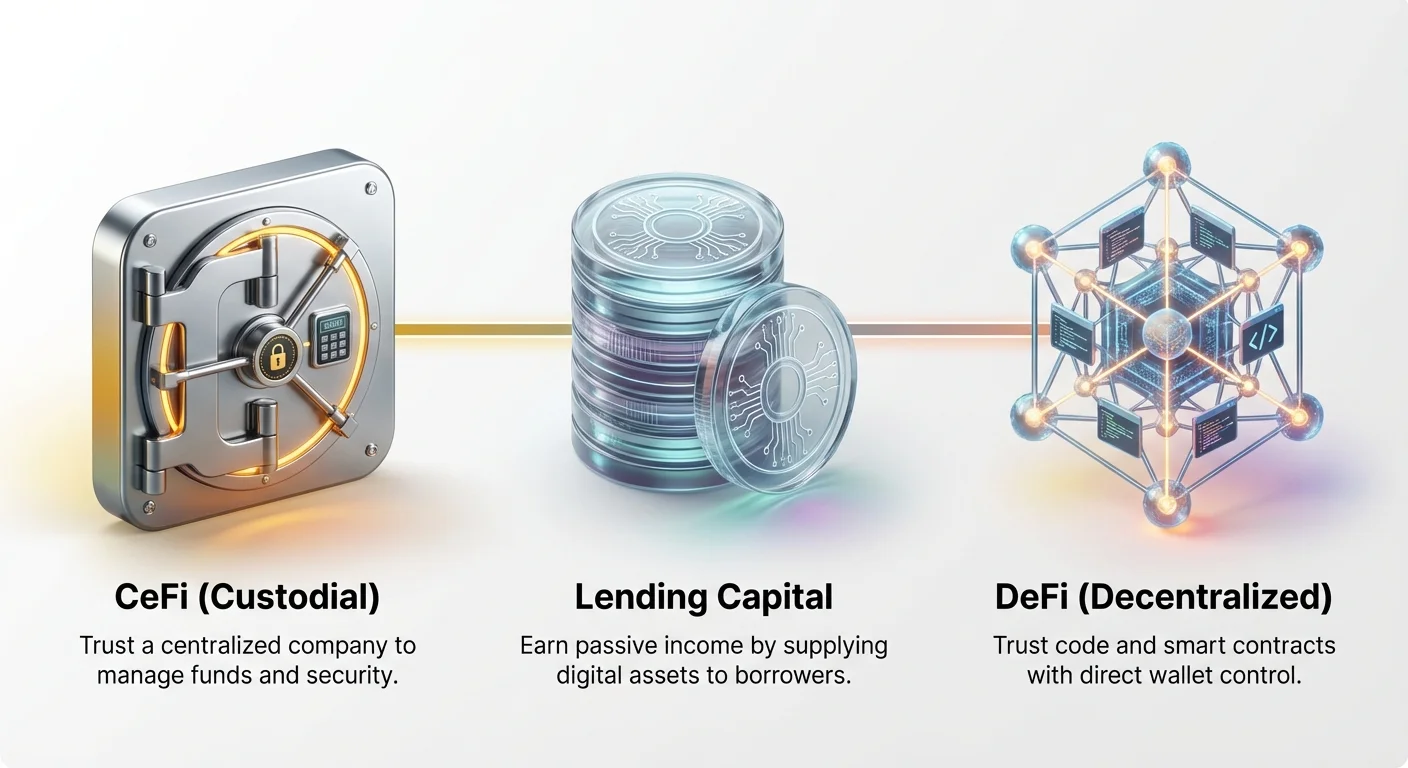
The Two Core Pathways: Custodial vs. Decentralized
The greatest differentiator in crypto lending is the mechanism used to manage the funds, secure the loan, and pay the interest. This mechanism determines where the risk lies.
1. Custodial Lending (Centralized Finance or CeFi)
In custodial lending, you deposit your crypto with a centralized company (like a crypto exchange or a dedicated lending platform). This company acts as an intermediary, holding your keys and managing the entire lending operation, including:
- Vetting borrowers.
- Handling collateral.
- Setting interest rates.
- Distributing yield.
Analogy: This is similar to a traditional bank. You hand over your money, trusting the bank (the platform) to safeguard it and manage its deployment. Because the platform holds your funds, they are the custodian of your assets.
2. Decentralized Finance (DeFi) Lending
In DeFi lending, there is no centralized company or intermediary. Lending is facilitated directly through self-executing computer code called smart contracts. Your funds are locked into a liquidity pool governed by this code, and borrowers interact directly with the contract.
Analogy: This is like a highly automated, transparent vending machine. The rules are written in the code (the contract), and the process of depositing funds, borrowing, and repaying is automated and visible on the blockchain. You maintain control of your private keys and only interact with the protocol via your crypto wallet.
Key Metrics: APR, APY, and Yield Volatility
When assessing lending opportunities, understanding the terminology is crucial:
- APR (Annual Percentage Rate): This is the simple yearly interest rate, excluding the effect of compounding.
- APY (Annual Percentage Yield): This is the effective yearly rate, factoring in the compounding of interest (earning interest on previously earned interest). APY is generally the higher and more relevant figure for investors.
- Yield Volatility: Crypto yields are rarely fixed. They fluctuate constantly based on market demand. A platform offering a stablecoin APY of 10% today might offer 4% next week if market conditions change. It is critical to monitor the sustainability of the displayed yield, especially if it seems significantly higher than the market average.
Deep Dive into Custodial (Centralized) Lending
Custodial platforms offer simplicity and familiar interfaces, but they introduce concentrated risk.
How Centralized Lending Platforms Work
When you deposit funds into a centralized lending platform (CEX), the platform pools all user deposits and then deploys those assets in various ways to generate yield. This deployment might involve:
- On-lending to retail borrowers: Offering loans secured by crypto collateral.
- Lending to institutional partners: Providing liquidity to hedge funds or trading desks, often unsecured or under proprietary terms.
- Proprietary Trading: In some cases, platforms may use deposited funds to engage in their own trading strategies (a major source of risk).
The platform manages the regulatory compliance (Know Your Customer or KYC/Anti-Money Laundering or AML checks) and acts as the legal counterparty for the loan.
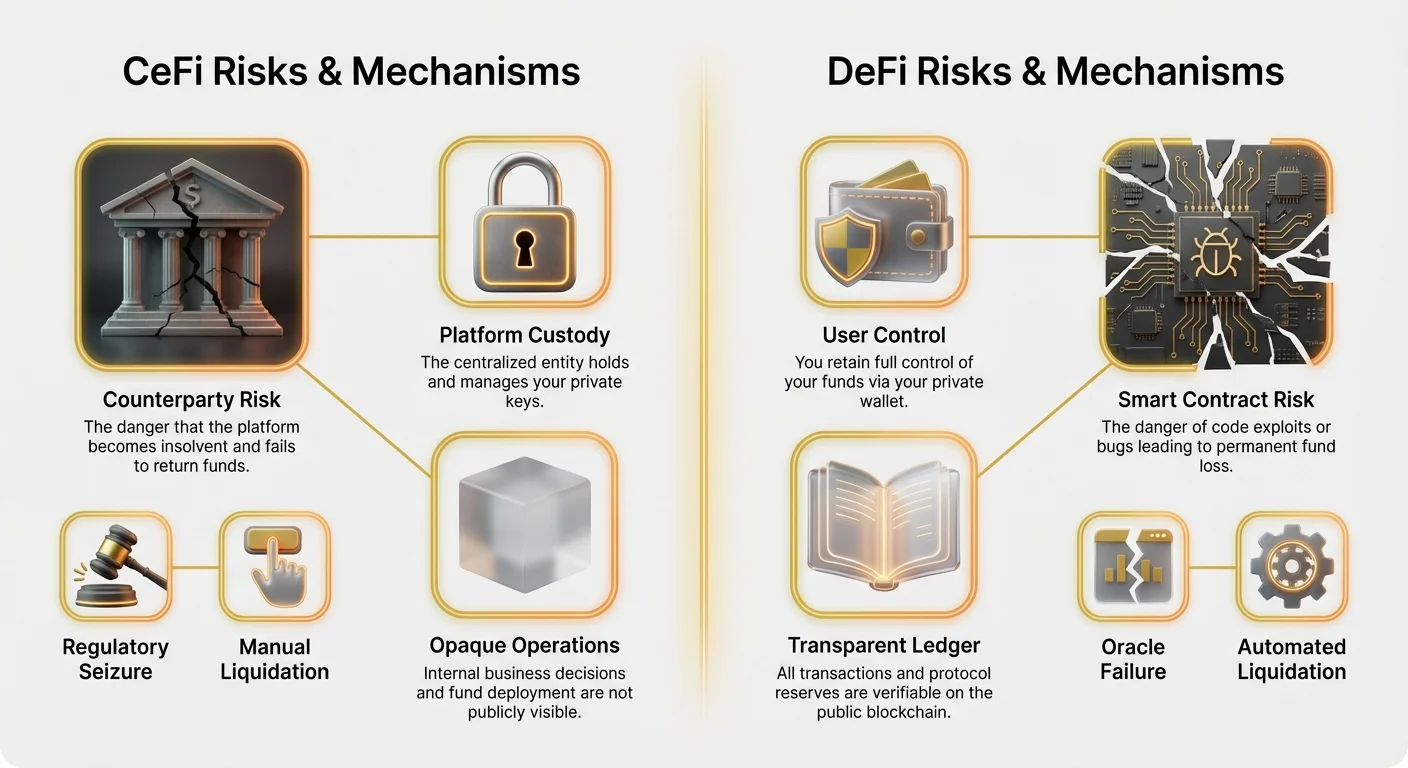
Counterparty Risk: The Solvency Danger
The primary risk in centralized lending is counterparty risk. This is the risk that the entity you are trusting with your funds (the centralized platform) fails to honor its obligations.
"Not Your Keys, Not Your Crypto" Principle: Since the custodial platform holds your private keys, you have effectively transferred ownership risk to them. If the company goes bankrupt, or if senior management makes poor capital allocation decisions (e.g., taking excessive risks with deposits), your funds may be lost or frozen.
Real-World Example (The 2022 Contagion): The collapse of major centralized lenders like Celsius, BlockFi, and Voyager vividly illustrated counterparty risk. These companies often promised high, stable yields but generated those yields by taking risky, proprietary bets or extending unsecured institutional loans. When the market crashed, these firms became insolvent, and customer funds were frozen in lengthy bankruptcy proceedings.
Assessing Counterparty Risk:
- Transparency: Does the company clearly disclose how it generates its yield? Are they vague about the deployment of funds? Vague answers often mask aggressive or risky strategies.
- Regulatory Status: Where is the platform incorporated? Is it licensed to operate in your jurisdiction? Regulatory oversight, while not perfect, provides a layer of legal protection.
Regulatory and KYC Compliance
Centralized platforms are required to comply with financial regulations in the jurisdictions where they operate. This involves strict KYC/AML processes, meaning users must provide personal identification (ID, proof of address) to open an account.
Pros of Compliance:
- Legal Recourse: Should the platform fail, regulatory oversight theoretically provides a path for legal action or recovery (though often slow and complex).
- Trust: Compliance indicates a certain level of commitment to traditional financial standards.
Cons of Compliance:
- Privacy Loss: Users must forfeit financial privacy.
- Asset Seizure Risk: In extreme legal or regulatory circumstances, government agencies can instruct the platform to freeze specific accounts or seize funds. Since the platform is the custodian, they have the technical ability to comply.
Assessing Yield Sustainability in CEXs
When a custodial platform offers yields significantly higher than the safest, most established decentralized alternatives (like Aave or Compound), it should be viewed as a major red flag.
Questions to Ask About High CEX Yields:
- Are the returns subsidized? Is the platform using venture capital or marketing budgets to pay high yields temporarily to attract customers, knowing these rates are unsustainable long-term?
- Are they taking proprietary risks? Is the platform lending unsecured or engaging in internal trading that exposes user deposits to major downside?
- Is the rate fixed or variable? Fixed rates are inherently riskier in a volatile market because the platform assumes the full risk of covering that fixed return, regardless of what they can earn elsewhere.
Best Practice: Prioritize platforms known for conservative risk management and moderate, transparent yields over those promising outlier returns.
Deep Dive into Decentralized Finance (DeFi) Lending
DeFi eliminates the intermediary, but it introduces different, highly technical risks tied to the underlying software and decentralized nature of the system.
How DeFi Lending Protocols Work
DeFi protocols (like Aave, Compound, or MakerDAO) operate entirely on a blockchain (typically Ethereum, Solana, or Polygon).
Key Mechanism: Liquidity Pools and Smart Contracts.
- Lender Action: When you deposit crypto, the smart contract registers your deposit and issues you a token representing your share of the pool (e.g., aTokens in Aave or cTokens in Compound).
- Borrower Action: Borrowers deposit collateral (often 120% to 150% of the loan value) into the pool and instantly borrow the desired asset.
- Interest Generation: The smart contract automatically manages the interest rate based on the pool’s utilization (how much crypto is borrowed vs. supplied). Interest is paid directly into the pool, increasing the value of the lenders' pool tokens.
This system is "trustless" because you don't need to trust a company; you only need to trust the code and the underlying blockchain.
Smart Contract Risk: The Code is Law Danger
The primary vulnerability in DeFi is smart contract risk. Since the system relies entirely on code, any flaw, bug, or vulnerability in that code can be exploited by malicious actors, leading to the permanent loss of all funds in the affected pool.
Types of Smart Contract Risk:
- Exploits and Bugs: Even protocols audited by multiple security firms can contain undiscovered vulnerabilities. If an attacker finds a way to manipulate the contract (e.g., using a flash loan exploit or re-entrancy attack), funds can be drained rapidly.
- Governance Attacks: Many protocols are managed by decentralized autonomous organizations (DAOs). If a large holder (or a coordinated group) gains enough voting power, they could potentially vote to change the core parameters of the contract, or even drain the treasury, prioritizing their own interests over lenders.
- Improper Integration: Protocols often interact with other DeFi applications. A bug in a collateral token or an external oracle can cascade into a failure for the lending protocol itself.
Mitigating Smart Contract Risk:
- Choose Audited and Battle-Tested Protocols: Focus on the largest, most highly-capitalized, and longest-running protocols (e.g., Aave and Compound) which have survived multiple market cycles and undergone continuous, rigorous third-party security audits.
- Verify Code Transparency: Ensure the code is open-source and publicly verifiable.
Oracle Failure Risk
DeFi lending relies heavily on oracles—secure feeds that bring real-world data (like the current price of Bitcoin or Ethereum) onto the blockchain. These price feeds are essential for determining when a borrower's collateral value drops below the required liquidation threshold.
If an oracle fails (e.g., reports an incorrect, artificially low price for Bitcoin), it can trigger cascading liquidations of healthy loans, or, conversely, prevent necessary liquidations, leaving the lending pool under-collateralized.
Mitigation: Protocols using decentralized, redundant oracle services (like Chainlink) significantly reduce this risk compared to those relying on a single or less tested source.
Liquidity Risk and Pool Dynamics
While DeFi is often praised for its immediate liquidity, specific pools can experience "run-on-the-bank" scenarios, leading to liquidity risk.
If a large percentage of deposited assets are borrowed, and lenders attempt to withdraw simultaneously, the pool may temporarily run out of the asset. While the lenders still own the underlying crypto, they cannot instantly withdraw it until borrowers repay their loans or the protocol incentivizes new deposits.
Health Factor and Utilization: DeFi protocols manage this by using utilization rates. As the utilization rate (borrowed assets / total assets supplied) increases, the smart contract automatically raises the borrowing rate to deter new borrowing and entice new supplying (lending), thus restoring equilibrium.
The Core Risk Framework: Comparing Custodial vs. DeFi
A sound risk-adjusted strategy requires a direct comparison of the specific risk exposures inherent in both models.
| Risk Category | Custodial (CeFi) Platforms | Decentralized (DeFi) Protocols |
|---|---|---|
| Primary Risk | Counterparty Risk (Insolvency, Fraud) | Smart Contract Risk (Code Exploit) |
| Custody of Funds | The platform holds your private keys. | You retain control via your own wallet. |
| Transparency | Low (Internal business decisions are opaque). | High (All transactions and reserves are public on the blockchain). |
| Regulatory Risk | High (Subject to jurisdiction-specific rules, potential for asset seizure). | Low (Protocols are jurisdiction-agnostic, though user interface may be subject to regulations). |
| Ease of Use | High (Simple bank-like interface). | Moderate (Requires technical familiarity with wallets and gas fees). |
| Liquidation Process | Managed internally by the platform. | Automated by smart contracts and oracles. |
Collateral Requirements and Liquidation Mechanisms
Both systems rely on collateralized over-lending, but the execution of liquidation differs dramatically.
Collateralization Ratios (LTV)
Loans in both CeFi and DeFi are almost always "over-collateralized." A borrower must deposit crypto collateral worth more than the asset they receive (e.g., deposit $150 worth of ETH to borrow $100 USDC).
- Loan-to-Value (LTV) Ratio: This ratio measures the size of the loan relative to the value of the collateral. An LTV of 66% means the loan is 66% of the collateral value.
- Liquidation Threshold: This is the LTV percentage where the collateral is automatically sold (liquidated) to repay the loan, ensuring the lender never loses capital.
Custodial Liquidation: The centralized platform monitors the borrower's LTV internally. If the threshold is breached, they issue a "margin call" (a request for the borrower to add more collateral). If the borrower fails to comply, the platform sells the collateral internally, charging fees. This process relies on human oversight and platform infrastructure.
DeFi Liquidation: Liquidation is instant and automated. The smart contract continuously monitors the health factor (a measure of proximity to the liquidation threshold). When the threshold is crossed, the contract allows liquidators (external participants incentivized by a small fee) to purchase the collateral at a discount, instantly repaying the debt to the lending pool. This speed protects the lender more efficiently than a manual CEX process, provided the oracle is accurate.
Platform Solvency and Transparency Assessment
How do you know if the platform holding or managing your money is solvent?
1. Assessing Centralized Solvency (CEXs)
Assessing the solvency of a CeFi platform is notoriously difficult because their internal ledger is private.
- Proof-of-Reserves (PoR): Following high-profile collapses, many CEXs now offer PoR audits, which attempt to prove that the company holds the crypto assets they claim.
- Caveat: PoR typically only verifies assets (what they hold), not liabilities (what they owe customers). A company can prove it has $1 billion in Bitcoin but fail to disclose that it owes customers $1.5 billion. It is a necessary but insufficient measure of solvency.
- Operational Transparency: Look for publicly disclosed business models. If a platform is generating 15% APY, they must be earning 18% or more from their loans and investments. The opacity of this delta is where the high-risk leverage usually hides.
2. Assessing Decentralized Transparency (DeFi)
DeFi solvency is inherently more transparent because the platform's assets and liabilities are public.
- Public Ledger Review: You can use blockchain explorers (like Etherscan) to see the exact amount of assets held in the lending protocol's smart contract pools. You can also view the utilization rates, total value locked (TVL), and individual loan positions.
- Over-Collateralization: In properly structured DeFi lending, there is usually no insolvency risk for the protocol itself, provided the liquidation mechanism works. If the collateral is always worth more than the loan, the pool is protected.
Conclusion on Solvency: While DeFi introduces smart contract risk, it largely eliminates the opacity and counterparty risk associated with centralized insolvency.
Systemic Risk vs. Isolated Platform Risk
When deploying capital, consider how the risk exposure scales:
- Isolated Platform Risk (CeFi): If one custodial platform fails (e.g., due to mismanagement or fraud), the failure is typically contained to that company and its users. The collapse is often an economic failure resulting from poor internal decisions.
- Systemic Risk (DeFi): DeFi risk is often interconnected. If a major protocol like Aave or Chainlink (an oracle provider) suffers a major exploit or failure, the consequences could ripple through dozens of smaller DeFi applications that rely on its liquidity or price feeds. This is a technological failure that can impact the entire decentralized ecosystem on a given chain.
Mitigation: In CeFi, diversification means spreading funds across multiple platforms. In DeFi, diversification means spreading funds across multiple protocols and multiple independent blockchains (e.g., using Aave on Ethereum and a different protocol on Solana).
Risk Mitigation Strategies and Insurance
Since risk cannot be eliminated, it must be managed and transferred.
Third-Party Decentralized Insurance
A key advancement in managing DeFi risk is the emergence of decentralized insurance providers. These providers offer "coverage" against specific defined risks, primarily smart contract failure.
How Decentralized Insurance Works:
- Providers: Platforms like Nexus Mutual allow users to pool capital (staked assets).
- Purchase Coverage: A lender pays a premium (a small percentage of the funds they are depositing) to purchase coverage for a specific lending protocol (e.g., Aave).
- Claim Event: If the covered protocol suffers a hack or exploit, and funds are verifiably lost due to a smart contract failure, the policyholder can file a claim.
- Claim Payout: Claims are reviewed and voted on by community members (assessors). If approved, the lender is paid out from the staked capital pool.
Important Caveats:
- Limited Scope: This coverage usually only applies to smart contract failure—it does not cover losses due to oracle failure, economic attacks, or general market volatility.
- Cost: Insurance premiums reduce your overall effective APY, but they are a necessary cost for robust risk management in DeFi.
Diversification Across Platforms and Assets
The cardinal rule of traditional finance applies directly to crypto lending: do not put all your eggs in one basket.
Diversification Checklist:
- Platform Type: Allocate capital across both custodial and decentralized platforms to balance counterparty risk against smart contract risk. For example, use a highly regulated CEX for a portion of stablecoin lending and a battle-tested DeFi protocol for another portion.
- Asset Class: Diversify across stablecoins (USDC, DAI, USDT) and volatile assets (ETH, BTC). Stablecoin lending offers lower, steadier yields but avoids the risk of the underlying collateral value dropping.
- Protocol & Chain: Within DeFi, use multiple major protocols (Aave, Compound, etc.) and explore lending opportunities on different, independent blockchains (Ethereum, Avalanche, Polygon) to avoid systemic risk tied to a single chain’s outage or failure.
Understanding Platform Safety Funds and Reserves
Some lending platforms and protocols maintain internal reserves designed to absorb losses before they impact user funds.
1. Centralized Safety Funds
CEXs often advertise "insurance funds" or "safety reserves."
- Assessment: These funds are useful, but their backing is often opaque. How is the fund funded? Is it held on-chain? Is it liquid? Lenders must rely entirely on the platform's honesty regarding the existence and adequacy of this fund.
2. Decentralized Safety Modules (DSMs)
Major DeFi protocols often utilize a dedicated Safety Module (SM) or similar mechanism.
- Assessment: Users stake the native governance token (e.g., AAVE tokens) into the Safety Module. If the protocol suffers a shortfall (e.g., after a liquidation failure), a portion of these staked tokens is automatically sold (slashed) to cover the deficit. This mechanism is transparent and highly effective because the stakers (who are often the protocol’s governance participants) are directly penalized for the protocol’s failure, incentivizing them to manage risk effectively.
Practical Guide to Crypto Lending Execution
Understanding the theoretical risks is only half the battle; the other half is knowing how to execute a loan safely and monitor its performance.
Step-by-Step: Lending on a Centralized Platform (CeFi)
CeFi lending is designed for maximum accessibility, mimicking online banking.
- KYC/AML Completion: Create an account and complete the mandatory identity verification process.
- Deposit: Transfer the cryptocurrency you wish to lend from your private wallet or exchange account to the platform’s deposit address.
- Opt-In: Navigate to the "Earn" or "Lending" section and select the asset. You typically need to agree to the platform's terms regarding interest payments and asset deployment.
- Monitoring: Monitor your APY and total accrued interest directly through the platform’s dashboard. Interest is usually credited daily or weekly.
Actionable Tip: Enable two-factor authentication (2FA) and use a strong, unique password. Since the CEX holds your keys, account security is entirely your responsibility.
Step-by-Step: Interacting with a DeFi Protocol
DeFi requires a foundational understanding of wallets and blockchain interaction.
- Setup Wallet: Install a non-custodial wallet (e.g., MetaMask, Trust Wallet) and ensure you have securely backed up your seed phrase. This wallet maintains ownership of your funds.
- Fund Wallet: Purchase crypto (e.g., ETH to pay for transaction fees, and USDC to lend) and send it to your wallet address.
- Connect Protocol: Navigate to the lending protocol (e.g., Aave’s decentralized application or DApp) and connect your wallet via the "Connect Wallet" button.
- Supply Assets: Select the asset you wish to lend. You will perform two main transactions:
- Approval (Allowance): The first transaction grants the smart contract permission to access a specific amount of your crypto within your wallet.
- Deposit: The second transaction executes the deposit of funds into the liquidity pool.
- Monitoring: Use the protocol dashboard to view your supplied assets, the real-time variable APY, and the token representing your claim on the pool (e.g., aUSDC).
Actionable Tip: Gas Management: DeFi transactions require payment in the native currency of the blockchain (e.g., ETH on Ethereum, MATIC on Polygon), known as "gas." Be aware of gas costs, as high fees can sometimes negate small interest gains. Lending on Layer 2 networks (like Polygon or Arbitrum) often dramatically reduces gas fees.
Monitoring Your Position: Health Factors and Liquidation Thresholds (For Borrowers)
While this guide focuses on lending, understanding the mechanics of borrowing is crucial for understanding the safety of your supplied funds. The health factor is the core metric.
- Health Factor (HF): This is a ratio showing how safely collateralized a loan is.
- HF > 1: The loan is safe.
- HF = 1: The loan is at the liquidation threshold.
- HF < 1: Liquidation is occurring or has occurred.
Lender Relevance: As a lender, you want protocols to maintain high overall collateralization and efficient liquidation mechanisms. Protocols that actively monitor and liquidate high-risk loans quickly protect your capital from shortfall risk. Choose protocols that maintain historically conservative collateral requirements.
The Critical Tax and Regulatory Landscape
Lending yield generates taxable income. Neglecting the reporting requirements can lead to serious compliance issues.
Tax Treatment of Accrued Crypto Interest
In almost all major jurisdictions (including the US, Canada, and Europe), the crypto interest you earn from lending is treated as taxable income.
When is Interest Taxable? Interest is typically considered "ordinary income" at the point it is received or accrued, according to comprehensive global tax regimes.
- Custodial (CeFi): The platform usually provides a clear statement (often a 1099 form in the US) detailing the interest paid, valued in fiat terms at the time of payment.
- Decentralized (DeFi): This is more complex. Because your yield is often earned continuously (every second), tax authorities typically require you to record the market value of the earned crypto (e.g., the USDC or ETH interest) at the exact moment it hits your wallet or when the share token value increases.
Taxable Event Nuance (The Two-Step Tax):
- Income Event: When you earn 1 ETH in interest, that ETH is taxed as ordinary income based on its fiat value on the day you received it.
- Capital Gains Event: If you hold that earned 1 ETH, and its value increases later when you sell it, the appreciation is subject to capital gains tax.
Reporting Requirements for DeFi and Centralized Yield
Accuracy is paramount for compliance, particularly as governments enhance their blockchain surveillance capabilities.
- Centralized Reporting: CEXs usually simplify this process by providing year-end tax forms that aggregate interest earned, simplifying tax preparation.
- DeFi Reporting Nightmare: Since there is no intermediary providing consolidated statements, you are personally responsible for tracking every transaction—every deposit, withdrawal, interest payment, and gas fee—and determining its fiat value at the time of the event. Manually performing this task is nearly impossible for active lenders.
The Importance of Integrating Crypto Tax Software
To manage the complexity of crypto lending, particularly in DeFi, specialized crypto tax software is essential.
How Tax Software Helps:
- Wallet/Exchange Integration: These tools connect directly to your custodial exchange accounts via APIs or track your public wallet addresses (DeFi) by reading the blockchain data.
- Transaction Categorization: The software automatically identifies and categorizes transactions (e.g., "Lending Interest Received," "Deposit," "Gas Fee").
- Cost Basis Tracking: It accurately tracks the fiat value of the assets you supplied and the income you received at the exact time of the transaction, creating the necessary audit trail for tax filings.
Best Practice: Set up your tax software integration early in your lending journey. Regularly sync your wallets and accounts to ensure the data is complete before year-end, which helps minimize reporting stress and ensures compliance with global tax laws.
Conclusion: Becoming a Risk-Adjusted Crypto Power User
Crypto lending provides potent opportunities for wealth generation, but success hinges not on finding the highest APY, but on executing a meticulous risk management strategy.
For the beginner seeking the simplest path, Custodial Lending (CeFi) offers ease of use and high familiarity, but requires an acceptance of concentrated counterparty risk—the risk that the company fails. This pathway demands rigorous due diligence on the platform's solvency and regulatory compliance.
For the technically proficient user prioritizing transparency and self-sovereignty, Decentralized Finance (DeFi) is the optimal choice. While it eliminates the risk of an intermediary stealing or mismanaging funds, it requires a high degree of technological vigilance to protect against smart contract exploits and oracle failures.
A truly risk-adjusted portfolio often involves strategic diversification: leveraging the security of regulated stablecoin CEXs for foundational yield, while allocating a manageable portion of capital to battle-tested DeFi protocols, secured with third-party insurance where available. By adopting this framework, you transform the high-stakes environment of crypto lending into a sophisticated, calculated approach to generating sustainable passive income.