
Welcome to the ultimate responsibility of self-custody. In the world of cryptocurrencies, a powerful concept dictates ownership: if you hold the keys, you own the money. These "keys" are not physical objects, but cryptographic data derived from a simple list of 12, 18, or 24 common words—your recovery phrase, often called a seed phrase or mnemonic phrase.
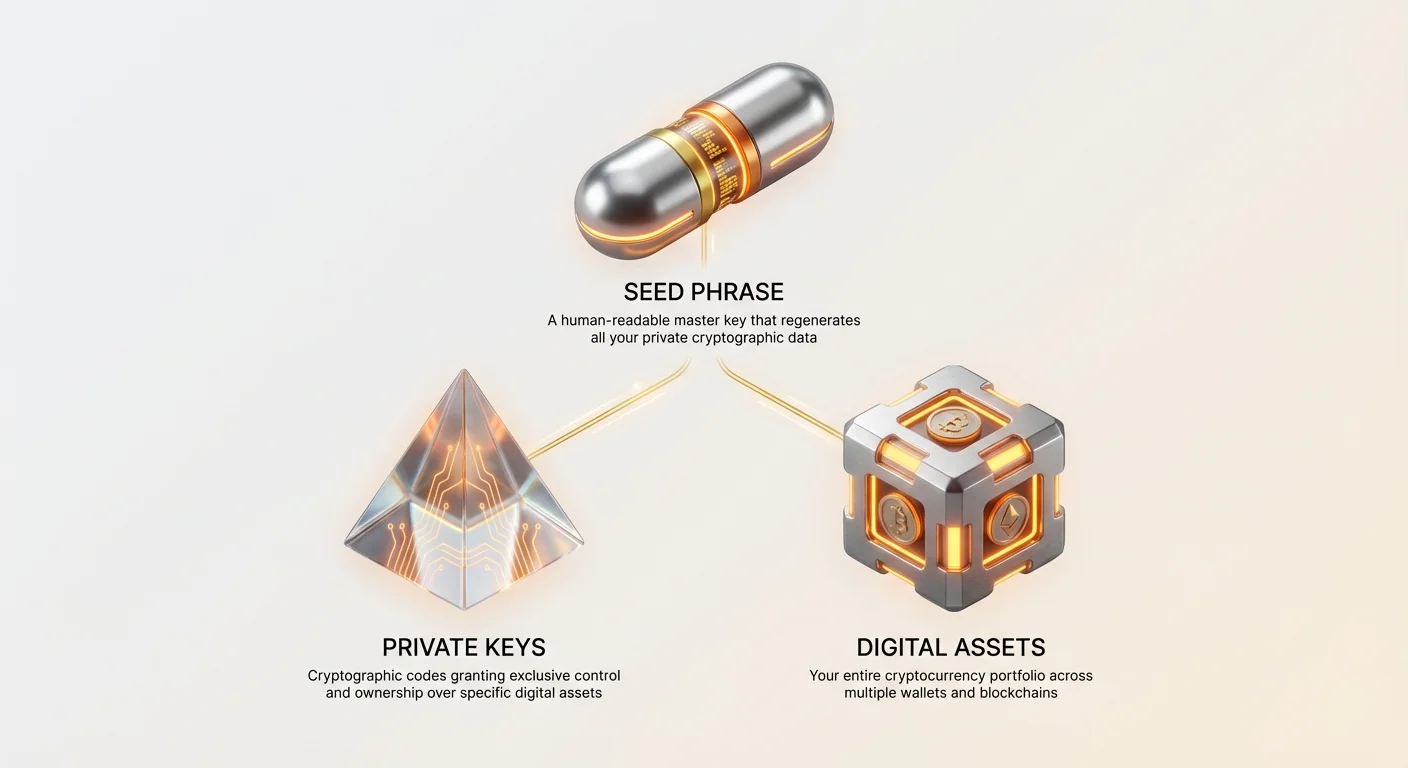
This phrase is, without exaggeration, the single most critical component of your digital wealth. It is the master key that regenerates all your private keys, granting universal access to your entire crypto portfolio, regardless of how many different wallets or blockchains you use. Losing it means losing your assets forever; having it stolen means instant, irreversible theft.
For those new to crypto, understanding and mastering seed phrase security is paramount. This deep dive moves beyond the simple advice of "don't lose it." We will explore the technical structure that makes these words so powerful (BIP39), examine advanced recovery systems designed to eliminate single points of failure (Shamir Secret Sharing), and provide practical strategies for physically protecting your master key against fire, water, deterioration, and human error.
Understanding the Crypto Master Key: What is a Seed Phrase?
A seed phrase is the human-readable backup mechanism for your crypto wallet. When you set up a non-custodial wallet (a wallet where only you control the private keys), the software generates a massive, random number (entropy). Instead of asking you to write down this complex string of numbers and letters, the software translates it into a standard list of words drawn from a predefined lexicon of 2,048 words. This process is defined by the industry standard known as BIP39.
The security of your seed phrase relies entirely on the mathematical improbability of anyone guessing the correct sequence. A 24-word seed phrase has approximately possible combinations, a number vastly larger than the number of atoms in the observable universe. This mathematical certainty is what makes self-custody possible—but only if the phrase itself remains perfectly secret and securely preserved.
Seed Phrases vs. Passwords: The Power Differential
It is essential to understand that a seed phrase is fundamentally different from a traditional password.
| Feature | Password/PIN (Exchange Login) | Seed Phrase (Self-Custody) |
|---|---|---|
| Function | Grants access to a centralized account. | Generates the cryptographic keys that are the ownership record. |
| Reset Capability | Can typically be reset via email or two-factor authentication (2FA). | Cannot be reset. It is the ultimate source of truth. |
| Scope | Controls one specific account or login. | Controls all assets across multiple chains generated by that wallet. |
| Vulnerability | Phishing, server hacks, account lockouts. | Physical theft, unauthorized viewing, deterioration, total loss. |
If you forget the password to a crypto exchange, you can usually verify your identity and regain access. If you lose your seed phrase for a self-custody wallet, no one—not the wallet developer, not a customer service agent, not the government—can help you recover your funds. The phrase is the key, and if the key is lost, the assets are permanently locked away.
The Danger of Loss: The Ultimate Single Point of Failure
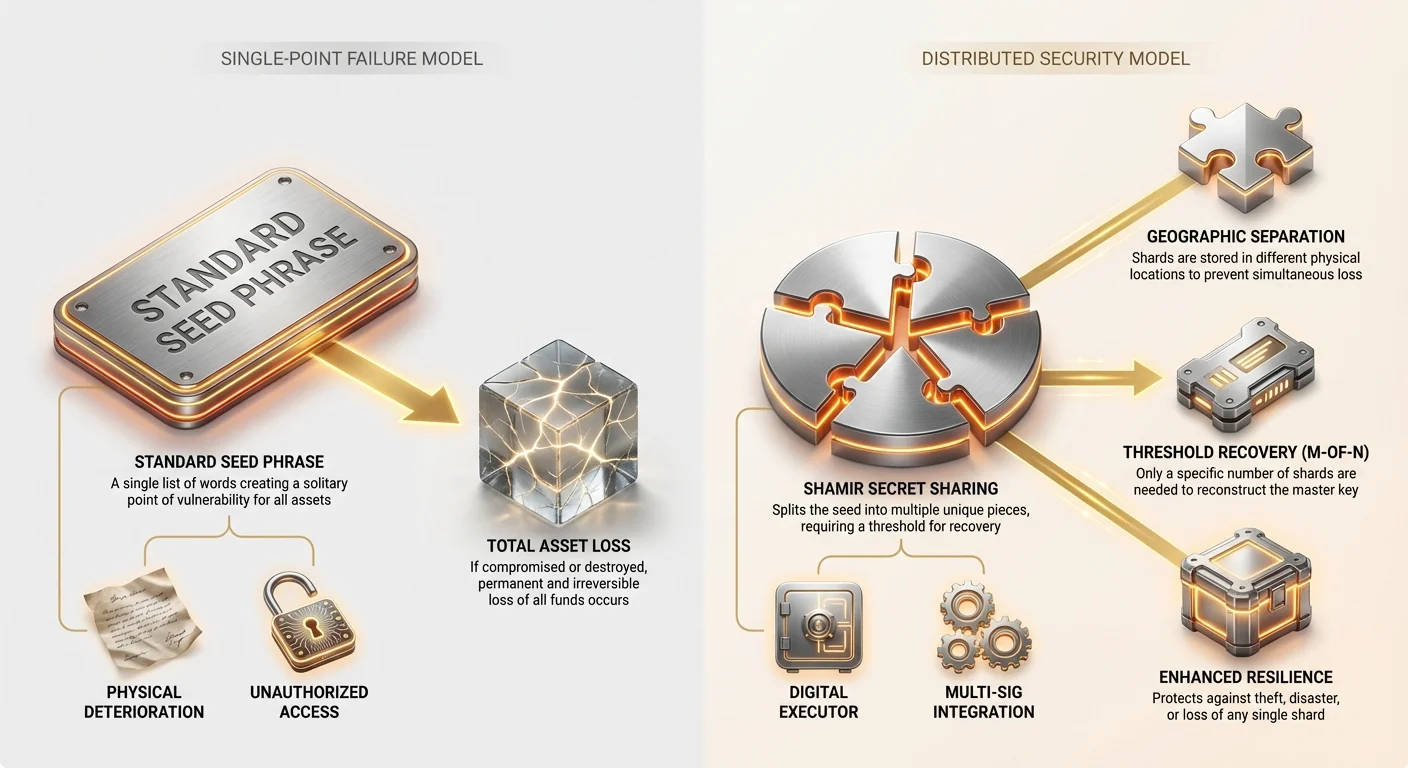
The seed phrase represents a single point of failure (SPOF) in your security architecture. If an attacker gains access to your phrase, they instantly gain full, silent control over your assets. They do not need your hardware wallet, your phone, or any secondary security measure. They simply input the phrase into their own wallet, sweep the funds, and the transaction is irreversible.
This is why traditional backup methods—taking a photo, storing it in a cloud drive, or keeping it in a password manager—are highly discouraged. These methods introduce digital vulnerabilities (malware, keyloggers) to what should be an entirely offline, physically secured asset.
The Technical Blueprint: Deconstructing BIP39
BIP39 (Bitcoin Improvement Proposal 39) is the standardized specification that defines how a mnemonic seed phrase is generated and used to derive the necessary cryptographic keys. Understanding the underlying technology provides a framework for secure management.
How 12 or 24 Words Become Your Keys
The process is deterministic, meaning that the same initial random input will always produce the same set of keys.
- Entropy Generation: The wallet software first generates a highly secure random number (the entropy). For a 24-word phrase, this entropy is 256 bits long.
- Checksum: A few extra bits (a checksum) are appended to the entropy to ensure the phrase hasn't been corrupted or mistyped.
- Mnemonic Translation: This combined number is broken into segments, and each segment corresponds to a word in the 2,048-word BIP39 dictionary.
- Master Seed: The 12 or 24-word phrase is run through a key stretching function (PBKDF2) along with an optional secondary password (the 25th word, discussed below) to produce the Master Seed. This Master Seed is what the wallet uses to generate every single private key for every address and asset you hold within the wallet.
This standardized process allows you to recover your funds using any modern, BIP39-compatible hardware or software wallet, even if the original company or device no longer exists.
The Critical 25th Word: The BIP39 Passphrase
The BIP39 standard includes an optional, highly powerful security feature known as the "passphrase" or the "25th word." This is a user-defined string of text—it can be anything (a word, a sentence, numbers, symbols)—that is added to the 12 or 24 words before the Master Seed is generated.
How the 25th Word Functions:
The passphrase acts as a multiplier, creating a completely new Master Seed. If you use the 24 words without the passphrase, Wallet A opens. If you use the 24 words plus the passphrase "MySecretPassword," Wallet B opens. Wallet A and Wallet B are mathematically distinct, storing completely separate assets.
Security Benefits:
- Denial: If an attacker finds your 24-word seed phrase, they might input it into a wallet and find zero funds (because the actual funds are secured behind the 25th word). You can genuinely deny having any crypto, even if your physical seed phrase is compromised.
- Plausible Deniability/Honeypots: Some advanced users intentionally keep a small, decoy amount of funds secured by the 24 words alone (Wallet A). The majority of their holdings are hidden behind the 25th word (Wallet B). If coerced, they can surrender Wallet A, protecting the majority of their wealth.
- Superior Protection: Since the 25th word is never written down alongside the 24 words, it introduces a necessary separation of knowledge. An attacker must compromise both the physical location of the 24 words and the mental/digital storage of the 25th word.
Best Practices for Passphrase Usage
Because the 25th word is not derived from the BIP39 dictionary, it has no recovery mechanism if forgotten. If you forget your passphrase, any funds secured by it are lost forever, even if you still have your 24-word phrase.
Actionable Tips:
- Do Not Write it With the Seed: Never store the 25th word on the same piece of paper or metal as the 24 words. This defeats its entire purpose.
- Memorization is Ideal: If the passphrase is short and complex enough, memorizing it provides the highest level of security, as it never exists in a physical or digital format accessible to others.
- Consider Encrypted Digital Storage: If you cannot memorize it, store it in a high-security, encrypted password manager (like a dedicated vault entry separate from your 24 words) or encrypted container, completely isolated from your seed phrase storage location.
- Treat it as a PIN: Keep it shorter and easier to type than a standard password, as you will use it frequently when restoring your wallet on a hardware device.
Moving Beyond Single-Point Failure: Shamir Secret Sharing (SSS)
Even with the enhanced security of a BIP39 passphrase, the 24-word phrase remains a single physical asset—vulnerable to a house fire, flood, or a single act of theft. For high-value portfolios, institutional holdings, or families needing a robust recovery plan, the concept of distributing the seed phrase is vital.
Shamir Secret Sharing (SSS) is a cryptographic technique that addresses this single point of failure by mathematically splitting the seed phrase into several unique pieces (shards).
What SSS is and How it Works (The ‘M of N’ Concept)
Named after cryptographer Adi Shamir, SSS allows a secret (in this case, the seed phrase) to be divided into a specified number of pieces, $N$, such that only a minimum number of those pieces, $M$, are required to reconstruct the original secret.
This is known as the "M-of-N" threshold scheme.
Example Scenario: 3-of-5 Scheme
- You create 5 unique shards ($N=5$).
- You set the recovery threshold at 3 ($M=3$).
- You distribute the 5 shards to 5 different trusted parties (family members, attorneys, safe deposit boxes).
If 2 shards are stolen or destroyed, the remaining 3 shards are still sufficient to recover the wallet. Crucially, the 2 stolen shards, or even 2 lost shards, are mathematically useless on their own; they reveal nothing about the original seed phrase. This removes the risk associated with any single shard being compromised.
Real-World Application and Setup
While SSS is a technical concept, modern hardware wallets (such as those from Ledger, Trezor, or Keystone) have integrated SSS protocols, often calling them "Social Recovery" or "Advanced Backup."
When setting up SSS in a hardware wallet, the user:
- Chooses the total number of shards ($N$).
- Chooses the recovery threshold ($M$).
- The wallet then performs the cryptographic division and displays $N$ unique recovery sheets, rather than a single 24-word phrase.
These recovery sheets often contain 20 words (instead of 24), which must be combined according to the threshold rules to reconstruct the Master Seed.
Trade-offs of Shamir Sharing
While SSS significantly enhances security and resilience, it introduces complexity that beginners must carefully manage.
| Pro (Benefits) | Con (Drawbacks) |
|---|---|
| Resilience: Protects against the loss or destruction of multiple physical copies. | Setup Complexity: Requires meticulous documentation of which shard is where and which parties hold them. |
| Tamper Resistance: A thief needs to compromise multiple, separate locations to succeed. | Recovery Complexity: If you need to recover, you must coordinate the retrieval of $M$ different physical shards. |
| Inheritance Utility: Allows for recovery by beneficiaries without requiring any one person to hold the entire key. | Increased Cost: Requires multiple physical storage solutions (e.g., metal plates) for all $N$ shards. |
| No Intermediary: Uses pure cryptography; no third-party needs to know the original secret. | Potential Fragmentation Risk: If $N-M+1$ shards are destroyed (e.g., 3 of 5, if 3 are destroyed, recovery is impossible), the funds are lost. |
For most retail investors, the combination of a well-secured 24-word BIP39 phrase plus a strong, separate 25th word is sufficient. SSS is generally recommended for those managing assets in the high six to seven figures or for institutional custody.
Physical Security: Protecting Your Recovery Phrase from the Elements
The primary vulnerability of a written seed phrase is its physical form. Paper deteriorates, ink fades, and ordinary home safes offer little protection against intense fire. Since your recovery phrase will likely outlive you, it must be stored using materials designed for longevity.
Why Paper is Not Enough
While inexpensive, paper is the weakest storage medium against the most common hazards:
- Fire: Standard paper burns easily, and even fire-rated safes rarely protect paper from intense heat (which can reach 1200°F in house fires).
- Water/Flood: Paper dissolves, and ink runs quickly.
- Time and Deterioration: Paper can become brittle, attacked by pests, or degraded by acidic ink over decades.
- Accidental Disposal: Simple clutter or mistaken cleanup can lead to permanent loss.
The Case for Metal Seed Phrase Storage
Metal storage solutions are non-negotiable for serious self-custody. They are designed to withstand temperatures far exceeding those found in typical structure fires, as well as water, pressure, and corrosion.
Key Features of Secure Metal Solutions:
- Material: The best materials are marine-grade stainless steel (304 or 316) or titanium. These metals have high melting points (2500°F+) and excellent corrosion resistance.
- Engraving/Stamping: Avoid using markers or adhesive labels. The phrase must be physically etched, stamped, or engraved into the metal. Many products use a tile-and-slot system where you physically stamp or slide letter tiles into a corrosion-resistant container.
- Construction: Choose robust, thick plates or rods. Systems that encapsulate the phrase completely offer better protection against abrasion and physical damage than simple exposed plates.
| Metal Type | Melting Point | Corrosion Resistance | Cost |
|---|---|---|---|
| Stainless Steel | ~2500°F (1370°C) | Excellent | Moderate |
| Titanium | ~3000°F (1650°C) | Superior | High |
| Aluminum | ~1200°F (660°C) | Fair (Too low for fire safety) | Low |
Actionable Tip: If you use a stamping system, practice stamping on scrap metal first to ensure the words are legible and deeply indented. Use the first four letters of each BIP39 word; these are unique enough for identification within the 2,048-word list.
Distribution Strategies: The Geographic Separation Principle
Even a perfectly stamped metal plate is still a single point of failure if stored in one location (e.g., your home safe). The Geographic Separation Principle mandates that backups be stored in locations separated by significant physical distance, minimizing the risk of a single catastrophic event (fire, localized flood, major earthquake) destroying all copies simultaneously.
Recommended Strategy (for a 24-word phrase backup):
- Backup 1 (Primary): Metal plate securely locked in a high-quality, bolted-down safe at your primary residence.
- Backup 2 (Secondary): Metal plate stored in a safe deposit box at a bank far from your primary residence (ideally 50+ miles away).
- Backup 3 (Tertiary/Inheritance): A piece secured in the hands of a trusted family member or estate attorney (especially critical if using Shamir Secret Sharing).
If you are using the BIP39 Passphrase (25th word), ensure that the storage location for this passphrase is completely independent of where the 24 words are kept.
Digital and Operational Security Layering
While the physical storage of the phrase must be metal and geographically separated, operational security (OpSec) ensures that the phrase is never accidentally leaked digitally or compromised during the backup process.
Encryption and Obfuscation Techniques
For some users, complete physical separation of all components is challenging. If you must use digital means for storage (e.g., for the 25th word or for a Shamir shard), robust encryption is mandatory.
- Password Managers: High-quality, zero-knowledge password managers (like 1Password or Keeper) can securely store small parts of the seed, provided the Master Password for the manager is extremely strong and separate from all other accounts.
- Cryptographic Obfuscation: You can deliberately alter the phrase or split it and encrypt the pieces. For example, you might encrypt a text file containing words 1-12 and give the key to person A, and encrypt a separate text file containing words 13-24 and give the key to person B. This requires both parties to coordinate and successfully decrypt their parts, adding a layer of security over simple SSS shards.
- Mnemonics and Memory Aids: While risky if not managed carefully, some users rely on mnemonics or complex substitution ciphers to protect the written words. For instance, writing down the phrase in the wrong language and then storing the "key" to the translation elsewhere. Caution: This introduces a complexity risk, meaning you might forget your own system.
Operational Security (OpSec) Best Practices
Operational security focuses on the process of handling the phrase, not just the final storage location.
- Air-Gapping: The entire seed generation and writing process must happen offline (air-gapped). When setting up a hardware wallet, ensure the device is not connected to a computer, or if it is, the computer is clean of malware and offline.
- No Digital Capture: Never take a photo of the seed phrase, never type it into a computer, never email it, and never store it in a standard cloud service (Google Drive, Dropbox, etc.). This is the easiest and most common way large amounts of crypto are stolen.
- Avoid Witnesses: Generate and write down your seed phrase in a private, secure location where you cannot be overlooked by cameras (even security cameras) or untrusted people.
- Use a Secure Writing Instrument: Use a permanent, archival-quality pen on paper backups before moving to metal. Destroy all evidence (scraps of paper, temporary digital notes, packaging) immediately and securely.
The Long-Term Plan: Crypto Inheritance and Estate Planning
One of the greatest challenges of self-custody is ensuring that digital assets can be accessed by your loved ones after you pass away or become incapacitated. Because crypto requires specialized technical knowledge and direct access to the seed phrase, standard wills and executors often fail.
Why Standard Wills Fail for Crypto
A traditional will instructs an executor on how to distribute physical or traditional financial assets (bank accounts, stocks). Banks and brokerages comply by verifying the will and the death certificate.
In self-custody crypto, there is no centralized entity to contact. If the seed phrase is not found or accessible, the assets are completely inaccessible to the heirs, regardless of what the will states. Furthermore, simply leaving the seed phrase openly written in a will risks exposing the key to every person who reads the document, creating a severe security risk.
Solutions: Trusts, Executors, and Multi-Sig Structures
Inheritance planning for crypto requires bridging the gap between legal frameworks and technical requirements.
- The Information Vault: The most secure method involves creating a detailed, encrypted document (the "information vault") that contains all the technical instructions needed for recovery, including wallet names, the required $M$ of $N$ shards (if using SSS), and the location of the 25th word.
- Naming a Digital Executor: Name a trusted individual (a Digital Executor or Digital Trustee) in your estate plan. This person is legally empowered and financially compensated to manage digital assets. They do not necessarily hold the keys themselves but are tasked with following the decryption and retrieval instructions you leave behind.
- Leveraging Multi-Signature (Multi-Sig) Wallets: Multi-sig structures are excellent for inheritance. You can set up a 2-of-3 wallet where key 1 is your hardware device, key 2 is held by a trusted family member/heir, and key 3 is held by your estate attorney or an escrow service. Upon your passing, the estate attorney (key 3) can coordinate with the heir (key 2) to move the funds without the need for key 1 (your physical device), effectively bypassing the need to find your exact seed phrase location. (Note: Multi-sig wallets use their own sets of seed phrases that must also be secured.)
- Specialized Inheritance Services: Some emerging providers offer "crypto inheritance solutions" that act as secure, encrypted time-delay vaults. These services require a death certificate and specific legal documentation to trigger the release of instructions to pre-nominated beneficiaries.
Detailed Checklist for Successors
The success of a crypto inheritance plan hinges on clarity. Your beneficiaries may be non-technical, so instructions must be step-by-step.
Ensure your successors have access to the following information (through the Digital Executor):
- Inventory: A list of all crypto assets, blockchains (e.g., Ethereum, Solana), and the corresponding wallet interfaces (e.g., MetaMask, Electrum, etc.) used.
- Wallet Model: The brand and model of the hardware wallet used to generate the seed phrase.
- Seed Location(s): Precise, non-obvious locations of the metal plates or SSS shards (e.g., "The blue box behind the books on the third shelf").
- Passphrase Location: Clear instruction on where to find the 25th word, if one was used.
- Recovery Walkthrough: A simple, written guide explaining exactly how to download the appropriate software, enter the seed phrase, and transfer the assets to a secure account or exchange.
- Legal Mandate: A legally robust letter of instruction granting permission and responsibility to the executor to handle these digital assets.
Conclusion: Taking Control of Your Digital Destiny
Mastering seed phrase security is not just about protecting your money; it’s about taking true, sovereign control over your financial future. As we move further into a world of self-custody, understanding technical standards like BIP39 and proactive solutions like Shamir Secret Sharing becomes essential knowledge, not optional expertise.
Your recovery phrase is the only thing standing between you and irreversible loss. By adopting resilient physical storage (metal), utilizing the protective layering of the 25th word, and establishing a clear, coordinated recovery plan (inheritance/SSS), you transform a fragile single point of failure into a highly robust and durable asset storage system designed to last generations. The security of your digital assets rests entirely in the strength of your preparation today.