
For many entering the world of decentralized finance (DeFi), the concept of earning passive income—or "yield"—is the primary attraction. The simplest way to generate yield in the crypto space is through staking, where you lock up your assets to help secure a blockchain and, in return, receive rewards.
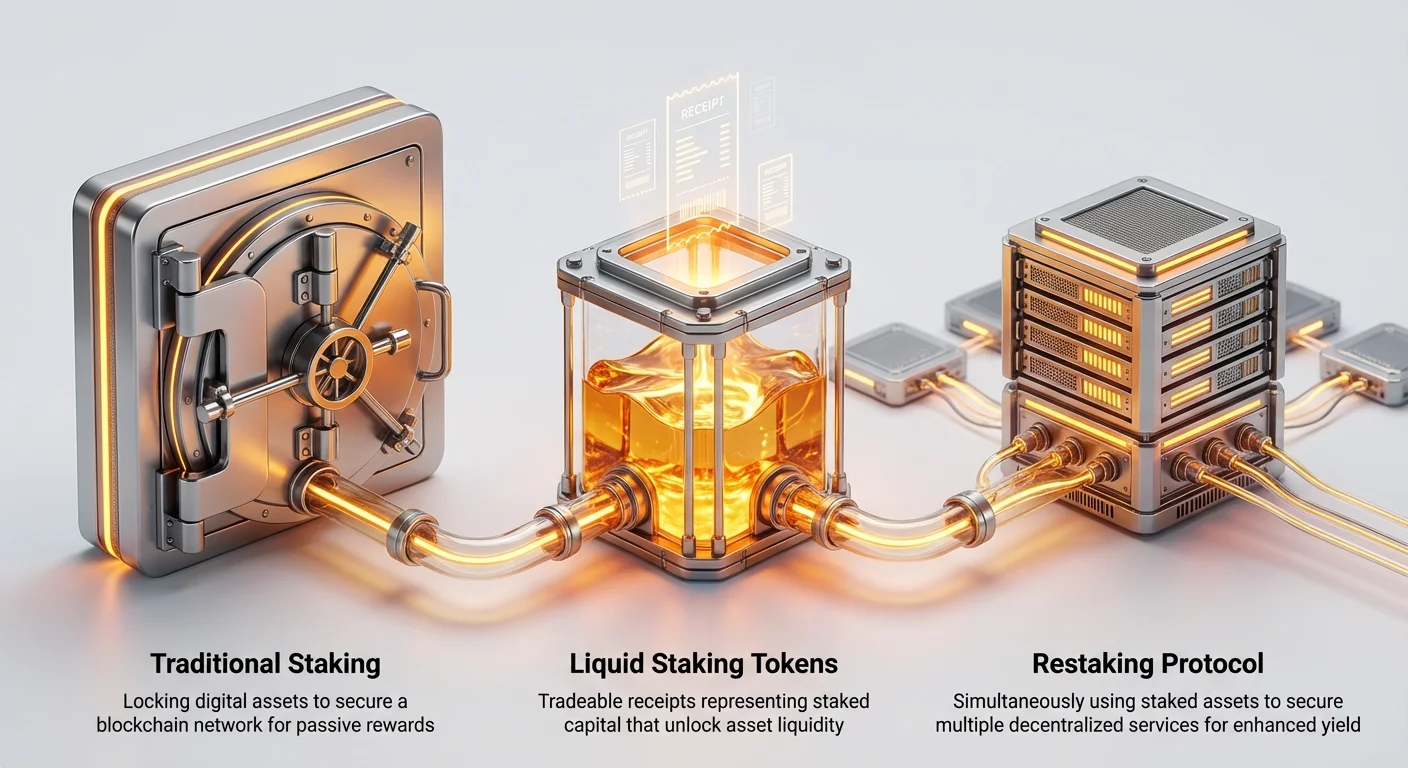
However, the world of staking has evolved rapidly, moving far beyond simply locking up tokens. Today, sophisticated strategies exist that allow users to reuse their staked capital multiple times, stacking layers of yield on top of the original investment. This strategy, which combines Liquid Staking Tokens (LSTs) and the innovation of Restaking, forms what we call "The Staking Stack."
This guide breaks down these three interconnected concepts—Staking, LSTs, and Restaking—and provides a framework for novices to understand how they work together. We will focus not just on maximizing potential returns, but more importantly, on navigating the unique and complex risks, particularly those related to validator security and the threat of slashing.
Foundation: Understanding Proof-of-Stake and Staking
Before we discuss maximizing yield, we must first understand the bedrock upon which the entire system is built: Proof-of-Stake (PoS). PoS is a consensus mechanism used by major blockchains like Ethereum, Solana, and Cardano to validate transactions and create new blocks without needing massive amounts of computing power (unlike the older Proof-of-Work system used by Bitcoin). For a detailed comparison, see our guide on Proof-of-Work vs. Proof-of-Stake.
How Staking Secures the Network
In a Proof-of-Stake system, the network relies on validators—special nodes that run the necessary software—to propose and attest to new blocks of transactions. To become a validator, an entity must "stake" a certain amount of the network’s native cryptocurrency (e.g., 32 ETH on Ethereum). This staked capital acts as a financial commitment, ensuring the validator acts honestly.
The mechanism is simple: If the validator behaves correctly (proposing blocks on time, attesting honestly), they are rewarded with new coins and transaction fees. If they attempt to cheat, collude, or simply go offline, they face a penalty known as "slashing"—the removal and destruction of some or all of their staked assets.
This economic incentive structure is why staking is so crucial: it directly funds the network’s security. When you stake your tokens, you are essentially lending your capital to help power this security mechanism, and the yield you earn is your reward for performing this essential service.
The Trade-Off: Locked Capital and Illiquidity
While basic staking is an excellent way to earn passive income, it comes with a significant drawback: illiquidity.
When you commit capital to a validator, that capital is locked up and cannot be accessed for other purposes. This locking period can sometimes last days, weeks, or even longer, depending on the network's withdrawal mechanisms. This creates an opportunity cost: the staked assets cannot be used in other DeFi protocols for trading, lending, or borrowing.
For a long time, users were forced to choose: either secure the network and earn staking rewards or keep their capital liquid for use elsewhere. Liquid Staking Tokens (LSTs) were invented specifically to eliminate this difficult choice.
Layer One: Liquid Staking Tokens (LSTs): Unlocking Liquidity
Liquid Staking Tokens (LSTs) are the first essential component of The Staking Stack. They allow users to participate in staking while simultaneously retaining access to the value of their locked assets. LSTs are foundational because they transform an illiquid asset into a fungible, tradeable token that can be deployed across the wider DeFi ecosystem.
LSTs Explained: A Receipt for Staked Assets
Imagine dropping off your coat at a busy theater. The attendant gives you a numbered claim ticket. You cannot wear the coat while it’s checked, but the claim ticket proves you own it and lets you retrieve it later.
An LST works similarly. When you deposit (stake) your cryptocurrency (e.g., ETH) into a Liquid Staking Protocol (LSP), the protocol handles the underlying staking process (managing validators, securing the network). In return, you are issued an LST (e.g., stETH, rETH, cbETH).
Key Characteristics of LSTs:
- Value Accumulation: The LST’s value is pegged to the original staked asset (1 LST ≈ 1 Original Asset). Crucially, the LST continuously accrues the staking rewards earned by the underlying protocol, meaning the LST token appreciates over time or is constantly rebased to reflect the earned yield.
- Liquidity: The LST itself is a separate ERC-20 token (on Ethereum). It can be traded on exchanges, used as collateral for loans, or deployed in liquidity pools—all while the original assets continue to earn staking rewards in the background.
The Dual Benefit of LSTs: Earning Staking Yield + Free Capital
The power of the LST lies in its ability to generate income in two simultaneous ways:
- Base Staking Yield: Automatically accrued by the underlying staked capital, rewarding you for securing the main network.
- DeFi Yield: Generated by deploying the LST (the receipt) into other protocols—lending it out to earn interest, providing liquidity to a decentralized exchange (DEX), or, as we will discuss, participating in restaking.
This layering of yield is the first step in building a sophisticated staking strategy. You move from a single revenue stream (staking) to a potential minimum of two revenue streams (staking + DeFi participation).
Risks Associated with LSTs
While LSTs unlock massive potential, they introduce new layers of risk that traditional staking does not carry:
1. Smart Contract Risk
LSPs operate via complex smart contracts. If there is a bug, exploit, or vulnerability in the protocol's code, the staked funds could be compromised or permanently lost. This risk is inherent in nearly all DeFi protocols but is especially critical when dealing with billions of dollars worth of staked assets.
2. Depeg Risk
An LST is ideally pegged 1:1 to the value of the underlying asset. However, severe market conditions, massive withdrawals, or liquidity crunches can cause the LST to temporarily "depeg," meaning its market price falls below the value of the asset it represents. While usually temporary, selling during a depeg locks in a loss. This phenomenon is closely related to the concepts discussed in Managing Cross-Chain Liquidity and De-Pegging Risk.
3. Slashing Risk from the Protocol
Although you are not running a validator yourself, the LST protocol is. If the validators managed by the LSP suffer a slashing event, the value of the LST token is directly reduced to cover that loss. When evaluating an LST, one must evaluate the security record and operational standards of the LSP itself.
Layer Two: Restaking: The Engine of Enhanced Yield
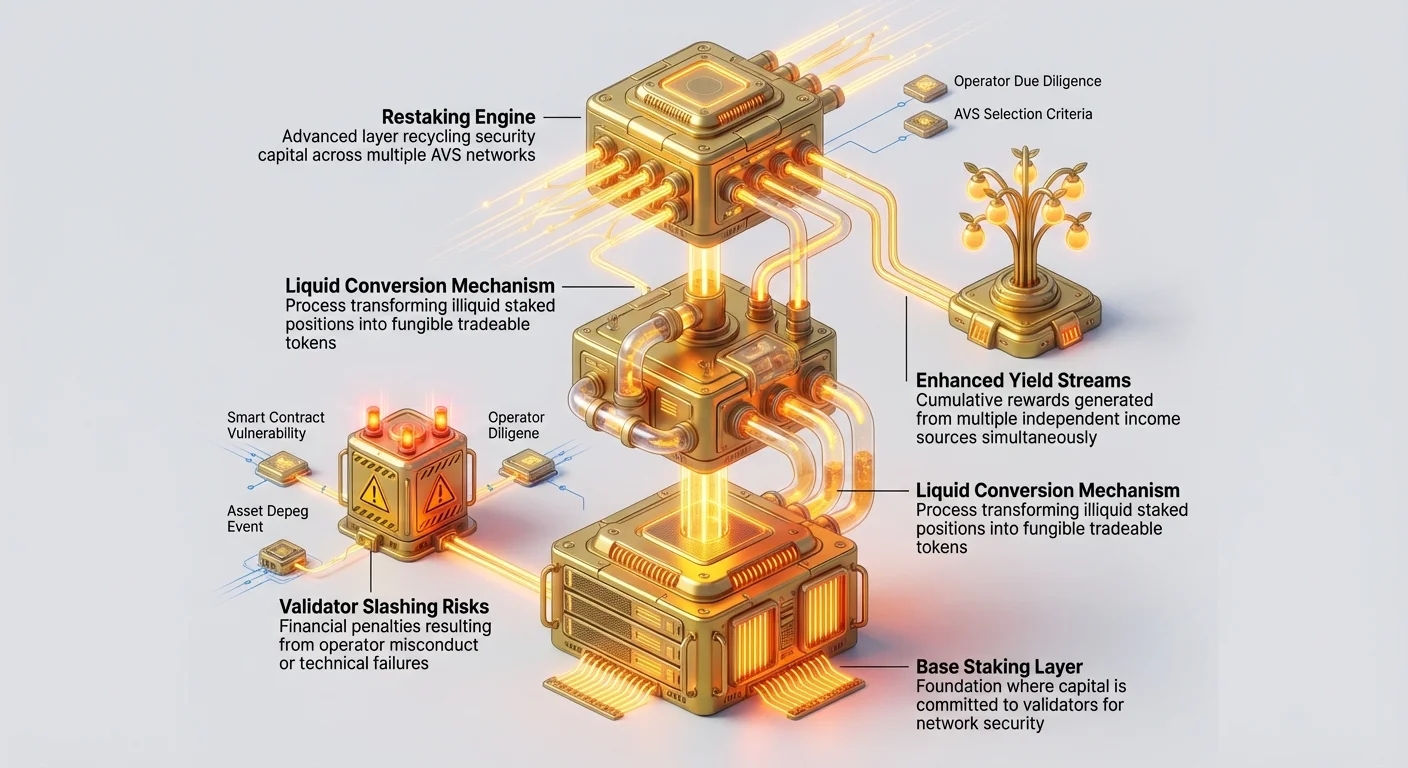
Once capital has been made liquid through an LST, it can enter the most advanced and highest-yielding layer of the stack: Restaking. Restaking is a cutting-edge concept designed to enhance by maximizing staked assets across multiple protocols.
What is Restaking?
If staking is using your cryptocurrency to secure Network A (e.g., Ethereum), Restaking is the process of using that same staked cryptocurrency (or its LST representation) to simultaneously secure Network B, Network C, or additional decentralized services, known as Actively Validated Services (AVSs).
Instead of securing only one blockchain, Restaking allows stakers to "opt-in" to validate other decentralized services that require cryptoeconomic security.
The Basic Flow:
- A user stakes ETH (or deposits ETH and receives an LST).
- The user takes that LST (or the staked position) and deposits it into a Restaking Protocol.
- The Restaking Protocol directs that capital to provide security/collateral for AVSs (e.g., decentralized oracles, bridging services, data availability layers).
- The user earns three rewards: Base Staking Yield, plus the new fees/rewards paid by Network B and Network C for the security they received.
The Concept of Cryptoeconomic Security
To grasp Restaking, it helps to understand what the AVSs are buying. They are buying trust and deterrence.
Every decentralized service needs assurance that its validators (or operators) are honest. In a Restaking environment, the stakers provide a "Security Deposit" in the form of their underlying staked assets.
- If the AVS operator acts honestly, they are rewarded.
- If the AVS operator misbehaves (e.g., provides false oracle data, censors transactions), the Restaking protocol can trigger a slashing event against the deposited assets, penalizing the dishonest operator.
In essence, Restaking allows a validator to monetize the trust they have already built with the original chain by offering that trust (and the financial penalty associated with losing it) to other networks.
The Double-Edged Sword: Maximizing Rewards and Slashing Risk
Restaking introduces significantly higher rewards because it generates income from multiple sources simultaneously. However, this increased yield comes with a dramatically increased risk profile, often referred to as "double slashing."
In traditional staking, you can only be slashed by the main network (e.g., Ethereum) for a major offense. In Restaking, you open yourself up to potential slashing penalties from every single AVS you opt into.
If a staker’s delegated assets are used by a malicious or incompetent AVS operator, the staker faces:
- Risk to Base Staking: The potential loss of the collateral securing the AVS.
- Risk of Lost Future Yield: The loss of the penalized capital reduces the base staking yield moving forward.
Therefore, Restaking is not just a yield play; it is an active risk management decision where stakers must meticulously vet the AVSs and the operators they delegate to.
Building the Stack: A Strategic Yield Combination
The goal of The Staking Stack is not just to use all these tools, but to combine them safely and strategically to maximize yield while fully understanding the compounding risks.
Step-by-Step Stacking Strategy
For a retail investor, building the Staking Stack generally follows a three-step path:
Step 1: Establish the Base (Staking & LST Conversion)
- Action: Take your base asset (e.g., ETH) and deposit it into a reputable Liquid Staking Protocol (LSP).
- Outcome: You receive an LST (e.g., stETH).
- Yield Earned: Base Staking Yield (Layer 1).
- Risk Introduced: Smart Contract Risk of the LSP, Depeg Risk.
Step 2: Delegate to Restaking
- Action: Take the LST received in Step 1 and deposit it into a Restaking Protocol.
- Outcome: Your LST is now backing the security of multiple AVSs, often through a delegated operator.
- Yield Earned: Base Staking Yield + Restaking AVS Rewards (Layer 2).
- Risk Introduced: Slashing Risk from multiple AVSs, Operator Competence Risk.
Step 3: Optional Yield Farming (LSTfi)
- Note: This step increases complexity and risk significantly.
- Action: Instead of delegating the LST immediately, you might first use the LST in a lending market as collateral to borrow a stablecoin, or deposit it in an LST-specific DeFi protocol (LSTfi) to earn trading fees or lending interest.
- Outcome: Multiple streams of yield on the LST before (or concurrent with) restaking.
- Yield Earned: Staking Yield + DeFi Lending/LP Yield (Layer 3).
- Risk Introduced: Liquidation Risk (if borrowing), Impermanent Loss (if LPing), Layered Smart Contract Risk.
Understanding Yield Layering
When employing the Staking Stack, it’s crucial to track where the returns are coming from. The overall yield (often expressed as Annual Percentage Yield, or APY) is the sum of various independent income streams:
| Layer | Source of Income | Risk Profile | Example (ETH Context) |
|---|---|---|---|
| Layer 1: Base Staking | Protocol rewards for block validation and network security. | Low-to-Moderate (Slashing, Protocol Risk) | 3-5% APY from validating Ethereum. |
| Layer 2: Restaking (AVSs) | Fees paid by external services for cryptoeconomic security. | High (Multiple Slashing vectors, Operator Risk) | 5-15% APY from securing a data oracle service. |
| Layer 3: LSTfi/DeFi | Lending interest, trading fees, or governance tokens from deploying the LST. | Variable (Liquidation, Smart Contract Risk) | 1-3% APY from providing stETH to a lending pool. |
| Layer 4: Incentives | Temporary token emissions, sometimes paid out in the Restaking protocol's native token. | Highest (Temporary, highly volatile) | Short-term governance token distributions. |
A successful strategy involves mapping these sources and ensuring that the rewards gained from Layers 2, 3, and 4 sufficiently compensate for the exponential increase in risk.
Calculating the Real APY
When protocols advertise returns, they often show the maximum theoretical yield (sometimes including temporary token incentives). For the Staking Stack, the complexity demands that you calculate the risk-adjusted or real APY.
Real APY = (Total Expected Yield) – (Estimated Risk Costs)
Risk Costs are not fees paid upfront; they represent the potential financial penalties (slashing potential) and exposure to market events (depeg risk).
- If the additional 10% APY from Restaking exposes your capital to a 5% historical annual slashing risk, your net gain from that layer is only 5%.
- If the protocol charges a 10% fee on rewards, that must also be deducted from the total.
A novice should always prioritize protocols that are older, have been extensively audited, and have transparent risk committees, even if they offer a slightly lower yield than a brand-new, unproven competitor. Low yield with high certainty beats high yield with high risk of capital loss.
Validator Security and Risk Management in the Stacking Stack
The core security component of the Staking Stack is the underlying validator network. As you layer yield, you are simultaneously compounding the risks associated with validator failure. Managing these risks, particularly slashing, is paramount.
The Slashing Mechanism and Its Impact
Slashing is the ultimate penalty in a Proof-of-Stake system. It serves two crucial purposes: punishment for malicious behavior and deterrence against future attacks.
Slashing is primarily triggered by three types of offenses:
- Double Signing: Proposing two different blocks for the same slot. This is often the most severe and highly penalized offense, indicating a clear attempt to mislead the network.
- Surround Voting: Attesting to two conflicting block proposals simultaneously.
- Inactivity (Less Severe Slashing): Going offline for an extended period, preventing the validator from performing its duties.
When you use an LST, the risk is managed by the LSP. When you Restake, the risk is expanded. You are now exposed to slashing rules defined not only by the primary chain but also by the specific slashing conditions set by the AVSs you opt into. A mild offense on the primary chain might result in a small penalty, but that same mistake might trigger a severe, financially punitive slashing event from a sensitive AVS.
Choosing a Restaking Operator Safely
For most retail users, directly running a validator and opting into Restaking AVSs is impractical due to the high capital requirements and technical complexity. Instead, they delegate their LSTs to professional Restaking Operators.
Choosing the right operator is the single most important decision in managing the Staking Stack's security risks. You are trusting them not only with your yield generation but with the safety of your principal. This requires a rigorous Identifying and Mitigating Smart Contract Risks within the delegated AVSs.
Due Diligence Checklist for Operators:
- Track Record and Reputation: How long has the operator been active? Do they have a perfect security record (zero past slashing events)? Look for transparent reporting on their validator performance.
- Insurance and Indemnity: Does the operator offer any internal insurance or guarantee to cover minor slashing events caused by their operational error? (Note: This is not always a guarantee against major, systemic risks).
- Fee Structure: What percentage of the rewards do they take, and is this fee competitive? High fees erode yield, but extremely low fees might signal insufficient investment in infrastructure redundancy.
- Decentralization Commitment: Does the operator use geographical distribution and diversified cloud providers to minimize the risk of a single point of failure (SPOF)? A highly centralized setup increases the risk of simultaneous failure and mass slashing.
- AVS Selection Transparency: If the Restaking protocol allows the operator to choose which AVSs to secure, is the operator transparent about their risk assessment for those AVSs? They should clearly define why they chose a particular service and what its associated slashing conditions are.
Mitigation Tactics for Slashing Risk
Even with the best operators, risk remains. A prudent beginner should utilize several mitigation tactics:
1. Capital Diversification
Do not put all your LSTs with a single Restaking Operator or dedicate them all to one type of AVS. If you have enough capital, distribute it across three or four highly reputable operators. If one suffers a mistake, the impact on your overall portfolio is limited.
2. Staking Insurance
Specialized decentralized insurance protocols (DeFi insurance) offer coverage specifically for slashing events. While these policies require premium payments (which reduce your effective APY), they provide a crucial safety net. This is often an excellent trade-off for beginners who prioritize capital preservation over maximum yield.
3. Prioritize Conservative AVS Selection
If the Restaking protocol allows you to select which AVSs to secure, begin by opting into only the most established, simplest services with the clearest and least punitive slashing conditions. Avoid new or experimental services until they have established a track record. High potential returns often correlate directly with higher experimental slashing risk.
Strategic Portfolio Placement and Long-Term View
The Staking Stack represents a powerful method for generating significant passive income, but it must fit within a broader financial strategy. It is not an alternative to diversification; it is a way to maximize returns on a portion of your existing holdings.
Fitting the Stack into Your DeFi Portfolio
When structuring a resilient DeFi passive income portfolio, the Staking Stack typically occupies the Moderate-to-High Risk, Active Income category.
- Low Risk (Base Layer): Simple holding of blue-chip assets, earning native base staking yield through non-custodial wallets.
- Moderate Risk (The Stack): Utilizing LSTs combined with highly reputable, audited Restaking operators and conservative AVS selection.
- High Risk (Leveraged Stack): Combining the stack with borrowing or looping (using the LST as collateral to borrow the base asset, then restaking the borrowed asset). This dramatically increases yield but introduces catastrophic liquidation risk alongside all the inherent smart contract and slashing risks. Beginners should strictly avoid leveraged staking strategies.
Your allocation to the Staking Stack should be calibrated to your tolerance for the loss of principal. Given the cumulative risks of LST depeg, smart contract failure, and operator slashing, the capital deployed here should be capital you are mentally prepared to lose or have significantly impaired.
The Long-Term Vision for Restaking
The Staking Stack is not a temporary yield farm; it is a reflection of the evolving architecture of decentralized security.
In the long term, Restaking aims to create a shared, economical security layer for the entire Web3 space. Every decentralized service currently reliant on its own small, independent set of validators (and therefore often less secure) could eventually purchase security assurance from a large, trusted pool of staked capital (like Ethereum's).
By participating in the Staking Stack now, users are not just generating yield; they are helping bootstrap the next generation of decentralized infrastructure. This foundational role underscores the importance of choosing competent, honest operators. An ethical and secure Staking Stack ensures the robustness and reliability of the services built on top of it, creating a self-reinforcing loop of security and utility.
Conclusion
The Staking Stack—the strategic combination of traditional staking, Liquid Staking Tokens (LSTs), and Restaking—offers a path for users to maximize their passive income potential in DeFi. By converting illiquid staked assets into flexible collateral, users can stack layers of yield by securing not just one network, but multiple decentralized services simultaneously.
However, complexity breeds risk. For every layer of yield added, a new layer of risk—be it smart contract vulnerability, asset depeg, or the critical threat of multi-vector slashing—is introduced. Success in this advanced strategy relies entirely on meticulous risk management, stringent due diligence in selecting Restaking operators, and a commitment to capital diversification.
Approach the Staking Stack with humility and caution. Start with conservative, audited protocols, prioritize capital safety over absolute maximum yield, and constantly monitor the performance and security disclosures of your chosen operators. By mastering the synergy and managing the inherent risks, you can transform your static holdings into a dynamic, multi-layered engine of decentralized income.