
Short selling is often misunderstood in the retail investment world. It is not merely a pessimistic bet that a price will drop; rather, when implemented strategically, it is a crucial tool for sophisticated traders to manage risk, capture opportunities during market downturns, and hedge against unexpected volatility. In the highly dynamic and often emotionally driven cryptocurrency market, understanding how to successfully open, manage, and exit a short position is essential for survival.
However, the crypto market presents unique dangers for short sellers. High volatility, concentrated whale activity, and the frequent use of extreme leverage mean that a short position carries the potential for unlimited loss. The concept of a "short squeeze"—where a rapid price increase forces short sellers to panic-buy—is a recurring, violent market event that can wipe out entire accounts.
This guide moves beyond the simple definition of short selling mechanics. We will dissect the strategic tools available—from margin to perpetual futures—and explore advanced tactics focused on identifying weak narratives, calculating risk exposure, and, most importantly, using short positions defensively to protect your existing portfolio.

The Mechanics of Crypto Short Selling: More Than Just Borrowing
To short sell means to enter a trade expecting the price of an asset to decline. If you expect Bitcoin (BTC) to fall from $60,000 to $50,000, you would ideally lock in a sale price of $60,000 now and buy it back later at $50,000, pocketing the $10,000 difference (minus any fees).
In traditional finance, this usually involves borrowing shares. In crypto, advanced traders use a variety of derivative instruments that are more capital-efficient and offer greater flexibility for hedging and speculation.
Margin Trading: Simple Borrowing and Leverage
Margin trading is the simplest method for shorting crypto. A trader borrows the asset they wish to short from an exchange or lending pool, using their own capital as collateral (margin).
The Process:
- Deposit Margin: You deposit $1,000 as collateral.
- Borrow: You borrow 1 BTC (valued at $60,000) from the exchange, using your $1,000 margin to cover potential losses.
- Sell: You immediately sell the borrowed 1 BTC for $60,000 cash.
- Wait: If the price drops to $50,000, you buy 1 BTC back for $50,000.
- Repay: You return the 1 BTC to the lender/exchange.
- Profit: You keep the $10,000 difference (minus interest paid for borrowing the coin).
While straightforward, margin shorting requires direct management of the borrowed asset and the accompanying interest (or funding rate). Crucially, the margin required is small relative to the total value of the asset, meaning you are utilizing leverage. A small price move against you can quickly deplete your collateral, leading to a forced closure of the position known as a liquidation.
Shorting via Futures and Perpetual Contracts
For advanced short sellers, using derivatives—especially futures and perpetual futures contracts—is the dominant derivatives strategy. This method avoids the need to physically borrow the underlying asset. Instead, you are entering into a legal agreement (a contract) to sell the asset at a predetermined price.
The Appeal of Perpetual Contracts
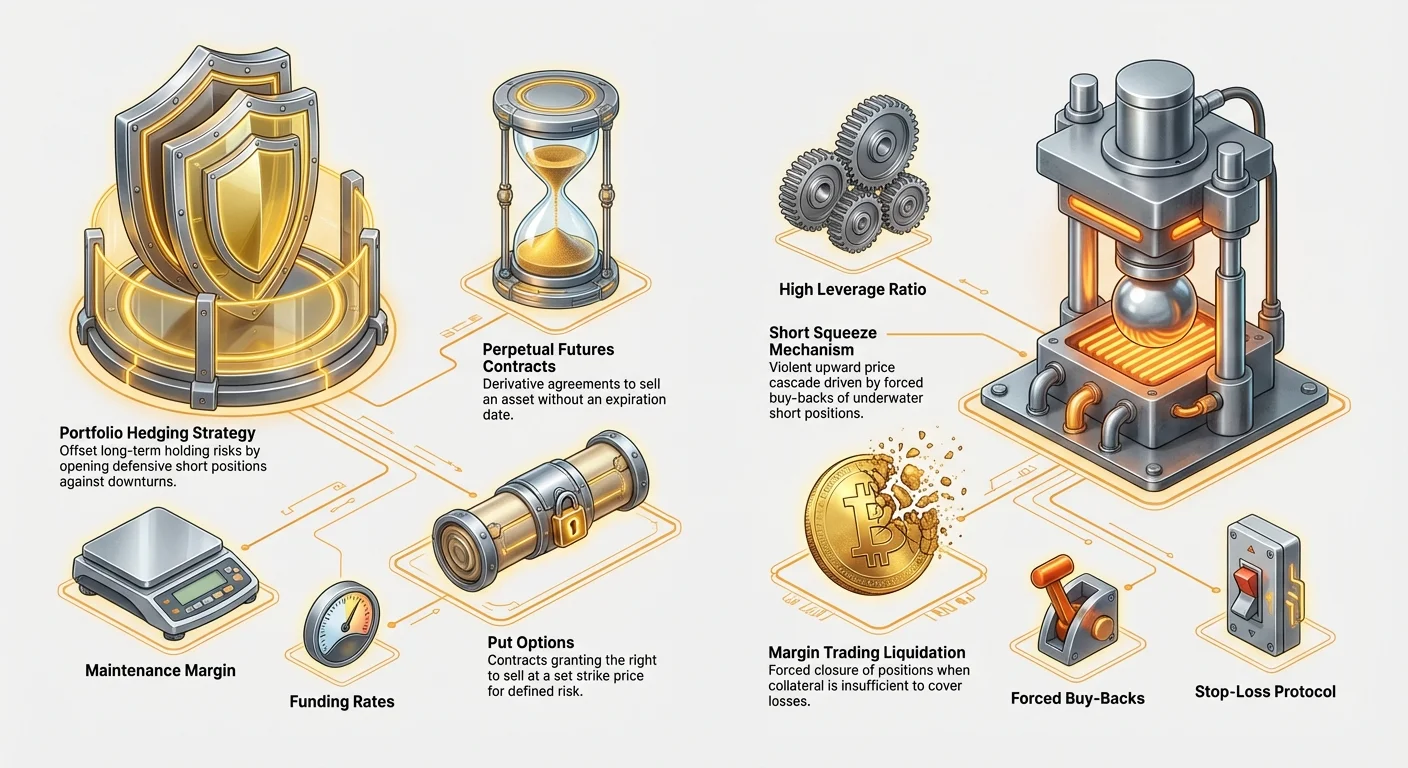
Perpetual futures are the most popular instrument for leveraged shorting in crypto. Unlike traditional futures, they do not have an expiration date. This flexibility allows traders to hold a short position indefinitely, provided they maintain sufficient margin.
When you short a perpetual contract, you are essentially opening a "sell" position. The contract settles not in the underlying cryptocurrency itself, but in the stablecoin (like USDT) or currency used as collateral.
Key Advantage: Funding Rates Perpetual contracts utilize a mechanism called the Funding Rate to keep the contract price closely tethered to the spot market price.
- If the majority of traders are long (betting on price increase), the funding rate is positive. Short sellers receive payments from long traders.
- If the majority of traders are short (betting on price decrease), the funding rate is negative. Short sellers must pay long traders.
Strategic short sellers monitor negative funding rates closely. A prolonged period of negative funding means many traders are already shorting, suggesting a potential market bottom or an "over-shorted" market ripe for a counter-trend reversal (a potential short squeeze).
Utilizing Options for Puts: Defined Risk Shorting
For traders who prioritize defined risk, shorting through options contracts provides a superior alternative. Options are contracts that give the holder the right, but not the obligation, to buy or sell an asset at a set price (the strike price) on or before a certain date.
To short sell using options, you would typically buy a Put option.
- Put Option: Gives you the right to sell the underlying asset at the strike price.
- Mechanism: If you buy a Put option with a strike price of $50,000 when BTC is at $60,000, you are betting it will fall below $50,000 before the expiration date.
- Maximum Loss: The maximum amount you can lose is the premium you paid for the Put option. If BTC rises to $100,000, the option expires worthless, but your loss is capped.
This defined-risk approach is fundamentally safer than leveraged futures or margin shorting, where theoretical losses are unlimited if the asset price continues to rise indefinitely. Advanced short sellers often combine buying Puts (hedging) with smaller, riskier futures short positions (speculation).
Identifying Overextended Narratives and Short Opportunities
The true mark of an advanced short seller is not simply finding a red candle, but identifying a fundamental or technical distortion in the market—an asset priced far beyond its intrinsic value or utility. These opportunities often materialize when a powerful narrative overtakes rational investment.
Technical Analysis: Recognizing Top Patterns
Technically focused short sellers rely on patterns that indicate market exhaustion and a likely reversal. These patterns suggest that buying pressure has peaked and momentum is shifting.
- Distribution Patterns: Look for classic topping structures like Head and Shoulders, Double Tops, or prolonged consolidation zones following parabolic moves, which align with market distribution phases. These formations show a fight between buyers and sellers where the sellers are beginning to gain control.
- Divergence in Momentum: A critical signal is a bearish divergence between price and momentum indicators (like the Relative Strength Index or RSI). If the asset price reaches a new high, but the RSI makes a lower high, it signals that the upward momentum is weakening, making the move fragile and a good short candidate.
- Failed Breakouts: An attempt to break a crucial resistance level followed by a rapid rejection (a "false breakout") often traps late buyers. This capitulation often provides excellent entry points for shorts, as the trapped buyers are quickly forced to sell.
Fundamental Overvaluation: The "Narrative Check"
In crypto, fundamental shorting often targets projects whose valuation far outpaces their technological adoption, user base, or actual revenue generation. This is the essence of identifying an "overextended narrative."
Questions for the Narrative Check:
- Utility vs. Hype: Is the project primarily driven by marketing hype or genuine, measurable utility? A project with a billion-dollar valuation and only 5,000 daily active users might be fundamentally overvalued.
- Tokenomics: Does the token distribution heavily favor insiders, venture capitalists, or the development team? Are massive token unlocks scheduled soon? A massive supply inflation event can provide a near-guaranteed downward pressure.
- Market Concentration: Has the asset achieved a price peak primarily driven by one or two influential personalities or specific promotional events? Dependence on a single narrative source makes the asset brittle when that source fades.
The goal here is to short the hype before the market collectively realizes the project is not delivering on its ambitious promises.
The Importance of Liquidity and Funding Rates
When selecting a crypto asset to short, liquidity is paramount. Low-liquidity assets are prone to massive price swings on small volume, making short positions extremely risky due to slippage and unpredictable liquidation events. Always choose assets with deep order books and active trading pairs.
Furthermore, as discussed previously, perpetually high, positive funding rates often suggest a prime short target. If long traders are paying shorts a high fee just to keep their positions open, it signals an overly optimistic market that may be nearing exhaustion. Conversely, be wary of shorting assets with highly negative funding rates, as this increases the likelihood of a punishing short squeeze.
The Anatomy of the Short Squeeze: Maximum Risk Exposure
The greatest risk for any short seller is the short squeeze. This market event happens when an asset’s price moves violently higher, forcing short sellers—who are losing money rapidly—to close their positions by buying back the asset. This forced buying creates a feedback loop, driving the price even higher and liquidating more shorts in a cascade.
What is a Short Squeeze? The Mechanism and Catalyst
A short squeeze requires two main ingredients:
- A Large Cohort of Short Sellers (High Short Interest): A significant percentage of the asset’s tradable supply must be borrowed and sold short.
- A Price Catalyst: A piece of unexpected positive news, a successful fundamental change, or simple whale accumulation that pushes the price past key resistance levels.
The Cascade Effect: When the price rises, short positions are immediately underwater. If the price hits the short sellers' liquidation point (where their collateral is exhausted), the exchange automatically closes the position by purchasing the asset on the open market. This sudden, non-discretionary market demand (forced buying) acts as heavy fuel for the rally, liquidating the next layer of short positions, and creating a violent, vertical price movement.
The market psychology during a squeeze is one of panic. Short sellers race to cover their positions before the next wave of liquidation hits, driving prices far past levels that would be justified by fundamentals alone.
Identifying Potential Squeeze Candidates
Advanced short sellers actively scan for assets that possess the structural vulnerability required for a squeeze. While "Short Interest" data is less transparent in decentralized crypto markets than in traditional stocks, traders look for proxies:
- High Open Interest (OI) in Futures: High OI, especially coupled with a high leverage ratio, indicates many contracts are open, representing potential fuel for liquidations. Look for sudden spikes in OI without corresponding dramatic price movements, suggesting the build-up of speculative positions.
- Negative Funding Rates (Extreme): While minor negative funding suggests a slight bearish bias, extremely negative funding rates signal that the market is heavily skewed to the short side. This makes the entire short position structure fragile and highly vulnerable to any upward price movement.
- Low Market Float/Supply: Tokens with a relatively small tradable supply (low float) compared to their total market cap are easier to squeeze. A whale or large institution needs less capital to absorb the circulating supply and initiate a price jump, trapping the short sellers.
Actionable Tip: Never short a community-driven asset with low float and high emotional attachment, especially if it has recently experienced a major price collapse. These assets are often targets for retail coordination, as seen in famous "meme stock" squeezes.
Navigating and Surviving a Squeeze
A squeeze is almost impossible to fight head-on. The goal is survival.
1. Mandatory Stop-Losses: This is non-negotiable. Because loss potential is unlimited on a short position, a hard stop-loss is the only guaranteed protection against catastrophic losses during a vertical squeeze. Set your stop-loss based on your maximum acceptable risk for that position, not on anticipated support levels, a critical step often calculated using Average True Range.
2. Conservative Position Sizing: Never use the maximum leverage offered by an exchange for a short position. This requires understanding concepts like Risk of Ruin. The lower your leverage, the greater your liquidation buffer, giving you more time to react during a volatile upswing. A 5x short position is exponentially safer than a 50x short position.
3. Maintaining Sufficient Collateral: Always keep your account collateral well above the minimum margin required (the maintenance margin). If a squeeze begins, having excess collateral allows you to add margin quickly (via a margin call) to prevent immediate liquidation, giving you time to evaluate the situation and potentially cover your position at a better price.
Strategic Shorting for Portfolio Hedging
While short selling for speculation is highly risky, using short positions as a defensive tool—hedging—is a fundamental part of advanced portfolio management. A hedge is a position taken to offset the risk of another asset. By shorting an asset you already own, you can lock in value without selling your underlying holdings.
Defining Hedging and Its Purpose
Imagine you hold a large portfolio of Ethereum (ETH) and various DeFi tokens. You believe in the long-term future of these assets, but you anticipate a severe economic or regulatory shock in the next three months that could cause a 30% market-wide correction.
If you simply sold all your assets, you might miss out on potential growth if the correction never materializes. Instead, you can use a short position (a hedge) to buffer the expected downside.
The Goal of Hedging: To reduce the overall portfolio volatility and preserve capital during expected downturns, allowing you to maintain your core long-term holdings (your conviction positions).
Calculating the Hedge Ratio (Basic Concept)
To hedge effectively, you cannot simply short a random amount. You must short a position size that roughly offsets your long position risk. This requires understanding the concept of a hedge ratio.
For simplicity, let’s consider hedging a BTC-heavy portfolio:
- Portfolio Value: $100,000 in BTC.
- Goal: Protect 50% of the portfolio value during a dip.
- Strategy: Open a short BTC position equivalent to $50,000.
If BTC drops by 20%:
- Long Portfolio Loss: $100,000 * 20% = $20,000 loss.
- Short Position Gain: $50,000 * 20% = $10,000 gain (ignoring leverage for now).
- Net Portfolio Loss: $20,000 (loss) - $10,000 (gain) = $10,000.
Instead of losing $20,000, you have limited the loss to $10,000. Once the market hits your target support level, you close the short position, realizing the gain, and your long positions are now better positioned to ride the rebound.
Using Beta for Altcoin Hedging: If you need to hedge an altcoin portfolio, the calculation becomes more complex due to Beta—the measure of an asset’s volatility relative to Bitcoin (or the overall market). If your altcoin has a Beta of 1.5 relative to BTC, it means it tends to move 1.5 times as much as BTC. You would need to adjust your BTC short position accordingly to account for the heightened volatility of your altcoins.
Implementing Micro-Hedges (Targeted Shorting)
In a broad bull market, not all assets move up equally, and certain sectors may be overvalued. Advanced traders use micro-hedges to reduce exposure to specific, weak-performing sectors without disrupting their overall market positioning.
Use Case: Shorting the Lagging Sector Suppose the Layer 1 (L1) sector is showing immense strength, but the Decentralized Finance (DeFi) sector is struggling with regulatory uncertainty and declining yields. Instead of exiting your profitable L1 positions, you might open targeted short positions on overvalued or exposed DeFi tokens.
This strategy allows you to maintain exposure to the overall bullish trend while simultaneously realizing profit from localized weakness. If the weakness spreads, your micro-hedges provide a buffer. If the L1 rally continues, you profit from the long side while the short loss is minimal.
Advanced Risk Management for Short Positions
Risk management is the defining feature separating a successful advanced trader from a gambler. Given the unlimited loss potential of non-options short positions, strict adherence to risk protocols is mandatory.
Understanding Margin Calls and Liquidation
For leveraged positions (margin and futures), the risk is controlled by your Maintenance Margin—the minimum amount of collateral required to keep the position open.
- Margin Call: If the price moves against your short position, your collateral will shrink. When your margin level approaches the maintenance margin, the exchange issues a margin call, requesting you deposit more funds to avoid liquidation.
- Liquidation: If you fail to meet the margin call, the exchange automatically force-closes your short position at the prevailing market price. This often happens rapidly during volatile price spikes (squeezes) and usually results in the total loss of the collateral used for that specific position.
Best Practice: Use an isolated margin account for short positions whenever possible. This segregates the risk, ensuring that a liquidation only affects the collateral dedicated to that short trade, not your entire portfolio.
Time Decay and Carry Costs
Shorting via different instruments introduces different recurring costs that erode potential profit over time.
1. Funding Rates (Perpetual Futures)
As discussed, you may be paying or receiving the funding rate every 8 hours. If you hold a short position for weeks while the market is slightly bullish (and the funding rate is positive), these small fees can significantly reduce your eventual profit, even if the price eventually drops. This is the carry cost of holding the position.
2. Options Premium Decay (Theta)
If you use Put options to short, you are subject to Time Decay (Theta). The value of an option constantly decreases as it approaches its expiration date, regardless of the underlying asset's price movement. If your anticipated price drop takes too long to materialize, your option may lose significant value due to time decay alone. Advanced traders must choose options with sufficient duration to allow the anticipated market event to unfold.
Best Practices for Position Management
- Define the Invalidation Point: Before opening a short position, define the exact price point at which your bearish thesis is proven wrong. This price should automatically be set as your stop-loss. Never move your stop-loss further away in the hope the price will reverse.
- Scale In, Not All-In: For large short positions, use a scaling strategy. Open a smaller initial position (e.g., 25% of your intended size) at the first entry point. If the price moves slightly higher, confirming the resistance, you add to the position (scale in) at a better average entry price. This strategy improves your resilience against sudden, short-term volatility.
- Take Partial Profits: Short selling success relies heavily on market panic. When the price begins to drop rapidly, take partial profits (e.g., close 30-50% of the position) at pre-determined targets. This locks in gains and reduces your exposure, allowing you to ride the remainder of the move risk-free.
- Hedge with Calls (The Advanced Counter-Hedge): For highly volatile short positions, a complex but effective maneuver is to buy a very small amount of out-of-the-money Call options. If a catastrophic short squeeze occurs, the Call options, which gain value rapidly as the price spikes, can partially offset the massive loss incurred by the leveraged short position. This acts as a disaster insurance policy.
Conclusion
Advanced short selling in the crypto market is a highly sophisticated endeavor that combines technical prowess, fundamental skepticism, and rigorous risk management. It is a critical skill for balancing a portfolio during inevitable bear markets and correcting market bubbles fueled by irrational exuberance.
While tools like perpetual futures offer unmatched capital efficiency and leverage, they simultaneously expose the trader to the existential threat of the short squeeze—a violent, liquidity-driven event that demands constant vigilance. By focusing on identifying overextended narratives, utilizing defined-risk tools like options, and rigorously implementing hard stop-losses and conservative position sizing, you can transform short selling from a speculative gamble into a disciplined, strategic advantage.
Remember: in the volatile world of digital assets, capital preservation must always take precedence over profit maximization. Use short positions defensively to hedge, and if you choose to speculate, do so with minimal leverage and maximum respect for the market’s capacity for extreme price movements.