The landscape of digital asset exchange has evolved significantly from the early days of simple peer-to-peer transfers. Today, participants in the cryptocurrency market face a myriad of choices when moving between assets. The decision to swap, trade, or utilize atomic mechanisms depends heavily on specific goals, risk tolerance, and the technical characteristics of the assets involved.
Understanding the fundamental differences between strategic swapping and active trading is essential for capital efficiency. While both actions result in the exchange of one asset for another, the underlying mechanisms, cost structures, and security models differ drastically. Traders must navigate these variables to minimize slippage, reduce fees, and maintain control over their funds.
Defining the Core Approaches
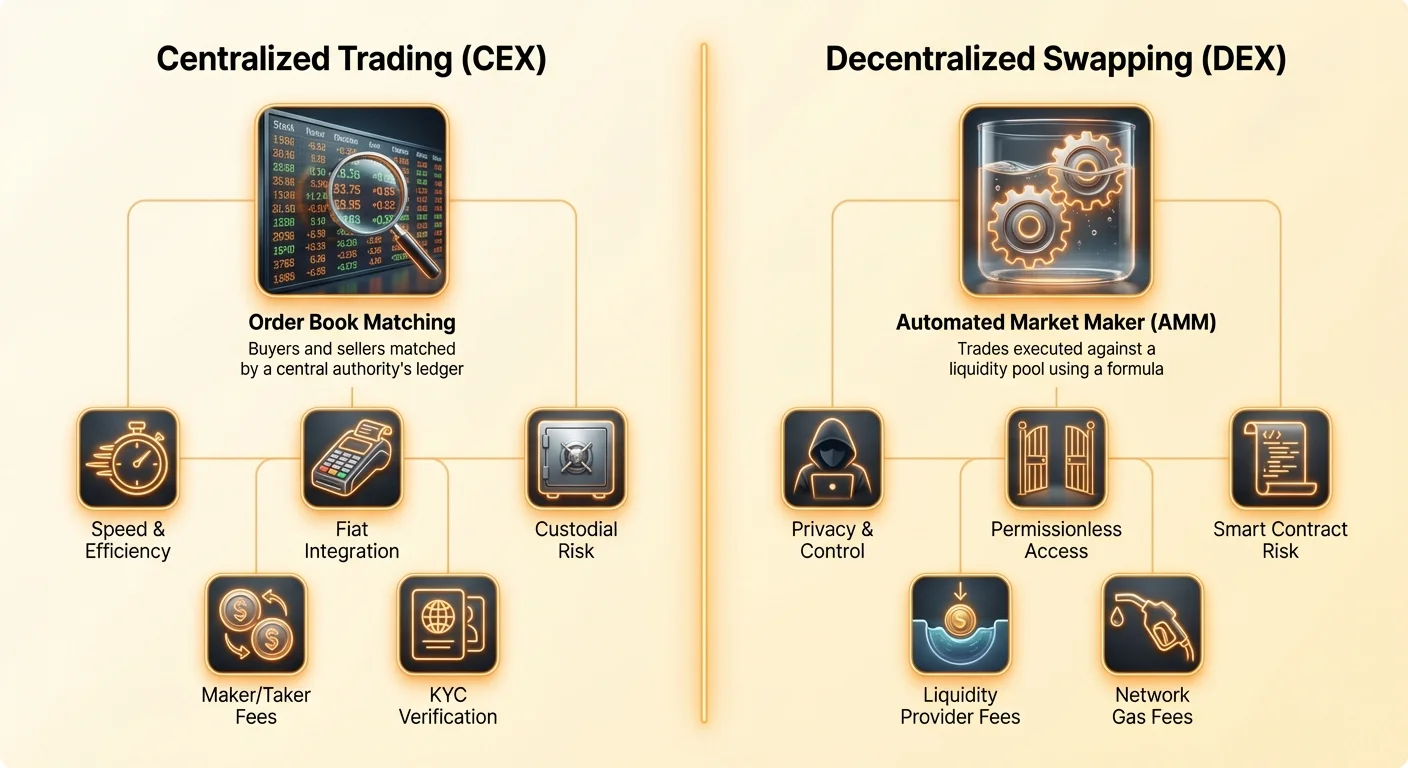
At its most basic level, a crypto exchange matches buyers with sellers. However, the method of this matching varies. In a traditional trading environment, this occurs through a central authority that maintains an order book. This ledger records all buy and sell intentions, matching them based on price and time priority. This offers precision but requires trust in the intermediary.
Swapping, particularly in the decentralized finance (DeFi) sector, often utilizes a different model known as an Automated Market Maker (AMM). Instead of matching a buyer directly with a seller, the user trades against a pool of liquidity. A mathematical formula determines the price based on the ratio of assets in the pool. This allows for continuous liquidity but can introduce pricing inefficiencies for large orders.
The Strategic Trilemma: Cost, Speed, and Privacy
Every exchange of value in the crypto ecosystem involves tradeoffs. Users must typically balance three primary factors: cost, speed, and privacy. Centralized platforms often excel at speed and cost for small-to-medium trades but usually require extensive identity verification. This sacrifices privacy for convenience.
Decentralized alternatives prioritize privacy and user control. They allow trading without identity verification, known as Know Your Customer (KYC) checks. However, these transactions occur directly on the blockchain, meaning they are subject to network congestion and gas fees. During times of high network activity, a simple swap can become prohibitively expensive compared to a centralized trade.
The Mechanics of Centralized Order Books
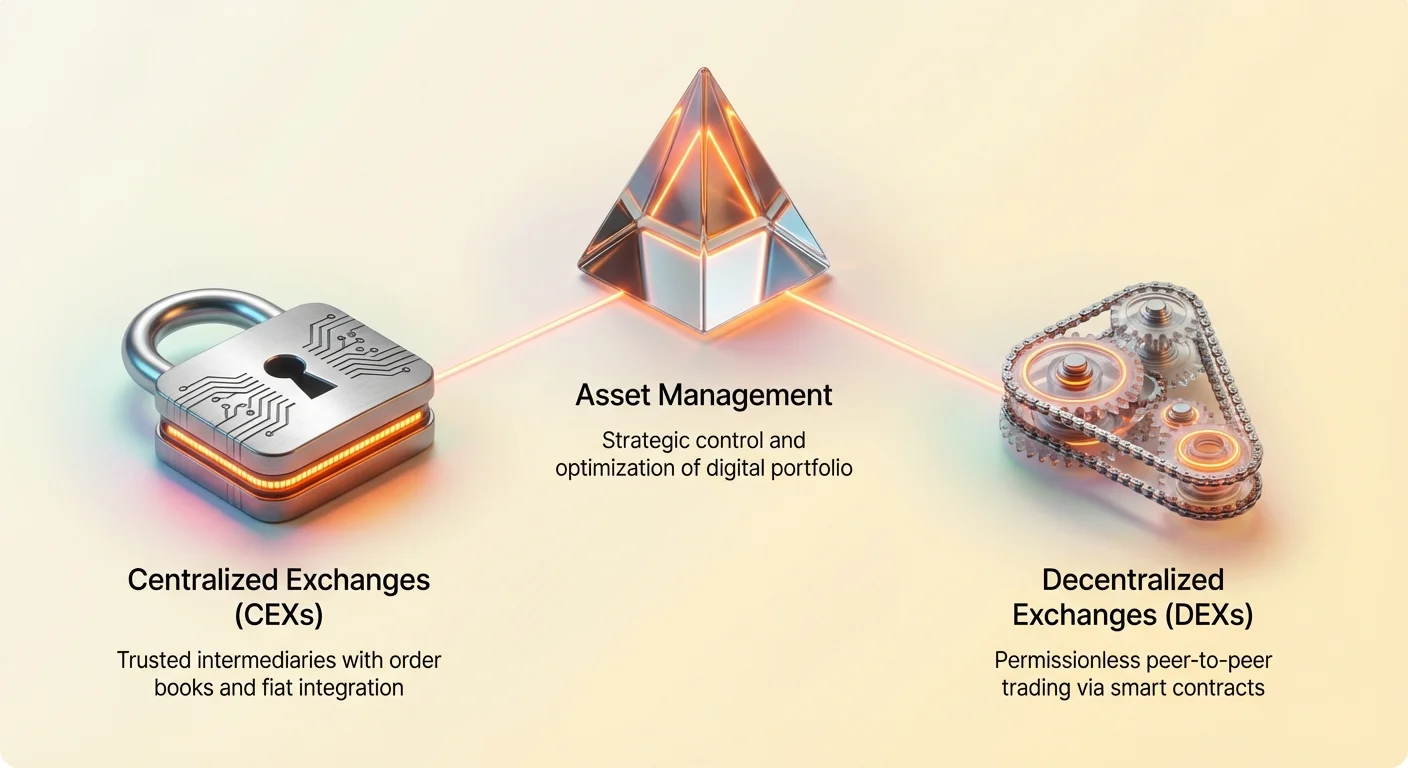
Centralized exchanges (CEXs) operate similarly to traditional stock markets. They are businesses that facilitate transactions between two parties. When a user deposits funds, they are essentially transferring custody to the exchange. The exchange then credits the user's internal account balance. This off-chain recording allows for near-instantaneous trading because the assets are not moving on the blockchain with every trade.
The primary mechanism here is the order book. Market makers place limit orders, which are requests to buy or sell at a specific price. These orders add liquidity to the book. Market takers place market orders, accepting the current available price to execute a trade immediately. This interaction creates a dynamic market depth where large volumes can often be absorbed without significant price impact.
Maker and Taker Dynamics
Understanding the roles of makers and takers is crucial for fee optimization. Exchanges typically employ a tiered fee structure to incentivize liquidity. Makers, who provide liquidity by placing orders that do not fill immediately, often pay lower fees. They are effectively stocking the shelves of the exchange.
Takers, who remove liquidity by filling existing orders, usually pay higher fees. For a trader executing a high-frequency strategy, the difference between maker and taker fees can significantly impact profitability. Strategic traders will often use limit orders to act as makers, capturing the spread and reducing their cost basis, rather than relying solely on market orders.
Custodial Risks and Benefits
The convenience of centralized trading comes with a distinct counterparty risk. The phrase "not your keys, not your coins" highlights the reality that funds held on a CEX are ultimately controlled by the exchange. If the platform becomes insolvent, gets hacked, or freezes accounts due to regulatory pressure, the user may lose access to their assets.
However, CEXs offer recourse that decentralized protocols cannot. They often have customer support teams, insurance funds, and security protocols like cold storage and multi-signature wallets. For users unfamiliar with private key management, the custody provided by a reputable CEX can essentially act as a safety net against personal error, such as losing a seed phrase.
Decentralized Exchange Protocols and AMMs
Decentralized exchanges (DEXs) represent a shift toward permissionless finance. Unlike their centralized counterparts, DEXs do not require a trusted third party to facilitate trade. Instead, they utilize smart contracts—self-executing code on a blockchain—to manage the exchange of assets. This structure ensures that users retain full custody of their funds until the exact moment the trade executes.
The dominant model for DEXs is the Automated Market Maker. In an AMM, liquidity providers deposit pairs of assets into a pool. When a trader wants to swap, they deposit one asset into the pool and withdraw the other. The price is adjusted automatically by an algorithm that maintains a constant product of the two asset reserves.
The Role of Liquidity Pools
Liquidity is the lifeblood of any exchange, but it functions uniquely in DeFi. In a CEX, market makers are often professional institutions. In a DEX, anyone can become a liquidity provider. By depositing assets into a pool, users earn a portion of the trading fees generated by the protocol. This crowdsourced liquidity model allows new assets to find a market without the need for centralized listing approvals.
However, liquidity pools are susceptible to slippage. If a trader attempts to execute a large order in a pool with low liquidity, their trade will significantly shift the ratio of assets, resulting in a worse price. Strategic swapping on a DEX requires analyzing the depth of the pool relative to the trade size to ensure efficient execution.
Privacy and Permissionless Access
One of the strongest arguments for using a DEX is privacy. Because there is no central authority, there is no requirement for identity verification. Anyone with a crypto wallet and an internet connection can interact with the contract. This is particularly vital for users in regions with limited financial infrastructure or strict capital controls.
This permissionless nature also means that new projects appear on DEXs long before they reach centralized platforms. Centralized listings require vetting, compliance checks, and often significant fees. DEXs allow for immediate market access, making them the primary venue for early-stage asset discovery and speculation.
Fee Structures: Network vs. Exchange Costs
Calculating the true cost of a transaction requires looking beyond the headline price. In the centralized world, the cost is primarily the exchange fee (maker/taker) and the withdrawal fee. Withdrawal fees can be significant, as exchanges often charge a flat rate to move assets off the platform, regardless of the actual network cost.
In the decentralized environment, the cost structure is different. Users pay a small protocol fee (often 0.3%) to liquidity providers, but the major cost is often the network fee, or "gas". This fee pays the miners or validators to process the transaction on the blockchain. On congested networks like Ethereum, gas fees can spike dramatically, making small trades economically unviable.
Understanding Network Data Costs
Network fees are determined by the amount of data a transaction consumes and the demand for block space. A simple transfer of ETH is relatively small in data terms. However, interacting with a smart contract to swap tokens requires more computational resources, leading to higher fees.
For Bitcoin transactions, the fee depends on the data size of the transaction inputs. If a user receives 1 BTC in ten separate 0.1 BTC increments, they have ten "notes" in their wallet. Sending that 1 BTC requires signing all ten inputs, resulting in a larger data size and a higher fee compared to sending a single 1 BTC input. Strategic users manage their "change" addresses and consolidate inputs during periods of low network fees to reduce future costs.
| Fee Component | Centralized Exchange (CEX) | Decentralized Exchange (DEX) |
|---|---|---|
| Trading Fee | Percentage (Maker/Taker) | Percentage (Protocol/LP Fee) |
| Network Fee | Covered by exchange (usually) | Paid by user (Gas) |
| Withdrawal Fee | High fixed fee | None (asset is already in wallet) |
Strategic Execution: When to Use Which
Choosing the right venue depends on the specific objective of the transaction. For high-frequency trading or moving large sums of money into fiat currency, centralized exchanges are generally superior. The deep liquidity of order books minimizes slippage, and the ability to connect directly to bank accounts facilitates the off-ramp process.
For long-term holders looking to diversify into a specific asset or acquire a token not yet listed on major platforms, DEXs are the optimal choice. The self-custodial nature aligns with the ethos of security, ensuring that the user is not exposed to counterparty risk during the holding period.
Utilizing Stablecoins for Volatility Management
A common strategy involves the use of stablecoins to manage market volatility without exiting the crypto ecosystem. Stablecoins are digital assets pegged to a fiat currency, such as the US Dollar. Traders often swap volatile assets like Bitcoin or Ethereum into stablecoins during market downturns to preserve capital.
This swap can happen on either CEXs or DEXs. On a CEX, this is a trade event that remains off-chain. On a DEX, this is a smart contract interaction. The choice depends on where the user intends to store the value. If the goal is to wait for a dip to buy back in quickly, a CEX offers faster execution. If the goal is to hold the stablecoin yield in a lending protocol, a DEX swap makes more sense.
Cross-Chain Considerations
The crypto market is fragmented across various blockchains (Bitcoin, Ethereum, Solana, etc.). Moving assets between these chains introduces complexity. Centralized exchanges often act as the easiest bridge. A user can deposit Bitcoin, sell it for USDT, and then withdraw that USDT as an SPL token on the Solana network.
DeFi solutions for this include atomic swaps and bridges. Atomic swaps allow for the exchange of cryptocurrencies from separate blockchains without intermediaries. However, these can be technically complex and suffer from lower liquidity. Cross-chain bridges lock assets on one chain and mint a representation on another, but these bridges have historically been targets for security exploits.
P2P Marketplaces: The Direct Approach
Peer-to-Peer (P2P) exchanges offer an alternative that bypasses both order books and AMMs. These platforms function like classified ads, where buyers and sellers post their terms. A reputation system helps users identify trustworthy counterparties, and the platform typically provides an escrow service to secure the funds during the trade.
P2P is particularly useful for converting crypto to cash using non-standard payment methods. Users can trade Bitcoin for bank transfers, gift cards, or physical cash. This flexibility makes P2P popular in regions where banking access is restricted or where local currency inflation drives demand for alternative stores of value.
Privacy and Negotiation
In a P2P environment, the trade is a negotiation. The price is not set by an algorithm or a global order book but by the individuals involved. This can sometimes lead to premiums above the market rate, known as the "spread," which accounts for the convenience and risk taken by the seller.
While P2P offers high privacy regarding the source of funds, many P2P platforms now require KYC verification to comply with regulations. However, the transaction itself—often a bank transfer between two individuals—does not explicitly flag the involvement of cryptocurrency to the banking institution, offering a layer of financial privacy.
Advanced Order Types and Tools
Centralized exchanges provide a suite of tools that are difficult to replicate fully on-chain. Stop-loss orders, which automatically sell an asset if it drops to a certain price, are essential for risk management. Limit orders allow traders to set a price ceiling or floor.
While some DEX aggregators now offer limit order functionality, they often rely on external keepers to execute the trade when the price is reached, which introduces latency and failure risk. For strict risk management strategies that rely on precise entry and exit points, the deterministic nature of a CEX matching engine remains superior.
Arbitrage Opportunities
Price discrepancies often exist between different exchanges. An asset might trade at a slightly higher price on a DEX compared to a CEX due to a recent large buy order clearing out the liquidity pool. Arbitrageurs exploit these differences by buying on the cheaper exchange and selling on the more expensive one.
This activity is vital for market efficiency, as it brings prices back into alignment. However, successful arbitrage requires factoring in all costs, including withdrawal fees and network gas. If the cost to move the asset between exchanges exceeds the price spread, the arbitrage opportunity is illusory.
Security Best Practices in Exchange
Regardless of the platform used, security is paramount. When using a CEX, users should always enable Two-Factor Authentication (2FA), preferably using an authenticator app rather than SMS, which is vulnerable to SIM swapping. Whitelisting withdrawal addresses adds another layer of safety, ensuring funds can only be sent to known wallets.
In the self-custodial DEX environment, security relies on key management. Users must protect their seed phrases and be wary of malicious smart contracts. Phishing attacks often mimic popular DEX interfaces to trick users into signing transactions that drain their wallets. verifying the URL and contract address is a critical habit for decentralized swapping.
Hardware Wallets and Interaction
For significant amounts of capital, utilizing a hardware wallet is the gold standard. These devices keep private keys offline. Many hardware wallets can interact directly with DEX interfaces via technologies like WalletConnect. This allows users to trade on a DEX while signing the transaction securely on the physical device.
When trading on a CEX, the assets are in the exchange's hot or cold wallets. Moving funds from a CEX to a hardware wallet after trading concludes is the best practice for long-term asset preservation. This reduces exposure to exchange insolvency or hacks.
Off-Ramps and Real-World Spending
Eventually, many users seek to convert digital assets back into goods, services, or fiat currency. This process is known as off-ramping. Centralized exchanges with banking integration are the primary conduit for this, allowing wire transfers to linked bank accounts.
Crypto debit cards represent a bridge between these worlds. These cards function like standard prepaid debit cards but are funded by crypto balances. When a user swipes the card, the provider converts the necessary amount of crypto into fiat to pay the merchant. This allows for seamless spending of digital assets without the merchant needing to accept crypto directly.
Physical vs. Virtual Cards
Providers often offer both physical and virtual cards. Virtual cards are issued instantly and are suitable for online purchases. Physical cards allow for in-person point-of-sale transactions and ATM withdrawals. These tools effectively turn a crypto portfolio into a checking account, albeit one with potential tax implications for every transaction depending on the jurisdiction.
The conversion fee on these cards is a critical factor. While convenient, users effectively perform a "sell" order at the moment of purchase. If the provider charges a high spread or conversion fee, the cost of buying a coffee with Bitcoin can be significantly higher than using cash.
Conclusion
Navigating the crypto exchange ecosystem requires a blend of technical understanding and strategic planning. Centralized exchanges offer speed, deep liquidity, and advanced tools suitable for active trading and fiat integration. They act as the primary on-ramp for new capital but carry custodial risks that users must weigh carefully.
Decentralized exchanges provide a permissionless, privacy-focused alternative that aligns with the core ethos of cryptocurrency. They are essential for accessing early-stage assets and maintaining self-custody. However, they demand a higher level of technical responsibility and are subject to the variable costs of blockchain network fees.
Ultimately, the choice between swapping and trading is not binary. Most sophisticated users employ a hybrid approach, utilizing CEXs for fiat conversion and high-volume execution while leveraging DEXs for asset diversification and holding. By understanding the mechanics of order books, AMMs, and liquidity, investors can navigate the market with greater efficiency and security.
The most effective strategy combines centralized precision for entry and decentralized protocols for long-term control and asset management.