
If you are new to cryptocurrency trading, you have likely bought assets using a standard centralized exchange (CEX) like Coinbase or Kraken. These public marketplaces work perfectly for buying $100 or even $10,000 worth of Bitcoin, providing instant execution and straightforward pricing.
However, as your investment portfolio grows, or if you are planning a single, massive transaction—say, selling $500,000 worth of Ethereum—using a public exchange presents a significant and expensive problem: market impact. When an order is large enough to consume most of the available buy or sell orders on the exchange's order book, the price you receive starts moving against you. This phenomenon is known as slippage and market impact, and it can cost large traders thousands or even tens of thousands of dollars on a single trade.
For sophisticated retail investors, high-net-worth individuals (HNWIs), and family offices, the Over-the-Counter (OTC) market provides the essential infrastructure to execute these massive orders discreetly and efficiently. OTC trading allows you to transact directly with a specialized broker or dealer, securing a firm price before the transaction takes place, eliminating market impact and providing crucial price certainty. This guide will walk you through the fundamentals of OTC trading, explain how it differs from traditional exchanges, and help you determine the best retail crypto OTC platforms to meet your needs.

What is Over-the-Counter (OTC) Trading in Crypto?
Over-the-Counter (OTC) trading refers to the decentralized process of buying and selling financial assets directly between two parties, without the use of a central exchange or intermediary public order book. In the context of cryptocurrency, the OTC market is where institutional players and large retail traders go to move massive amounts of digital assets quickly and privately.
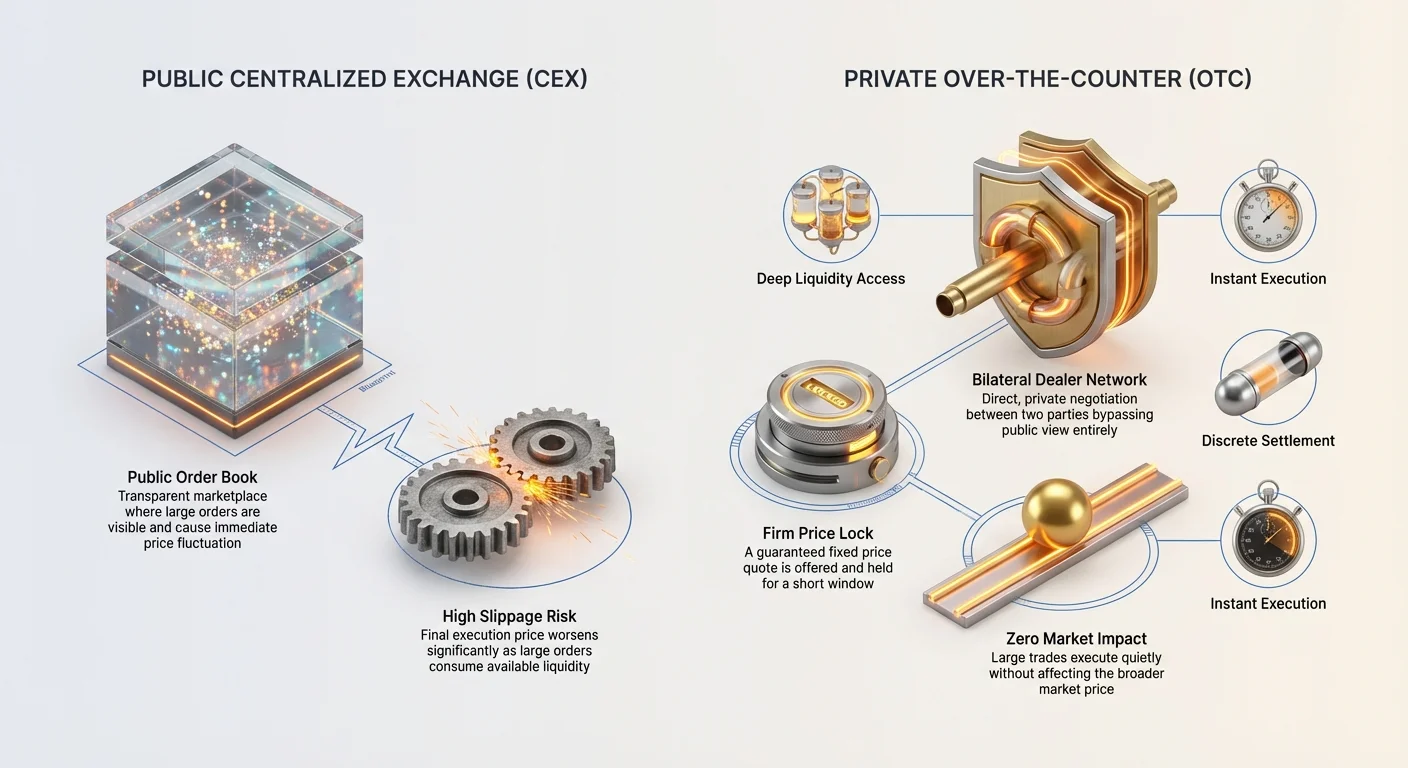
Think of a traditional centralized exchange (CEX) as a bustling public stock market where everyone can see the current price and volume. OTC, conversely, is like a private negotiation conducted between you and a trusted broker behind closed doors.
The Core Difference: OTC vs. Centralized Exchanges (CEX)
The fundamental difference between CEX and OTC lies in how the price is discovered and how the transaction is settled.
| Feature | Centralized Exchange (CEX) | Over-the-Counter (OTC) Trading |
|---|---|---|
| Price Discovery | Public, transparent order book. Prices fluctuate instantly based on supply/demand. | Bilateral negotiation. A fixed quote is offered by a dealer for a specified size. |
| Transaction Size | Best for small to medium orders (up to 6 figures). | Essential for large orders (6 figures and above). |
| Market Impact | High risk of slippage and market movement for large orders. | Zero market impact, as the trade is executed off-exchange. |
| Speed/Execution | Instant execution upon placing a market order. | Requires quote negotiation, but execution is usually guaranteed within seconds of acceptance. |
| Privacy | Low. Your order quantity (if large) is public knowledge until filled. | High. The transaction remains private between you and the broker. |
How OTC Provides Price Certainty (The Bilateral Deal)
When a retail trader uses a CEX, they place an order to buy a specific amount of Bitcoin at the current market price. If they buy $500,000 worth, they consume all the available liquidity at the lowest prices, forcing their trade to fill at increasingly higher prices. The result is an average price that is significantly worse than the initial price displayed.
In the OTC environment, the process is reversed:
- Request for Quote (RFQ): The retail trader contacts their OTC broker and requests a quote for a specific size (e.g., "I want to sell 150 BTC").
- Firm Quote: The broker consults their internal trading desks, liquidity providers, and inventory, then immediately provides a firm price (e.g., "$68,500 USD per BTC").
- Acceptance: The trader has a short window (often 60 seconds) to accept the quote. If accepted, the price is locked in.
- Settlement: The trade is executed at the agreed-upon price, regardless of what the public market does during that negotiation window.
This model guarantees price certainty and is the primary benefit of OTC trading for serious capital allocators.
The Problem OTC Solves: Minimizing Market Impact and Slippage
To understand the necessity of OTC trading, especially when learning how to trade crypto OTC, it’s crucial to understand the concepts of liquidity, slippage, and market impact. These elements are the hidden costs of trading that often erode profits on large transactions conducted via public exchanges.
Understanding Liquidity and the Order Book
Liquidity refers to how easily an asset can be bought or sold without causing a significant change in its price. A highly liquid asset (like Bitcoin on a major exchange) has many buyers and sellers at any given moment.
A CEX operates via a central order book, which is a list of all current buy and sell orders.
- Bids: Orders to buy at a specific price (below the current market price).
- Asks: Orders to sell at a specific price (above the current market price).
When you place a large market order to buy, your order starts filling from the lowest ask price available. If that first price level only contains 10 BTC, and you are buying 100 BTC, your order must move up the order book, consuming subsequent offers at higher and higher prices until the entire 100 BTC is purchased. This climbing process is what creates market impact.
Defining Slippage and Why It Matters for Large Trades
Slippage is the difference between the expected price of a trade and the price at which the trade is actually executed.
- Example of CEX Slippage: A trader wants to buy 100 BTC. The visible market price is $70,000. Because the order book is thin above that price, the average execution price for the entire 100 BTC ends up being $70,250. The slippage (the $250 difference across 100 BTC) results in an extra cost of $25,000.
OTC trading bypasses the public order book entirely. Since the broker (the counterparty) assumes the risk of filling the large order and handling its execution across various markets, the trader receives a single, guaranteed price. This structure eliminates external slippage risk for the retail trader.
The Benefit of Discretion and Privacy
In addition to reducing cost, OTC provides unparalleled discretion—a significant factor for high-net-worth individuals and traders who do not want to reveal their intentions to the broader market.
If a major trader placed an open order to sell 500 BTC on a CEX, other sophisticated traders (including algorithmic bots) would immediately spot this large incoming supply. They might front-run the order, selling their assets quickly before the major transaction pushes the price down further, or they might cancel their existing buy orders, worsening liquidity and accelerating the price drop.
When you transact OTC, only two parties know about the deal: you and the broker. The trade is executed privately, often settled between the broker and their institutional network, without ever hitting the open public order book. This discretion prevents adverse market reaction and potential front-running, making it a key benefit of OTC trading.
Eligibility: Is Retail OTC Trading Right for You?
The term "OTC" often conjures images of massive hedge funds, but in the modern crypto landscape, retail OTC services are accessible to sophisticated individual investors who meet certain criteria. Understanding these requirements is fundamental to knowing how to trade crypto OTC.
Defining "High-Net-Worth" and Minimum Order Sizes
While there is no single universal standard, retail OTC desks typically cater to transactions that would cause significant market impact on public exchanges.
Minimum Order Size: Most retail OTC desks set a minimum trade size. This threshold often begins in the range of $100,000 USD equivalent, though some may start as low as $50,000 for highly liquid assets like Bitcoin and Ethereum. For altcoins, the minimums may be higher because the underlying liquidity is thinner.
If you are consistently trading volumes below $50,000, the small fee savings and the convenience of your CEX might still outweigh the added steps of using an OTC desk. However, if your transactions regularly cross that $100,000 mark, using an OTC broker becomes an economic necessity to protect your capital from slippage.
When to Use OTC vs. Breaking Up Trades on a CEX
A common strategy for large traders on CEXs is "iceberging"—breaking a massive order into many small, staggered market orders to hide the true size. While this reduces immediate impact, it is complex, time-consuming, and still risks market exposure over time.
You should consider using OTC when:
- Speed is Critical: You need to enter or exit a massive position immediately without worrying about how much liquidity is available right now.
- Price Certainty is Non-Negotiable: You are executing a strategic trade (e.g., funding a specific venture or making a major portfolio rebalance) where knowing the exact final price is paramount.
- The Asset is Illiquid: You are trading an altcoin that has a very small order book. A $50,000 trade on a small altcoin might cause 5% slippage on a CEX, whereas an OTC desk can usually source the necessary liquidity with minimal spread.
The Role of KYC/AML in Retail OTC
Retail OTC desks, often operating as regulated money services businesses or broker-dealers, have strict Know Your Customer (KYC) and Anti-Money Laundering (AML) requirements.
To use these services, you must provide extensive documentation proving your identity and, frequently, the source of your funds. Unlike some anonymous peer-to-peer trading environments, retail OTC platforms must adhere to institutional standards. This thorough vetting process is actually a positive signal, as it indicates a regulated and trustworthy counterparty. If an OTC service does not ask for stringent KYC/AML documentation, it should raise significant red flags regarding compliance and security.
How Retail OTC Transactions Work: The Process
Understanding the workflow is essential for effectively leveraging best retail crypto OTC platforms. The operational model relies entirely on the relationship between the client (the trader) and the broker (the dealer).
The OTC Broker/Dealer Model
In OTC trading, the broker acts as a principal or market maker, not just an intermediary.
- Principal Model: When you request a quote, the OTC desk offers you a price and is ready to buy or sell the asset from its own inventory or by immediately hedging the trade with its network of liquidity providers. The broker effectively takes the opposite side of your trade. This is why they can offer a guaranteed price.
- Profit via Spreads: The OTC desk makes money on the spread—the difference between the price at which they buy an asset (the bid) and the price at which they sell it (the ask). This spread, which includes their operating cost and desired profit, is factored into the firm quote they provide you. The spread replaces the traditional exchange trading fee.
Requesting a Quote (RFQ) and Price Locking
The execution process is typically streamlined via secure digital portals, phone calls, or instant messaging systems, depending on the platform and size of the trade.
- Initiation: The client requests a quote for a specific action (Buy/Sell) and a specific asset quantity.
- Quote Generation: The dealer checks the current price across dozens of major exchanges, institutional dark pools, and other OTC desks. They quickly calculate the necessary spread to cover their risk and potential execution costs.
- Firm Quote Delivery: The client receives the firm quote (e.g., 100 BTC at $69,123.50). This price is typically valid for 30 to 90 seconds.
- Acceptance and Execution: Once the client accepts the quote, the broker locks the price and immediately executes the trade. The trade is now a legally binding, confirmed transaction.
The speed of the RFQ process is critical. Modern retail OTC platforms provide specialized electronic interfaces that allow high-net-worth retail traders to receive and accept quotes almost instantaneously, mimicking the speed of a CEX but with guaranteed large-volume execution.
Settlement and Custody Considerations
Settlement refers to the final exchange of funds and assets.
OTC trades are typically settled either by delivery-versus-payment (DVP) or by the trader having pre-funded a deposit with the broker.
- Pre-Funding: Many retail OTC desks require the trader to hold the fiat currency (if buying crypto) or the crypto assets (if selling crypto) directly in a segregated account with the broker before the trade. This eliminates counterparty risk for the broker and speeds up settlement.
- Post-Trade Transfer: After the trade is executed, the newly purchased assets (or fiat funds) are credited to the client’s account. Clients then typically withdraw the assets to their preferred external wallet (cold storage).
Crucially, because OTC brokers handle large sums, they often provide sophisticated custody solutions—sometimes utilizing institutional-grade cold storage or partnering with prime brokerage services—giving the client peace of mind regarding asset security, which is a major concern when dealing with substantial capital.
Selecting the Best Retail Crypto OTC Platforms and Brokers
Choosing a reliable OTC partner is arguably more important than choosing a centralized exchange, as you are relying on their solvency and integrity for large capital transfers. When evaluating the best retail crypto OTC platforms, high-net-worth investors must prioritize reputation, transparency, and integrated services.
Key Selection Criteria: Fees, Spreads, and Technology
While CEXs charge explicit trading fees (like 0.1% per trade), OTC brokers incorporate their profit into the spread. When comparing platforms, you must look beyond raw fees for minimizing trading costs.
- Tightness of the Spread: The best platforms leverage deep liquidity networks to offer the tightest possible spread (the smallest difference between the bid and ask price). A tighter spread translates directly to lower trading costs for you. Ask potential brokers for average spread data on Bitcoin and Ethereum for your typical trade size.
- Technology and UI/UX: For large-volume retail traders, the ability to rapidly request and accept quotes via a stable, proprietary trading terminal or API is vital. Lagging technology can lead to missed opportunities or quote expirations. Look for platforms that offer instant, verifiable RFQ tools.
- Settlement Speed: How fast does fiat clear, and how fast are the crypto assets transferred to your designated wallet? Institutional-grade OTC should offer near-instant settlement.
Security and Counterparty Risk Assessment
In an OTC transaction, you are entering a bilateral agreement with the broker, making them your counterparty. If the broker defaults or fails to deliver the asset after receiving your payment, you suffer a loss. This is known as counterparty risk.
To mitigate this:
- Regulation and Licensing: Prioritize platforms that are regulated in reputable jurisdictions (e.g., US, UK, Singapore). Look for licenses relating to money transmission, securities brokerage, or digital asset services. Regulation ensures operational oversight and capital requirements.
- Proof of Solvency and History: Research the platform’s track record, security incidents, and financial backing. Major exchanges that extend OTC services (like Coinbase Prime or Kraken OTC) often benefit from the exchange's vast reserves and established security protocols.
- Custody Solutions: Inquire about their custody procedures. Do they use hot wallets (less secure) or institutional-grade cold storage solutions? Are client funds segregated from operational funds?
Integrated Services (Lending, Prime Brokerage Lite)
The most advanced retail OTC desks often offer integrated financial services that enhance the value proposition for large investors. These are the hallmarks of a true full-service platform and are often considered the best retail crypto OTC platforms.
- Lending and Borrowing: If you are a long-term holder, the OTC platform may facilitate lending your assets to earn yield, or borrowing fiat using your crypto as collateral, all within the same regulated environment.
- Portfolio Management: Some platforms offer segregated account services and detailed reporting, making tax and portfolio management significantly easier for large volume traders.
- Fiat On/Off Ramps: Efficient, high-volume fiat banking relationships are critical. Ensure the platform has rapid wiring capabilities and secure fiat custodians.
A single platform that can handle large trades, provide secure custody, and offer advanced lending or yield products is far more valuable than using three separate providers, streamlining your entire crypto trading workflow.
Benefits of OTC Trading: A Summary for Sophisticated Investors
For the investor moving substantial capital, OTC trading transforms a high-risk logistical headache (slippage, market impact, execution failure) into a secure, predictable transaction. The benefits of OTC trading extend far beyond simple price certainty.
1. Superior Execution for Large Blocks
The primary benefit is guaranteeing a single, firm price, eliminating the risk of slippage. When dealing with hundreds of thousands or millions of dollars, this guaranteed execution can save tens of thousands of dollars compared to using a market order on a liquid CEX. For illiquid assets, the guaranteed price might be the only way to execute the trade without collapsing the market.
2. Reduced Regulatory and Compliance Risk
By using a licensed OTC broker (often a subsidiary of a major regulated exchange), high-net-worth individuals ensure their large transactions are executed within a compliant and legally sound framework. This is crucial for corporate clients, family offices, and investors who face annual audits or strict reporting requirements.
3. Access to Deeper Liquidity
OTC desks aggregate liquidity from dozens of sources—other exchanges, mining pools, dark pools, and other OTC dealers globally. This allows them to fill orders that would be impossible to execute solely on the order book of a single public exchange. This deeper liquidity is essential for handling trades in millions of dollars.
4. Privacy and Market Insulation
OTC transactions provide critical market insulation. By keeping large transactions off public order books, the trader prevents sophisticated market participants from front-running their trades or initiating adverse price action, protecting the integrity of their overall trading strategy.
Conclusion
OTC trading is not a beginner’s gateway into crypto, but rather the essential tool for those who have reached a professional level of capital allocation. If your trade size consistently breaches the six-figure mark, the imperative shifts from seeking the lowest percentage fee to minimizing slippage and market impact.
Learning how to trade crypto OTC means moving away from the public view of the order book and engaging in direct, confidential negotiation with a trusted financial counterparty. By diligently vetting your potential brokers based on regulatory standing, technical capability, and spread tightness, you can identify the best retail crypto OTC platforms to secure superior execution and strategic discretion for your largest digital asset movements. For high-net-worth retail investors, OTC is not just an option—it is the optimal trading infrastructure.