
Introduction
The landscape of digital asset acquisition involves more than simply selecting an image and clicking a purchase button. A robust strategy for acquiring Non-Fungible Tokens (NFTs) requires a deep understanding of the underlying infrastructure, ranging from the digital wallets that hold assets to the exchanges used to fund them. It also necessitates a clear grasp of valuation metrics and safety protocols.
At the core of this ecosystem is the concept of decentralization. Unlike traditional commerce, where a central authority mediates every transaction, the crypto economy relies on peer-to-peer interactions. This shift places the responsibility of security and valuation directly on the user. Understanding how to navigate these systems is the first step toward building a collection.
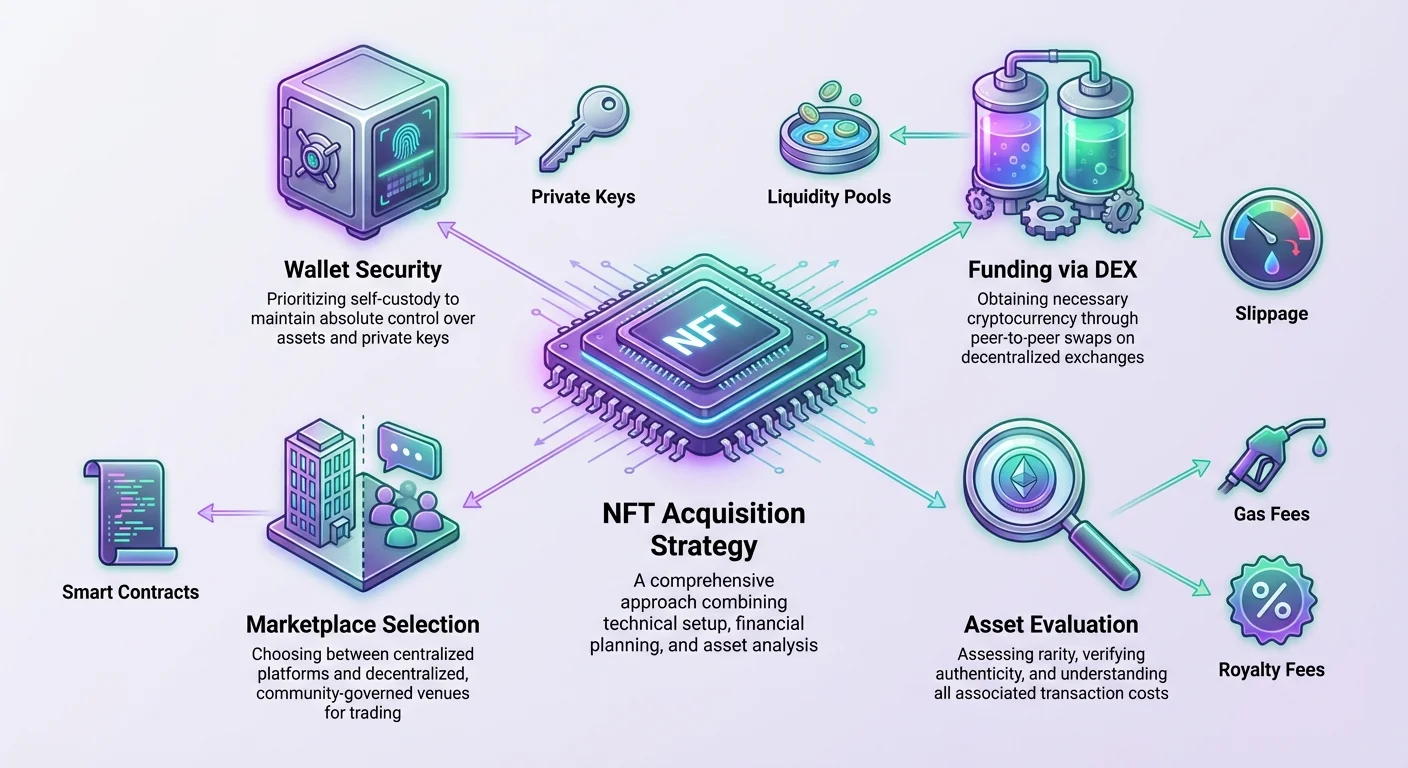
Success in this space is built upon three pillars: technical preparation, marketplace selection, and asset evaluation. Technical preparation involves setting up self-custodial storage and acquiring cryptocurrency through efficient channels. Marketplace selection involves choosing platforms that align with your philosophy on governance and security.
Finally, asset evaluation requires the ability to analyze rarity, verify authenticity, and understand the fee structures that influence the final cost of an acquisition. By mastering these elements, participants can navigate the complexities of the digital asset market with confidence and precision.
The Digital Wallet Ecosystem
The Importance of Self-Custody
The fundamental tool for any participant in the NFT market is the digital wallet. Often referred to as web3 wallets or crypto wallets, these applications serve as the primary interface for interacting with blockchains. While they are often compared to physical wallets, their function is more akin to a keychain and a browser combined.
The most critical distinction in wallet technology is between custodial and self-custodial solutions. In a custodial arrangement, a third party retains ultimate control over the private keys and funds. This mirrors traditional banking, where a financial institution holds money on behalf of a customer.
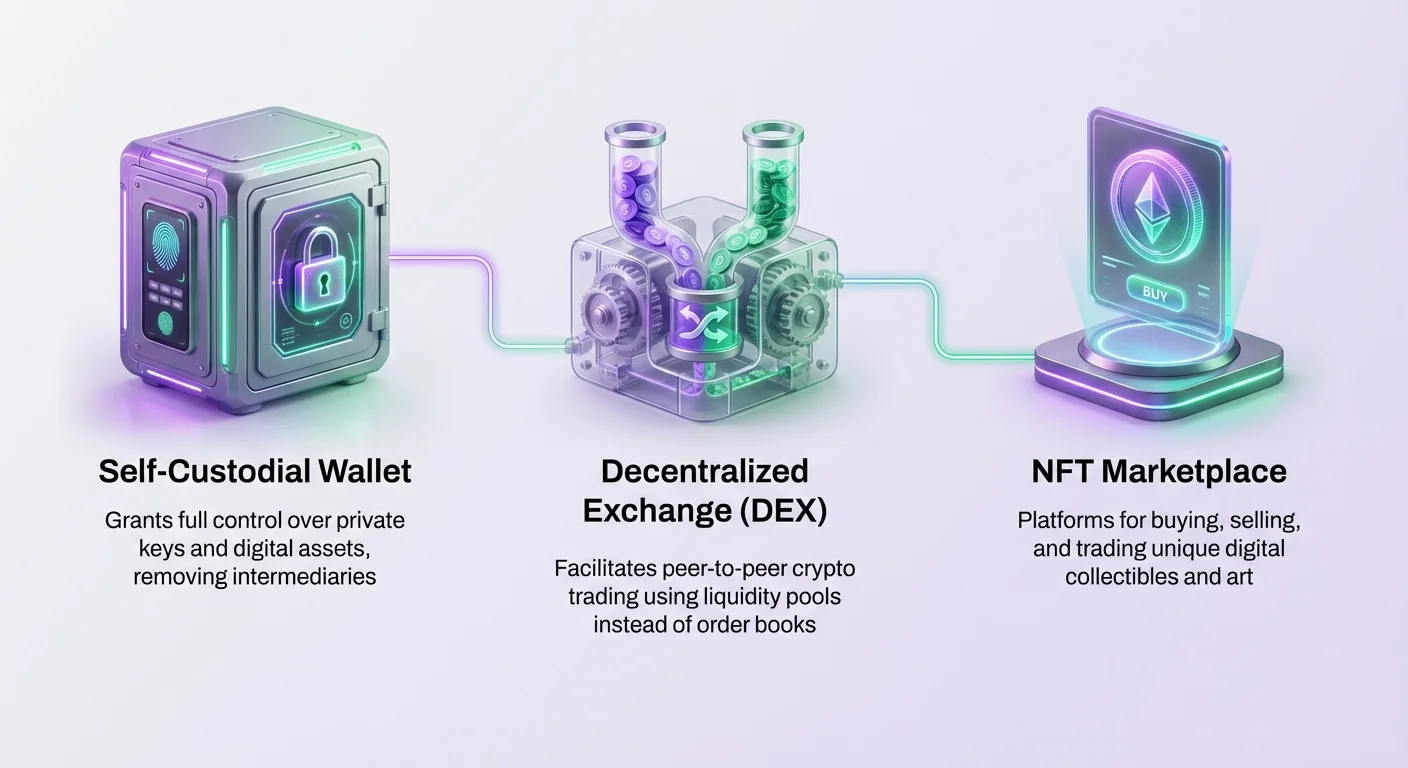
In contrast, self-custodial wallets grant the user full control over their contents. This aligns with the ethos of decentralized finance (DeFi) and web3, where the objective is to remove intermediaries. When buying NFTs on decentralized marketplaces, a self-custodial wallet is typically required to interact with the smart contracts directly.
Possessing full control also means bearing full responsibility. If access is lost to a self-custodial wallet, there is no customer support line to restore it. This makes the security and management of wallet credentials a top priority for any collector.
Wallet Functionality and Connectivity
Beyond simple storage, modern digital wallets are sophisticated tools for transaction management. They are necessary not only to hold the NFT after purchase but also to store the cryptocurrency required for the transaction fees and the purchase price itself. Every action that alters the state of a blockchain requires a transaction fee.
These fees are paid in the native currency of the blockchain being used. For instance, an artist minting or a collector buying on the Ethereum network must hold ETH to pay for gas fees. A wallet must therefore be capable of managing multiple types of assets simultaneously.
Wallets also act as the login mechanism for the decentralized web. Instead of creating a username and password for every marketplace, users connect their wallets. This connection grants the application permission to view public balances and request transaction approvals.
This interoperability is powered by protocols that allow wallets to communicate with thousands of decentralized applications (DApps). Whether the goal is to swap tokens on a decentralized exchange or bid on a digital artwork, the wallet remains the constant identity and command center for the user.
Acquiring Funds via Decentralized Exchanges
DEX Architecture and Liquidity
Before purchasing an NFT, a collector must acquire the appropriate cryptocurrency. Decentralized Exchanges, or DEXs, have become a primary method for obtaining these assets without relying on centralized intermediaries. DEXs facilitate peer-to-peer transactions, allowing users to swap between different cryptoassets permissionlessly.
The backbone of a DEX is liquidity. In traditional markets, liquidity refers to the ease with which an asset can be bought or sold without affecting its price. In the context of a DEX, liquidity is provided by users who deposit funds into "liquidity pools."
A liquidity pool typically consists of a pair of assets, such as a governance token and a native blockchain currency. These pools replace the order books found in centralized exchanges. Instead of matching a specific buyer with a specific seller, the DEX trades against the liquidity in the pool.
This system allows for continuous trading availability as long as the pool is funded. Liquidity is so vital that exchanges often incentivize users to deposit their assets into these pools by offering a share of the trading fees. Without sufficient liquidity, a DEX cannot function effectively, leading to inefficient pricing.
The Mechanics of Swapping
The primary function of a DEX is the "swap." This is the action of exchanging one cryptocurrency for another. It is distinct from buying crypto with fiat currency (government-issued money). DEXs generally handle crypto-to-crypto trades, meaning a user must already possess some digital assets to participate.
The swap interface is designed for simplicity, often featuring two main fields. The user selects the asset they wish to sell in the top field and the asset they wish to acquire in the bottom field. Once the wallet is connected, the exchange calculates the rate based on the current state of the liquidity pool.
Behind this simple interface lies a complex automated market maker (AMM) system. The AMM determines the price algorithmically based on the ratio of assets in the pool. When a user executes a swap, they are essentially adding one asset to the pool and withdrawing the other.
This action changes the ratio of assets in the pool, which in turn adjusts the price for the next trade. This mechanism ensures that pricing responds dynamically to supply and demand. For the user, the process is seamless, but understanding this mechanic explains why prices fluctuate during large trades.
Technical Trading Concepts
Understanding Slippage
One of the most important concepts to master when swapping tokens for an NFT purchase is slippage. Slippage refers to the difference between the expected price of a trade and the price at which the trade is actually executed. This phenomenon occurs in all markets but is particularly prevalent in decentralized crypto markets, requiring liquidity and slippage mastery.
Slippage happens when the price moves between the time an order is placed and the time it is confirmed on the blockchain. It can also occur if the trade size is large relative to the available liquidity in the pool. A large order shifts the ratio of assets significantly, causing the price to "slip" against the buyer.
Most DEX interfaces allow users to set a "slippage tolerance." This is a percentage value that represents the maximum price movement a user is willing to accept. If the price changes by more than this percentage during the transaction, the trade will fail.
It is generally advisable to keep slippage tolerance low to avoid paying more than expected. Increasing the tolerance might ensure a trade goes through during volatile periods, but it also exposes the user to front-running and poor execution prices. If 1 ETH is quoted at a certain price, a high slippage setting could result in receiving significantly less value.
Exchange Paths and Routing
Direct trading pairs are not always available for every combination of assets. For example, a user might hold a specific token and wish to acquire a different niche token to buy a specific NFT. If a direct liquidity pool for these two assets does not exist, the DEX must find an alternative route.
This process is known as finding an exchange path. The DEX algorithm analyzes available liquidity pools to find the most efficient way to complete the swap. It might route the trade through an intermediary token, typically a highly liquid asset like Wrapped Ethereum (WETH) or a stablecoin.
For instance, if a user wants to swap Token A for Token B, but no A-B pool exists, the DEX might execute a trade from A to WETH, and then from WETH to B. This happens automatically in the background.
The goal of this routing is to find the path with the highest liquidity and lowest price impact. While this feature improves the user experience by enabling swaps between unconnected assets, it is important to note that each step in the path may incur a small fee, slightly increasing the overall cost of acquisition.
Analyzing DEX Metrics
Successful acquisition strategy involves analyzing the health of the market before trading. DEXs provide analytics dashboards that offer insights into the state of various tokens and pools. Key metrics include total liquidity, trading volume, and fee generation.
Liquidity data shows the depth of the market. High liquidity indicates that an asset can be traded in significant amounts without causing drastic price changes. Low liquidity suggests that even small trades could cause high slippage, making it a riskier entry point.
Volume data tracks the amount of value traded over a specific period, such as 24 hours. High volume usually signals active interest and a healthy market. Conversely, low volume might indicate a stagnant asset or a lack of interest from the community.
Fees generated can also be a useful metric, particularly for those interested in providing liquidity. By analyzing these figures, users can determine which pairs are the most active and stable. This data helps in making informed decisions about when and where to swap assets in preparation for an NFT purchase.
Navigating NFT Marketplaces
Centralized vs Decentralized Platforms
Once a collector has the necessary funds, the next step is choosing a marketplace. Marketplaces are the primary venues for buying, selling, and trading NFTs. They can be broadly categorized into centralized and decentralized platforms, each offering different benefits and risks.
Centralized marketplaces operate similarly to traditional e-commerce sites. They are often run by a single company that maintains control over the platform's operations. While they may offer a streamlined user experience, they pose custody risks. If the company fails or goes insolvent, user assets held on the platform could be lost.
Decentralized marketplaces prioritize peer-to-peer interaction and user control. Platforms like Rarible operate on multiple blockchains and emphasize permissionless trading. In this model, the marketplace acts as a facilitator rather than a custodian. Assets move directly from seller to buyer via smart contracts.
This approach aligns with the broader philosophy of web3. Users retain control of their NFTs and funds until the moment of sale. Furthermore, decentralized platforms are less susceptible to censorship or external pressure, as they are not controlled by a single centralized entity that can unilaterally freeze assets or block users.
Governance and Community Control
A distinct feature of some decentralized marketplaces is the integration of governance tokens. These tokens represent a stake in the platform's future and decision-making processes. This stands in stark contrast to centralized models where users have little to no say in how the platform is run.
For example, platforms may issue a native token that grants holders voting rights. This allows the community to propose and vote on changes to the platform, such as fee structures, feature rollouts, or moderation policies. It shifts the power dynamic from a corporate boardroom to the user base.
Holders of these governance tokens essentially share in the ownership of the network. In some models, they may also be entitled to a portion of the revenue generated by the platform. This incentivizes users to contribute to the health and growth of the marketplace.
Centralized competitors typically do not offer this level of inclusion. Their decision-making is driven by shareholder interests and regulatory compliance, which may not always align with the best interests of the active user community. The presence of a governance model is often a key differentiator for those prioritizing decentralization.
| Feature | Decentralized Marketplaces | Centralized Marketplaces |
|---|---|---|
| Custody | Self-custodial (User holds keys) | Custodial (Platform holds keys) |
| Governance | Community voting via tokens | Corporate decision making |
| Access | Permissionless | May require KYC/Restrictions |
Purchasing Mechanisms
Auction Strategies
Marketplaces generally offer two main methods for acquiring an NFT: auctions and fixed-price listings. Auctions are commonly used for unique, high-value items or new releases where the market value is yet to be determined. The most frequent format is the English auction, also known as a timed auction.
In a timed auction, the seller sets a minimum price and a duration. Potential buyers place bids, and each new bid must typically exceed the previous one by a certain increment. The auction concludes when the timer runs out, and the highest bidder wins the item.
Strategy in auctions involves timing and valuation. Bidders must decide whether to place a bid early to set a precedent or wait until the final moments to avoid driving up the price prematurely. It is important to remember that placing a bid usually requires locking up funds in a smart contract.
If the reserve price (minimum price) is met, the sale is executed automatically. This ensures that the seller cannot back out after a valid bid is placed. However, if the minimum is not met, the auction expires, and the NFT remains with the seller.
Fixed Price and Offers
The alternative to an auction is the "Buy Now" or fixed-price listing. In this scenario, the seller sets a specific price for the NFT. This method is straightforward: the first person to pay the listed price acquires the asset immediately. This is similar to standard online retail shopping.
However, even with fixed-price listings, negotiation is often possible. Most marketplaces allow prospective buyers to make "offers" on listed (and sometimes unlisted) items. An offer allows a buyer to propose a price lower than the listing price, or to bid on an item that isn't currently for sale.
Sellers are not obligated to accept these offers. They can choose to ignore them, reject them, or accept them at any time. For buyers, making an offer is a way to signal interest without committing to the full asking price.
When making an offer, the buyer must typically wrap their cryptocurrency (e.g., converting ETH to WETH) because the protocol needs to be able to pull the funds automatically if the seller accepts. This adds a layer of flexibility to the market, allowing for price discovery even outside of formal auction structures.
Valuation and Verification
Assessing Properties and Rarity
Valuing an NFT goes beyond simple price comparison. Many NFT projects, particularly large collections (often called PFP or profile picture projects), utilize a system of "properties" or "traits." These are specific characteristics assigned to each individual token within the collection.
Traits can include visual elements like background color, clothing, accessories, or eye type. Within the collection, certain traits are generated less frequently than others. The scarcity of these specific traits contributes significantly to the perceived value of the individual NFT.
Marketplaces often display these properties alongside the image, showing the percentage of items in the collection that share that specific trait. An NFT with a combination of rare traits generally commands a higher market price than one with common traits, even if they are part of the same collection.
Smart collectors analyze these rarity rankings to identify undervalued assets. If an item is listed near the "floor price" (the lowest price for any item in the collection) but possesses rare traits, it may be considered a good acquisition. Rarity tools and marketplace filters are essential for this analysis.
Safety and Authenticity
The decentralized nature of crypto markets means that scams and counterfeits are a persistent risk. A common threat involves fake collections that copy the imagery and name of a popular project in an attempt to trick buyers. Verifying authenticity is a critical step in the acquisition process, and crucial for mitigating transactional fraud.
Reputable marketplaces implement verification systems to combat this. They often assign "badges" or checkmarks to verified creators and established collections. These badges signal that the marketplace has vetted the project and confirmed its legitimacy.
Before purchasing, a buyer should always look for these verification markers. It is also prudent to cross-reference the collection's smart contract address with the official address listed on the project's website or official social media channels.
Relying solely on the visual appearance of the NFT is dangerous, as images can be easily copied. The value lies in the cryptographic token and its provenance, not just the image file. Ensuring that the token originates from the correct contract is the only way to guarantee authenticity.
Cost Structure and Management
Fee Breakdowns
The cost of acquiring an NFT involves more than just the sale price. Several types of fees are layered into every transaction, and ignoring them can lead to unexpected expenses. The most immediate cost is the network transaction fee, often called "gas."
Gas fees are paid to the network validators or miners to process the transaction. These fees fluctuate based on network congestion. During times of high activity, gas fees can spike significantly, sometimes costing more than the item itself for lower-value assets.
In addition to gas, marketplaces charge a trading fee. This is typically a percentage of the sale price taken by the platform to cover operational costs. For example, a platform might take 2.5% of every transaction.
Finally, there are royalty fees. These are payments made to the original creator of the NFT for every secondary sale. When a creator mints a project, they can specify a royalty percentage. This ensures creators benefit from the ongoing success of their work. Buyers should be aware that this percentage is deducted from the seller's proceeds, but it influences the overall pricing structure of the secondary market.
| Fee Type | Recipient | Purpose |
|---|---|---|
| Gas Fee | Network/Miners | Processing the blockchain transaction |
| Trading Fee | Marketplace | Platform revenue and maintenance |
| Royalty Fee | Creator/Artist | Perpetual compensation for the artist |
Post-Acquisition Management
Once the transaction is successful, the NFT is transferred to the buyer's wallet. However, viewing the asset usually requires an interface, as raw blockchain data is not visually intuitive. Marketplaces serve as a primary gallery for viewing collected items.
By connecting the wallet to a marketplace, users can view their profile, which aggregates the NFTs held in that address. The interface organizes the collection, allowing the owner to sort items by price, date of purchase, or collection name.
This profile view is also where owners manage their assets for future sales. From this dashboard, an owner can list an item for sale, transfer it to another wallet, or update the listing price. It acts as a portfolio management tool.
It is important to remember that while the marketplace displays the image, the asset lives on the blockchain. Even if a specific marketplace goes offline, the NFT remains safely in the user's self-custodial wallet, accessible via other platforms or block explorers. This permanence is the defining feature of true digital ownership.
Conclusion
Acquiring NFTs is a multifaceted process that blends financial technology with digital art appreciation. It begins with the foundational security of self-custodial wallets, ensuring that the user maintains absolute control over their assets and keys. This autonomy is the bedrock of the web3 ecosystem, distinguishing it from traditional custodial models.
The journey continues through decentralized exchanges, where the necessary cryptocurrency is obtained through liquidity pools and automated market makers. Understanding the technical nuances of these swaps, such as slippage and routing, enables collectors to enter the market efficiently. This preparation is essential before engaging with the marketplaces themselves.
Finally, the strategy culminates in the careful selection and evaluation of assets. By leveraging verification badges, analyzing rarity traits, and navigating auction mechanics, buyers can make informed decisions. The combination of technical safety, financial literacy, and diligent research forms the basis of a successful acquisition strategy in the digital asset space.
True ownership in the digital age requires taking personal responsibility for security, verification, and valuation.