
The shift from traditional banking to digital asset ownership transfers the burden of security entirely to the individual. In the world of cryptocurrencies, there is no fraud department to call if funds go missing. There is no bank manager to reverse a transaction sent to the wrong address. Security in this environment requires a proactive mindset that treats personal devices and recovery information as high-value targets.
Cryptocurrencies like Bitcoin and Ether operate on peer-to-peer networks. This structure allows users to send value anywhere in the world without asking for permission from a central authority. However, this freedom comes with the absolute responsibility of safeguarding the access tools required to move those funds. If the specific access codes are lost or stolen, the assets associated with them are irretrievable.
To navigate this landscape effectively, one must understand the mechanics of ownership. It is not enough to simply buy a digital asset. You must understand how it is stored, how access is granted, and the specific vulnerabilities that exist in both software and hardware environments. Implementing a robust defense strategy involves layering security practices to eliminate single points of failure.
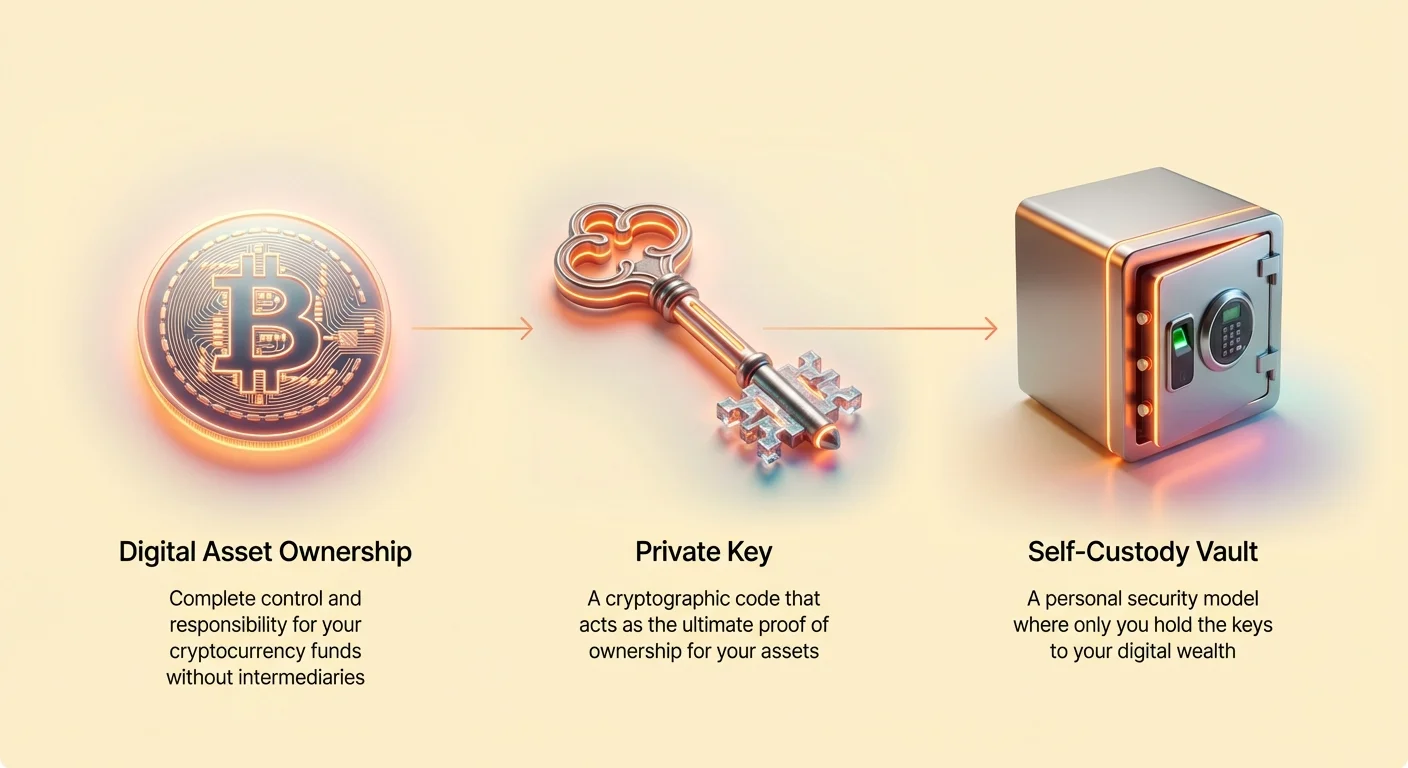
The Mechanics of Digital Ownership
At the heart of digital asset security lies the concept of the private key. This is the technical proof of ownership for any cryptocurrency funds. A private key is essentially a long, randomly generated string of characters. It functions similarly to a password for a bank account, but with much higher stakes.
In a traditional banking setup, a password grants access to an account held by a third party. If you forget the password, the bank can reset it. With cryptocurrency, the private key is the account control mechanism. There is no administrative override. If a third party gains possession of this key, they have total control over the funds and can transfer them immediately.
Public vs. Private Keys
To understand how transactions work, it helps to visualize a mailbox. The public key, or wallet address, acts like the mail slot. Anyone can drop items (cryptocurrency) into it. You can share this address openly with the world to receive funds. It poses no security risk to let others know your public address.
The private key acts as the physical key that opens the mailbox. Only the person holding this key can retrieve the contents or send them elsewhere. When a transaction is initiated, the wallet software uses the private key to create a digital signature. This signature proves to the network that the transaction was authorized by the true owner without ever revealing the private key itself.
The Recovery Phrase
Because raw private keys are long strings of hexadecimal characters, they are difficult for humans to manage. Most modern wallets convert these complex strings into a format called a recovery phrase, seed phrase, or secret passphrase. This is typically a list of 12 to 24 random words taken from a specific dictionary.
This sequence of words acts as a master key. If a phone is lost, destroyed, or wiped, entering this sequence of words into a new wallet application will regenerate the private keys and restore access to the funds. Consequently, protecting this phrase is just as important as protecting the device itself. Anyone who finds this list of words can clone the wallet and drain its contents.
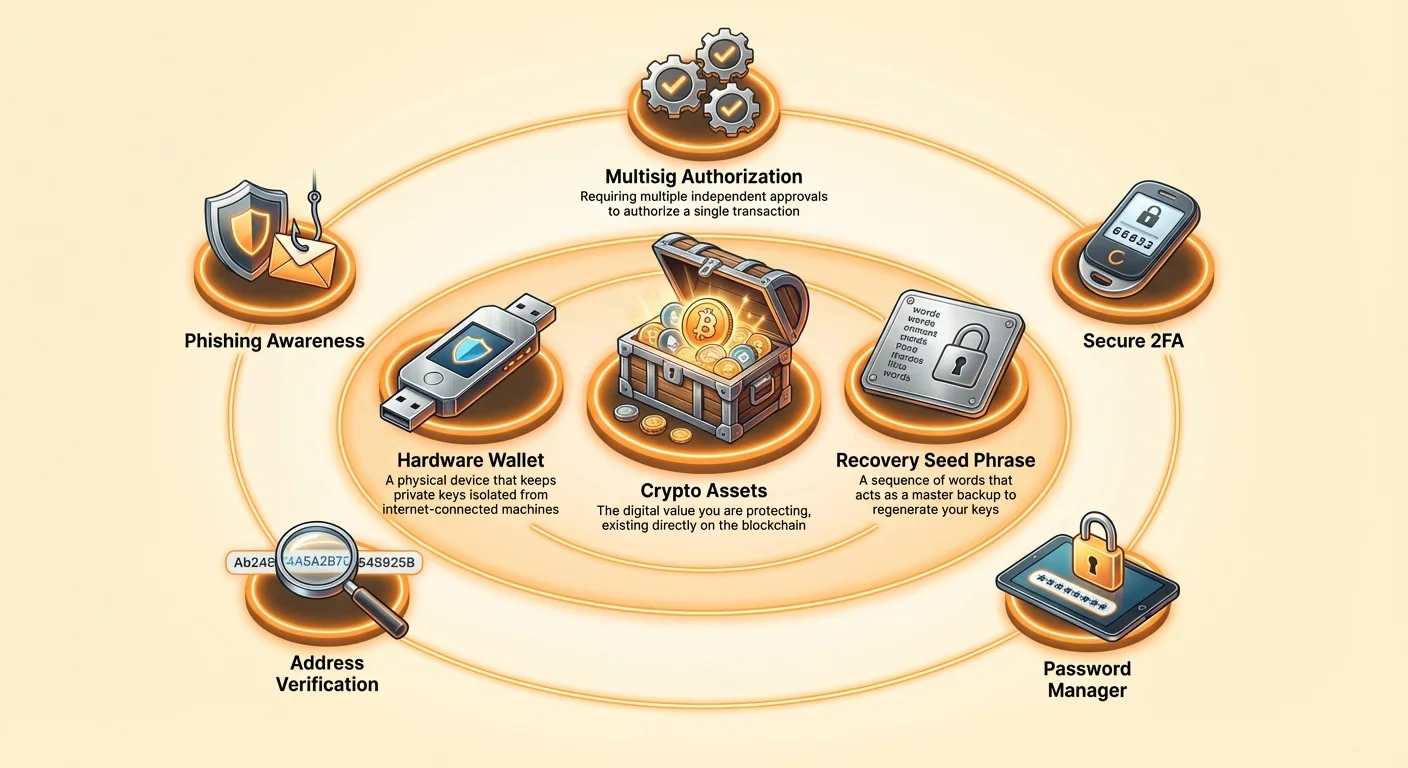
Custodial vs. Self-Custodial Risks
A fundamental decision in crypto defense is choosing between custodial and self-custodial models. This choice dictates who holds the private keys and, by extension, who bears the primary security risks. Understanding the distinction is vital for preventing loss due to platform failure or external hacks.
In a custodial arrangement, a third party such as a centralized exchange holds the digital assets. The user logs in with a username and password, much like online banking. While convenient for trading, this model introduces significant third-party risk. The user does not technically own the crypto; they own a claim to the crypto held by the exchange.
Dangers of Centralized Storage
Centralized exchanges create large pools of liquidity that become attractive targets for hackers. If an exchange is breached, user funds can be stolen en masse. Because these platforms are often unregulated or domiciled in offshore jurisdictions, users may have little legal recourse if assets are lost.
Beyond hacking, custodial wallets are subject to operational risks. If the platform goes bankrupt, user funds may be locked indefinitely during liquidation proceedings. Even in normal operations, exchanges may freeze withdrawals, delay transactions, or charge excessive fees to release funds. Governments can also pressure centralized entities to block specific users, as seen in various financial censorship events globally.
The Self-Custody Advantage
Self-custodial wallets place the user in full control. No third party has access to the private keys. This eliminates the risk of exchange bankruptcy or platform-level hacks. The assets exist directly on the blockchain, and the wallet software merely acts as an interface to manage them.
This model ensures that funds are always accessible, regardless of the operational status of any company. It prevents censorship, as no administrator can block a transaction created with a valid private key. However, this power means the user is solely responsible for defense. If a user falls victim to a phishing attack or loses their backup, there is no support team to restore access.
Active Defense Against Remote Threats
Threats like SIM swaps, phishing, and remote access attacks rely on compromising the user's authentication methods or tricking them into revealing sensitive data. A proactive defense strategy focuses on hardening the access points to the wallet and ensuring that even if one layer is breached, the funds remain secure.
Remote access threats often involve malware that allows an attacker to view a victim's screen or control their computer. If a user keeps their recovery phrase stored in a text file or a screenshot on their desktop, a remote attacker can copy it instantly. This reality dictates a strict rule: never store private keys or recovery phrases in digital form.
Password Management Protocols
Adhering to strict password management is the first line of defense. Users should never reuse passwords across different financial applications. If a database from a lower-security site is leaked, attackers will try those credentials on crypto exchanges and email accounts.
For software wallets, the application should be secured with biometrics or a strong PIN. This ensures that if the physical device falls into the wrong hands, immediate access is blocked. However, biometrics only protect the app on that specific device. They do not protect the backup phrase if it is stored insecurely elsewhere.
Two-Factor Authentication (2FA) Logic
When using services that require a login, such as cloud backups or exchange accounts, Two-Factor Authentication (2FA) adds a critical layer of security. If an attacker manages to steal a password, they still cannot access the account without the second factor.
However, not all 2FA methods are equal. SMS-based 2FA is vulnerable to SIM swap attacks, where an attacker tricks a mobile carrier into transferring the victim's phone number to a new SIM card. Once they control the number, they can intercept the verification codes. Using app-based authenticators or hardware security keys removes this vulnerability, as the code is generated locally on the device and cannot be intercepted via the cellular network.
Hardware and Software Wallet Architecture
The type of wallet chosen plays a significant role in defense against remote threats. Wallets generally fall into two categories: software (hot) wallets and hardware (cold) wallets. Each offers a different balance of convenience and security, and understanding their architecture helps in deploying them correctly.
Software wallets run on general-purpose devices like smartphones or laptops. They are connected to the internet, which makes them convenient for frequent transactions. However, because the device runs many other programs and connects to various networks, it is susceptible to viruses and malware.
Hardware Isolation
Hardware wallets are physical devices designed solely to store private keys. They connect to a computer or phone, usually via USB, only when a transaction needs to be signed. Critical security architecture lies in how they handle the keys. The private key never leaves the physical device.
When a user wants to send funds, the transaction data is sent to the hardware wallet. The device signs the transaction internally and sends the completed signature back to the computer. Even if the computer is infected with malware or a remote access trojan, the attacker cannot extract the private key from the hardware device. This isolation makes hardware wallets the gold standard for storing significant amounts of value.
Software Wallet Security
While software wallets are inherently more exposed, modern applications use encryption to mitigate risks. When a wallet is created, the private keys are encrypted on the device's storage. They are only decrypted momentarily when the user authenticates with a PIN or biometric scan.
Reliable software wallets also integrate non-custodial features, ensuring the provider never sees the user's keys. Users should verify the reputation of the wallet software, checking community forums and app store reviews to ensure the code has not been compromised. Using open-source wallets allows the community to audit the code for backdoors or security flaws.
Strategic Backup Procedures
The most common cause of crypto loss is not hacking, but the loss of backup information. If a device is broken and the recovery phrase is missing, the funds are gone forever. A comprehensive backup strategy addresses physical durability, redundancy, and protection from theft.
The primary method for backing up a self-custodial wallet is writing down the 12 to 24-word recovery phrase on paper. This paper must be stored in a secure location, such as a fireproof safe or a locked deposit box. It is advisable to create multiple copies and store them in separate geographic locations. This protects against local disasters like fire or flood.
Cloud Backup Integration
To address the difficulty of managing physical scraps of paper, some modern wallets offer automated cloud backups. This system encrypts the wallet's recovery phrase and stores it in a cloud service like Google Drive or Apple iCloud.
Crucially, the file is encrypted with a custom password chosen by the user. This master password acts as a decryption key. Even if the cloud account is hacked, the attacker receives only a file of gibberish without the custom password. This method simplifies recovery; the user only needs to reinstall the app, log in to their cloud account, and enter their decryption password.
The Analog Gap
Despite digital conveniences, the "analog gap" remains a powerful security tool. Keeping the seed phrase strictly offline prevents all remote attacks. Hackers cannot phish a piece of paper stored in a safe. They cannot use a remote access tool to view a document that has never been typed into a computer.
Users must resist the temptation to take a photo of their handwritten seed phrase. Photos are often automatically synced to cloud galleries. If the cloud account is compromised, the photo of the seed phrase is available to the attacker in plain view. The transition from physical paper to digital image breaches the air-gap security layer.
Advanced Defense: Multisig and Cold Storage
For individuals managing substantial portfolios or organizations holding treasury assets, single-signature wallets may not offer sufficient protection. Advanced defense strategies involve requiring multiple approvals for any transaction. This distribution of authority is known as multisig (multi-signature) technology.
A standard wallet requires one signature to move funds. A multisig wallet requires M-of-N signatures. For example, a "2-of-3" wallet involves three separate private keys, and at least two must sign a transaction for it to be valid. This structure eliminates the single point of failure associated with a lost key or a compromised device.
| Security Model | Configuration | Benefit |
|---|---|---|
| Standard Wallet | 1-of-1 Signature | Simple, fast access for daily use. |
| Family Multisig | 2-of-3 Signatures | Prevents loss if one member loses a key. |
| Corporate Treasury | 3-of-5 Signatures | Requires board consensus for spending. |
Threat Mitigation with Multisig
Multisig effectively neutralizes many physical and remote threats. If an attacker uses a remote access tool to compromise one computer holding one key, they still cannot steal the funds because they lack the second signature.
In a physical kidnapping or extortion scenario, a multisig setup can prevent immediate theft if the keys are geographically distributed. If the user only has access to one key at their home, they physically cannot comply with an attacker's demand to transfer all funds immediately. This complexity acts as a deterrent and a safety buffer.
Cold Storage Implementation
Cold storage refers to keeping private keys completely offline at all times. While hardware wallets are a form of cold storage, users can also generate "paper wallets." This involves generating keys on a computer that has never been connected to the internet and printing them out.
Cold storage is ideal for long-term holding, often called "HODLing." Since the keys never touch an internet-connected device, the attack surface for online hackers is reduced to zero. The risks shift entirely to physical security and the durability of the medium used to store the keys.
Transaction Hygiene and Network Fees
Security also involves understanding how transactions interact with the blockchain network. Errors in sending funds can be just as damaging as theft. Because blockchain transactions are irreversible, verifying destination addresses is a critical habit.
Malware known as "clipboard hijackers" can detect when a user copies a crypto address and silently replace it with an attacker's address. When the user pastes the destination, they may inadvertently send funds to the hacker. Defense against this involves manually checking the first and last few characters of every address after pasting.
Fee Customization and Speed
Network congestion can cause transaction delays. Self-custodial wallets often allow users to customize the network fee. Paying a higher fee incentivizes miners to include the transaction in the next block, ensuring speed. Paying a lower fee saves money but risks the transaction remaining pending for hours or days.
Understanding fees is a security issue because panic can lead to errors. If a transaction is "stuck" due to a low fee, users might try to resend it or use untested tools to accelerate it, opening themselves up to scams. Patience and understanding how the "mempool" (transaction waiting area) works prevent rash decisions.
| Priority Level | Fee Relative Cost | Confirmation Speed |
|---|---|---|
| Fast | High | ~10-20 Minutes |
| Medium | Standard | ~30-60 Minutes |
| Slow | Low | 1 Hour to Days |
Smart Contract Interaction
When using decentralized finance (DeFi) applications, users must approve smart contracts to spend their tokens. Granting unlimited allowance to a malicious contract allows it to drain the wallet at a later time. Users should only approve the exact amount needed for a transaction or use tools to revoke allowances after use.
Defi involves interacting with code rather than people. If the code has a bug or is designed maliciously, the connected wallet is at risk. Using a separate wallet for DeFi interactions, containing only the funds needed for that session, segregates the risk from the user's main savings.
Recovering from Device Failure
The true test of a defense strategy is the recovery process. Devices fail, get lost, or are stolen. A robust plan ensures that asset access survives the hardware. The recovery process relies entirely on the backup method chosen during setup—either the cloud password or the manual seed phrase.
For cloud backups, the process is streamlined. The user downloads the wallet app on a new device, selects the restore option, logs into their linked provider account, and enters the decryption password. This restores the private keys and resyncs the transaction history from the blockchain.
Manual Restoration
Restoring from a manual seed phrase requires precision. The user must select "Import Wallet" and type the 12 to 24 words in the exact order they were generated. The words must be lowercase and separated by single spaces.
If a word is entered incorrectly, the wallet software will generate a completely different set of private keys, resulting in an empty wallet. This is why clear handwriting and checking the spelling against the official word list (BIP39 standard) is vital during the initial backup.
Importing Paper Wallets
For those moving funds from a paper wallet to a digital wallet, the process involves "sweeping." The wallet app scans the QR code or takes the private key string from the paper wallet and broadcasts a transaction sending the entire balance to the new wallet. This effectively retires the paper wallet, as its security is considered compromised once the private key has been entered into a digital device.
Conclusion
Defending digital assets against modern threats requires a shift in perspective from passive reliance on institutions to active personal responsibility. The threats of SIM swaps, phishing, and remote access attacks target the human element of the security chain. By understanding the immutability of blockchain transactions and the critical role of private keys, users can build a defense that withstands these vectors.
Implementing self-custodial solutions, utilizing hardware isolation for significant values, and adhering to strict backup protocols creates a fortress around digital wealth. Security is not a product that can be purchased; it is a consistent practice of hygiene and vigilance. Whether through multisig configurations or simple disciplined password management, the goal remains the same: to ensure that only the rightful owner ever possesses the keys to the vault.
Your private keys are the only proof of ownership; if you do not control them, you do not own your assets.