
When you first enter the world of crypto self-custody, securing your funds is the priority. But as you advance, you quickly realize that your crypto wallet is more than just a storage container; it’s a portal. To interact securely with decentralized applications (dApps), manage multiple cryptocurrencies, and switch between hardware and mobile devices seamlessly, you need standards.
Why does one wallet recognize your Bitcoin, while another, using the exact same secret phrase, doesn't see your Ethereum? Why can your mobile wallet connect to a decentralized exchange (DEX) running on your desktop browser? The answers lie in a set of core technical rules—called Bitcoin Improvement Proposals (BIPs)—and the crucial communication standard known as WalletConnect.
This guide moves beyond basic wallet definitions, offering a comprehensive look at the underlying architecture that governs crypto self-custody. Mastering these concepts—from BIP standards to derivation paths and WalletConnect V2—is essential for any user aiming for true self-sovereignty and seamless interaction within the decentralized web.
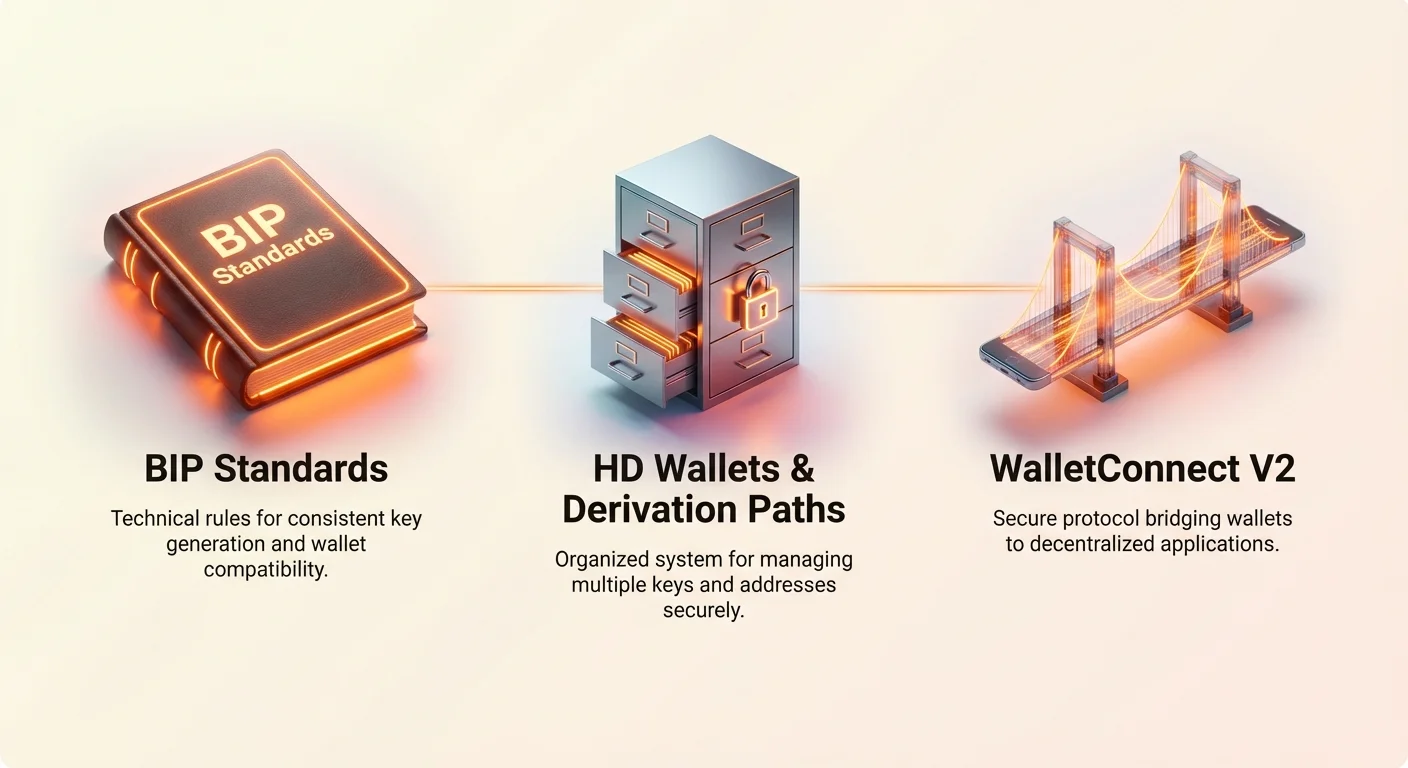
The Foundation of Wallet Construction: BIP Standards
Before digital wallets were standardized, moving your funds between different software could be a nightmare. Every wallet manufacturer had its own way of generating keys, meaning your backup phrase from Wallet A might be useless in Wallet B. Bitcoin Improvement Proposals (BIPs) solved this. BIPs are the technical rulebook established by the Bitcoin community, acting as industry-wide standards that ensure consistency, security, and interoperability across all compliant wallets.
If a wallet adheres to a specific BIP, you can generally trust that your funds are accessible across any other compliant wallet, regardless of the brand or format (mobile, hardware, or desktop).
Understanding BIP-39: The Seed Phrase Standard
BIP-39 is arguably the most important standard for newcomers, as it defines the mechanism for creating and managing your recovery seed phrase (sometimes called a mnemonic phrase).
In simple terms, BIP-39 takes the long, complex string of numbers and letters that make up your cryptographic private key and converts it into a human-readable list of 12, 18, or 24 common words. This process makes the critical backup step much easier and less prone to transcription error.
How BIP-39 Works:
- Entropy: The wallet generates a high degree of random data (entropy).
- Word List: This data is mapped to a pre-defined list of 2048 words (the BIP-39 wordlist).
- Checksum: A few bits are added to check for typos.
- Mnemonic: The final list of words is presented to the user.
Any wallet that uses the BIP-39 standard will generate the exact same keys from the exact same word sequence. This standardization is why you can safely restore your funds from a Trezor wallet onto a mobile app like Exodus, or vice versa.
The Significance of BIP-44: Multi-Coin Consistency
While BIP-39 gives you the master key (the seed phrase), BIP-44 gives you the master map for organizing your funds.
In the early days of crypto, wallets were typically "single-key," meaning they held one private key for one address. If you wanted a new address for better privacy, you needed a new private key and a separate backup. This became unmanageable, especially as users started holding multiple cryptocurrencies (Bitcoin, Ethereum, Solana, etc.).
BIP-44 establishes a specific, five-part structure for organizing all the private keys derived from your single BIP-39 seed phrase. This structure ensures that a single seed can manage hundreds of different coins and countless addresses, all neatly categorized.
The primary benefit of BIP-44 is predictability. If Wallet A uses BIP-44, it knows exactly where to look for your Ethereum addresses (folder 60) and where to look for your Bitcoin addresses (folder 0). Without BIP-44, every multi-currency wallet would have to guess the correct location for each coin, making interoperability impossible.
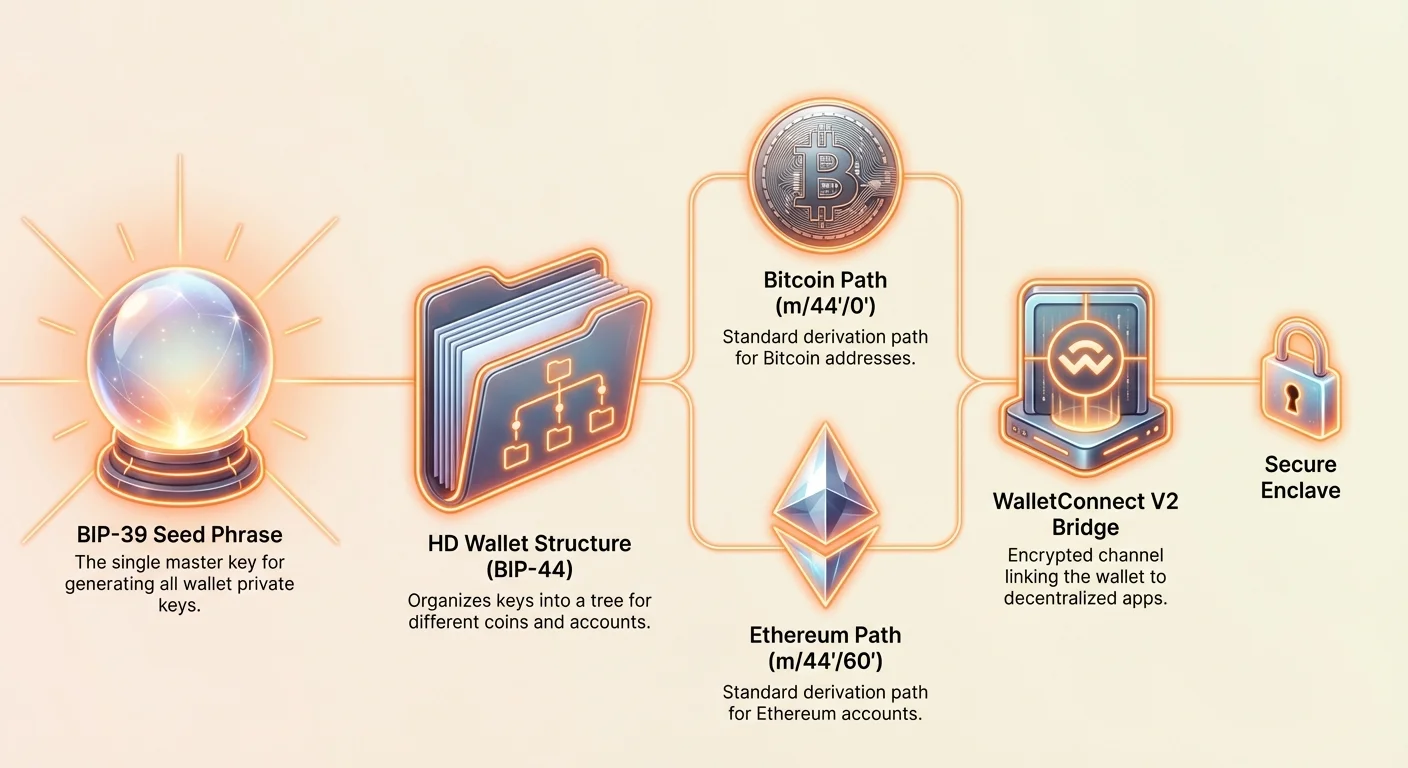
Hierarchical Deterministic (HD) Wallets: The Filing Cabinet Approach
BIP standards define the why (interoperability), and Hierarchical Deterministic (HD) wallets define the how (the architecture).
An HD wallet is a system that allows a single master seed (the BIP-39 phrase) to deterministically generate a virtually unlimited tree of keys (private and public). Think of your seed phrase as the secure lock on a massive filing cabinet, and the HD structure as the organized system of folders, sub-folders, and documents inside that cabinet.
Why HD Wallets Are Superior to Simple Wallets
HD wallets offer profound advantages in security and convenience over their predecessors:
- Single Backup: You only need to back up the 12 or 24-word seed phrase. If you lose your device, restoring this one phrase restores every coin, every account, and every address you have ever generated.
- Improved Privacy: An HD wallet can generate a new receiving address for every transaction you receive. Crucially, the public addresses are created using an extended public key (xPub), which can be shared with auditors or services without revealing the private key.
- Efficiency and Speed: Because all keys are generated mathematically from the root seed, wallets can quickly "derive" (calculate) the necessary private keys on demand, rather than storing hundreds of individual keys separately.
In essence, HD wallets separate the critical asset (the master seed) from the operational components (the individual addresses), vastly improving security protocols, especially for hardware wallets (cold storage).
Decoding Derivation Paths (The Map to Your Funds)
The "hierarchical" part of the HD wallet is managed by the derivation path. This is the specific sequence of instructions that tells the wallet where to look within the key tree to find the private key corresponding to a specific cryptocurrency address.
The derivation path is represented by a sequence of numbers separated by slashes, usually starting with m/ (or M/ for the extended public key). It looks something like this:
Let's break down the standard BIP-44 structure:
| Element | Description | Example Value |
|---|---|---|
| m | Denotes the Master Seed Key. | m |
| Purpose | Always 44' for BIP-44 wallets. |
44' |
| Coin | A unique number identifying the cryptocurrency (e.g., Bitcoin is 0', Ethereum is 60'). |
0' or 60' |
| Account | Allows users to separate accounts for different purposes (e.g., 0' for savings, 1' for trading). |
0' |
| Change | Specifies if the key is for receiving funds (0) or for change addresses (1). |
0 |
| Index | The specific address number within the account. | 0 (the first address) |
Example of a Standard Bitcoin Path: m/44'/0'/0'/0/0
This path tells the wallet: "Start at the master seed, use the BIP-44 standard, look for Bitcoin keys (0'), find the primary account (0'), look for a receiving address (0), and pull up the first address (0)."
Customizing Derivation Paths for Advanced Users
Understanding the derivation path is crucial because it is the primary reason why interoperability sometimes breaks down. If you import your BIP-39 seed phrase into a new wallet, and that wallet uses a slightly different derivation path for your chosen coin, your funds will appear to be missing—when in reality, the wallet is just looking in the wrong folder.
Common Path Variations and Their Uses
While BIP-44 provides a general standard, the crypto ecosystem has evolved, leading to different path conventions for specific purposes, primarily to optimize efficiency or support new cryptographic requirements:
1. Bitcoin-Specific Paths (BIP-49 and BIP-84)
As Bitcoin developed new address types (like SegWit), the community introduced new BIPs to govern these specific path structures, ensuring backward compatibility:
- BIP-49 (P2SH-SegWit): Used for older SegWit addresses starting with '3'. The path changes the purpose field:
m/49'/0'/0'/0/0. - BIP-84 (Native SegWit): Used for modern, lowest-fee SegWit addresses starting with 'bc1'. The path changes the purpose field again:
m/84'/0'/0'/0/0.
If you receive Bitcoin into a Native SegWit address using Wallet A, but Wallet B defaults to the older BIP-44 path, Wallet B will not show your balance until you manually tell it to scan the BIP-84 path.
2. Ethereum and EVM Path Variations
Ethereum introduced its own convention, using coin code 60'. However, unlike Bitcoin, Ethereum accounts are usually not separated by change/index, often using a simpler path for account generation:
- Standard Ethereum (BIP-44):
m/44'/60'/0'/0/0(Most commonly used, especially by hardware wallets). - Ledger Live Ethereum: Ledger often uses a slightly different path notation for different account setups, requiring users to select the correct type when importing.
Actionable Tip: If you migrate your seed phrase and funds are missing, before panicking, check the support documentation of the old wallet to see if they utilize a non-standard or alternative derivation path for your specific coin or account type. Most advanced wallets (like Electrum, Trezor Suite, or MetaMask) allow you to manually select or enter a custom path to scan.
Troubleshooting Wallet Compatibility Issues
The mismatch in derivation paths is the number one technical hurdle faced by self-custody adopters. Here is a framework for troubleshooting:
| Scenario | Problem Identification | Solution |
|---|---|---|
| Missing Bitcoin Funds | The new wallet is scanning the default legacy path (BIP-44), but the funds were sent to a newer Native SegWit address. | Check the wallet settings for options to add a Native SegWit (BIP-84) account type. |
| Missing Altcoin/Token Funds | The original wallet used a custom path (e.g., for staking accounts), but the new wallet only uses the standard BIP-44 path. | Consult the old wallet’s documentation for the specific coin's path. Use the new wallet's "import custom path" feature (if available). |
| Hardware Wallet Connection Issues | The hardware wallet is generating the correct keys, but the software interface (e.g., MetaMask) is looking for the keys in the wrong location. | Ensure the wallet interface is configured to the specific HD path used by your hardware wallet brand (e.g., Ledger often uses a different sequence than Trezor for specific tokens). |
By viewing your funds not as physical coins stored in the wallet, but as data points located at specific coordinates on a massive map (the derivation path), you gain the technical insight needed to manage any migration or compatibility challenge.
Connecting the Ecosystem: Mastering WalletConnect V2
While BIPs define how wallets are built internally, WalletConnect defines how wallets securely interact with the outside world—specifically with decentralized applications (dApps).
WalletConnect is an open-source protocol that allows mobile wallets, desktop wallets, and hardware-backed wallets to securely link to and communicate with any dApp or Web3 application running in a desktop browser or another mobile application. It acts as an encrypted communication channel, ensuring that your private keys never leave the secure environment of your wallet device.
How WalletConnect Bridges Wallets and dApps
Imagine you want to use a DEX (like Uniswap) on your desktop computer, but your crypto assets are stored securely on a mobile app or a hardware wallet that cannot be plugged directly into the browser.
WalletConnect solves this using a standardized handshake protocol:
- Initiation: The dApp displays a QR code containing the WalletConnect URI (a cryptographic connection string).
- Scanning/Linking: You scan the QR code with your mobile wallet app (or link the URI if using desktop-to-desktop).
- Encrypted Session: A secure, end-to-end encrypted connection is established between the dApp interface (the signing requestor) and your wallet (the signing authority).
- Transaction Authorization: When you initiate a swap on the dApp, the dApp sends the raw transaction data securely through the WalletConnect bridge to your wallet.
- Confirmation: Your wallet displays the transaction details (what you are spending, where it is going) for your review. You approve and sign the transaction using your private key within the wallet’s secure enclave.
- Broadcast: The signed transaction is sent back through WalletConnect to the dApp interface, which then broadcasts it to the blockchain.
The critical security advantage is that the dApp never touches your private keys. It only receives the signed, completed transaction data.
Key Improvements in WalletConnect V2 (Security and Multi-Chain)
WalletConnect V1 was functional but lacked robust multi-chain support and session stability. WalletConnect V2 was introduced to address these limitations, making it the standard for advanced Web3 interaction today:
1. Multi-Chain Interoperability
V1 was primarily focused on single-chain sessions. V2 introduced a flexible structure that allows a single WalletConnect session to maintain connections across multiple blockchains simultaneously (e.g., connecting to both Ethereum and Polygon with one QR code scan). This is vital for modern DeFi usage, where users frequently bridge assets or interact with applications deployed across several networks.
2. Enhanced Session Persistence
V2 utilizes a decentralized messaging relay network that provides much greater reliability. If your internet connection drops or you close the browser, the V2 session can often be restored quickly, preventing the need to re-scan the QR code for every interaction.
3. Optimized Permissions and Security
V2 allows wallets to request specific permissions from the user upfront, such as requesting access to only one specific chain or method. This clear delineation of permissions enhances security and prevents malicious dApps from attempting to operate on chains you didn't explicitly approve.
Actionable Tip: Always verify the dApp URL directly in your mobile wallet when using WalletConnect. The connection request will display the URL it is linking to. This simple step prevents connection to phishing sites that mimic legitimate applications.
Conclusion: The Architecture of Self-Sovereignty
Understanding wallet standards and interoperability mechanisms moves you from being a passive user of crypto technology to an active participant who understands the architecture behind the scenes.
BIP standards (BIP-39 and BIP-44) ensure that your cryptographic keys are generated and organized deterministically, providing the ultimate backup safeguard and allowing you to move your funds between different compliant wallets effortlessly. Mastering the concept of the derivation path (HD wallets) grants you the ability to troubleshoot compatibility issues when moving funds across different software that may utilize unique address structures.
Finally, WalletConnect V2 serves as the essential, secure bridge between your isolated, protected wallet and the active, interactive world of Web3 dApps.
By understanding how these three components—BIPs, Derivation Paths, and WalletConnect—work together, you gain the technical confidence necessary to execute advanced crypto strategies, manage complex multi-chain portfolios, and maintain true self-sovereignty in the digital economy.