
The digital asset landscape is often viewed through a narrow lens of financial return. For many newcomers, the primary allure of cryptocurrency lies in the potential for price appreciation or the generation of passive income through yield farming. While these economic incentives are powerful drivers of adoption, they represent only the surface layer of a much deeper structural shift. Beneath the immediate appeal of annual percentage yields lies a fundamental transformation in how human organizations are structured and governed.
Decentralized networks offer a unique proposition that extends far beyond simple investment vehicles. They provide a mechanism for direct ownership and control over the infrastructure itself. In traditional finance, depositing money into a bank does not grant the depositor a say in how that bank is run or which policies it implements. The relationship is purely transactional and passive.
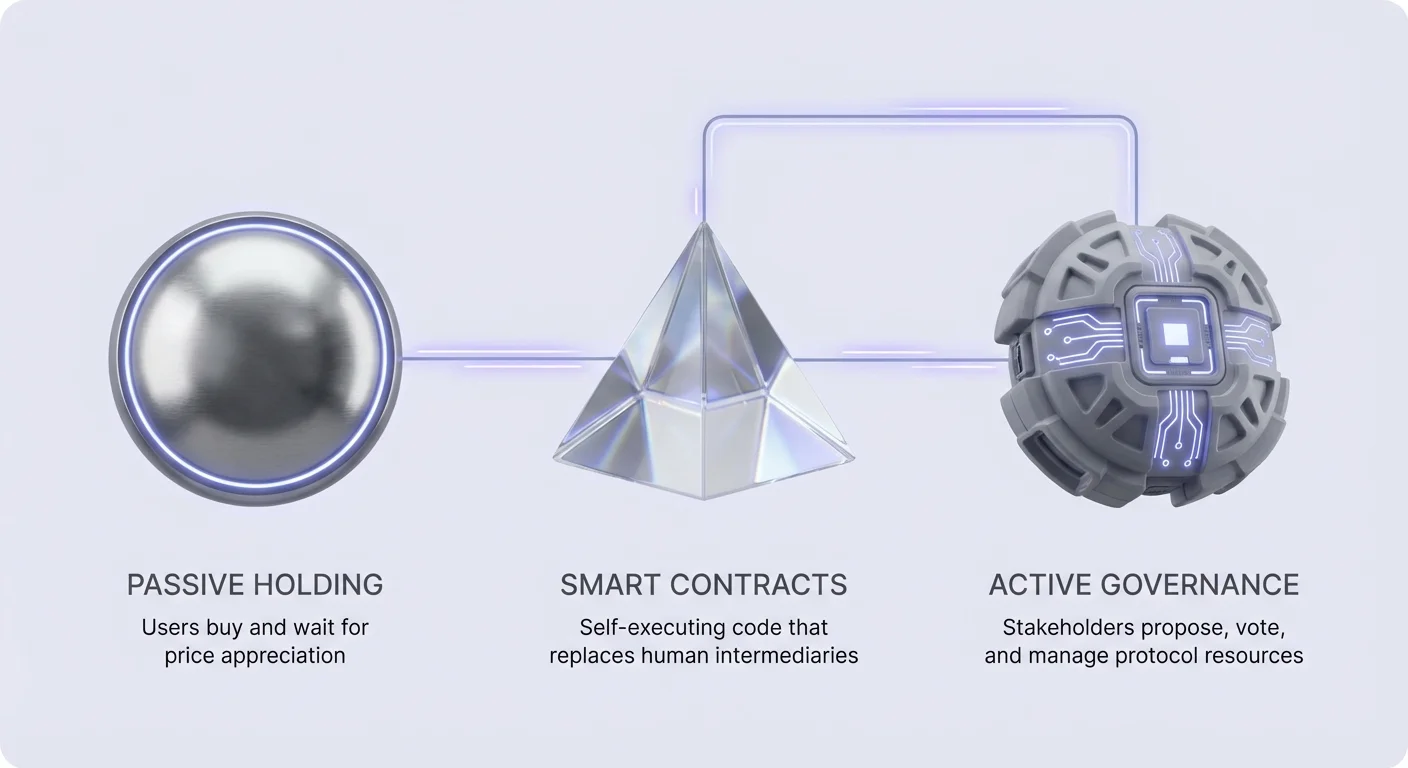
In contrast, the Web3 ecosystem is built on the principle of active participation. Through the use of cryptographic tokens, users transition from passive customers to active stakeholders. This shift effectively turns users into partial owners who share responsibility for the network's direction. This evolution is most visible in the rise of governance protocols and Decentralized Autonomous Organizations.
The Architecture of Autonomy
The Role of Smart Contracts
At the heart of this shift is the smart contract. These are self-executing agreements with the terms of the contract directly written into lines of code. In the context of governance, smart contracts replace the bylaws and legal enforcement mechanisms found in traditional corporate structures. They ensure that rules are applied transparently and without the need for human intermediaries to interpret them.
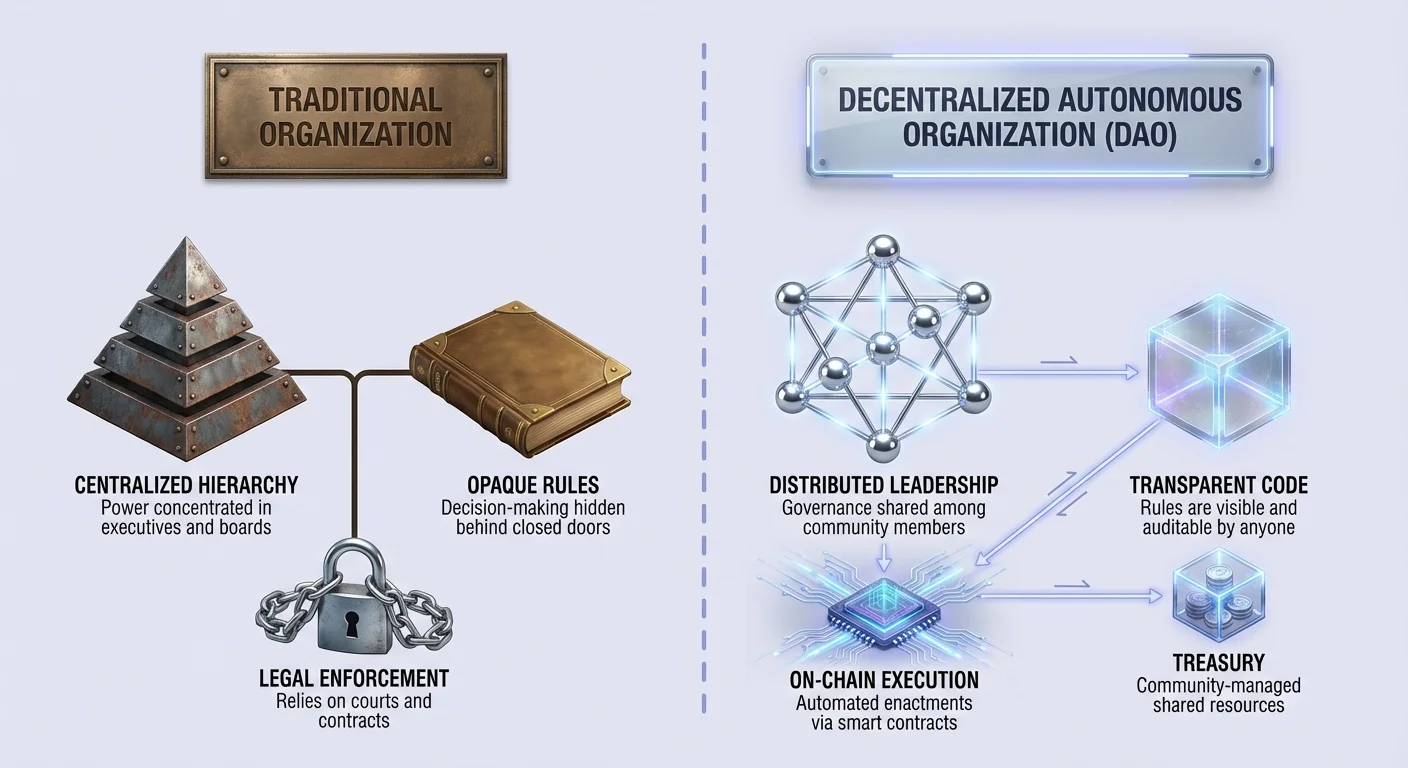
When a decision is made within a decentralized network, it is not merely a suggestion passed to a board of directors. It is often an executable command that the protocol automatically enacts once specific criteria are met. This automation removes the opacity often found in legacy institutions where decision-making processes are hidden behind closed doors.
From Intermediaries to Code
Traditional organizations rely on a hierarchy of human managers to coordinate activity and manage resources. This introduces latency, cost, and the potential for human error or corruption. Decentralized finance and governance protocols aim to flatten this structure. By relying on code to enforce rules, these systems can coordinate thousands of participants across the globe who do not know or trust one another.
The removal of the intermediary changes the cost structure of coordination. It allows for the formation of organizations that can manage significant treasuries and complex operations without a physical headquarters or legal incorporation in a specific jurisdiction. This is the foundational concept that enables network participation to mean something more than just earning interest.
Deconstructing the DAO
Organizational Structure
A Decentralized Autonomous Organization, or DAO, represents a new way to structure online communities and businesses. It is an entity where the rules of operation are encoded in smart contracts. Unlike a traditional company with a CEO and a board of directors, a DAO can feature a completely flat hierarchy. In this model, leadership is distributed among the community members rather than concentrated in the hands of a few executives.
However, not all DAOs are structureless. Some adopt stratified systems that resemble improved versions of corporate hierarchies, depending on their specific goals. The key differentiator remains the method of enforcement. In a legacy company, rules are enforced by law and employment contracts. In a DAO, they are enforced by the blockchain itself.
Treasury and Resource Management
One of the most critical functions of a DAO is the management of shared resources. Many protocols accumulate value in a treasury, often denominated in the project's native token or stablecoins. The allocation of these funds is not decided by a CFO but by the collective voice of the token holders.
Participants might vote to use treasury funds for software development, marketing initiatives, or liquidity mining rewards. This collective resource management allows the community to directly fund the initiatives they believe will bring the most value to the network. It aligns the incentives of the builders, the users, and the investors, as they are often the same people.
The Mechanics of On-Chain Governance
The Token as a Ballot
In the realm of decentralized networks, the native token often serves a dual purpose. It acts as a unit of value and as a voting instrument. Possession of these tokens grants the holder the right to propose changes or vote on existing proposals. This is often referred to as "governance rights." The weight of a vote is typically proportional to the number of tokens held, a system comparable to shareholder voting in public companies.
This mechanism ensures that those with the most financial risk, or "skin in the game," have the most significant influence over decisions. If the protocol fails due to poor governance, the value of the tokens is likely to drop, financially impacting those who voted for the bad decisions. This alignment of risk and control is central to decentralized security models.
The Proposal Lifecycle
Governance is not a chaotic free-for-all; it usually follows a structured process. It begins with a proposal, often discussed in forums or community channels. Once a consensus begins to form, the proposal is formalized and put on-chain for a vote.
During the voting period, token holders cast their ballots cryptographically. If the proposal passes the required threshold, the smart contract executes the changes. This could range from adjusting interest rate parameters in a lending protocol to upgrading the entire software architecture of the network. This process makes the evolution of the protocol transparent and verifiable by anyone with an internet connection.
Staking as a Governance Tool
Beyond Passive Rewards
Staking is frequently marketed simply as a way to earn a percentage yield, similar to interest in a savings account. However, the technical reality is that staking is a service provided to the network. In Proof of Stake (PoS) blockchains, stakers are the guardians of the ledger. They are responsible for validating transactions and securing the history of the chain.
When a user stakes their assets, they are essentially posting a security bond. They are vouching for the honesty of the validator they support. If that validator acts maliciously or fails to maintain uptime, the protocol may penalize the staker through a process known as slashing. This punitive mechanism ensures that participants remain attentive and honest.
Active Governance Participation
Staking often unlocks governance capabilities that are unavailable to passive holders. In many systems, only staked tokens are eligible to vote. This requirement filters out short-term speculators who may hold the token for only a few hours or days. It restricts governance power to those who have locked their capital for a specific duration, signaling a longer-term commitment to the project's success.
This integration of staking and governance creates a robust feedback loop. Users are incentivized to make decisions that increase the security and value of the network because their capital is locked within it. Their yield is not just a gift; it is compensation for the work of governance and the assumption of risk.
The Evolution of Restaking
Extending Security
A recent innovation known as restaking has expanded the scope of network participation. Traditionally, staked assets are locked to secure a single blockchain. Restaking allows these same assets to be repurposed to secure additional protocols simultaneously. This might include oracle networks, data availability layers, or bridges that connect different blockchains.
This concept addresses a fragmentation issue in the crypto space. New services often struggle to build a large enough network of validators to be secure. By leveraging the existing trust and economic weight of a major blockchain's validator set, these new services can bootstrap their security without issuing highly inflationary rewards to attract new capital.
Native vs. Liquid Methods
Restaking generally occurs in two forms. Native restaking involves operating a validator node and running additional software to support the new services. This requires technical expertise and hardware management. It offers direct participation in the security infrastructure of multiple networks.
For the average user, liquid restaking is the more accessible route. This involves using Liquid Staking Tokens (LSTs) which represent ownership of the underlying staked asset. These tokens can be deposited into restaking protocols, allowing users to lend their security weight to various applications while retaining some degree of liquidity. This maximizes the utility of the capital but introduces layers of complexity regarding smart contract interactions.
Risks and Responsibilities
Smart Contract Vulnerabilities
Engaging in governance and advanced staking strategies is not without peril. The primary risk factor in any decentralized application is the code itself. Because DAOs and staking protocols run on open-source software, they are visible to everyone, including potential attackers. If a hacker identifies a flaw in the smart contract logic, they may be able to drain the treasury or steal staked assets.
Audit reports from security firms mitigate this risk but do not eliminate it. Even audited code can contain subtle bugs that only appear under specific conditions. Users participating in these systems must accept that the "law" governing their funds is computer code, which is subject to human error during its creation.
Governance Attacks and Centralization
The decentralized nature of these systems can also be exploited through economic means. In a "governance attack," a malicious actor might acquire a large supply of tokens, potentially through borrowing them, to force through a proposal that harms the protocol. They might vote to transfer the treasury funds to their own wallet or change protocol parameters to favor a specific trade.
Furthermore, the concentration of tokens among a small group of insiders or early investors can lead to centralization. If a few entities hold the majority of voting power, the "decentralized" organization becomes effectively a dictatorship. This reality requires participants to remain vigilant and monitor the distribution of voting power within the communities they join.
The Broader Ecosystem of Participation
Identity and Reputation
As the ecosystem matures, participation is moving beyond simple token holdings. On-chain identity solutions are beginning to play a role in governance. By establishing a verifiable history of participation, users can build reputation scores. This could eventually lead to governance models that weigh votes based on contributions and expertise rather than just wealth.
This shift would make DAOs more meritocratic. A developer who consistently contributes code or a community member who manages documentation might earn greater voting influence than a passive whale. This evolution is crucial for the long-term sustainability of decentralized organizations, as it incentivizes active labor and intellectual contribution alongside capital provision.
Financial Derivatives and Markets
The financial layer remains a critical component of how these networks operate. Decentralized exchanges and derivative markets provide the liquidity necessary for governance tokens to have value. Without liquid markets, the economic incentives that drive staking and security would collapse.
Prediction markets also intersect with governance. They can be used to gauge the community's sentiment regarding the potential outcome of a proposal. Before a vote is cast, a prediction market could signal whether the market believes a specific change will increase or decrease the token's value. This adds an informational layer to the decision-making process, utilizing collective intelligence to guide governance.
Comparing Participation Models
To understand the transition users make when entering the DeFi space, it is helpful to contrast the passive holding of assets with the active engagement required by governance and DAO participation. The table below outlines the fundamental differences between these two approaches to crypto assets.
| Feature | Passive Holding | Active Governance |
|---|---|---|
| Primary Goal | Price Appreciation | Protocol Direction |
| Action Required | Buy and Hold | Vote and Propose |
| Risk Profile | Market Volatility | Smart Contract Risk |
| Reward Type | Capital Gains | Protocol Yield & Influence |
| Network Impact | Minimal | Security & Upgrades |
The distinction between holding an asset and participating in a network is significant. Passive holding relies entirely on external market forces to generate value. The holder is a passenger in the vehicle. Active participation places the user in the driver's seat, allowing them to influence the route and maintenance of the vehicle. While this requires more effort and understanding, it aligns with the core ethos of Web3 technologies: user sovereignty.
Conclusion
The narrative of cryptocurrency is evolving from one of financial speculation to one of organizational innovation. While yield and staking rewards remain attractive incentives for attracting capital, the true power of the technology lies in its ability to coordinate human activity without centralized intermediaries. Through DAOs and governance protocols, users are granted the tools to build, manage, and secure the platforms they utilize daily.
However, this power comes with significant responsibility. The risks associated with smart contracts, the potential for governance attacks, and the complexities of restaking require a vigilant and educated user base. As these systems mature, the definition of what it means to be a "user" will continue to expand. It will no longer imply merely consuming a service but actively maintaining and governing the digital infrastructure of the future.
True decentralization requires users to transition from passive investors into active guardians of the protocols they utilize.