
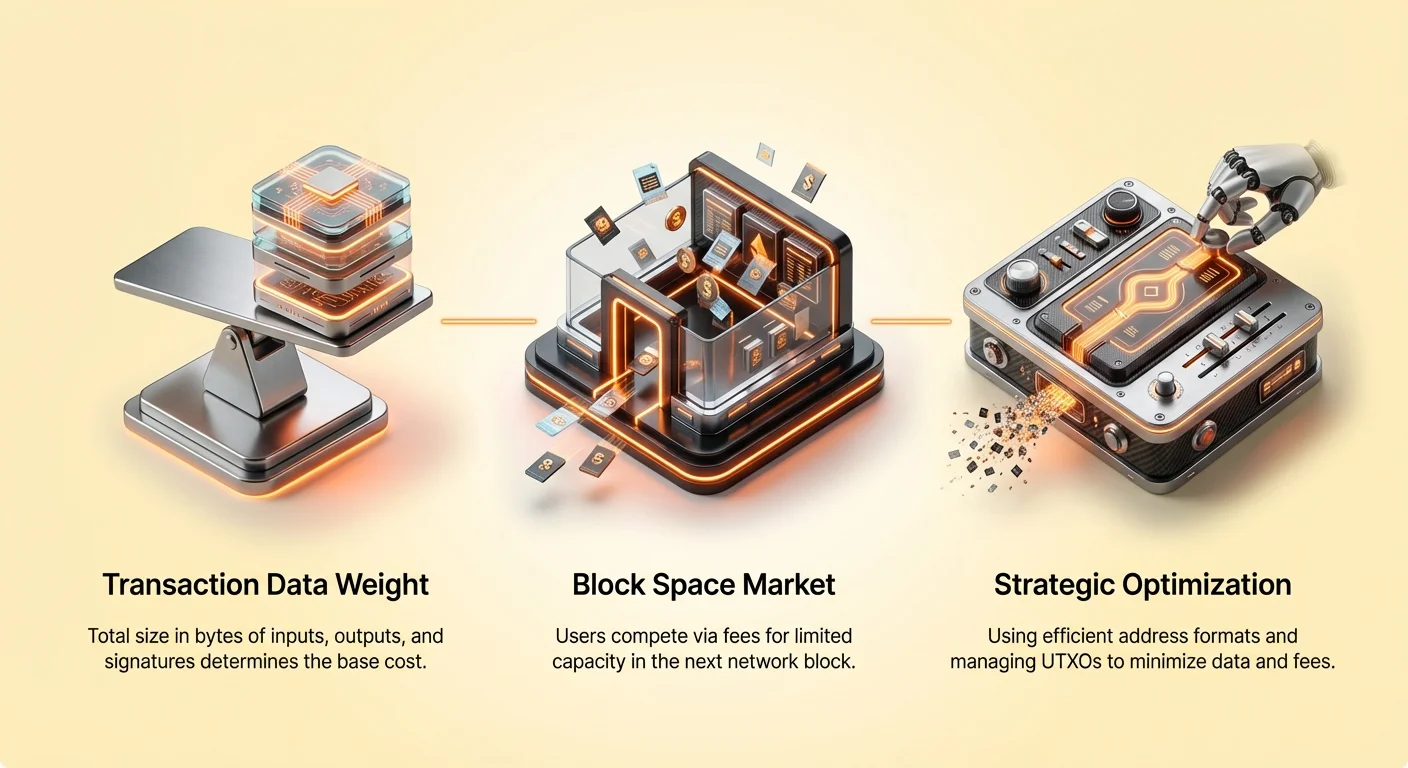
Sending bitcoin involves far more than simply entering an amount and selecting a destination. While the user interface of a modern wallet makes the process appear instantaneous and simple, the underlying mechanics are complex. Understanding these mechanics is essential for anyone looking to use the network efficiently. When you send funds, you are engaging in a global market for block space. This market determines how quickly your transaction is processed and how much it costs.
To navigate this environment effectively, users must understand the relationship between data size and fees. Unlike traditional banking where fees are often flat or based on the transfer amount, Bitcoin fees are derived from data weight. This distinction creates unique opportunities for optimization. By learning how the network views your transaction data, you can make strategic decisions that save money and improve reliability.
The ability to manage these variables largely depends on the type of software you use. Self-custodial tools provide the necessary controls to adjust fees and manage the digital "change" associated with your holdings. This level of management allows users to prioritize speed when necessary or minimize costs during periods of high network activity. Mastering these concepts transforms a passive user into an active participant who can navigate the blockchain with precision and confidence.
The Mechanics of Transaction Data
The Bitcoin network operates on a public ledger system that tracks the movement of value through specific inputs and outputs. When a user initiates a transfer, they are not physically moving coins from one device to another. Instead, they are broadcasting a message to the network. This message requests an update to the ledger, reassigning ownership of specific units from one address to another.
How the Ledger Updates Ownership
Every transaction consists of data that must be verified and stored by miners. This process consumes resources, specifically storage space within a block. The blockchain has a limited capacity for how much data can be included in each new block, which is generated roughly every ten minutes. Because space is scarce, miners prioritize transactions that offer the highest compensation per unit of data.
This compensation is known as the network fee. It acts as an incentive for miners to include a specific transaction in the next block. If a user attaches a fee that is too low relative to the current demand for block space, the transaction may be ignored temporarily. It sits in a waiting area known as the mempool until market rates drop or the user increases the fee.
The Role of Digital Signatures
Security is maintained through cryptographic keys. A wallet manages these keys, which are used to sign transactions. The private key acts like a password, granting the authority to spend funds associated with a specific public address. When a transaction is broadcast, the network uses the corresponding public key to verify that the signature is valid without ever revealing the private key itself.
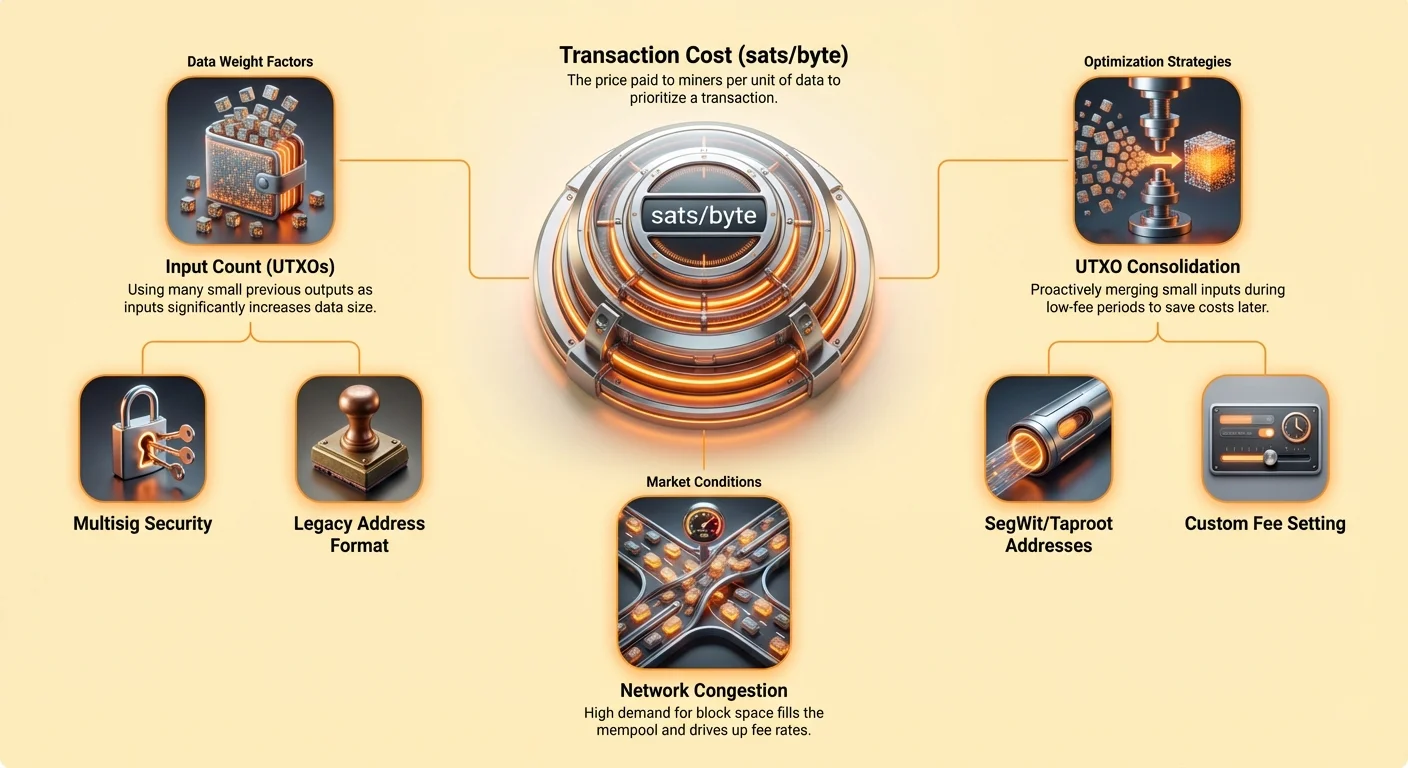
This signing process adds to the data weight of the transaction. Complex security arrangements, such as those requiring multiple signatures, increase the amount of data required to authorize a transfer. Consequently, the security structure of a wallet directly impacts the cost of sending funds. Users must balance their need for advanced security with the understanding that more complex locking mechanisms result in higher transaction fees.
The UTXO Model Explained
To understand fee strategy, one must first understand the Unspent Transaction Output (UTXO) model. This is the system Bitcoin uses to track ownership. It functions differently from a traditional bank account which simply displays a total balance. In the UTXO model, a user's balance is actually the sum of discrete "chunks" of bitcoin they have received in the past and not yet spent.
The Cash Note Analogy
The system is best understood by comparing it to physical cash. Imagine you have a wallet containing a $5 bill, a $10 bill, and a $20 bill. Your total balance is $35, but you do not have a single "$35 bill." If you want to pay someone $15, you cannot simply transmit "15" into existence. You must select the $20 bill to hand over.
In this scenario, the recipient keeps $15, and you receive $5 back as change. The blockchain works in a virtually identical manner. If a user holds 1 BTC that originated from a single previous transaction, they possess one UTXO worth 1 BTC. If they wish to send 0.1 BTC to a friend, they must spend the entire 1 BTC input. The network protocol directs 0.1 BTC to the friend's address and creates a new output of 0.9 BTC that is sent back to the sender's wallet as change.
Inputs and Outputs
A transaction is constructed by gathering inputs (the UTXOs being spent) and creating outputs (the destination and the change). The number of inputs and outputs directly correlates to the size of the transaction in bytes. A transaction that gathers ten small inputs to pay for one large purchase is significantly larger in data terms than a transaction that uses a single large input.
For example, a miner who receives a 6.25 BTC block reward has a single, clean input. If they send 1 BTC to another party, the transaction is simple: one input (6.25 BTC) and two outputs (1 BTC to the recipient, 5.25 BTC back to the miner). This transaction consumes minimal data. Conversely, a user who has received one hundred separate payments of 0.01 BTC has the same total balance but a much heavier wallet in terms of data. Spending that 1 BTC requires referencing all one hundred previous transactions, resulting in a massive data footprint and a much higher fee.
Fee Calculation and Market Dynamics
Network fees are not determined by the dollar value of the transaction. Sending one million dollars worth of bitcoin can cost less than sending one hundred dollars, provided the million-dollar transaction uses fewer inputs. The fee is calculated based on the size of the transaction in bytes, usually expressed in satoshis per byte (sats/byte). A satoshi is the smallest unit of bitcoin, representing one hundred millionth of a single coin.
Supply and Demand for Block Space
The fee rate fluctuates based on network congestion. When many users are trying to transact simultaneously, they compete for the limited space in the next block. This competition drives up the price per byte. During these periods, users who need their transactions confirmed quickly must pay a premium. Conversely, when the network is quiet, the demand for space drops, and transactions can be processed for a minimal fee.
Wallet software typically estimates these fees automatically. The software scans the current state of the network and suggests a fee rate likely to result in confirmation within a desired timeframe. However, blind reliance on automated estimates can sometimes lead to overpaying. Advanced users monitor the mempool to see the backlog of unconfirmed transactions and set their fees manually to match their urgency.
Customizing Transaction Speed
Most self-custodial wallets offer three standard tiers for fee settings. These presets allow users to choose between cost and speed without needing to perform complex calculations. The "Fastest" setting bids aggressively to get into the very next block, usually confirming in under 20 minutes. This is ideal for time-sensitive payments but comes with the highest price tag.
The "Fast" or standard setting aims for confirmation within the next three blocks, or roughly 30 minutes. This strikes a balance between reliability and cost. Finally, an "Eco" or slow setting might aim for confirmation within six blocks (one hour). This option allows users to pay significantly less if they are willing to wait. Users should be cautious not to set the fee too low, as this can result in the transaction getting stuck in the mempool for hours or even days until network traffic subsides.
| Fee Setting | Estimated Confirmation | Cost Profile |
|---|---|---|
| Fastest | ~10-20 Minutes | High Premium |
| Standard | ~30 Minutes | Market Average |
| Eco | ~60+ Minutes | Low Cost |
Address Formats and Efficiency
The type of Bitcoin address used also influences transaction efficiency. Over time, the network has upgraded to support newer address formats that use block space more effectively. Legacy addresses, which typically start with the number "1", are the original format. While fully functional, transactions originating from these addresses occupy the most space and are the most expensive to use.
SegWit and Reduced Data Weight
An upgrade known as Segregated Witness (SegWit) introduced a new way to structure transaction data. Addresses associated with this upgrade often start with "3" or "bc1". The primary benefit of SegWit is that it separates, or segregates, the signature data from the rest of the transaction. This signature data is then discounted when calculating the transaction's weight.
By using SegWit addresses, users can reduce the effective size of their transactions. Since fees are paid per unit of data, a smaller effective size translates to lower fees for the same transaction speed. This efficiency gain is automatic for users who adopt wallets that support these modern address formats. It represents a passive way to save on fees without needing to adjust manual settings for every transfer.
Taproot and Future Optimization
Further enhancements, such as Taproot, continue to improve privacy and efficiency. Taproot addresses, which start with "bc1p", offer additional benefits, particularly for complex transactions. They make multi-signature transactions and other complex smart contracts look identical to standard transactions on the blockchain. This uniformity improves privacy while potentially offering further reductions in data weight for advanced use cases.
Adopting these newer formats helps the entire network scale. When individual users consume less block space, more transactions can fit into each block. This collective efficiency helps keep fee pressure lower for everyone. Therefore, choosing a wallet that defaults to SegWit or Taproot addresses is a key component of an optimal sending strategy.
UTXO Management and Consolidation
Managing UTXOs is a proactive strategy to minimize future costs. As mentioned earlier, accumulating many small inputs (often called "dust") can become problematic. If fees rise significantly, the cost to spend a small UTXO might exceed the value of the UTXO itself. For instance, if you have a UTXO worth $5 but the fee to include that input in a transaction is $6, that money is effectively unspendable until fees drop.
The Strategy of Consolidation
To prevent this, users can perform consolidation transactions during periods of low network fees. Consolidation involves sending all of your small UTXOs to yourself in a single transaction. This action consumes the many small inputs and creates one large output. You are essentially exchanging a pile of loose change for a single large denomination bill.
Performing this maintenance when fees are low—perhaps on weekends or during overnight hours—prepares the wallet for high-fee environments. When the user later needs to send a transaction during a congestion spike, they will only need to spend one single input. This keeps the data size of that urgent transaction small, ensuring the fee remains manageable even when rates are high.
Privacy Implications of Consolidation
While consolidation is excellent for fee management, it has implications for privacy. Combining multiple inputs links them together on the public ledger. If one UTXO is known to be associated with a specific identity and it is combined with another anonymous UTXO, an observer can infer that both belong to the same entity.
To mitigate this, users concerned with privacy should be selective about which inputs they combine. Some advanced wallets offer "coin control" features. This allows the user to manually select which specific UTXOs to use for a given transaction. By carefully managing which inputs are merged, users can maintain a separation of identities while still optimizing their wallet's structure for future spending.
Wallet Types and Fee Control
The ability to manage fees and UTXOs relies entirely on the wallet software chosen. Not all wallets provide the same level of control. Custodial wallets, such as those found on centralized exchanges, often obscure these mechanics entirely. When you withdraw from an exchange, the exchange acts as the sender. They determine the fee and often charge the user a flat rate that is higher than the actual network cost to cover their overhead.
Self-Custody and Autonomy
In contrast, self-custodial wallets place the user in direct control of the blockchain interaction. Because the user holds the private keys, they have the authority to construct the transaction exactly as they wish. This includes setting the precise fee rate in sats/byte.
Self-custodial apps typically provide the interface for fee customization discussed earlier (Fast, Eco, Custom). They also ensure that the user is not subject to arbitrary delays or withdrawal limits imposed by third parties. This autonomy is crucial for optimal sending, as it allows the user to react to market conditions in real-time rather than relying on a custodian's fixed policy.
Security in Self-Custody
With this control comes the responsibility of security. Self-custodial wallets require the user to back up their recovery phrase—a sequence of 12 to 24 random words. This phrase can regenerate the private keys if the device is lost. Proper management of this phrase is the single most important security step for a self-custody user.
If the recovery phrase is lost, the funds are unrecoverable. If the phrase is exposed to a malicious actor, the funds can be stolen. Therefore, while self-custody offers the best tools for fee management and transaction optimization, it requires a disciplined approach to security that custodial solutions do not demand of their users.
Multisig Wallets and Transaction Size
For users managing significant value, standard single-signature wallets may not offer sufficient security. This leads to the adoption of multi-signature (multisig) wallets. A shared or multisig wallet requires approval from multiple private keys to authorize a transaction. For example, a "2-of-3" wallet creates three keys but requires any two of them to sign a transaction.
Complexity Increases Data
While multisig arrangements eliminate the single point of failure associated with standard wallets, they increase the data size of every transaction. A transaction that must carry two or three digital signatures is naturally larger than one carrying a single signature. This means that multisig transactions will fundamentally cost more in network fees than standard transactions, assuming the same number of inputs.
Users implementing multisig setups must factor this premium into their fee strategy. The enhanced security against theft or loss of keys is generally considered worth the additional cost for large amounts. However, for frequent, small daily transactions, a multisig structure may be inefficient due to the consistently higher fee burden.
Shared Decision Making
Beyond the technical data weight, shared wallets introduce a human element to the sending process. Transferring funds from a shared wallet takes more time because it requires coordination between participants. A transaction request must be created and then shared with other key holders for approval.
This latency is a trade-off for the governance benefits. It is useful for organizational treasuries or family savings where oversight is desired. However, in a scenario where speed is critical, the need for multiple human approvals can be a bottleneck. Optimization in this context involves ensuring all participants are available and know how to sign transactions promptly when required.
Avoiding Common Pitfalls
Even with a solid understanding of fees and UTXOs, users can make mistakes. One common error is panic-bumping fees. When a transaction is pending, impatient users may attempt to replace it with a significantly higher fee to force it through, often overpaying in the process. Patience is often the best financial strategy; unless a transaction is time-critical, it will eventually confirm as network demand ebbs and flows.
Reading the Wrong Signals
Another pitfall is misunderstanding the fee unit. Users sometimes look at the total dollar amount of the fee rather than the sat/byte rate. A $10 fee might look high, but if the transaction involves consolidating fifty inputs, $10 might actually be too low to get confirmed. Conversely, a $1 fee might be excessive for a tiny, simple transaction. Always evaluating the cost in terms of data density (sats/byte) provides the true picture of the market.
Address Verification
Finally, optimal sending is futile if the funds go to the wrong place. Bitcoin transactions are irreversible. A mistake in the destination address results in permanent loss. Users should always verify the alphanumeric string or QR code carefully. While this does not impact the fee strategy directly, it is the fundamental baseline for successful transmission. No amount of fee optimization can recover funds sent to a nonexistent or incorrect address.
Conclusion
Optimal sending is a skill that combines technical knowledge with market awareness. By understanding that Bitcoin fees are a product of data size and network demand, users can make informed choices that save money and ensure reliability. The UTXO model serves as the foundation for this understanding, revealing why transaction costs vary so wildly even when transfer amounts remain the same. Managing these digital "notes" through consolidation during low-fee periods is a hallmark of an advanced user.
The choice of wallet software acts as the enabler for these strategies. Self-custodial solutions unlock the necessary controls for fee customization and input management, while modern address formats like SegWit and Taproot provide passive efficiency gains. Balancing these technical efficiencies with privacy needs and security models, such as multisig, allows for a tailored approach to asset management. Whether prioritizing speed for urgent payments or minimizing costs for long-term storage, the power to optimize lies in understanding the underlying mechanics of the blockchain.
Strategic management of transaction data and timing is the key to minimizing costs and maximizing efficiency on the Bitcoin network.