
The creation of alternative cryptocurrencies through the process of forking represents one of the most fascinating aspects of open-source software. Bitcoin, as the pioneer of blockchain technology, laid a foundation that has been replicated and modified countless times to address specific needs or technical philosophies. While many of these divergent paths have faded into obscurity, Litecoin stands out as a resilient and functional example of how a fork can establish its own distinct identity and utility within the broader digital asset ecosystem.
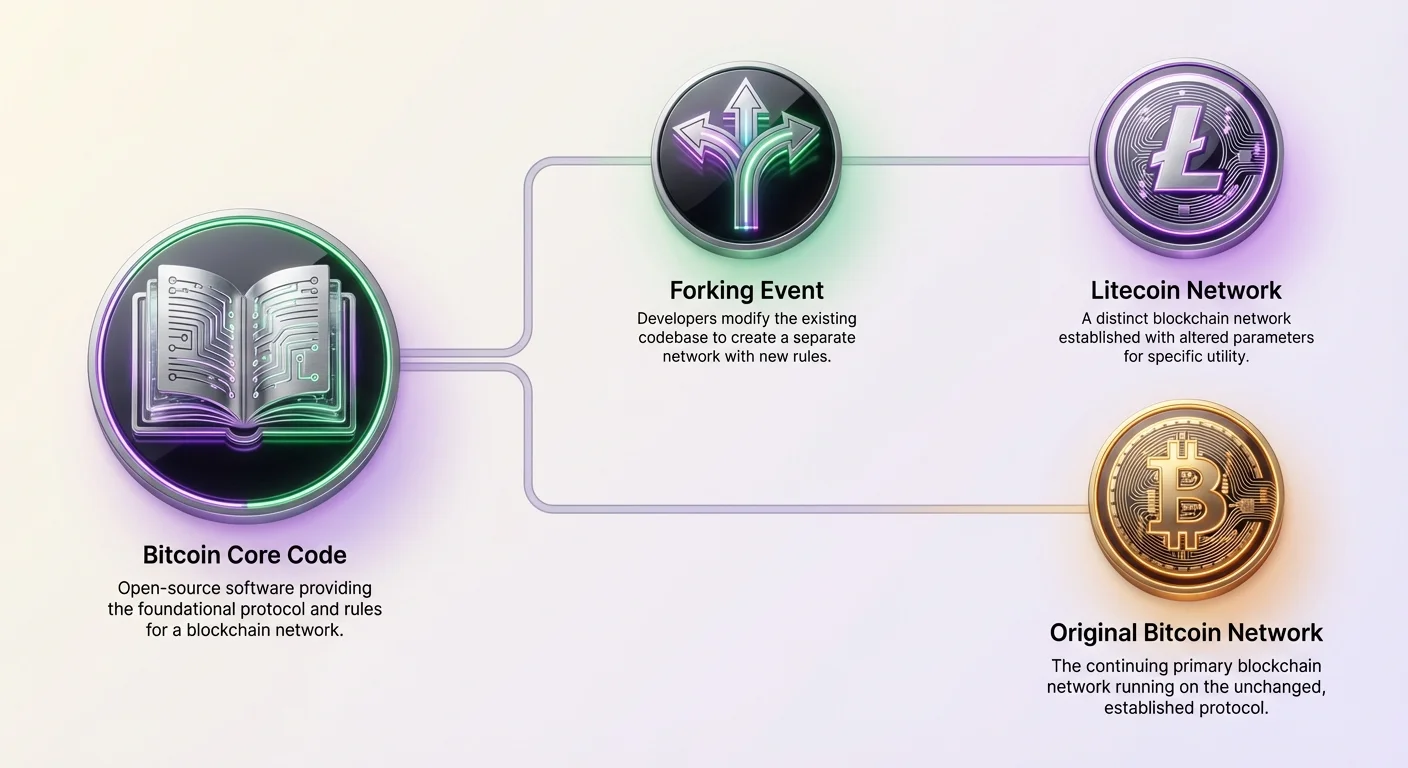
A fork occurs when developers take the existing code of a blockchain protocol and modify it to create a separate network. This process allows for experimentation with different technical parameters without risking the stability of the original chain. In the case of Litecoin, the modifications were not born out of hostility or a desire to replace Bitcoin. Instead, the goal was to create a complimentary system that could handle smaller, more frequent transactions with greater efficiency.
This relationship is often described using the metaphor of precious metals. If Bitcoin is viewed as the digital equivalent of gold—a store of value suited for large settlements—Litecoin was designed to be the digital silver. This distinction is more than just a marketing slogan. It is rooted in the specific technical choices made during the network's inception, particularly regarding transaction speed, cryptographic algorithms, and total supply caps.
Analyzing the utility of such a fork requires looking beyond price action and examining the fundamental engineering decisions. By altering key variables like block generation time and hashing algorithms, developers can tailor a blockchain for specific use cases. Litecoin demonstrates that a fork can successfully coexist with its parent chain by serving a different economic niche, specifically focusing on the velocity of money and ease of transfer for everyday commerce.
The Mechanics of Blockchain Forks
Understanding Code Divergence
At its core, a blockchain fork is a divergence in the rules governing a network. Since Bitcoin is open-source, its code is publicly available for anyone to view, copy, and modify. A fork happens when a developer takes this source code and creates a new version with altered protocols. This new version splits off to form a separate blockchain history starting from a specific point in time.
The changes implemented during a fork can vary significantly in scope. Some forks are minor updates that remain compatible with the old system, known as soft forks. Others, known as hard forks, introduce radical changes that make the new chain incompatible with the previous version. This results in two distinct networks running in parallel, each with its own native currency and community of validators.
The Purpose of Forking
The primary motivation behind creating a fork is often to solve perceived limitations in the original protocol. In the early years of cryptocurrency, debates frequently centered on scalability and the speed of transactions. Developers sought ways to process more data per second without compromising decentralization. Forking provided a direct avenue to test these theories in a live environment.
For Litecoin, the driving force was the desire to improve transaction confirmation times and democratize the mining process. By launching a separate network, the creators could implement a faster block time and a different mining algorithm. This allowed them to observe how these changes affected network security and user experience without disrupting the operations of the main Bitcoin network.
Litecoin’s Origins and Strategic Vision
The Founding Philosophy
Litecoin was launched in 2011 by Charlie Lee, a former engineer at Google. His vision was not to compete directly with Bitcoin for the title of supreme store of value. Instead, he aimed to solve the liquidity and speed issues that made Bitcoin cumbersome for small, daily transactions. The project was released as a fork of the Bitcoin Core client, inheriting the robust security features of the original codebase while tweaking parameters for speed.
This approach allowed Litecoin to benefit from Bitcoin's established stability while carving out a unique market position. The launch was handled fairly, without a pre-mine, meaning the creator did not allocate coins to himself before the public release. This decision helped build trust within the early crypto community, establishing Litecoin as a decentralized project rather than a centralized scheme.
Complementary Utility
The strategic positioning of Litecoin as a complement to Bitcoin was crucial for its survival. Many other forks attempted to position themselves as "better versions" of Bitcoin, which often led to toxic community splits and eventual failure. Litecoin avoided this trap by acknowledging Bitcoin's dominance as a settlement layer while offering itself as a more agile medium of exchange.
This cooperative narrative helped Litecoin gain widespread adoption on exchanges and payment processors early on. It became a liquidity bridge, allowing traders to move funds between platforms quickly when Bitcoin networks were congested. The utility here was practical and immediate, proving that a fork could add value to the ecosystem by relieving pressure on the primary chain.
Technical Architecture and Mining
The Scrypt Algorithm
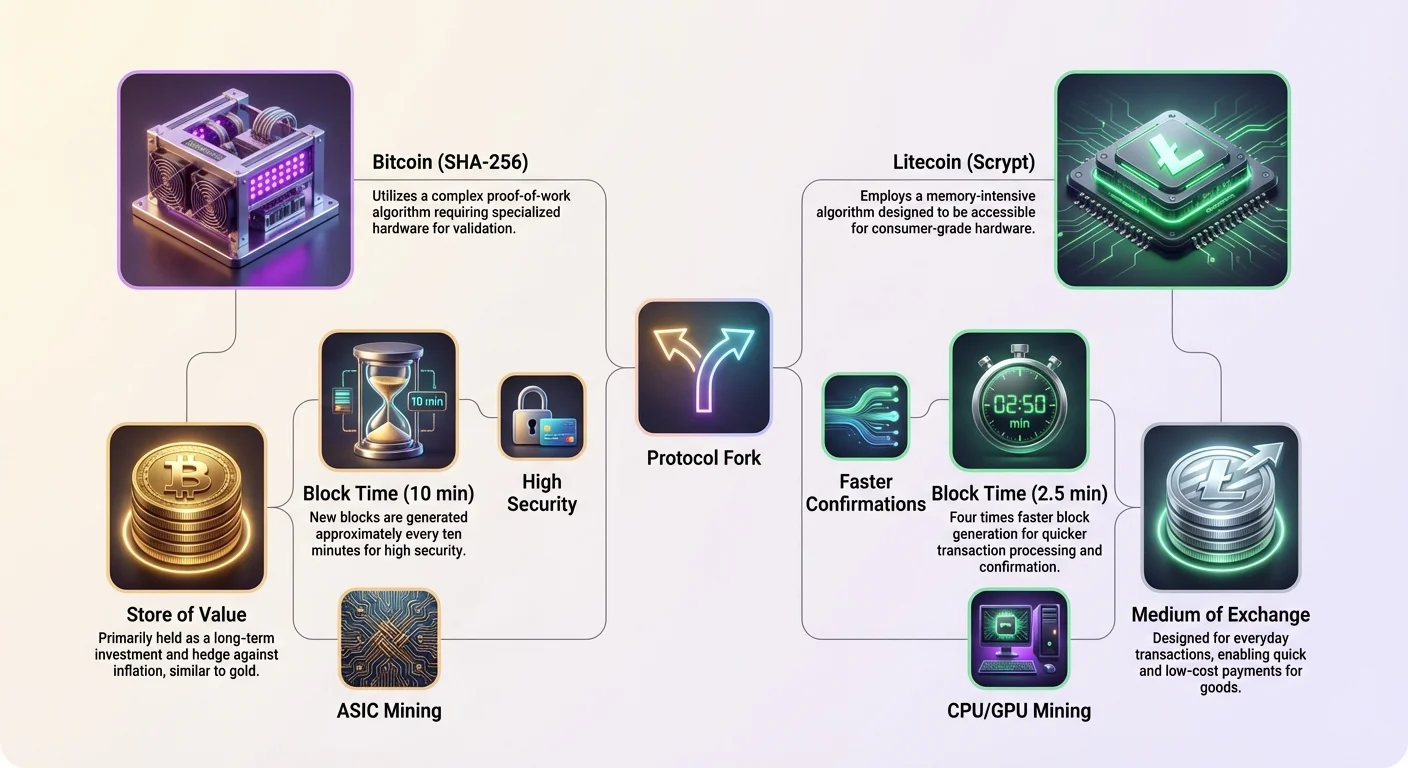
One of the most significant technical deviations Litecoin made was the adoption of the Scrypt hashing algorithm. Bitcoin uses SHA-256, a complex algorithm that requires substantial computational power to solve. As Bitcoin grew, mining became dominated by specialized hardware known as ASICs (Application-Specific Integrated Circuits). This industrialization pushed individual hobbyists out of the mining space.
Scrypt was chosen because it is more memory-intensive than SHA-256. The initial intention was to make it resistant to ASIC development, allowing users to mine Litecoin using consumer-grade hardware like CPUs and GPUs. While ASICs were eventually developed for Scrypt as well, the initial period of resistance helped distribute the currency to a wider base of users and enthusiasts, fostering a decentralized network topology from the start.
Block Generation Speed
The speed at which a blockchain confirms transactions is dictated by its block time. Bitcoin produces a new block roughly every 10 minutes. While this provides a high level of security for large transactions, it can be slow for point-of-sale purchases. A merchant selling coffee cannot easily wait 10 to 20 minutes for a transaction to be confirmed.
Litecoin reduced the block generation target to 2.5 minutes, making it four times faster than Bitcoin. This reduction dramatically improves the user experience for everyday payments. The faster block time also reduces the risk of double-spending attacks for merchants who require only one or two confirmations, as these can be achieved in a fraction of the time required on the Bitcoin network.
Analyzing Scarcity and Supply Dynamics
The concept of scarcity is central to the value proposition of cryptocurrencies. Bitcoin is famous for its hard cap of 21 million coins, a feature that mimics the limited supply of gold. When creating Litecoin, the developers had to adjust this parameter to align with the faster block production rate. They settled on a supply cap that follows a logical multiple of Bitcoin’s model.
Litecoin has a maximum supply of 84 million coins. This is exactly four times the supply of Bitcoin, mirroring the four-fold increase in transaction speed (2.5 minutes vs. 10 minutes). This mathematical symmetry maintains the same disinflationary issuance schedule as Bitcoin, with block rewards halving approximately every four years.
This increased supply makes individual units of Litecoin more abundant and psychologically more accessible for smaller purchases. A user might hesitate to spend a fraction of a Bitcoin on a minor item, but spending whole units of Litecoin feels more natural for commerce. This supports the narrative of Litecoin serving as "cash" for spending, while Bitcoin serves as "gold" for saving.
Despite the larger supply, Litecoin remains strictly scarce. Once the 84 million limit is reached, no new coins will ever be created. This preserves the deflationary properties that attract investors to crypto assets, ensuring that the currency cannot be devalued by arbitrary inflation or policy changes by a central authority.
Functionality in Payments and Remittances
Transaction Fee Economics
A critical component of utility for any payment network is the cost of usage. When blockchain networks become congested, users compete to have their transactions included in the next block by offering higher fees to miners. On the Bitcoin network, fees can spike during periods of high demand, making small transactions economically unviable.
Litecoin’s architecture, with its faster block times and larger capacity, typically results in significantly lower fees. This low-cost structure is essential for its role as a transactional currency. It allows users to send micropayments or pay for low-cost services without the transaction fee consuming a large percentage of the transfer value. This efficiency makes Litecoin a preferred option for peer-to-peer transfers where cost is a primary concern.
Cross-Border Remittances
The combination of speed and low fees makes Litecoin particularly effective for the remittance market. Sending money across international borders using traditional banking rails is notoriously slow and expensive, often taking days to settle and incurring high currency conversion fees. Cryptocurrencies offer a solution, but only if the network is reliable and liquid.
Litecoin has established deep liquidity across almost every major cryptocurrency exchange and payment processor globally. This ubiquity means it can be easily converted into local fiat currency in most countries. For a migrant worker sending funds home, using Litecoin can mean the recipient gets the money in minutes rather than days, with more of the principal amount remaining intact due to minimal network costs.
Privacy and Fungibility Enhancements
Fungibility is a vital property of sound money. It means that one unit of currency is indistinguishable from another. In transparent public ledgers, transaction histories can sometimes be traced, potentially "tainting" coins that were involved in illicit activities. This transparency, while good for auditability, can pose risks to user privacy and fungibility.
Litecoin has taken proactive steps to address this through the integration of the MimbleWimble Extension Blocks (MWEB). This upgrade introduces optional confidentiality features to the network. It allows users to conceal transaction amounts and sender addresses for specific transfers, providing a layer of financial privacy similar to physical cash.
The implementation of MWEB distinguishes Litecoin from Bitcoin, which has been slower to adopt privacy features on its main layer. By offering this functionality, Litecoin enhances its utility as a medium of exchange. Merchants and consumers often prefer not to broadcast their entire financial history to the world when making a simple purchase, and MWEB provides a solution to this legitimate need.
The "Testnet" Narrative and Upgrades
Adopting Segregated Witness (SegWit)
One of Litecoin's unique roles in the ecosystem has been serving as a live testing ground for major protocol upgrades. Because Litecoin shares much of Bitcoin's codebase but has a smaller market capitalization, it carries less systemic risk. This allows its community to reach consensus on technical changes more rapidly.
A prime example was the activation of Segregated Witness (SegWit). This upgrade was designed to fix transaction malleability and improve block capacity. While the debate raged in the Bitcoin community for years, Litecoin successfully activated SegWit first. This successful deployment provided valuable data and confidence to Bitcoin proponents, helping to pave the way for Bitcoin’s eventual adoption of the same technology.
The Lightning Network
Following the activation of SegWit, Litecoin was also able to implement the Lightning Network. This Layer 2 scaling solution allows for instant, nearly free transactions by creating payment channels between users. While primarily developed for Bitcoin, Litecoin’s integration of Lightning demonstrates its commitment to staying at the forefront of payment technology.
The compatibility of both networks with Lightning also opens the door for atomic swaps. This technology enables users to trade Bitcoin for Litecoin directly across the blockchain without needing a centralized exchange. Such interoperability further cements the symbiotic relationship between the two networks, allowing Litecoin to function as a high-speed on-ramp or off-ramp for the Bitcoin economy.
Comparing Key Metrics
To fully appreciate the differences between these two networks, it is helpful to view their core technical specifications side by side. These parameters define the economic and operational reality of each chain.
| Feature | Bitcoin | Litecoin |
|---|---|---|
| Consensus Algorithm | SHA-256 (Proof of Work) | Scrypt (Proof of Work) |
| Maximum Supply | 21 Million | 84 Million |
| Block Time | 10 Minutes | 2.5 Minutes |
This comparison highlights the deliberate engineering choices made by Litecoin’s developers. The Scrypt algorithm dictates the mining hardware landscape, preventing direct competition with Bitcoin miners. The increased supply and faster block times are calibrated to support higher transaction volume and lower individual unit price, optimizing the network for daily spending rather than long-term hoarding.
Conclusion
The history of cryptocurrency is littered with forks that promised revolution but delivered only fragmentation. Litecoin stands apart as a case study in successful differentiation. By identifying specific limitations in the parent protocol—namely speed and mining centralization—and adjusting technical parameters to address them, it carved out a durable niche. Its longevity serves as proof that a fork need not be a competitor to be successful; it can instead be a valuable partner in a multi-chain ecosystem.
As the digital asset landscape evolves, the utility of "boring" but reliable networks becomes increasingly apparent. While newer blockchains promise complex smart contract capabilities and high throughput, they often sacrifice decentralization or stability. Litecoin’s steadfast focus on doing one thing well—secure, fast, and cheap payments—ensures it remains a vital component of the crypto infrastructure. It validates the concept that open-source forks are a feature, not a bug, enabling specialization and resilience.
Forks like Litecoin demonstrate that altering technical parameters can create specialized tools that complement, rather than cannibalize, the original network.