
For over a decade, Bitcoin has successfully served as the world’s most secure decentralized ledger for value transfer. Its core design prioritized simplicity, reliability, and security above all else. This focus ensured that Bitcoin maintained its status as "digital gold," but it also limited its ability to execute complex, self-executing agreements—known as smart contracts.
The world of decentralized finance (DeFi), however, relies on smart contracts to automate lending, exchanges, and financial instruments. This has led to a fundamental question within the Bitcoin ecosystem: How can we expand Bitcoin’s functionality to support these complex applications without sacrificing the security and decentralization that make Bitcoin unique?
This debate has split development efforts into two distinct architectural paths, each representing a different philosophical trade-off. One path advocates for cautious, minimal changes to the core protocol (Layer 1 Opcode Upgrades), while the other promotes building entirely new, feature-rich ecosystems parallel to Bitcoin (Layer 2 Sidechains). Understanding this comparison is crucial for grasping the future landscape of Bitcoin-based innovation.
The Foundation: Bitcoin Script and Its Limits
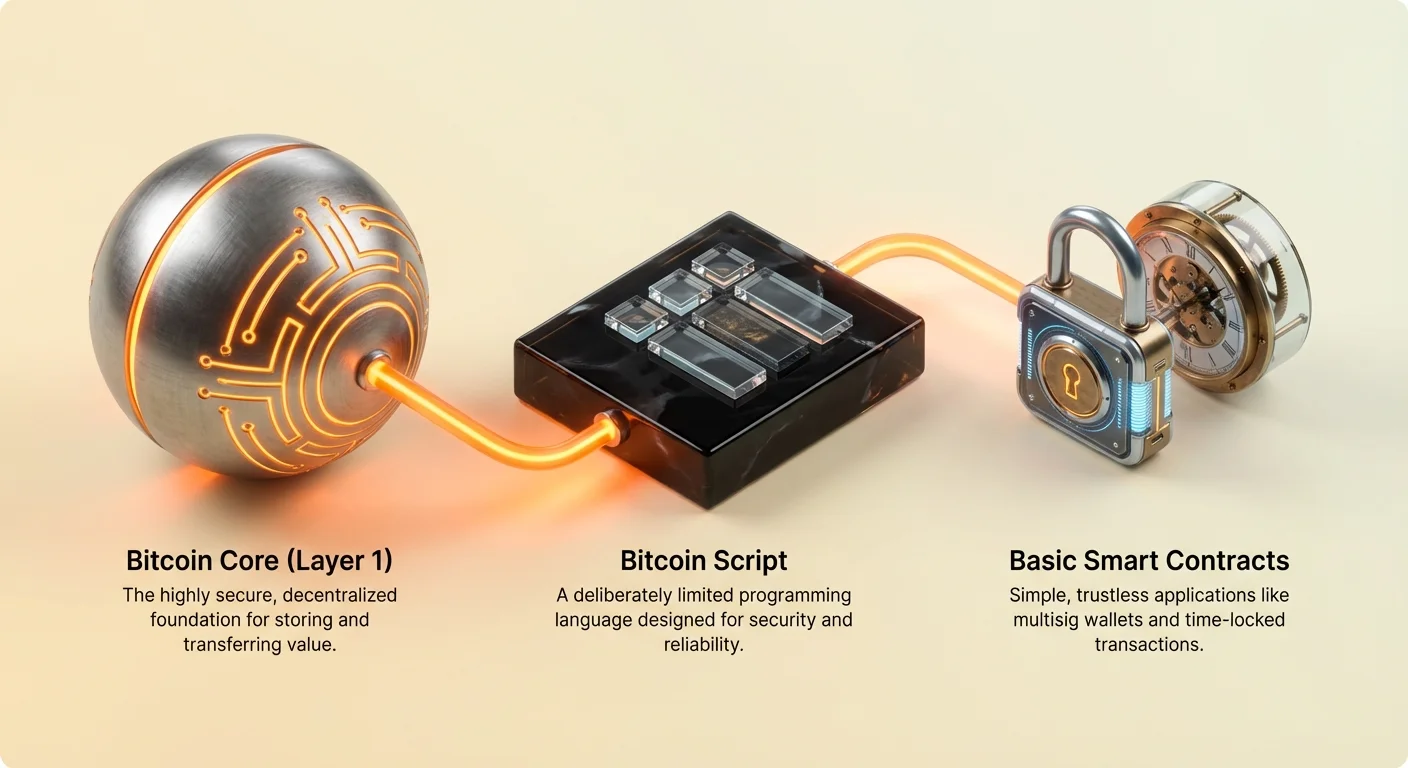
Before exploring scaling solutions, it is essential to understand why Bitcoin requires upgrades in the first place. Bitcoin’s native programming language is called Bitcoin Script. While it handles basic financial logic perfectly, it is deliberately restricted.
Intentional Simplicity: Turing Incompleteness
Bitcoin Script is often described as Turing incomplete. In programming, a Turing-complete language is one capable of performing any computation that a modern computer can, including complex logic, loops, and conditional statements.
Satoshi Nakamoto specifically designed Bitcoin Script to be Turing incomplete to prevent a specific class of critical bugs: infinite loops. If a malicious user could write an infinitely looping contract on the Bitcoin main chain (Layer 1, or L1), they could potentially stall the entire network, leading to a catastrophic denial-of-service (DoS) attack. By limiting the complexity and ensuring every script eventually terminates, Bitcoin secures its immutability and predictability.
Basic Trustless Applications
Despite its limitations, Bitcoin Script is capable of executing powerful, foundational smart contracts that underpin much of the basic self-sovereignty found in crypto today:
- Multisignature (Multisig): Requires multiple keys to authorize a transaction (e.g., "3 of 5 keys required"). This is fundamental for corporate treasuries, secure cold storage, and decentralized governance.
- Time Locks (OP_CHECKLOCKTIMEVERIFY): Locks funds until a specific time or block height is reached. This is essential for escrow services, vesting schedules, and payment channels like the Lightning Network.
- Atomic Swaps: Allows two different parties to exchange two different cryptocurrencies (e.g., BTC for LTC) directly, without relying on a centralized exchange or trusted third party. These swaps use combinations of time locks and cryptographic hash functions to ensure that either both transactions execute or neither does.
While powerful, these native scripts cannot support dynamic, state-changing applications like DeFi lending pools or decentralized autonomous organizations (DAOs). This limitation drives the need for external enhancements.
The Minimalist Path: Layer 1 Opcode Upgrades
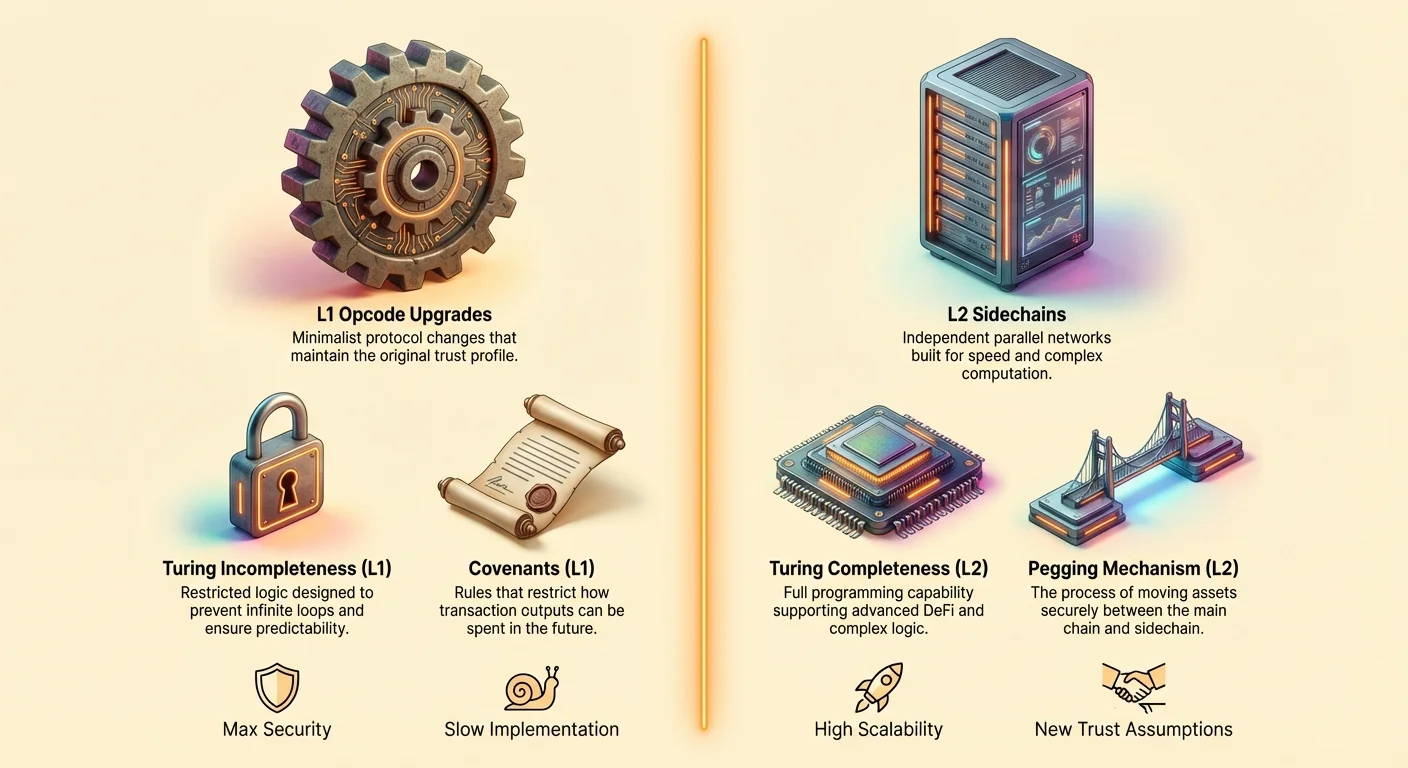
The first approach to expanding Bitcoin’s smart contract capabilities is to make small, specific improvements to the core Layer 1 protocol itself. This approach is highly cautious, focusing on maximizing security by only adding features that maintain the original trust profile.
The Power of New Opcodes
Opcodes are the basic computational commands within Bitcoin Script. Adding a new Opcode is like adding a new, highly specialized tool to the protocol’s toolkit. These additions must be implemented through a consensus upgrade, typically a soft fork.
A primary example of a highly requested L1 upgrade is the reintroduction of OP_CAT (concatenation). While seemingly simple (it allows combining two data elements on the stack), OP_CAT is transformational because it enables the creation of covenants.
What are Covenants?
A covenant is a transaction rule that restricts how the funds of that transaction can be spent in the future. For instance, a covenant could stipulate: "These funds can only be spent to an address that starts with ‘bc1q,’ or they can only be sent to another multisig wallet, or they must wait 90 days before moving."
Covenants allow users to build highly secure, self-enforcing vaults and recursive systems (where outputs feed into new constrained inputs), paving the way for advanced non-custodial applications, such as efficient decentralized exchanges and self-managed inheritance solutions, all secured by the Bitcoin main chain.
Maximizing Security and Trustlessness
The most compelling advantage of Layer 1 Opcode Upgrades is the minimal increase in trust assumptions.
When a smart contract is executed using native L1 features (like OP_CAT and covenants), it inherits the full, uncompromised security of the Bitcoin network. The contract is validated by tens of thousands of nodes worldwide, secured by the most powerful hashing network (Proof-of-Work), and recorded immutably on the global ledger.
- Trust Assumption: You only trust the established, battle-tested Bitcoin consensus rules.
- Security: Highest possible. Bugs or failures are exceptionally costly to exploit due to the network’s size.
- Decentralization: Full. All participants validate the new rules equally.
Limitations and Implementation Difficulty
Despite the security benefits, the L1 upgrade path faces significant hurdles:
- Consensus Challenge: Implementing an Opcode upgrade requires near-universal agreement from miners, developers, and node operators (a consensus upgrade). This process is slow, contentious, and can take years, as the ecosystem prioritizes safety over speed.
- Limited Scope: Even with new Opcodes, the language remains intentionally limited (Turing incomplete). Complex applications requiring loops or external data sources (oracles) are generally impossible to implement purely on L1. The goal is to build the minimum necessary functionality, not to achieve feature parity with platforms like Ethereum.
The Expedient Path: Layer 2 Sidechains and Execution Environments
The alternative approach—building Layer 2 (L2) solutions, specifically sidechains—solves the problem of complexity and speed by creating parallel networks that interact with, but do not directly reside on, the Bitcoin L1.
Sidechains are independent blockchains designed to handle high-frequency, complex computational tasks. They use their own consensus mechanisms (often Proof-of-Stake or federated models) and their own fee structures, freeing them from Bitcoin’s inherent limitations.
Achieving Turing Completeness
Sidechains (such as Rootstock, sometimes referred to as RSK, or the Stacks network) can achieve full Turing completeness. This means they can host sophisticated smart contracts that are nearly identical in functionality to those found on Ethereum (ETH) or other Layer 1 platforms.
For example, a sidechain can run an Ethereum Virtual Machine (EVM)-compatible environment, allowing developers to port existing DeFi applications and tools directly to the Bitcoin ecosystem. This allows for complex applications like automated market makers (AMMs), decentralized lending protocols, and complex governance structures to utilize Bitcoin as their base asset.
The Critical Trust Challenge: Pegging Mechanisms
The greatest technical challenge for any sidechain is the "pegging" process—securely moving BTC from the high-security L1 network to the high-functionality L2 network, and then back again. This process introduces new trust assumptions that are necessary for speed and complexity.
When a user moves 1 BTC to a sidechain (a process called "pegging in"), the original BTC is locked on the main chain, and a new representation (e.g., 1 rBTC or sBTC) is minted on the sidechain. The security of this mechanism defines the trust model of the entire L2.
1. Custodial Federations
The simplest form of pegging often involves a custodial federation. Here, a predefined, small group of entities (often miners, exchanges, or development teams) holds the private keys necessary to unlock the BTC locked on L1.
- Trade-off: This is a centralized point of failure. Users must trust the federation members not to collude, lose their keys, or become compromised. While functional and fast, it sacrifices Bitcoin’s core value proposition of eliminating counterparty risk.
2. Decentralized Pegs (Merged Mining and Drivechains)
More sophisticated sidechains seek to minimize this trust requirement through complex mechanisms like merged mining or concepts like Drivechains. Merged mining allows Bitcoin miners to secure the sidechain simultaneously with their normal mining operations, theoretically tying the sidechain’s security closer to Bitcoin’s L1 security budget.
However, even advanced pegs require users to trust the new rules of the L2 consensus mechanism—rules that are often less secure, less validated, and less decentralized than Bitcoin's L1.
Scaling and Speed Benefits
The clear advantage of L2 sidechains is massive scaling. Since the computational work is offloaded, transaction speeds can be near-instantaneous (measured in seconds), and costs are dramatically lower.
This makes L2 environments suitable for daily spending, microtransactions, high-frequency trading, and user-facing applications where latency is a major barrier. They offer immediate, tangible improvements in user experience by reducing congestion on the main chain.
Architectural Comparison: Choosing a Smart Contract Stack
The choice between L1 Opcode Upgrades and L2 Sidechains is ultimately a philosophical decision about which trade-offs the community is willing to accept: maximum security or maximum functionality.
| Feature | Layer 1 Opcode Upgrades (e.g., OP_CAT) | Layer 2 Sidechains (e.g., Rootstock, Stacks) |
|---|---|---|
| Trust Model | Trust the Bitcoin consensus (minimal trust). | Trust the sidechain’s validators, federation, and pegging mechanism (new trust assumptions). |
| Contract Complexity | Limited (Turing incomplete); focused on covenants. | High (Turing complete); supports full DeFi and complex logic. |
| Security Inheritance | Inherits 100% of Bitcoin’s Proof-of-Work security. | Depends on the L2’s security budget, which is typically much lower than L1. |
| Implementation Speed | Very Slow (requires consensus and soft fork). | Fast (can be deployed immediately by developers). |
| Transaction Cost | High (must pay L1 transaction fees). | Very Low (paid via L2 fees). |
| Ideal Use Case | Self-custodial vaults, highly secure long-term contracts, low-frequency high-value transfers. | DeFi, frequent payments, gaming, complex user-facing applications. |
The Trust Hierarchy
The core difference boils down to the trust hierarchy.
When you use an L1 contract enabled by an Opcode upgrade, your digital assets are still secured directly by the full power of the Bitcoin network. The risk of the contract failing is primarily a coding risk, not a systemic security risk.
When you use an L2 sidechain, you are effectively accepting a derivative security model. While your funds are ultimately tethered to Bitcoin, they are only as secure as the sidechain’s mechanism for locking, minting, and executing those funds. If the federation controlling the peg is compromised, or if the sidechain's custom consensus fails, the user's funds could be lost, even if Bitcoin L1 remains perfectly secure.
Scalability vs. Decentralization
The two stacks offer opposing solutions to the scaling problem:
- L1 Opcode Scaling: Achieves scaling by making contracts more efficient and smaller (e.g., enabling more complex logic with less data). This preserves decentralization but limits throughput.
- L2 Sidechain Scaling: Achieves scaling by offloading execution entirely onto a separate, faster chain. This increases throughput dramatically but introduces centralization risk in the new chain's consensus or pegging mechanism.
Practical Use Cases and Trade-offs
The choice between the two stacks depends heavily on the specific application's requirements for security and speed.
Use Cases for Layer 1 Opcodes
L1 upgrades are designed for applications where security and non-custodial assurances are paramount, and speed is secondary.
- Trust-Minimized Vaults and Inheritance: Using covenants enabled by opcodes, users can create wallets that impose immutable rules on fund movement (e.g., requiring a time delay before spending, or restricting the destination address). This is ideal for cold storage and estate planning, where the security of the funds over decades is the main priority.
- Highly Secure Interoperability: Covenants can enable more secure and efficient mechanisms for Atomic Swaps and complex cross-chain bridges, ensuring that the security of the interaction relies entirely on cryptographic proofs validated by the L1.
Use Cases for Layer 2 Sidechains
L2 sidechains are necessary for applications demanding the speed and feature set required for modern finance and consumer applications.
- Decentralized Finance (DeFi): Lending, borrowing, yield farming, and stablecoins require frequent state changes and complex execution, which necessitate the Turing completeness and low latency of L2s.
- NFTs and Gaming: Digital collectibles and gaming applications involve thousands of small, rapid transactions and complex metadata management that would overwhelm the Bitcoin main chain. These are perfectly suited for a fast, cheap sidechain environment.
Actionable Tip: Assessing Risk
When evaluating a Bitcoin-based application, always ask: Where is the BTC held, and who validates the contract execution?
- If the BTC is locked via a mechanism that only requires the standard Bitcoin protocol rules (e.g., a simple multisig or a time lock enabled by L1 opcodes), the risk is low.
- If the BTC has been moved across a peg and is now represented by a token on an L2, you must assess the risk profile of that specific L2—its validator set, its centralization points, and the security of its pegging mechanism. The deeper the functionality, the greater the trust placed in the L2 itself.
Conclusion
The debate over Bitcoin smart contracts is less a technical argument about capability and more a philosophical one about risk tolerance. The two architectural paths—L1 Opcode Upgrades and L2 Sidechains—represent fundamentally different approaches to innovation.
L1 Opcode Upgrades embody the conservative spirit of Bitcoin, offering slow, highly secure, trust-minimized expansion. They aim to add the bare minimum of functionality while maintaining the highest possible degree of decentralization.
L2 Sidechains, conversely, represent the pragmatic drive for rapid innovation, offering immediate Turing-complete functionality and scalability. They succeed by accepting a marginal reduction in trustlessness in exchange for speed and feature richness.
Ultimately, both stacks serve critical roles. L1 Opcodes provide the bedrock of security and non-custodial control for high-value applications, while L2 Sidechains provide the necessary infrastructure for scaling the ecosystem and delivering consumer-ready financial services. Together, they outline a comprehensive roadmap for how Bitcoin can evolve into a feature-rich, global financial layer.