
Понад десять років Bitcoin слугує основою цифрової дефіцитності та само-суверенітету, переважно функціонуючи як надійний, незмінний реєстр для передачі вартості. Однак архітектура, розроблена Satoshi Nakamoto — попри революційність — мала неминучі обмеження, особливо щодо гнучкості скриптів, конфіденційності та ефективності транзакцій.
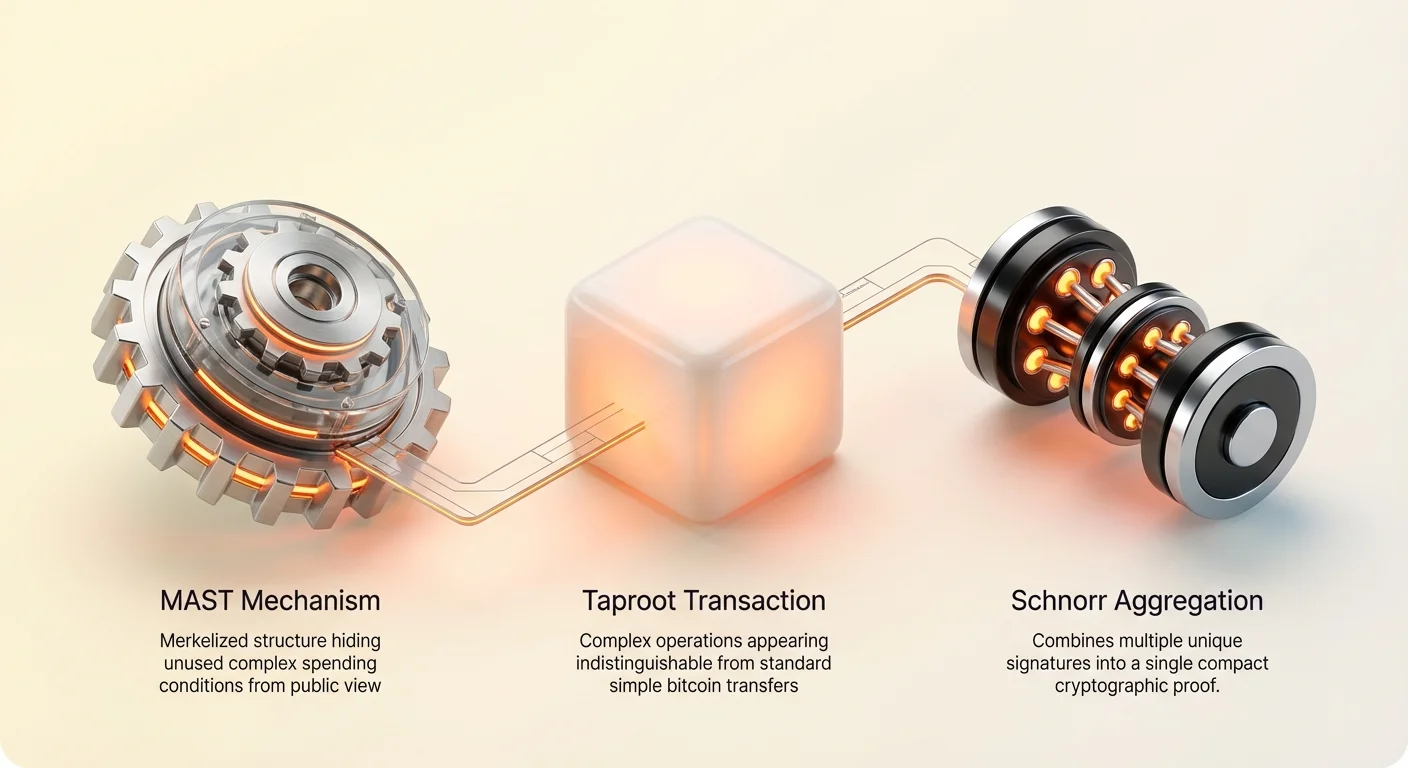
Оновлення Taproot, активоване наприкінці 2021 року, є найзначнішим покращенням базового шару Bitcoin (Layer 1) після SegWit у 2017 році. Taproot — це не одна функція; це складний набір із трьох взаємопов’язаних технологій: MAST (Merkelized Abstract Syntax Trees), Schnorr Signatures і адреси Pay-to-Taproot (P2TR).
Це оновлення фундаментально змінює спосіб виконання складних транзакцій у мережі. Якщо старі транзакції транслювали всі потенційні умови витрати в усьому світі — витрачаючи дорогоцінний простір блоків і розкриваючи чутливі дані, — Taproot дозволяє складним скриптам виглядати невідмінними від простих платежів з одним підписом. Ця архітектурна зміна суттєво покращує конфіденційність, знижує витрати та, що критично, закладає міцний інфраструктурний фундамент, необхідний Bitcoin для підтримки просунутих смарт-контрактів і масштабних рішень Layer 2 (L2), таких як Lightning Network. Наш фокус тут — не лише що таке Taproot, а як воно надає розробникам можливості для створення наступного покоління децентралізованих фінансів і інструментів само-кастоді на найбезпечнішому блокчейні у світі.
The Problem Taproot Solves: Bitcoin's Original Scripting Limitations
To understand the genius of Taproot, we must first recognize the constraints of Bitcoin’s original scripting language. Bitcoin uses a simple, stack-based language (often called Script) to define the rules for spending funds.
Anatomy of a Simple Bitcoin Transaction
Before Taproot, most Bitcoin transactions utilized either Pay-to-Public-Key-Hash (P2PKH), which is the standard single-signature payment, or Pay-to-Script-Hash (P2SH), which allowed for more complex rules like multi-signature requirements or time-locks.
When you spend funds using P2SH, the network must verify that the conditions you set (the script) are met. Crucially, when a transaction is spent, the entire script is published on the blockchain, along with the proof (the signature) that satisfies it.
For instance, if you set up a multi-signature transaction requiring 2 out of 3 keys to agree (a 2-of-3 multisig), the public record would show all three potential keys, the requirement (2-of-3), and the two required signatures, regardless of how simple the actual execution was.
The Cost of Complex Transactions
This requirement to publish the entire, potentially complex spending script had significant drawbacks:
- Reduced Privacy (Information Leakage): Revealing the entire script exposes all possible ways the funds could have been spent, even if only one path was ultimately chosen. In the 2-of-3 example, the identities of all three key holders are exposed, even if they were dormant.
- Increased Transaction Size and Fees: Complex scripts, especially those involving many participants or conditional time-locks, take up much more block space. Since fees are primarily determined by transaction size, this made sophisticated custody solutions (like corporate treasury multi-sig or intricate inheritance plans) very expensive and inefficient.
- Lack of Fungibility: Fungibility means that one unit of a currency is interchangeable with any other. When a complex script is clearly visible on the blockchain, it makes that specific transaction output look different from a standard, simple transaction output. This visual distinction can make it easier for external parties to track certain types of funds, harming the overall fungibility of Bitcoin.
MAST: Making Complex Scripts Look Simple
Merkelized Abstract Syntax Trees (MAST) is the core cryptographic concept that allows Taproot to solve the transparency and efficiency problems inherent in P2SH.
Understanding Merkel Trees
To grasp MAST, we must first understand the Merkle Tree (also known as a Hash Tree). This data structure is foundational to Bitcoin itself, as every block uses a Merkle Tree to efficiently summarize all transactions within that block.
A Merkle Tree works like a digital filing system:
- Each piece of data (in the case of MAST, this is a potential spending condition, or "script path") is individually hashed.
- These individual hashes are paired and hashed together, moving up the tree structure.
- This process continues until all the data is condensed into a single, summary hash called the Merkle Root.
The powerful advantage of the Merkle Root is that it allows anyone to verify that a specific piece of data is included in the set, simply by providing a small number of intermediate hashes (the Merkle Path) rather than having to show all the data.
How MAST Hides Unexecuted Conditions
MAST applies this Merkle Tree concept to the spending conditions of a transaction.
Imagine a complex smart contract that has four possible paths for spending funds:
- Path A: Alice and Bob both sign (standard spending).
- Path B: After 90 days, only Alice can sign (time-lock recovery).
- Path C: After 180 days, only a backup key signs (inheritance/safety).
- Path D: Requires input from an oracle (e.g., weather data trigger).
Using the old P2SH model, all four paths (A, B, C, and D) would be exposed on the blockchain when the funds are spent.
Using MAST:
- Each path (A, B, C, D) is the "leaf" of a Merkle Tree.
- All four paths are summarized into a single MAST Root.
- When Alice and Bob execute Path A, they only publish the script for Path A and the small cryptographic proof (the Merkle Path) necessary to prove that Path A is included in the MAST Root.
The critical benefit: The existence of Paths B, C, and D is revealed by the Merkle Root, but their actual scripting content remains completely private and unpublished on the chain. Only the executed path is revealed, leading to massive space savings and increased confidentiality.
Practical Example: The Multi-Sig Scenario
Consider a corporate treasury that requires a 3-of-5 multi-signature agreement for routine expenses, but also requires a simplified 1-of-5 signature path (after 6 months) for emergency liquidation if the company dissolves.
- Pre-MAST: The standard 3-of-5 script and the emergency 1-of-5 script must both be broadcast to the chain, increasing transaction size and revealing the emergency spending rules to everyone.
- With MAST: If the 3-of-5 path is used, only the 3-of-5 script is broadcast, along with the small proof that it belongs to the contract. The 1-of-5 emergency liquidation path remains hidden within the MAST Root, only revealed if it is actually executed later.
MAST fundamentally transforms complex conditions into efficient, compact, and private proofs.
Schnorr Signatures: The Key to Efficiency and Privacy
While MAST addresses script complexity, the second major component of Taproot—Schnorr signatures—addresses signature efficiency, security, and anonymity. Bitcoin originally used the Elliptic Curve Digital Signature Algorithm (ECDSA). Schnorr is a mathematically superior alternative that brings two immense benefits: signature aggregation and enhanced security proofs.
The Technical Superiority of Schnorr vs. ECDSA
ECDSA signatures, while secure, are bulky and necessitate individual verification. If a transaction requires three signatures, the blockchain requires three separate blocks of signature data, and the network nodes must verify those three distinct blocks sequentially.
Schnorr signatures, based on simpler math and security assumptions, offer a significant advantage: linearity. This means that multiple public keys can be combined into a single, valid aggregated public key, and multiple signatures can be combined into a single, valid aggregated signature.
Signature Aggregation: Batch Verification and Efficiency
Signature aggregation is perhaps the most visible improvement Taproot brings to scaling:
- Multi-Party Efficiency: In a 5-of-5 multi-signature transaction using Schnorr, the five required public keys can be cryptographically merged into one new public key, and the five corresponding signatures can be merged into a single, aggregated signature.
- Blockchain Interpretation: To the rest of the Bitcoin network, this aggregated transaction looks exactly like a standard, single-signature payment (P2PKH).
- Verification Speed: Nodes verify this single aggregated signature faster than verifying five individual ECDSA signatures. This improvement saves computational power for every network participant and drastically reduces the data size of complex transactions.
This capability is revolutionary for multi-party applications like corporate custody, joint ownership wallets, and, most importantly, Layer 2 scaling solutions.
The Privacy Dividend (Key Aggregation and the P2TR Format)
The ability to aggregate keys and signatures provides a critical boost to privacy and fungibility.
If a multi-sig transaction looks identical to a standard single-signature transaction, outside observers cannot determine if the transaction was complex (requiring multiple parties, time-locks, or specialized contracts) or simple (just one person sending money).
This introduces true output uniformity to the network, meaning sophisticated smart contract outputs are functionally indistinguishable from simple peer-to-peer payments. This significantly strengthens Bitcoin's fungibility, ensuring all satoshis are treated equally by observers.
Taproot Explained: The Seamless Integration of MAST and Schnorr
Taproot is the overarching implementation that ties MAST for conditional execution and Schnorr for signature efficiency together under a new, unified address type.
Pay-to-Taproot (P2TR) Addresses
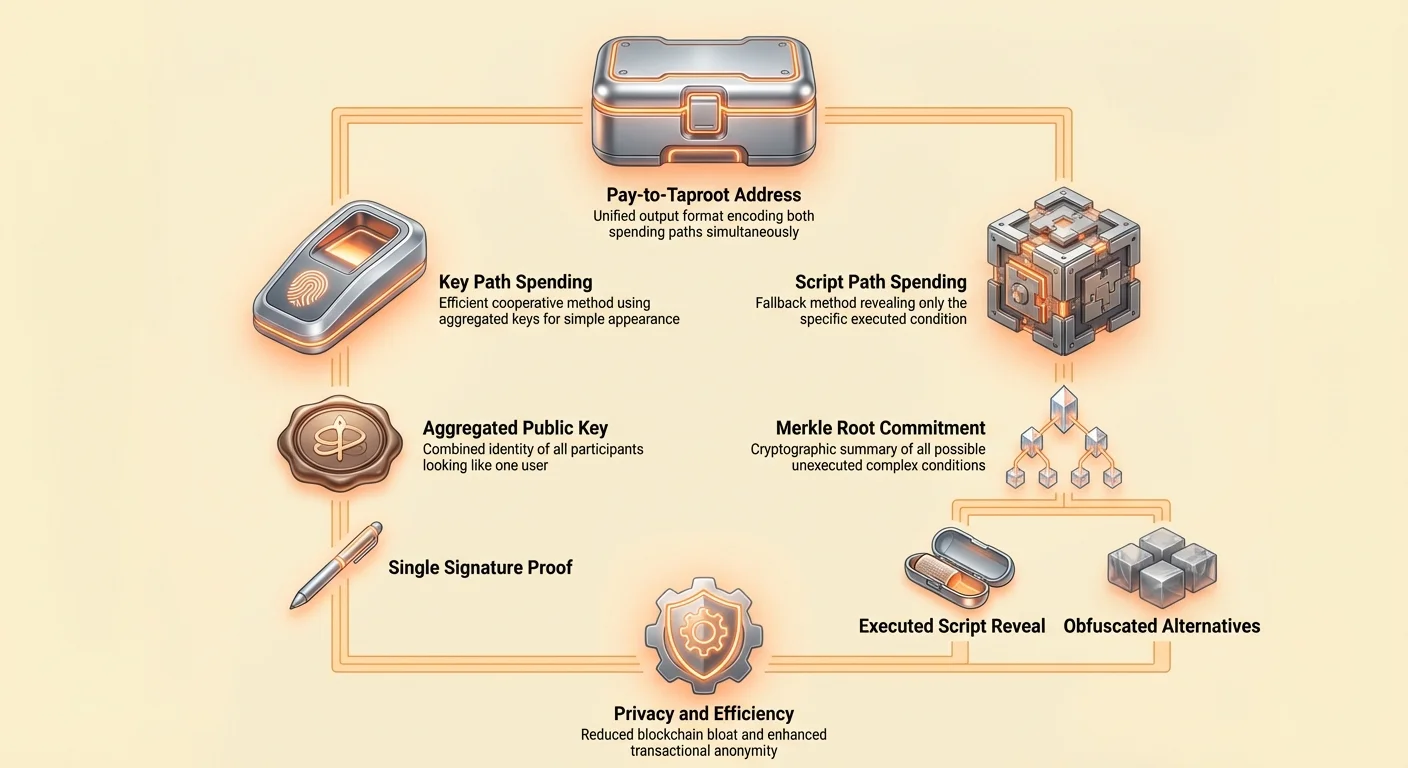
Taproot introduces a new standard output type called Pay-to-Taproot (P2TR). P2TR outputs encode not just a single public key, but a combination of a public key (for the Schnorr key aggregation path) and the Merkle Root of all potential spending scripts (for the MAST script path).
When funds are sent to a P2TR address, the transaction effectively locks the funds using two distinct methods simultaneously: the Key Path and the Script Path.
The Key Path vs. The Script Path (The Choice Mechanism)
Taproot is designed around a simple, efficient trade-off: if all parties cooperate, use the simple, cheap path; if they disagree or require complex conditions, use the slightly more expensive but robust path.
1. The Key Path (The Ideal Scenario)
The Key Path is the preferred and most efficient way to spend funds locked in a P2TR output. This path is activated when all original participants agree on the spending conditions and cooperate.
- How it works: All participants aggregate their public keys into a single Taproot key, and then aggregate their signatures into a single Schnorr signature.
- Result: The on-chain transaction looks exactly like a standard, single-signer P2PKH transfer. The entire MAST structure remains hidden, saving space and preserving privacy. This path is maximally cheap and efficient.
2. The Script Path (The Conditional Scenario)
The Script Path is activated if the participants cannot cooperate, or if the transaction requires a predetermined script condition (like a time-lock or the input of an oracle).
- How it works: The spending transaction reveals the specific script condition that was met (e.g., "Time-lock of 90 days has passed") and the small Merkle Proof required to validate that this script was indeed part of the original MAST Root.
- Result: This transaction is slightly larger than the Key Path, but still significantly smaller and more private than the old P2SH model, because it only reveals the one executed script, keeping all other potential spending conditions private.
Achieving Script Obfuscation
The combination of the Key Path and the Script Path achieves a powerful property called script obfuscation.
From the perspective of an outside observer analyzing the blockchain:
- If the Key Path is used (which is anticipated to be the most common usage for cooperative parties, especially in L2 solutions), the transaction is completely opaque and private. It looks like simple spending.
- Even if the Script Path is used, the observer only learns about the specific condition that was met, not the details of all the alternative conditions that were also possible.
This seamless integration ensures that simple, cooperative uses are highly efficient, while complex, conditional uses remain highly private—a massive leap forward for Layer 1 flexibility.
Вплив Taproot на сучасну розробку Bitcoin
Taproot — це не просто косметичне оновлення; це найкритичніше інфраструктурне оновлення, яке дозволяє Bitcoin перейти за межі базової передачі вартості до сфери складних децентралізованих застосунків.
Масштабування рішень Layer 2 (ефективність Lightning Network)
Lightning Network, основне рішення масштабування L2 для Bitcoin, сильно залежить від мультипідписних каналів і часових замків для безпеки. Taproot безпосередньо вирішує болі відкриття та закриття цих каналів.
До Taproot відкриття та закриття каналу Lightning вимагало видимих мультипідписних транзакцій (зазвичай 2-of-2), які були громіздкими, дорогими та легко ідентифікованими як активність L2.
З Taproot і підписами Schnorr:
- Відкриття каналу: Відкриття каналу Lightning може використовувати Key Path. Транзакція фінансування тепер виглядає як проста транзакція 1-of-1 у ланцюгу, суттєво зменшуючи слід у блоці та підвищуючи конфіденційність.
- Кооперативне закриття: Якщо канал закривається кооперативно (найпоширеніший сценарій), знову використовується Key Path, мінімізуючи комісії та залишаючись невідмінним від стандартних платежів.
- Некооперативне закриття: Якщо необхідно некооперативне закриття, використовується Script Path (який включає умови часового замка), але завдяки MAST публікуються лише необхідні релевантні умови, все одно економлячи простір порівняно зі старою моделлю.
Ця ефективність суттєво знижує вартість участі в Lightning Network, стимулюючи ширше впровадження та покращуючи швидкість і надійність миттєвих платежів Bitcoin.
Можливість складних смарт-контрактів
Хоча Ethereum створено спеціально для Turing-complete смарт-контрактів, дизайн Bitcoin пріоритизує безпеку та незмінність, роблячи його мову скриптів навмисно обмеженою. Taproot не змінює цей фундаментальний фокус, але робить виконання складних смарт-контрактів Bitcoin набагато практичнішим і доступнішим.
Ключові сфери, що виграють від Taproot:
- Discreet Log Contracts (DLCs): DLCs дозволяють сторонам виконувати контракти на основі введення зовнішнього джерела даних (оракула), як-от спортивні результати чи ціни акцій, не розкриваючи деталей контракту мережі. Можливість MAST у Taproot ідеальна для цього, приховуючи численні потенційні результати та розкриваючи лише один результат, обраний оракулом.
- Covenants: Covenants (здатність обмежувати як UTXO може бути витраченим у майбутньому) — потужні інструменти для створення складних самовиконних фінансових продуктів. Taproot надає необхідну гнучкість у середовищі скриптів L1, роблячи covenants (часто в комбінації з іншими запропонованими опкодами) життєздатними та ефективними.
- Просунуте управління скарбницею: Корпорації тепер можуть розробляти високоскладні вкладені сценарії мультипідпису з спеціалізованими ключам відновлення, часовими замками та шляхами екстреної ліквідації без величезних комісій чи розкриття своєї пропрієтарної схеми керування ключами публіці.
Зменшення сліду в ланцюгу та комісій транзакцій
Чистим результатом агрегації Schnorr та ефективності MAST є зменшення загальних даних, необхідних для виконання складних транзакцій.
Зменшуючи середній розмір транзакцій для мультипідписів та застосунків L2, Taproot зменшує загальне заторів у мережі. Це безпосередньо перетворюється на:
- Нижчі комісії: Менше даних — менше витрат для користувача.
- Швидші підтвердження: Менша обробка даних допомагає майнерам і вузлам працювати швидше та ефективніше.
- Збільшена ємність: Хоча Taproot не є чистим збільшенням розміру блоку, його оптимізація даних транзакцій функціонально збільшує кількість складних транзакцій, що вміщуються в один блок.
Філософські та архітектурні наслідки
Taproot — це не лише технічне оновлення; це філософське твердження про еволюцію Bitcoin при збереженні його основних принципів безпеки. Його активація вимагала майже одностайної підтримки спільноти (механізм soft fork "Speedy Trial"), демонструючи відданість екосистеми дисциплінованому, сумісному з минулим зростанню.
Компроміси: Децентралізація проти сили скриптів
Історичні дебати в крипто часто протиставляють Bitcoin (пріоритет безпеки та децентралізації) платформам на кшталт Ethereum (пріоритет гнучкості скриптів і багатства функцій). Taproot обережно долає цей компроміс.
На відміну від оновлень, які можуть скомпрометувати працездатність повних вузлів чи ввести високоскладні правила консенсусу, Taproot — це не-контроверсійна оптимізація. Воно використовує існуючі перевірені криптографічні принципи (дерева Merkle, еліптичні криві) для досягнення ефективності без потреби в потужніших апаратних засобах чи зміни моделі безпеки.
Можливість вводити гнучкість (смарт-контракти, складну логіку) через Script Path при збереженні ефективності та конфіденційності простих платежів через Key Path забезпечує, що Bitcoin може підтримувати просунуту розробку без компромісу свого статусу найміцнішого децентралізованого реєстру.
Taproot як енаблер для Bitcoin DeFi
Хоча термін "DeFi" (децентралізовані фінанси) часто асоціюється з високошвидкісними мережами альткойнів, міцна безпечна форма DeFi на базі Bitcoin набирає обертів. Taproot є центральним для цього.
Поточна проблема для Bitcoin DeFi полягає в тому, що транзакції Layer 1 можуть бути повільними та дорогими. Taproot робить набагато дешевшим встановлення фундаментів L1, необхідних для застосунків L2/L3, заповнюючи прогалину між безпекою Bitcoin і функціональними вимогами DeFi.
Наприклад, потенційні майбутні оновлення — як-от активація потужного опкоду скриптів OP_CAT (який дозволяє конкатенацію даних і динамічне створення скриптів) — є по-справжньому життєздатними та ефективними лише тому, що Taproot уже заклав основу для компактного конфіденційного виконання скриптів через MAST. Taproot обробляє криптографічну конфіденційність та ефективність, дозволяючи майбутнім змінам консенсусу зосередитися виключно на розширенні логічної функціональності.
По суті, Taproot надає необхідну сантехніку, яка дозволяє розробникам будувати складні, але доступні застосунки на базі Bitcoin, змінюючи парадигму з Bitcoin як просто цифрового золота на Bitcoin як інфраструктурний шар для глобальних децентралізованих фінансів.
Висновок
Оновлення Taproot, що інтегрує MAST і підписи Schnorr у формат P2TR, знаменує грандіозну зміну в архітектурному потенціалі Bitcoin. Це кульмінація років спільних досліджень, спрямованих на збереження фундаментальної безпеки Bitcoin при величезному розширенні його корисності.
Для новачків і розробників takeaway чіткий: Taproot фундаментально оптимізує ефективність кожної складної взаємодії в Bitcoin. Роблячи транзакції мультипідпису, часові замки та умовні скрипти схожими на прості платежі з одним ключем, Taproot покращує конфіденційність користувачів, знижує комісії та забезпечує більшу фунгібельність у мережі.
Критично, Taproot слугує основою для майбутнього масштабування Bitcoin. Роблячи рішення Layer 2, як-от Lightning Network, дешевшими та конфіденційнішими у використанні, та дозволяючи ефективне виконання просунутих смарт-контрактів, як-от DLCs, Taproot озброїв Bitcoin складністю, необхідною для наступного покоління інструментів само-суверенних фінансів. Воно забезпечує, що найбезпечніша грошова мережа світу також готова бути гнучкою платформою для децентралізованої інновації.