
Welcome to the world of decentralized finance (DeFi), where sophisticated financial tools are available to anyone with an internet connection. One of the most powerful—and riskiest—activities in DeFi is borrowing and leveraging. Unlike traditional banks, DeFi protocols allow users to borrow crypto assets by providing other crypto assets as security, a process known as collateralization and borrowing.
Leverage, in simple terms, means using borrowed funds to increase the size of your investment position. If you believe a certain asset will increase in value, borrowing money to buy more of it can amplify your potential returns. However, this amplification works both ways: leverage also amplifies your potential losses.
In DeFi, the primary risk of using leverage is liquidation. Since crypto markets are highly volatile, the value of your collateral can drop quickly, forcing the protocol to automatically seize and sell your assets to pay off your debt. Understanding and actively managing this risk is paramount to survival in DeFi. This guide will take you step-by-step through the mechanics of decentralized borrowing, focusing intensely on the critical tools and strategies needed to avoid losing your funds to liquidation.
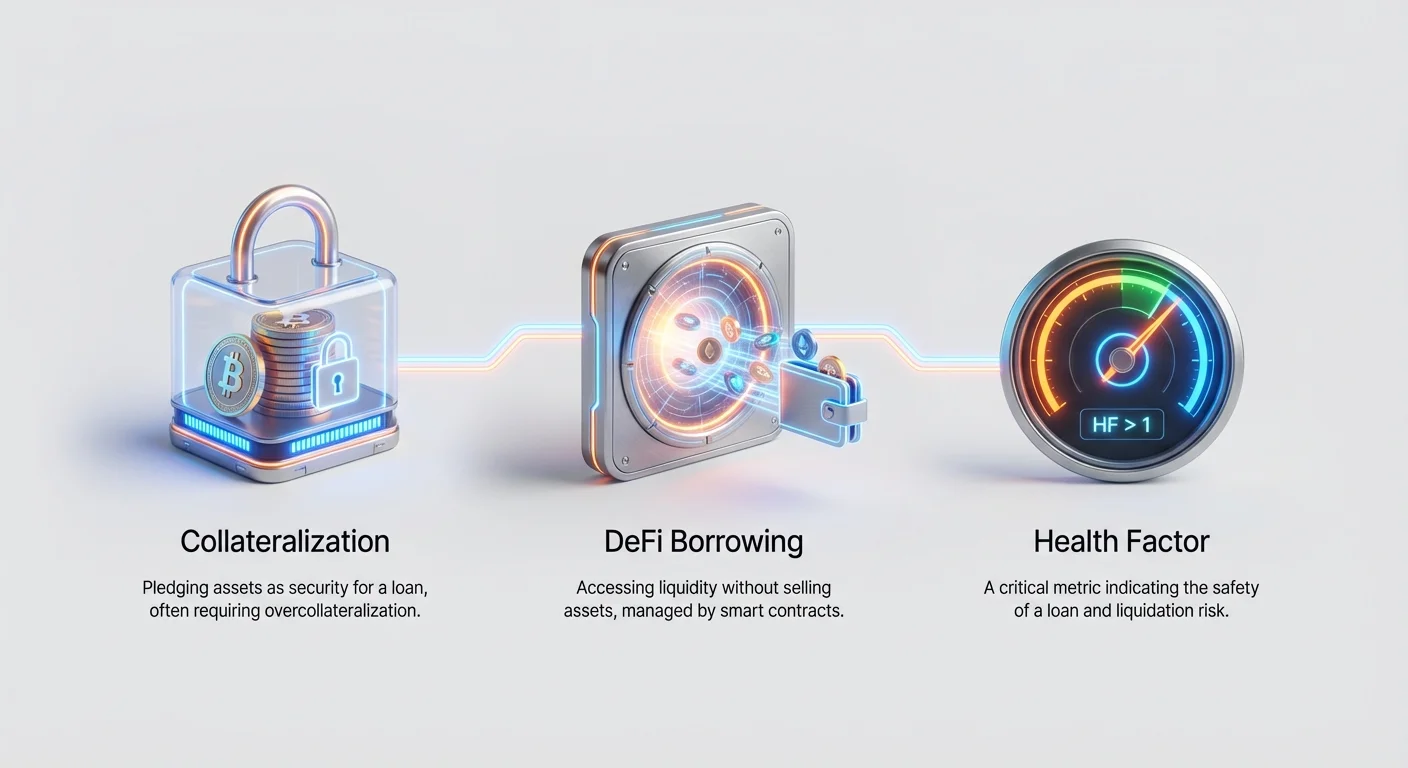
The Fundamentals of Decentralized Borrowing
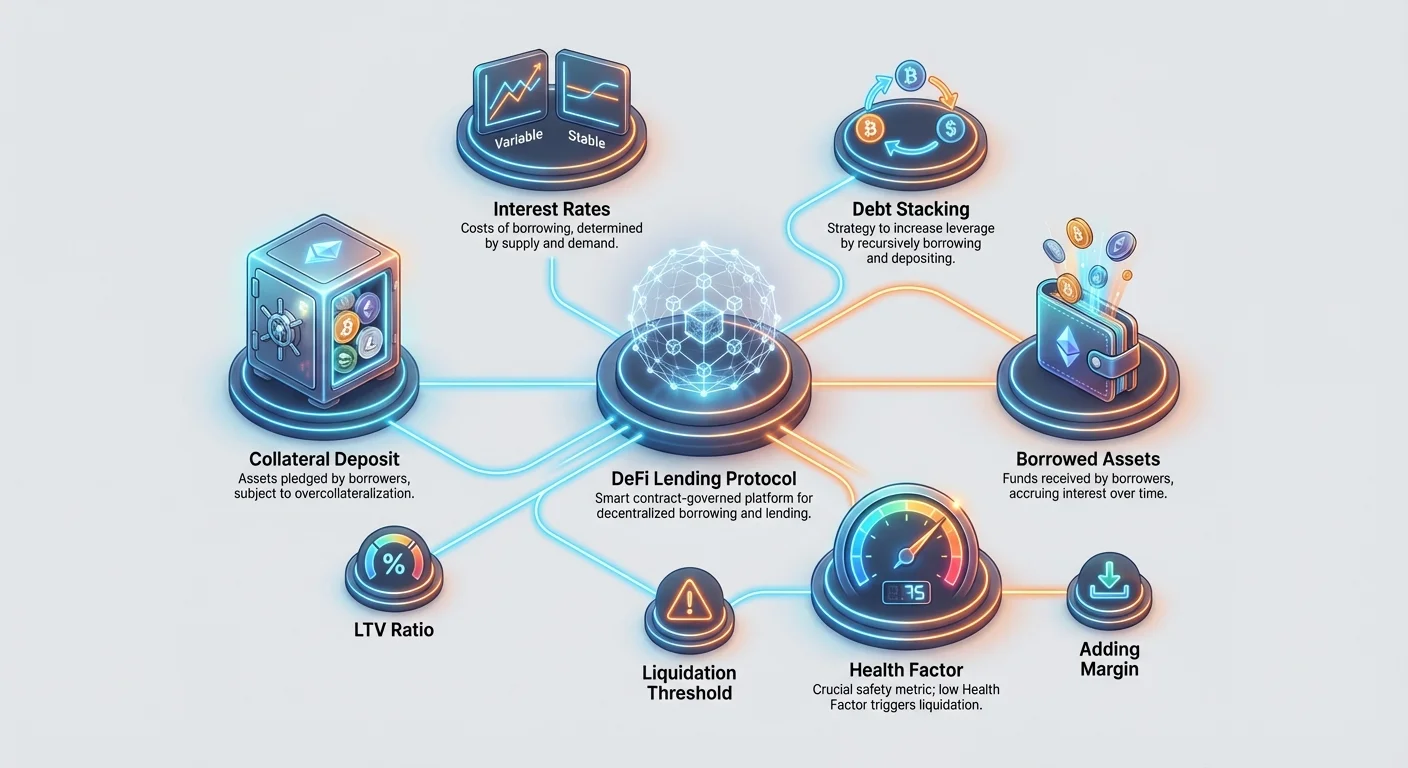
Decentralized lending protocols (like Aave or Compound) operate without intermediaries. They are governed by smart contracts that automatically manage the debt, interest rates, and, crucially, the liquidation process.
When you interact with a lending protocol, you typically take on two roles: a supplier (who provides assets to earn interest) and a borrower (who locks up collateral to take out a loan).
Collateral and Overcollateralization
To borrow assets in DeFi, you must first deposit collateral. Collateral is the asset you pledge as security. If you fail to repay your loan, the collateral is what the protocol uses to recover the debt.
The most critical difference between DeFi loans and traditional bank loans is the requirement for overcollateralization. This means the value of the assets you pledge must be significantly higher than the amount you borrow.
Why is overcollateralization necessary?
- Volatility: Crypto assets can fluctuate drastically in price within minutes. Overcollateralization provides a necessary buffer to ensure the loan remains solvent even if the collateral asset drops suddenly.
- No Credit Checks: Since there are no legal systems or credit bureaus governing these loans, the smart contract relies entirely on the value of the collateral to guarantee repayment.
For example, if you deposit $1,500 worth of Ethereum (ETH) and borrow $1,000 worth of stablecoins (like USDC), your loan is overcollateralized by 150%.
Loan-to-Value (LTV) Ratio
The Loan-to-Value (LTV) ratio is a crucial metric that determines the maximum amount you are allowed to borrow against your collateral.
LTV Ratio Calculation:
Each protocol assigns a maximum LTV ratio for every supported asset, reflecting its volatility and liquidity. Highly stable assets might have a maximum LTV of 80% (meaning you can borrow 80 cents for every dollar of collateral), while highly volatile assets might only allow 50%.
If the initial LTV limit for ETH is 75%, and you deposit $1,000 of ETH, the maximum you can initially borrow is $750. However, borrowing the maximum amount is extremely dangerous, as the slightest dip in ETH’s price could immediately push you into the liquidation zone.
Interest Rates: Variable vs. Stable
When you borrow in DeFi, you incur interest. This interest is paid to the suppliers who provided the funds you borrowed. Protocols typically offer two types of rates:
- Variable Rate: This rate constantly adjusts based on the supply and demand for the asset within the protocol. If many people are borrowing the asset, the variable rate will spike. This provides flexibility but introduces uncertainty regarding your long-term cost.
- Stable Rate: This rate is typically slightly higher than the variable rate but remains locked for the duration of the loan. While it offers predictability for your repayment schedule, it can still change over time if the protocol needs to re-adjust its reserve parameters.
Actionable Tip: For leverage strategies focused on long-term appreciation of collateral, a stable rate might offer better planning security, even if the variable rate is momentarily lower.
Mastering Liquidation Risk: The Health Factor
The single most important metric for managing a leveraged DeFi position is the Health Factor (HF), sometimes referred to as the Safety Factor. This is the protocol’s internal gauge of the safety of your loan. If your Health Factor falls too low, your collateral will be liquidated.
How the Health Factor Works
The Health Factor is a numerical representation of the buffer between your current LTV and the critical Liquidation Threshold.
Health Factor (HF):
- HF > 1: Your loan is safe. The higher the number, the safer the position. An HF of 2 means your collateral could theoretically drop by 50% before hitting the danger zone.
- HF = 1: This is the critical threshold. If your HF hits exactly 1, your position is immediately eligible for liquidation.
- HF < 1: Liquidation occurs. The protocol allows a liquidator (usually a bot) to repay a portion of your debt using the borrowed assets, seizing an equivalent (plus penalty) portion of your collateral.
The exact calculation of the Health Factor is complex, often involving the collateral’s value and the specific liquidation threshold set by the protocol. But conceptually, it serves as your gas gauge—you always want to keep it far from empty.
Tracking Your Loan's Safety
Every major decentralized lending platform provides a dashboard where you can view your real-time Health Factor. This is not a metric to check once a week; it is one that requires constant monitoring, especially during periods of high market volatility.
Example Scenario:
| Metric | Initial State (Safe) | Market Crash (Danger) |
|---|---|---|
| Collateral (ETH) Value | $2,000 | $1,400 |
| Borrowed Amount (USDC) | $1,000 | $1,000 |
| Liquidation Threshold | 85% | 85% |
| Current LTV | 50% ($1k/$2k) | 71.4% ($1k/$1.4k) |
| Health Factor | 1.70 (Safe) | 1.19 (Close to 1) |
In this scenario, a 30% drop in ETH price moves the Health Factor from a comfortable 1.70 down to a dangerously low 1.19. If the price of ETH drops just a little further, say another 5-10%, the loan hits 1.0 and liquidation begins.
What Triggers Liquidation?
Liquidation is an automated process triggered by two main events that drive the Health Factor down to 1:
- Collateral Value Drops: This is the most common trigger. If the market price of your deposited asset (e.g., ETH) falls, the value of your collateral decreases relative to your fixed borrowed debt, increasing your LTV.
- Borrowed Debt Increases: This happens due to accrued interest. While interest rates are usually small, they are constantly increasing the total amount you owe. If you have an extremely low Health Factor to begin with, the interest alone could eventually trigger liquidation, even if the collateral price remains stable.
When liquidation occurs, the liquidator repays the necessary portion of your debt and takes your collateral, often with a penalty fee (e.g., 5% to 15%) added on top. This penalty compensates the liquidator for the risk and effort of making the loan solvent again, meaning you lose more collateral than was strictly necessary to cover the debt.
Strategic Borrowing for Leverage (Debt Stacking)
Leverage in DeFi is often achieved through a method commonly called "debt stacking" or the "crypto leverage loop." This strategy aims to increase exposure to a specific asset by recursively using that asset (or loans taken against it) as further collateral, often referred to as leveraged yield farming.
The Crypto Leverage Loop
The loop is a repeating sequence of three steps that increases your effective exposure:
- Deposit Collateral (A): Deposit your initial asset (e.g., ETH).
- Borrow Asset (B): Borrow a second asset, typically a stablecoin (e.g., USDC), against your initial collateral.
- Acquire More Collateral (A): Use the borrowed USDC to immediately purchase more of the initial collateral asset (ETH).
- Repeat: Deposit the newly acquired ETH back into the protocol as additional collateral, allowing you to borrow even more, albeit at diminishing returns.
By repeating this loop, you significantly increase your exposure to ETH. If ETH goes up, you profit greatly; however, your initial position now has a much lower overall Health Factor, making it fragile in a downturn.
The Risk of the Loop: While debt stacking maximizes upward exposure, it tightly links the solvency of your entire position to the stability of the collateral asset. Since you are repeatedly borrowing against an increasingly larger total amount of collateral, your liquidation point is much closer than if you had only taken out a single loan.
Example Use Case: Borrowing Stablecoins Against Volatile Assets
The most common and relatively safer use of leverage involves borrowing stablecoins against volatile crypto assets (like ETH or SOL).
Goal: Hold your ETH long-term but gain immediate liquidity for other needs (like paying bills, investing in low-risk DeFi yield pools, or waiting for a dip to buy more).
Scenario: You have 10 ETH ($30,000) that you do not want to sell because you believe in its long-term growth.
- Action: You deposit the 10 ETH as collateral.
- Borrowing: You borrow $5,000 in USDC (a very safe LTV of ~16%).
- Result: You now have immediate cash liquidity ($5,000) without selling your ETH. You remain fully exposed to any upside in ETH, but you must pay interest on the $5,000 USDC loan.
If ETH price doubles, you still owe only $5,000 plus interest, but your collateral is now worth $60,000. If ETH price drops significantly, you still have a massive safety buffer before liquidation. This strategy allows for liquidity while maintaining exposure, provided the borrowed amount is conservative.
Advanced Collateral: Using Liquid Staking Tokens (LSTs)
A modern strategy involves using Liquid Staking Tokens (LSTs) as collateral. LSTs (like stETH or cbETH) represent staked tokens that are earning yield.
The benefit of LSTs as collateral:
- Earning Two Layers of Yield: The underlying ETH is earning staking rewards, and the LST itself is deposited into the lending protocol, potentially earning further supply interest or being used to borrow (creating leverage).
- High Correlation: LSTs are meant to trade nearly 1:1 with the underlying staked asset (e.g., stETH trades near 1 ETH). This stability often gives them a higher LTV ratio compared to non-staked, volatile assets.
While LSTs offer yield optimization, they introduce smart contract risk (the risk that the LST contract fails) and depeg risk (the risk that the LST trades significantly below the value of the underlying asset), which can rapidly accelerate liquidation via depeg.
Advanced Risk Management Techniques
Survival in DeFi leverage hinges entirely on disciplined risk management. Beginners should prioritize protecting their capital over maximizing immediate returns.
Active Collateral Management (Adding Margin)
The most effective way to manage a loan’s Health Factor is to actively monitor it and be prepared to add collateral when necessary—a process sometimes called "adding margin" or "replenishing collateral."
If your Health Factor (HF) starts dipping toward 1.2 or 1.15 due to falling collateral prices, you should immediately consider two preventative actions:
- Deposit More Collateral: This increases the overall value backing your debt, instantly raising the LTV and boosting the HF. This is the simplest fix but requires you to have spare assets available.
- Repay Part of the Loan: By repaying a portion of the borrowed amount, you lower the numerator (Amount Borrowed) in the LTV calculation, which also increases the Health Factor. If you borrowed stablecoins, this requires you to acquire stablecoins elsewhere (or sell some of your collateral outside the protocol) to repay.
Do Not Wait Until HF = 1.05: Waiting until the last minute exposes you to "slippage," where a sudden market drop could cause liquidation before your transaction confirms on the blockchain. Always maintain a large safety buffer.
The Safety Buffer Principle
A professional DeFi borrower never utilizes the maximum allowed LTV. They operate on the Safety Buffer Principle:
- Protocol Limit: If the protocol's maximum LTV is 75%, this is your legal maximum.
- Your Personal Limit (Safety Buffer): Set a rule that you will never initiate a loan above 50% or 60% LTV.
This 15-25% buffer provides necessary breathing room. When volatility strikes, you have time to react, source extra funds, or monitor the situation without the immediate threat of liquidation.
Tip for Tracking Volatility: When calculating your safety buffer, look at the historical volatility of your collateral asset. If the asset historically drops 30% during major crashes, ensure your current loan could survive a 40% drop before you even consider depositing more collateral.
Monitoring Market Volatility and Fee Management
External factors play a major role in liquidation risk:
- Network Congestion (Gas Fees): During periods of extreme market volatility (e.g., a major crash), blockchain gas fees spike dramatically as thousands of people rush to adjust their positions. If your Health Factor is critically low, high gas fees might prevent you from successfully adding collateral or repaying debt in time, resulting in liquidation even if you had the funds ready.
- Price Oracles: DeFi protocols rely on decentralized price feeds (oracles) to determine the value of your collateral. While these are reliable, borrowers must understand that liquidation occurs based on the oracle price, not necessarily the current trading price on a single decentralized exchange (DEX).
- Sustained Downtrends: If the price of your collateral asset enters a sustained, long-term downtrend, a simple liquidation buffer is not enough. Debt stacking strategies become inherently flawed, requiring a complete unwinding of the leveraged position to protect capital.
Specialized and High-Risk Borrowing Concepts
While most DeFi activity revolves around overcollateralized lending, two concepts offer different levels of risk and opportunity: leveraging with stablecoins and the highly specialized use of flash loans.
Leveraging with Stablecoins
Leveraging using only stablecoins is a strategy designed to reduce volatility risk while earning yield on deposits.
The Strategy:
- Deposit a highly stable asset (e.g., USDC).
- Borrow another highly stable asset (e.g., USDT).
- Use the borrowed USDT to provide liquidity elsewhere, purchase an interest-bearing token, or repeat the process to acquire more USDC (debt stacking stablecoins).
Since the collateral (USDC) and the debt (USDT) are both pegged to the US dollar, the risk of liquidation due to price volatility is almost zero. The only liquidation risks remaining are:
- Interest Accrual: If your borrowing rate is higher than your earning rate, your debt will eventually outweigh your collateral.
- Depeg Risk: If one of the stablecoins loses its $1 peg significantly (e.g., dropping to $0.90), the Health Factor will fall, making liquidation possible.
This approach transforms DeFi borrowing from a volatility bet into a purely interest rate arbitrage opportunity, relying on the stability of the dollar peg.
An Overview of Flash Loans
Flash loans are perhaps the most unique, advanced, and high-risk financial primitive in DeFi. They are characterized by two remarkable features: (1) They are completely uncollateralized, and (2) they must be borrowed and repaid within a single smart contract execution.
- Uncollateralized: They are the only loans in DeFi that do not require collateral.
- Must be Repaid in the Same Transaction Block: The loan must be taken out, used, and fully repaid (plus a small fee) within the execution of a single atomic blockchain transaction.
If the smart contract determines that the loan cannot be repaid by the end of the transaction, the entire transaction fails, and the loan is effectively canceled, leaving the protocol reserves untouched.
Use Cases (Not for Beginners):
Flash loans are used by advanced users and bots primarily for complex arbitrage opportunities, collateral swaps, and refinancing debt.
- Example: Collateral Swap: If a user’s ETH collateral is nearing liquidation, they might use a flash loan to temporarily borrow enough stablecoins to repay the original ETH loan entirely, switch the collateral to a safer asset (like USDC), and then immediately take out a new, healthier ETH loan to repay the flash loan—all in one transaction.
Risk: While flash loans themselves carry no liquidation risk for the borrower (the risk of non-repayment is nullified by the contract reversal), they are commonly associated with complex security exploits and "flash loan attacks," where malicious actors use them to manipulate prices or drain liquidity pools. As a beginner, understanding that they exist is sufficient; executing them requires advanced coding and security knowledge.
Conclusion
Decentralized borrowing and leverage are powerful tools that offer investors the ability to optimize capital and maximize returns. However, they are unforgiving environments where mistakes are met with automated penalties.
The successful management of leveraged positions boils down to one rule: Never ignore your Health Factor.
By committing to overcollateralization, establishing wide safety buffers, actively monitoring your collateral’s price, and being prepared to add margin when market conditions worsen, you can effectively navigate the risks of DeFi borrowing. Approach leverage with caution, prioritize capital preservation, and always remember that a solvent loan with a small return is infinitely better than a liquidated position with a 15% penalty.