Cryptocurrency ownership requires a fundamental shift in how individuals perceive and manage financial assets. Unlike the traditional banking system, where a financial institution secures funds and processes transactions, the crypto ecosystem places the burden of security directly on the user. This shift eliminates reliance on third-party intermediaries, but it also removes the safety nets common in legacy finance, such as fraud reversal or account recovery services.
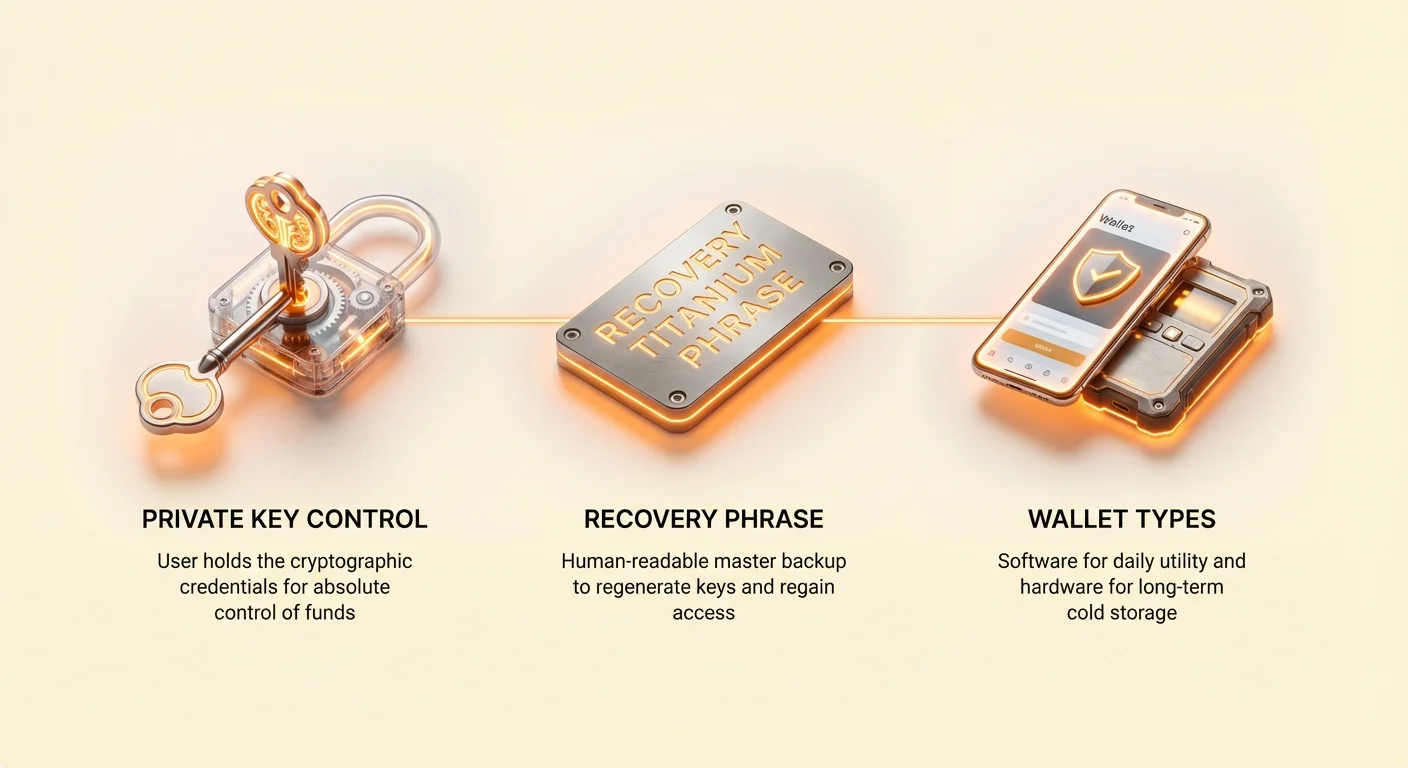
Navigating this environment requires understanding that a "wallet" is not a storage container for digital coins. Instead, it is a sophisticated key management tool. It stores the cryptographic credentials needed to access and move assets that live on the blockchain. Because these credentials grant absolute control over funds, the software or hardware chosen to manage them is the single most critical decision a user makes.
There is no single solution that fits every user. A high-frequency trader has different needs than a long-term investor, just as a corporate treasury requires different controls than a casual spender. By analyzing the intersection of security requirements, convenience needs, and technical capability, users can construct a wallet matrix that matches their specific profile. This approach minimizes risk while ensuring funds remain accessible for their intended purpose.
The Custodial Model
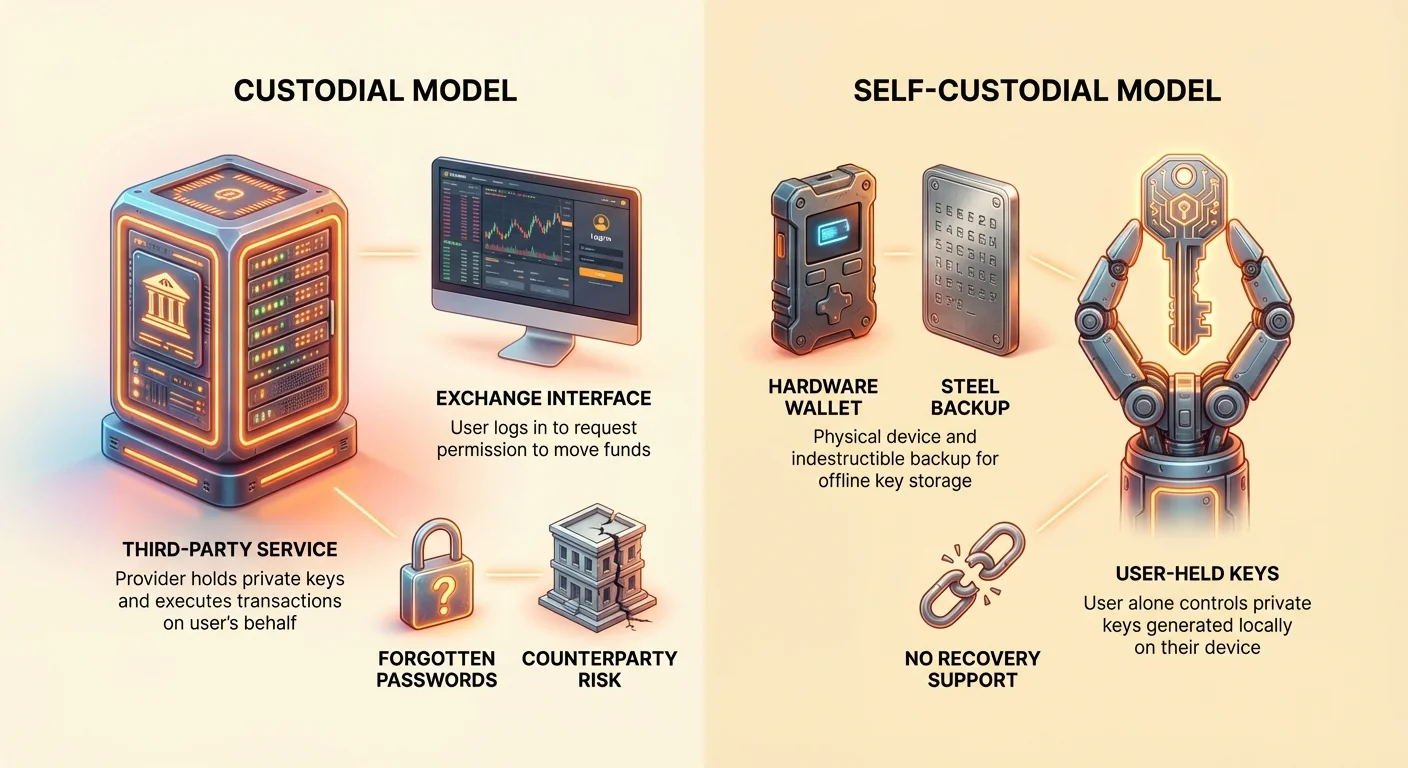
In the custodial model, a third-party service provider operates somewhat like a traditional bank. The provider holds the private keys that control the digital assets. When a user logs into an exchange or a custodial app to make a transaction, they are essentially asking the provider for permission to move the funds. The provider then checks their internal ledger and executes the transaction on the blockchain on the user's behalf.
This model offers high convenience. Users can reset passwords if they forget them, and they generally do not need to worry about the technical intricacies of key management. It is often the entry point for new investors buying their first assets. However, this convenience comes with significant counterparty risk. If the custodian becomes insolvent, is hacked, or faces regulatory seizures, the user may lose access to their holdings entirely.
The Self-Custodial Standard
Self-custodial wallets, also known as non-custodial wallets, operate on the principle that the user alone should control the private keys. When a self-custodial wallet is created, the cryptographic keys are generated locally on the user's device. The software provider never sees, stores, or accesses these keys. This ensures that the user retains censorship resistance and total ownership of the assets.
This model protects the user from third-party failures. A self-custodial wallet user does not need to worry about an exchange going bankrupt because the assets are not held by the exchange. However, this autonomy introduces strict personal responsibility. If a user loses their private key or recovery phrase, there is no customer support department that can restore access. The funds are lost forever.
Assessing Your Risk Profile
Choosing between custodial and self-custodial solutions depends on a realistic assessment of personal risk tolerance. Users who are prone to losing passwords or who are uncomfortable with technical responsibility might find the risks of self-custody outweigh the benefits. Conversely, users who prioritize financial sovereignty and want to eliminate corporate risk will find self-custody essential. Many experienced users employ a hybrid approach, keeping small amounts on custodial platforms for trading while moving the majority of their wealth to self-custody for long-term safety.
How Keys Work
To understand wallet security, one must understand the relationship between public and private keys. A wallet generates a private key, which is a randomly generated 256-bit number. This key is mathematically akin to a digital signature. It is used to sign transactions, proving to the network that the sender has the right to move the funds. This key must remain absolutely secret.
From the private key, the wallet derives a public key. The public key is then used to generate the public address, which functions like an email address or bank account number. It is safe to share the public address with anyone, as it can only be used to receive funds or view the balance. It cannot be used to withdraw or spend funds. The one-way mathematical relationship ensures that the private key cannot be reverse-engineered from the public address.
The Recovery Phrase
Managing a raw 256-bit number is difficult and prone to human error. To solve this, modern wallets use a standard that converts the private key into a human-readable format known as a seed phrase or recovery phrase. This typically consists of 12 to 24 random words taken from a specific list.
This phrase is the master key to the wallet. If a phone is lost or a computer crashes, the user can input these words into any compatible wallet software to regenerate the private keys and regain access to the funds. Because this phrase is a direct representation of the private key, it must be secured physically. Storing it in a cloud note, screenshot, or email exposes it to online hackers.
Address Formats and Evolution
Bitcoin addresses have evolved over time to support new features and efficiency upgrades. Legacy addresses, which start with the number "1", are the original format. Later, SegWit addresses were introduced to reduce transaction fees and improve network capacity. These often start with a "3" or "bc1".
The most recent upgrade, Taproot, utilizes addresses starting with "bc1p" and offers enhanced privacy and efficiency for complex transactions. A good wallet software will handle these formats automatically, but users should be aware that using modern address types can result in lower transaction fees. While all formats are interoperable, upgrading to a wallet that supports the latest standards is beneficial for long-term usage.
| Address Type | Prefix | Key Benefit |
|---|---|---|
| Legacy | 1... | Maximum compatibility |
| Nested SegWit | 3... | Multi-signature support |
| Native SegWit | bc1q... | Lower fees |
Software Wallets
Software wallets, often referred to as "hot wallets," are applications that run on general-purpose computing devices like smartphones, laptops, or desktops. These devices are almost always connected to the internet. This connectivity allows for rapid broadcasting of transactions and easy integration with decentralized applications (dApps) and finance protocols.
The primary advantage of software wallets is utility. They are excellent for daily spending, interacting with Web3 services, and managing smaller amounts of capital. Mobile wallets, in particular, utilize features like camera scanning for QR codes, making them the standard for in-person crypto payments. They often include features for buying, selling, and swapping assets directly within the interface.
However, the constant internet connection represents a vulnerability. General-purpose devices are susceptible to malware, keyloggers, and screen-capturing viruses. If a computer is compromised, a hacker could potentially extract the private keys or seed phrase from a software wallet. Therefore, hot wallets should be treated like a physical wallet: useful for carrying cash for the day, but not a place to store one's life savings.
Hardware Wallets
Hardware wallets, or "cold storage," are specialized physical devices designed for the sole purpose of securing private keys. These devices generate and store keys on a dedicated, tamper-resistant chip. Crucially, the private keys never leave the device. When a user wants to send a transaction, the unsigned transaction data is sent to the hardware wallet.
The user reviews the transaction details on the device's physical screen and confirms it by pressing physical buttons. The device signs the transaction internally and sends only the valid signature back to the computer or phone to be broadcast to the network. Even if the computer is infected with aggressive malware, the attacker cannot extract the private keys from the hardware wallet.
Paper and Steel Wallets
Before hardware wallets became popular, "paper wallets" were a common form of cold storage. This involves generating keys on an offline computer and printing them onto a piece of paper. While this effectively keeps keys offline, paper is fragile. It can degrade, tear, or be destroyed by water or fire.
To mitigate physical damage, some users opt for steel wallets. These are backup tools where the recovery phrase is engraved or assembled using metal tiles into a stainless steel or titanium plate. These are virtually indestructible and can survive house fires, floods, and corrosion. While not a "wallet" for daily use, steel backups are the ultimate insurance policy for the recovery phrase associated with a hardware or software wallet.
Shared Control Mechanics
For users managing significant sums or corporate treasuries, relying on a single private key creates a single point of failure. If that one key is lost or stolen, the funds are gone. Multisig (multi-signature) technology addresses this by distributing control across multiple keys.
In a multisig setup, the wallet is configured to require signatures from multiple private keys to authorize a transaction. This is often described as an "M-of-N" scheme, where N is the total number of keys and M is the number required to sign. A common configuration is 2-of-3. In this scenario, three distinct keys are generated. Any two of them are required to move funds.
Reducing Single Points of Failure
Multisig wallets offer redundancy and security. For an individual, a 2-of-3 setup allows them to store one key on a hardware wallet, one on a computer, and one in a safe deposit box. If the hardware wallet is lost, the other two keys can recover the funds. If a thief steals the computer key, they cannot move funds without a second key.
This structure is also ideal for organizations. A company can set up a treasury wallet where three out of five board members must sign any transaction over a certain value. This prevents any single employee from embezzling funds and ensures that spending decisions are executed with consensus. While multisig adds complexity to the setup process, it provides the highest level of security available for Bitcoin storage.
The Byte-Based Cost Model
A common misconception is that transaction fees are based on the dollar value of the amount being sent. In reality, Bitcoin network fees are determined by the amount of data (measured in bytes or weight units) the transaction consumes on the blockchain. A transaction sending $10 million might cost the same in fees as a transaction sending $10, provided they both consume the same amount of block space.
The data size of a transaction depends on its complexity. A simple transaction from one address to another is small. A complex transaction involving multiple inputs or multisig scripts is larger. When the network is busy, users must pay a higher rate per byte to incentivize miners to include their transaction in the next block.
Understanding UTXOs
To manage fees effectively, one must understand the Unspent Transaction Output (UTXO) model. Bitcoin works similarly to cash. If a user receives three separate payments of 1 BTC each, they have three distinct 1 BTC "notes" (UTXOs) in their wallet. If they then want to send 2.5 BTC, the wallet must bundle all three notes together as inputs.
Bundling multiple inputs increases the data size of the transaction, which increases the fee. Conversely, if a user has a single 5 BTC note, sending 2.5 BTC requires only one input, resulting in a smaller transaction and a lower fee. The wallet handles this "change" automatically, sending the remainder back to the user, much like a cashier returning change after a purchase with a large bill.
Fee Customization
High-quality self-custodial wallets allow users to customize network fees. During periods of high congestion, fees can spike. Users who are not in a rush can choose a lower fee rate and wait longer for confirmation. Wallets often provide presets like "Fast," "Medium," or "Eco."
Setting a fee too low does not mean the funds are lost. It simply means the transaction will sit in the "mempool" (the waiting area for unconfirmed transactions) until fees drop or the transaction is dropped from the pool. Advanced users can monitor the network status to set a manual fee that balances cost and speed, ensuring they do not overpay for simple transfers.
Mobile Wallets and QR Codes
For users who view crypto primarily as a medium of exchange, mobile software wallets are the most practical choice. These apps turn a smartphone into a point-of-sale device. The integration of the camera allows for instant scanning of QR codes, which eliminates the risk of typing errors when entering long addresses.
Mobile wallets are designed for speed and user experience. They often support biometric security, allowing users to authorize small transactions with a fingerprint or face scan. While they are hot wallets and thus carry some security risk, the utility they provide for peer-to-peer payments and retail transactions makes them indispensable for the "daily spender" profile.
Lightning Network Integration
For frequent spending, standard on-chain transactions can be too slow or expensive. Many modern mobile wallets now integrate the Lightning Network. This is a Layer-2 solution that sits on top of the Bitcoin blockchain. It enables near-instant transactions with fees that are a fraction of a cent.
Lightning wallets are essential for micro-transactions, such as tipping content creators or buying coffee. They maintain the security properties of the main network while providing the speed required for commerce. Users focused on spending should prioritize wallets that support both on-chain and Lightning transactions seamlessly.
Cold Storage Dominance
The "HODLer" is a user whose primary goal is long-term wealth preservation. For this profile, transaction speed and convenience are irrelevant. The priority is absolute security. Hardware wallets are the standard choice here. By keeping keys offline, the HODLer mitigates the risk of remote attacks.
For significant amounts, HODLers often employ "deep cold storage." This might involve generating keys on an air-gapped computer (one that has never touched the internet) or using a hardware wallet that is stored in a secure off-site location. The inconvenience of accessing these funds is a feature, not a bug, as it prevents impulsive selling and protects against coercion.
Steel and Redundancy
HODLers must also plan for physical disasters. Relying on a piece of paper for a recovery phrase is a risk over a timeline of decades. Steel backup plates are a common accessory for this profile. Additionally, HODLers often distribute their backups.
They might keep the hardware device in their home, a steel backup of the seed phrase in a bank safety deposit box, and a secondary paper backup with a trusted family member. This geographic distribution ensures that no single fire, flood, or theft can destroy the wealth. The matrix for this user leans heavily toward physical security and redundancy.
Manual vs. Automated Backups
The traditional method of backing up a wallet involves writing the 12 to 24-word seed phrase on paper. This is secure from digital threats but prone to human error. Users might misspell a word, have unclear handwriting, or lose the paper.
Some modern wallets offer automated cloud backups. In this system, the wallet encrypts the recovery phrase with a strong, user-created password and stores the encrypted file in the user's cloud account (like iCloud or Google Drive). This is convenient, as restoring the wallet only requires logging into the cloud account and knowing the password. However, it reintroduces a dependency on third-party cloud providers and requires trusting the strength of the encryption password.
Inheritance and Access
A critical but often overlooked aspect of the wallet matrix is succession planning. If a user dies, their crypto dies with them unless someone else can access the keys. Self-custody means there is no bank to present a death certificate to.
Wallets do not inherently solve this, but users can structure their backups to accommodate it. This might involve including the recovery phrase in a legal will or using a "dead man's switch" service that releases information after a period of inactivity. Shared multisig wallets can also function as an inheritance tool, where a beneficiary holds a key that only becomes useful when combined with a key held by a lawyer or executor.
Coin Control and Address Reuse
Privacy in crypto is not automatic. The blockchain is a public ledger, and anyone can view the entire history of transactions associated with an address. If a user reuses the same address for every deposit, they build a comprehensive financial profile that can be tracked.
Privacy-focused wallets offer features like "coin control." This allows users to choose exactly which UTXOs to spend in a transaction. For example, if a user has a UTXO received from a KYC exchange and another from a private peer-to-peer sale, coin control prevents the wallet from combining them in a single transaction, which would link the identities.
Generating Fresh Addresses
To maintain privacy, users should utilize a fresh address for every transaction. High-quality wallet software does this automatically. Each time a transaction is received, the wallet generates a new public address from the master public key.
This practice, known as a Hierarchical Deterministic (HD) structure, ensures that a user's total balance is not visible to someone who only knows one of their addresses. While the user sees a unified balance in their app, on the blockchain, the funds are scattered across many different addresses. This complicates the efforts of chain analysis firms and malicious actors attempting to track wealth.
Avoiding Phishing and Scams
Even the most secure hardware wallet cannot protect a user who voluntarily gives away their keys. The most common threat to wallet security is social engineering. Attackers create fake websites that look identical to legitimate wallet interfaces or exchange logins.
Even the most secure hardware wallet cannot protect a user who voluntarily gives away their keys. The most common threat to wallet security is social engineering. Attackers create fake websites that look identical to legitimate wallet interfaces or exchange logins. These phishing sites trick users into entering their seed phrase or connecting their wallet to a malicious smart contract. Once the user approves the connection or reveals the seed, the attacker empties the wallet. A robust security profile includes vigilance: never clicking suspicious links, verifying URLs, and understanding that no legitimate support agent will ever ask for a seed phrase.
The Role of Verified Software
Supply chain attacks are another vector. This occurs when a user downloads a fake or compromised version of a wallet app. Scammers often buy ads on search engines to place fake wallet downloads above the real ones.
Users should always download software directly from the official vendor's website or verify the cryptographic signature of the download file. For mobile apps, checking the developer name and the number of reviews on the app store is a basic precaution. Using open-source wallets allows independent security researchers to audit the code, providing an additional layer of trust that the software is doing exactly what it claims to do.
Conclusion
The landscape of cryptocurrency storage is defined by a series of trade-offs. There is no such thing as a wallet that offers maximum convenience, maximum security, and zero responsibility simultaneously. Custodial options offer ease of use but introduce trust risks. Self-custodial software wallets offer autonomy and utility but require diligence against malware. Hardware wallets offer robust security but add friction to the spending process. Multisig setups offer institutional-grade protection but require complex management.
Building an effective wallet matrix means mapping these tools to specific portions of one's portfolio. A user might keep spending money in a mobile Lightning wallet, medium-term savings in a standard software wallet, and life savings in a multisig cold storage setup. By compartmentalizing assets and matching the storage method to the value at risk, users can enjoy the benefits of the crypto economy while mitigating its inherent dangers.
The most secure wallet is not a specific product, but a behavior pattern where you never share your recovery phrase.