
Securing digital assets requires a fundamental shift in how we perceive ownership and responsibility. In the traditional financial system, banks and institutions act as custodians who guard money and facilitate transactions. If a credit card is lost or a password is forgotten, a centralized authority exists to restore access. This safety net does not exist in the realm of decentralized digital currencies like Bitcoin.
When an individual acquires cryptocurrency, they are effectively becoming their own bank. This sovereignty grants absolute control over funds, allowing for permissionless transactions and immunity from arbitrary account freezes. However, this power comes with the burden of total responsibility. If the cryptographic keys that grant access to these assets are lost or destroyed, the funds are irretrievable. There is no customer service department to call and no password reset link to click.
Therefore, the most critical skill for any crypto user is not trading or market analysis, but rather the proper management of digital wallets and the implementation of robust backup protocols. Understanding the mechanics of storage, the hierarchy of keys, and the methods for recovery is essential for preserving wealth over the long term.
The Architecture of Digital Ownership
To understand how to secure assets, one must first understand what a wallet actually does. A common misconception is that a wallet stores cryptocurrency files directly on a device. In reality, a wallet is a key management tool. The assets themselves live on the public blockchain ledger, which records the history of all transactions. The wallet stores the credentials required to authorize the movement of those assets.
Public and Private Key Pairs
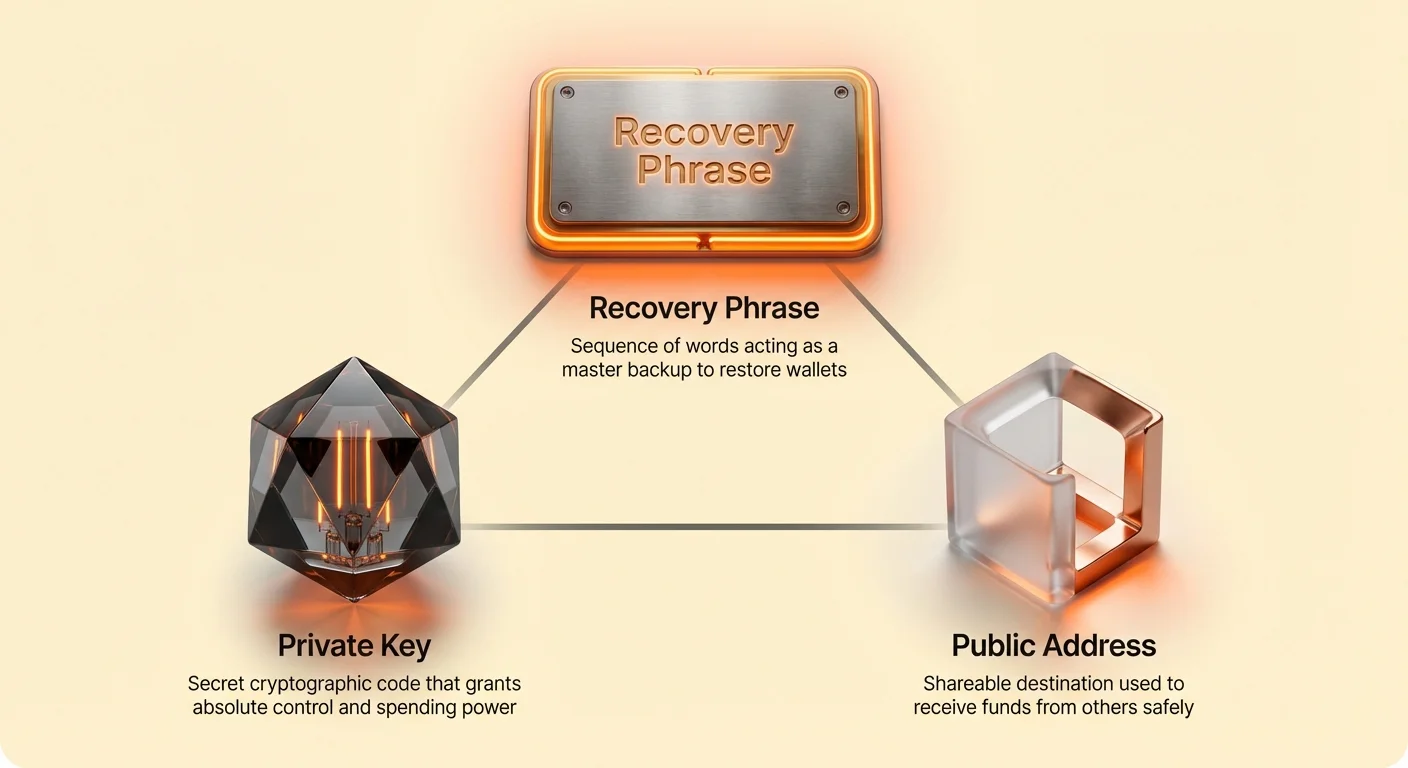
At the core of this system is a pair of cryptographic keys: the public key and the private key. These keys are mathematically linked but serve distinct functions. The public key is comparable to a bank account number. It is used to derive the public address that users share to receive funds. It is safe to distribute this address freely to anyone who needs to send payment.
The private key, however, acts as the digital signature and password combined. It is a 256-bit secret number that grants the holder the ability to spend or transfer the bitcoin associated with the corresponding public address. Whoever possesses the private key controls the funds. If a malicious actor gains access to a private key, they can drain the wallet immediately. Conversely, if the private key is lost, the assets remain on the blockchain but become mathematically impossible to move.
The Role of the Recovery Phrase
Managing a raw 256-bit alphanumeric string is unwieldy and prone to human error during transcription. To solve this, modern wallets utilize a standard known as a recovery phrase, also frequently called a seed phrase or secret passphrase. This is a list of 12 to 24 random words generated by the wallet software during the initial setup.
This sequence of words functions as a master key. It translates the complex cryptographic data into a human-readable format. If a phone is lost, a computer crashes, or a hardware device is destroyed, the entire wallet can be reconstructed on a new device simply by entering this list of words in the correct order. Consequently, protecting this phrase is the single most important aspect of crypto security.
Differentiating Storage Methods
Not all wallets offer the same level of security or utility. The choice of storage method depends largely on the volume of assets being secured and the frequency with which they need to be accessed. Understanding the trade-offs between convenience and security is vital for establishing a proper backup protocol.
| Wallet Type | Connectivity | Security Level | Best Use Case |
|---|---|---|---|
| Software (Hot) | Online | Moderate | Daily spending, small amounts |
| Hardware (Cold) | Offline | High | Long-term storage, large sums |
| Exchange | Custodial | Low (Third-party risk) | Active trading |
Software Wallets and Convenience
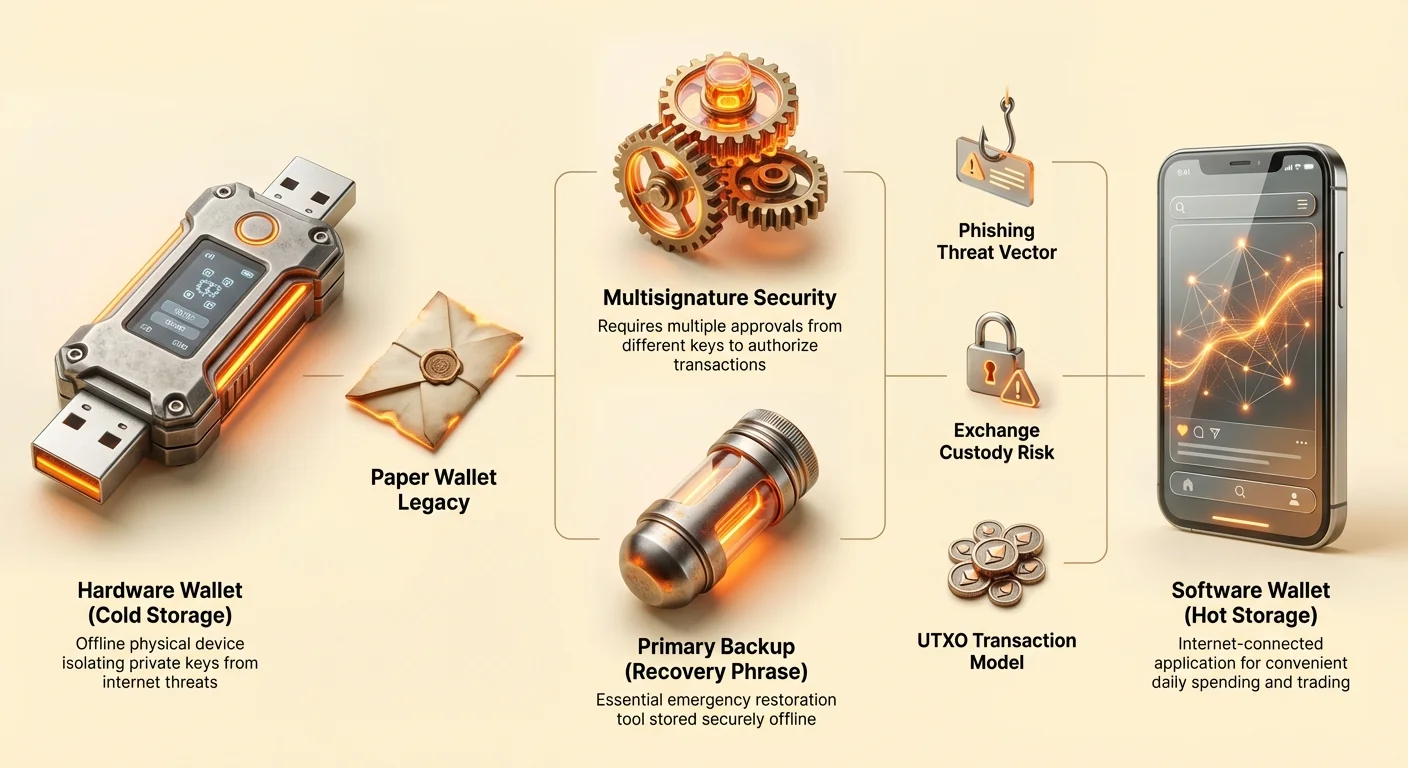
Software wallets, often referred to as "hot wallets," run as applications on mobile devices, desktops, or web browsers. Their primary advantage is accessibility. They allow users to send, receive, and trade assets quickly, making them ideal for day-to-day use or smaller holdings. Because these devices are connected to the internet, they carry a theoretical risk of exposure to malware or remote hacking attempts.
Despite the connection to the internet, reputable non-custodial software wallets are generally secure for everyday purposes. They encrypt the private keys on the device itself, ensuring that the wallet provider cannot access the user's funds. For many users, a mobile wallet serves as their primary interface with the blockchain, functioning similarly to a checking account for daily operations.
The Fortress of Cold Storage
For substantial amounts of bitcoin, hardware wallets provide the gold standard of security. These are physical electronic devices, often resembling USB drives, designed specifically to isolate private keys from the internet. This isolation is referred to as "cold storage."
When a user wishes to send a transaction using a hardware wallet, the device must be physically connected to a computer or mobile phone. The transaction data is sent to the hardware device, which signs the transaction internally using the private key. The signed transaction is then sent back to the computer to be broadcast to the network. Crucially, the private key never leaves the device and is never exposed to the internet-connected computer. This protects the funds even if the computer being used is infected with viruses or keyloggers.
Backup Best Practices and Protocols
Creating a backup is not merely a suggestion; it is a mandatory step in wallet creation. Without a backup, a lost device equates to lost wealth. The process of backing up involves securing the recovery phrase or private key in a manner that withstands physical disasters and digital threats.
Manual Physical Backups
The most traditional method of backing up a wallet is writing the 12 or 24-word recovery phrase on paper. This should be done immediately upon wallet generation. The words must be written clearly, in the exact order presented, and double-checked for spelling accuracy. A single wrong letter or word can render the backup useless.
Once written, this paper should be stored in a secure location, such as a fireproof safe or a safety deposit box. It is advisable to create multiple copies and store them in geographically separate locations. This protects against localized disasters like fires or floods. Under no circumstances should this paper be photographed or saved as a digital image, as this would expose the key to cloud leakage or gallery snooping apps.
Automated Cloud Solutions
Recognizing the friction and risks associated with paper backups, some modern self-custodial wallets have introduced automated cloud backup systems. These services allow users to create a single custom password that encrypts the wallet's private keys and stores the encrypted file in a cloud service like Google Drive or Apple iCloud.
This approach offers significant convenience. If a device is lost, the user simply reinstalls the wallet app, logs into their cloud account, and enters their decryption password to restore access. This method eliminates the need to manage physical paper scraps and reduces the risk of human error during manual transcription. However, it introduces a reliance on the security of the chosen password and the cloud provider's infrastructure.
Paper Wallets and Offline Generation
A paper wallet is a unique form of cold storage where the public and private keys are generated offline and printed physically onto paper. This method removes digital hardware from the equation entirely. The paper contains the keys, often represented as QR codes, allowing funds to be sent to the address and swept off the paper later using the private key.
While paper wallets are immune to online hacking, they are fragile. Paper can degrade, ink can fade, and the physical object can be easily lost or stolen. Furthermore, the process of generating them requires strict hygiene to ensure the printer or computer used is not compromised. For most users, hardware wallets have superseded paper wallets as the preferred method of cold storage due to their durability and ease of use.
Advanced Protection: Multisignature Wallets
For individuals, families, or organizations seeking a higher tier of security, multisignature (multisig) wallets offer a robust solution. A standard wallet is considered "single-signature," meaning one private key is sufficient to authorize a transaction. A multisig wallet, by contrast, distributes control across multiple keys and requires a defined number of approvals to move funds.
Removing the Single Point of Failure
The primary advantage of a shared or multisig wallet is the elimination of a single point of failure. In a standard setup, if the private key is lost or stolen, the funds are compromised. In a multisig setup, the wallet is configured with multiple participants or devices.
A common configuration is a "2-of-3 wallet". In this scenario, three separate private keys are generated. To authorize a transaction, at least two of the three keys must provide a signature. This structure protects the funds even if one key is compromised. A thief would need to steal two separate keys to access the assets. Similarly, if one key is lost, the remaining two can still be used to recover the funds and move them to a new wallet.
Use Cases for Shared Control
Multisig wallets are highly effective for estate planning and family savings. A wallet could be shared between family members, requiring consensus before funds are spent. This ensures that no single individual can drain the savings impulsively or maliciously. It also acts as a safety mechanism; if one family member loses their access, the others can still retrieve the funds.
Organizations and businesses also utilize multisig wallets to manage treasuries. A board of directors might hold the keys, with a requirement that a majority must sign off on any significant expenditure. This cryptographic enforcement of governance prevents embezzlement and ensures transparency in how organizational funds are utilized.
The Mechanics of Transactions and Privacy
Securing a wallet also involves understanding how transactions affect privacy and data exposure on the blockchain. The Bitcoin network is a public ledger, meaning every transaction is visible to anyone with an internet connection. While identities are not directly attached to addresses, patterns of activity can reveal information about a user's holdings.
The UTXO Model Explained
Bitcoin transactions operate on the Unspent Transaction Output (UTXO) model. This is similar to spending physical cash. If a user has a single "digital coin" worth 5 BTC and wishes to send 1 BTC to a friend, they cannot simply break off a piece of the data. Instead, the entire 5 BTC input is sent to the network. The protocol sends 1 BTC to the recipient and sends 4 BTC back to the sender as "change."
This change usually goes to a newly generated address within the sender's wallet. This mechanism is handled automatically by wallet software. However, it has implications for transaction fees and privacy. If a wallet contains many small inputs (like a pocket full of pennies), combining them to make a large payment requires more data space on the blockchain, resulting in higher network fees.
Address Management and Privacy
Because the ledger is public, reusing the same address for every transaction allows outside observers to easily cluster activity and estimate a user's total wealth. If an address is shared publicly, anyone can paste it into a block explorer and view its entire history.
To mitigate this, privacy-focused best practices dictate using a fresh address for every new transaction. Modern Hierarchical Deterministic (HD) wallets handle this automatically. They generate a virtually infinite sequence of new public addresses from the single master seed phrase. This separates transactions on the public ledger while allowing the user to manage the combined balance through a single interface.
Identifying and avoiding Fraud
The irreversible nature of crypto transactions makes users a prime target for scammers. Fraudsters rely on social engineering and deception rather than technical hacks to steal funds. Recognizing these threats is a crucial component of a security protocol.
Phishing and Social Engineering
Phishing attacks attempt to trick users into revealing their recovery phrases or private keys. These often take the form of emails or messages pretending to be from a wallet provider, exchange, or support team. The message might claim that an account is frozen or that a security update is required.
These communications will direct the user to a malicious website that mimics a legitimate service. Once the user enters their seed phrase into the fake site, the attackers capture the information and drain the wallet. It is a universal rule that legitimate wallet providers and support staff will never ask for a recovery phrase. Any request for this information is a guaranteed scam.
Fake Wallets and Imposters
Another vector for fraud involves fake wallet applications. Scammers create software that looks identical to popular wallet apps and upload them to third-party app stores or promote them via fake advertisements. When a user installs the fake app and generates a wallet, the software sends the private keys directly to the scammer.
To avoid this, users should always download software directly from the official vendor's website. Verifying the URL and checking for HTTPS encryption helps ensure the site is authentic. Additionally, avoiding sponsored ads in search results prevents landing on look-alike sites designed to distribute malware.
Recovery Protocols and Contingencies
A security plan is incomplete without a tested recovery protocol. Merely having a backup is insufficient; users must know how to use it. Recovery is the process of restoring access to funds using the backup mechanism when the primary access method fails.
Restoring from a Seed Phrase
If a device is lost or broken, the user must acquire a new device and install compatible wallet software. During the setup process, the option to "Import Wallet" or "Restore from Backup" should be selected. The user then manually enters the 12 to 24 words from their paper backup.
Great care must be taken during this process. The words must be entered in the correct sequence. Most wallets verify the words against a standardized dictionary to prevent spelling errors. Once the phrase is processed, the wallet software recalculates the private keys and scans the blockchain for transaction history, restoring the balance and full access to the funds.
Handling Compromised Keys
If a user suspects that their recovery phrase has been exposed—perhaps they accidentally showed it on a webcam or stored it in an unencrypted file—they must act immediately. The backup is no longer secure.
The correct protocol is to create a completely new wallet with a fresh, secure recovery phrase. The user must then transfer all funds from the compromised wallet to the new wallet immediately. This "sweeping" of funds moves the assets to a new set of private keys that the potential attacker does not possess.
Conclusion
The transition to self-custody represents a significant leap in financial independence. By holding private keys, individuals gain immunity from bank failures, censorship, and third-party mismanagement. However, this independence requires a disciplined approach to security. The combination of robust backup methods, cold storage for significant wealth, and vigilance against social engineering forms the bedrock of asset protection.
Whether utilizing simple software wallets for daily spending or complex multisignature setups for family estates, the principles remain the same. The private key is the asset. Protecting it from physical loss through redundancy and from digital theft through isolation ensures that digital wealth remains secure. As the ecosystem evolves, sticking to these fundamental protocols ensures that users can navigate the digital economy with confidence and safety.
Your private key is the only proof of ownership; never share it, lose it, or store it online unencrypted.