
Blockchain networks operate on a system of incentives and resource management that is fundamentally different from traditional centralized banking. In a centralized system, a bank covers the cost of servers and infrastructure, often charging users a monthly fee or profiting from their data. In decentralized networks, the infrastructure is run by thousands of independent participants known as miners or validators. These participants contribute computational power and hardware to secure the network and process transactions.
Network fees serve as the primary compensation for these service providers. They are not arbitrary charges but are determined by a complex interplay of market forces. Every time a user initiates a transfer or interacts with a smart contract, they must pay a fee to have their request processed. This fee acts as a gatekeeper, preventing spam and ensuring that the limited resources of the network are allocated efficiently.
The cost of using a blockchain is rarely static. It fluctuates based on the current state of the network, the complexity of the request, and the specific rules of the blockchain protocol. Understanding how these fees are calculated, and why they change, is essential for anyone navigating the cryptocurrency ecosystem. It shifts the user's perspective from seeing fees as a mere annoyance to understanding them as a necessary mechanism for decentralized security and prioritization.
The Economics of Block Space
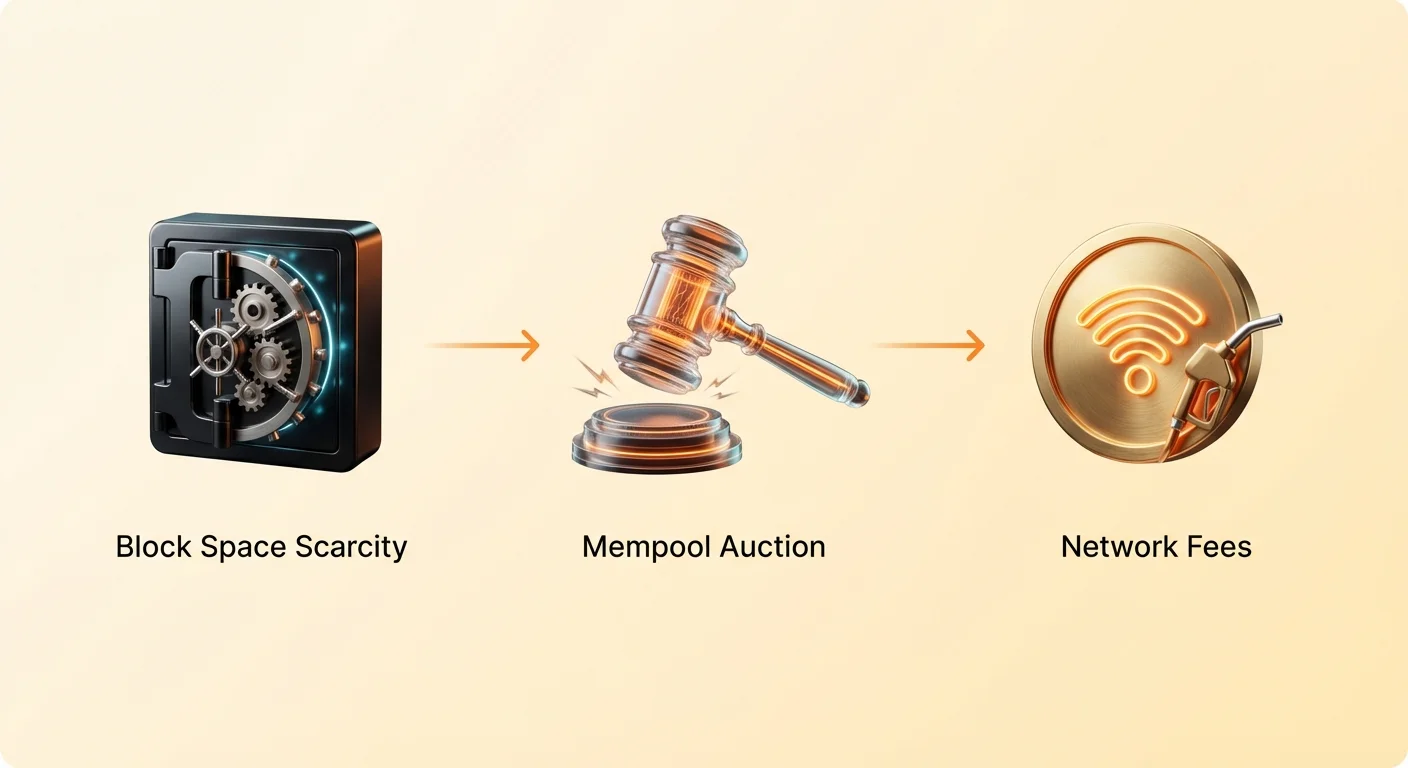
At the core of fee dynamics is the concept of scarcity. A blockchain is essentially a ledger composed of blocks, and each block has a finite capacity. This capacity might be measured in megabytes, as seen in Bitcoin, or in a computational unit called gas, which is utilized by Ethereum. Because blocks are produced at fixed time intervals, the supply of available space for transactions is strictly limited.
This limitation creates a market for block space. Users who want their transactions included in the next block must compete with one another for the available slots. When demand is low, there is plenty of room for everyone, and fees remain low. However, when demand exceeds the supply of space in a block, the network becomes congested.
The Auction Mechanism
To manage this scarcity, blockchain networks utilize a mechanism similar to an auction. When a user broadcasts a transaction, it enters a waiting area known as the mempool. Miners and validators select transactions from this pool to construct the next block. Since they are profit-seeking entities, they are naturally incentivized to prioritize transactions that offer the highest fees.
Users effectively bid against each other for priority. If you need a transaction confirmed immediately, you must outbid other users by attaching a higher fee. This ensures your transaction is attractive enough to be picked up in the very next block. If time is not a factor, you can offer a lower fee and wait until the congestion clears and the price for block space drops.
Supply and Demand Equilibrium
The fee market acts as an equilibrium mechanism between supply and demand. When the network is busy, fees rise, which naturally discourages low-value or non-urgent transactions. Users who might have sent a small test transaction or a low-priority consolidation of funds may decide to wait when costs are high.
This dynamic ensures that high-value economic activity can always proceed if the user is willing to pay the market rate. It prevents the network from grinding to a halt under the weight of infinite spam, as the cost to attack the network by filling blocks becomes prohibitively expensive. The fee market ensures the most economically significant transactions are prioritized during periods of heavy usage.
Components of Transaction Complexity
Not all transactions are created equal. The fee is not just a flat rate for access; it often reflects the burden a transaction places on the network. In simpler blockchain models, this burden is primarily a function of data size. A transaction that has many inputs and outputs, such as sending funds to ten different people at once, takes up more data space in a block than a simple transfer between two wallets.
Because block space is the scarce resource, larger transactions generally cost more. Users are essentially paying for the number of bytes they occupy in the distributed ledger. This is why consolidating many small inputs into one output can be expensive, as the data required to prove ownership of each small fragment adds up.
On smart contract-enabled blockchains, complexity takes on a different meaning. It is not just about data storage but also about computational execution. A simple value transfer requires minimal processing power. However, interacting with a decentralized finance protocol or minting a digital asset triggers a series of code executions on the blockchain's virtual machine.
| Transaction Type | Complexity Level | Relative Cost |
|---|---|---|
| Standard Transfer | Low | Lowest |
| Token Swap (DEX) | Medium | Moderate |
| NFT Minting | High | Highest |
The network must charge for this computational work to prevent infinite loops and excessive processing loads on the nodes. Therefore, the fee is derived from both the space the transaction occupies and the number of computational steps required to finalize it.
Gas: The Fuel of Computation
In ecosystems like Ethereum and other EVM-compatible chains, the concept of "gas" is introduced to measure computational effort precisely. Gas is a unit of account that quantifies the work required to perform specific actions. Every operation, from adding two numbers to storing a variable, has a fixed cost in gas units.
Gas is distinct from the native currency of the network. While gas measures the work, the user pays for that gas using the blockchain's native token, such as ETH or MATIC. This separation allows the system to assign a constant work value to operations even as the market price of the cryptocurrency fluctuates wildly.
Gas Limit and Consumption
When initiating a transaction, a user specifies a gas limit. This acts as a budget, setting the maximum amount of computational work the user is willing to pay for. Simple transfers usually have a standard fixed limit, typically 21,000 gas on Ethereum. Complex interactions with smart contracts require significantly higher limits because the code logic is more involved.
If a transaction runs out of gas before completing its operations, the network reverts the changes to prevent partial updates. However, the user still pays the fee for the work that was attempted. This mechanic ensures that the network is compensated for the computational resources used, even if the outcome was not what the user intended.
The Price of Gas
While the amount of gas required for a specific action is constant, the price per unit of gas is volatile. This price is typically denominated in "gwei" on the Ethereum network. The gas price is the variable that users adjust to compete in the auction for block space.
During quiet periods, the price per unit of gas might be very low. During a highly anticipated NFT launch or a period of market volatility, the price per unit can skyrocket. The total transaction cost is calculated by multiplying the gas units used by the current gas price. This formula means that even a simple transaction can become expensive if the market price for gas is high.
The Role of Burning and Base Fees
Modern blockchain updates have introduced mechanisms to make fee markets more predictable. One significant development is the implementation of a base fee system, most notably through Ethereum's EIP-1559 upgrade. Before this, users had to guess the appropriate fee to pay, often overpaying to ensure inclusion or underpaying and getting stuck.
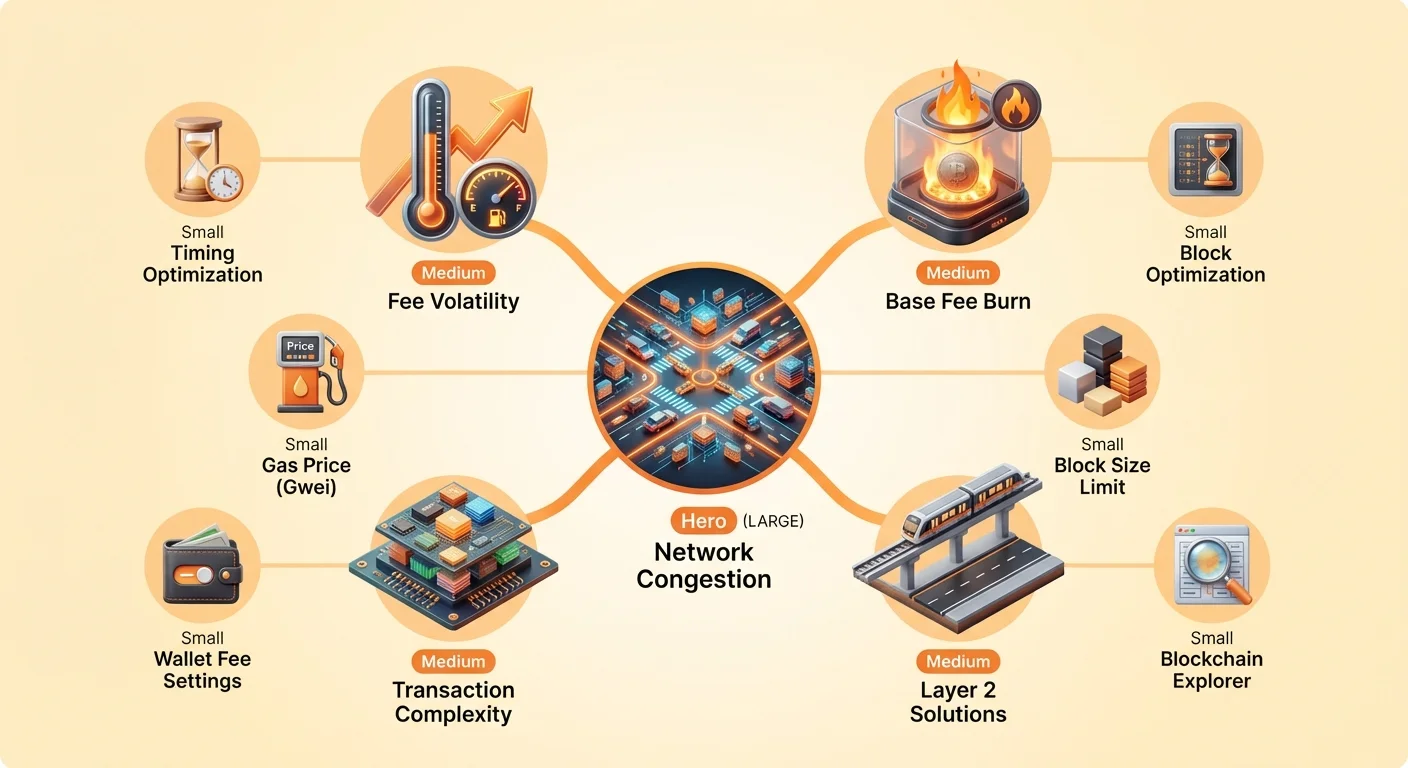
The base fee is a mandatory charge included in every block. It is determined algorithmically by the protocol based on the fullness of the previous block. If a block is more than 50% full, the base fee for the next block increases. If it is less than 50% full, the fee decreases. This creates a predictable pricing curve that reacts to congestion in real-time.
Crucially, this base fee is "burned," meaning it is permanently removed from the circulating supply of the cryptocurrency. This burning mechanism acts as a deflationary force, potentially increasing the value of the remaining tokens over time. It shifts the benefit of high network usage from solely the miners to all token holders.
To incentivize miners or validators to include a transaction, users add a "priority fee" or tip on top of the base fee. While the base fee gets destroyed, the priority fee goes directly to the validator. In times of extreme congestion, the bidding war shifts to this priority fee, as users compete to jump the queue even after meeting the base requirement.
Network Congestion and Mempool Dynamics
Congestion is the primary driver of fee volatility. Blockchains have a fixed throughput, meaning they can only process a certain number of transactions per second. When the rate of incoming transactions exceeds this throughput, the excess builds up in the mempool, which serves as a waiting room for unconfirmed transactions.
The Bottleneck Effect
Imagine a highway with a toll booth that can only process ten cars per minute. If twenty cars arrive every minute, a traffic jam forms immediately. In the blockchain world, the toll is variable. Drivers who are willing to pay more get to skip the line. The mempool represents this line of waiting cars.
As the mempool fills up, the "price to enter" the next block rises. Wallets and fee estimators look at the pending transactions and recommend fees based on what is likely to be accepted. If a user sets a fee that was appropriate an hour ago, but the mempool has since flooded with high-priority activity, their transaction may remain pending for hours or even days.
Peak Activity Periods
Network activity is rarely uniform. It follows patterns based on human behavior and market events. Certain times of day, coinciding with the opening of major financial markets, often see higher traffic. Specific events, such as a sharp drop in crypto prices, trigger a rush of users trying to deposit funds to exchanges or adjust collateral positions in DeFi protocols.
During these peak times, the fee market enters a frenzy. Users prioritizing speed over cost will set extremely high fees. This raises the average fee required for inclusion, forcing everyone else to either pay up or wait. Once the event passes and the backlog in the mempool clears, fees typically return to their baseline levels.
Consensus Mechanisms and Fee Structures
The underlying method a blockchain uses to reach agreement, known as the consensus mechanism, also influences the fee environment. Proof of Work (PoW) networks, like Bitcoin, rely on miners who expend vast amounts of energy to solve puzzles. The block reward and transaction fees must be sufficient to cover these hardware and electricity costs.
In Proof of Stake (PoS) systems, validators secure the network by locking up capital rather than burning energy. While they still incur costs for running nodes and maintaining uptime, the operational overhead can be lower compared to industrial-scale mining. This difference can influence the long-term economic sustainability of the network and the reliance on fees versus block subsidies.
However, the primary determinant of the fee remains the demand for block space rather than the cost of production. Even in an energy-efficient PoS network, if the demand for space exceeds the limit, fees will rise. The consensus mechanism defines how the security is provided, but the block size limit defines the scarcity that drives the fee market.
Scaling Solutions and Layer 2 Efficiency
As adoption grows, the limitations of Layer 1 blockchains (the main networks like Ethereum or Bitcoin) become apparent. To address the high costs associated with congestion, developers have created Layer 2 solutions. These protocols operate on top of the main blockchain and are designed specifically to reduce transaction costs and increase throughput.
Off-Chain Processing
Layer 2 solutions work by moving the bulk of transaction processing off the main chain. Instead of every single coffee purchase or gaming move needing to be recorded and validated by every node on the main network, these transactions are handled by the Layer 2 protocol. This reduces the competition for the scarce block space on Layer 1.
The Layer 2 network processes thousands of transactions rapidly and efficiently. It then periodically bundles these transactions together and submits a summary or proof to the main Layer 1 blockchain. By anchoring this summary to the main chain, the Layer 2 inherits the security of the base layer without requiring the base layer to do all the heavy lifting.
Rollups and Cost Sharing
Rollups are a popular type of Layer 2 technology. They "roll up" many transactions into a single piece of data. The cost of the single Layer 1 transaction used to settle the batch is split among all the users in the bundle.
If it costs $50 to submit a batch of data to Ethereum, but that batch contains 1,000 user transactions, the cost per user is only $0.05. This economy of scale allows for complex interactions and high-frequency trading that would be economically unfeasible on the main network. It effectively expands the supply of block space, lowering the equilibrium price for everyone.
Transaction Types and Variability
The variability of fees is also dictated by the type of action a user performs. A blockchain explorer can reveal the stark differences in gas usage between different transaction types. Simple value transfers are the most efficient operations. They involve updating the balances of two addresses, a process that requires minimal computation.
Decentralized Exchange (DEX) swaps involve more logic. The smart contract must check liquidity pools, calculate exchange rates, update balances, and potentially route the trade through multiple pairs. This requires significantly more gas. Consequently, swapping tokens will almost always be more expensive than sending them.
Minting Non-Fungible Tokens (NFTs) or deploying new smart contracts sits at the top of the cost hierarchy. These actions often involve writing large amounts of data to the blockchain's permanent storage. Storage is one of the most expensive resources on a decentralized network because every node must retain that data indefinitely. Therefore, these transactions incur the highest fees.
Managing and Optimizing Costs
For the end-user, the fee market is not something they can control, but it is something they can navigate. Most self-custodial wallets offer tools to help users manage their transaction costs. When sending crypto, wallets typically provide three settings: fast, average, and slow (often labeled as "Eco").
Wallet Fee Settings
The "Fast" setting attaches a higher fee, aiming for inclusion in the next one to three blocks. This is ideal for urgent payments. The "Eco" or slow setting attaches a lower fee. This signals to the network that the transaction is not urgent. It may sit in the mempool for an hour or more until a block is mined that has extra space.
For advanced users, custom fee settings allow for precise control. By checking a blockchain explorer or a gas tracker tool, a user can see the exact fees currently being accepted. They can then set a fee slightly above the minimum to ensure processing without overpaying.
Timing and Tools
Timing is also a powerful tool for optimization. Because fee markets respond to human activity, they often show cyclical patterns. Weekends or late nights in major time zones often see lower congestion. A user who can wait to execute a complex smart contract interaction until Sunday morning might pay a fraction of the cost compared to doing it on a Tuesday afternoon.
Blockchain explorers act as the window into this data. They allow users to monitor the current gas price, the status of the mempool, and the confirmation times for recent blocks. By utilizing these resources, users can make informed decisions about when to transact and how much to bid, ensuring they are not overpaying for block space they do not urgently need.
Conclusion
The dynamics of cryptocurrency fee markets are a direct result of decentralized architecture. They represent the honest cost of securing a network without a central authority. Through a combination of limited supply, fluctuating demand, and auction-based inclusion, fees ensure that the most valuable transactions are prioritized and that the network remains protected from spam.
Innovations like the base fee burn mechanism and Layer 2 scaling solutions are continuously evolving the landscape, making costs more predictable and efficient. While high fees can be a friction point, they are also a sign of robust network demand and security. By understanding the factors of congestion, complexity, and timing, users can navigate these markets effectively, balancing their need for speed against the cost of execution.
Fees are the necessary price of decentralized security, regulating demand to keep the blockchain efficient and accessible.