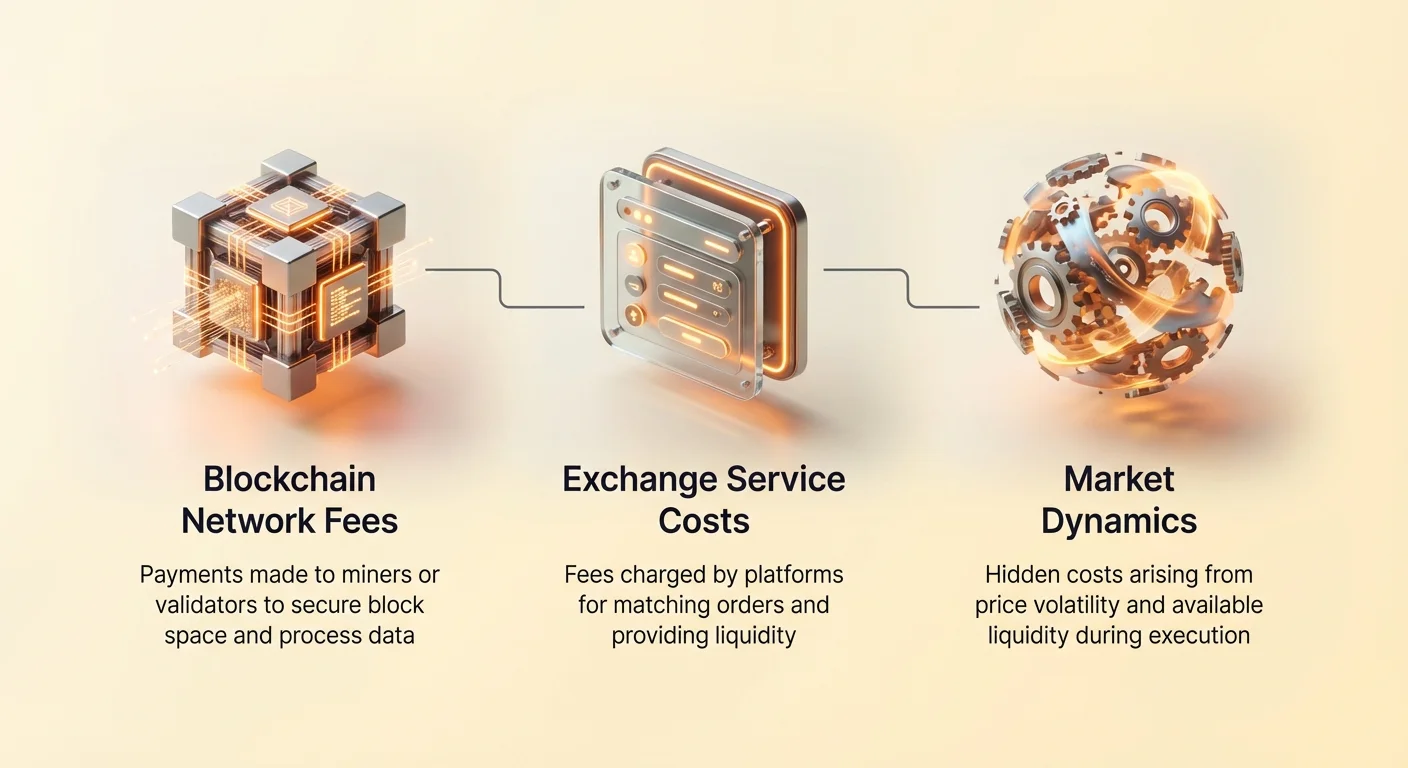
Navigating the financial landscape of digital assets requires a shift in perspective from traditional banking. In the legacy financial system, transaction costs are often hidden, standardized, or absorbed by intermediaries. In the cryptocurrency ecosystem, costs are dynamic, transparent, and driven by supply and demand mechanisms that vary from one blockchain to another. Understanding these costs is not merely about saving a few dollars; it is about mastering the mechanics of the network itself.
Every action on a blockchain, whether sending funds, swapping tokens, or minting digital assets, consumes resources. These resources are finite. Blockchains produce blocks of data at set intervals, and the space within these blocks is limited. When you initiate a transaction, you are effectively bidding for a spot in that limited space. This creates a marketplace for transaction inclusion where prices fluctuate based on network congestion and the complexity of your request.
Beyond the blockchain layer, the venue you choose to conduct your business introduces its own layer of costs. Centralized exchanges, decentralized protocols, and peer-to-peer platforms all operate with distinct fee structures. Some charge for matching orders, others for withdrawing funds, and some profit from the spread between buying and selling prices. A savvy user must navigate these variables to ensure that the value of their assets is not eroded by unnecessary friction.
This guide dissects the anatomy of crypto transaction costs. We will explore the technical foundations of network fees, the economic models of exchanges, and the hidden market forces like slippage that can impact trade execution. By understanding these components, you can make informed decisions about when, where, and how to transact.
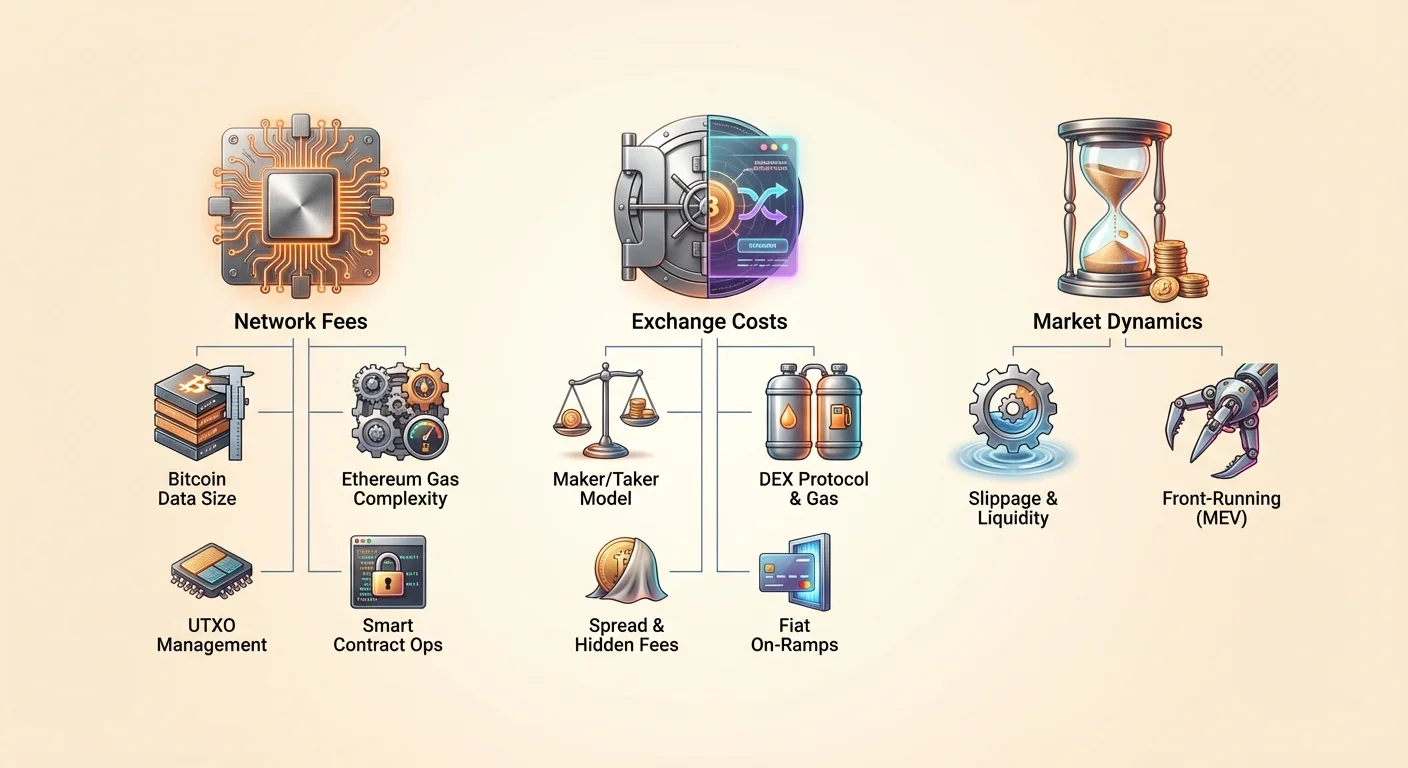
The Mechanics of Network Fees
Network fees are the compensation paid to the operators of a blockchain. These operators, known as miners in Proof of Work systems or validators in Proof of Stake systems, secure the network and process transactions. The fee is not an arbitrary charge but an incentive mechanism designed to prioritize transactions and deter spam. Without a cost attached to network usage, malicious actors could flood the system with infinite useless data, grinding operations to a halt.
How Blockchain Resources Are Priced
The cost of a transaction is fundamentally determined by data size and demand. In the Bitcoin network, fees are calculated based on the weight of the transaction in bytes. A simple transfer from one person to another takes up a predictable amount of space. However, more complex transactions, such as those involving multi-signature wallets or opening payment channels, require more data. Since a block on the Bitcoin blockchain has a maximum size limit, transactions that consume more data must pay a higher fee to justify their inclusion.
Ethereum and similar smart contract platforms use a different metric known as gas. Gas measures the computational effort required to execute a specific operation. A simple transfer of value requires a minimal amount of gas. Interacting with a decentralized finance protocol, minting a non-fungible token, or executing a complex swap requires significantly more computational power. Consequently, the gas limit for these transactions is higher, leading to a greater total cost.
The price of gas itself, often denominated in "gwei," fluctuates based on network traffic. When many users attempt to transact simultaneously, the demand for block space exceeds supply. Users must offer a higher gas price to incentivize validators to include their transaction first. During periods of extreme congestion, such as a popular token launch, gas prices can spike dramatically, making simple transactions prohibitively expensive.
The Data Structure of Bitcoin Transactions
To understand why some Bitcoin transactions cost more than others, one must look at the Unspent Transaction Output (UTXO) model. When you hold bitcoin, you do not hold a single balance like a bank account. Instead, you hold various "notes" or digital checks received from previous transactions. These are called inputs. When you send bitcoin, your wallet selects enough of these inputs to cover the amount and creates new outputs for the recipient and your change.
Consider a scenario involving two users, Alice and Bob. Alice wants to send 1 BTC. She acquired this bitcoin in two separate transactions of 0.5 BTC each. To send 1 BTC, her transaction must reference both of those 0.5 BTC inputs. This adds data to the transaction file. Bob also wants to send 1 BTC. However, he acquired his holdings through one hundred small transactions of 0.01 BTC each.
Bob's transaction must bundle one hundred separate inputs to make up the total sum. This results in a transaction file that is significantly larger in terms of data bytes than Alice's. Since miners charge based on the data size, Bob will pay a much higher fee than Alice, even though they are sending the exact same amount of value. This highlights the importance of UTXO management for frequent users.
Ethereum Gas and Smart Contract Complexity
On the Ethereum network, the complexity of the code being executed is the primary driver of cost. Every operation in a smart contract has a fixed gas cost associated with it. Reading data from the blockchain is cheap, while writing new data to the permanent storage is expensive. This is why claiming rewards from a staking pool or swapping tokens on a decentralized exchange costs more than a standard transfer of Ether.
It is crucial to understand that you pay for the computation, not the result. If you set a gas limit that is too low for a complex transaction, the network may process part of the operation until it runs out of the allocated gas. In this scenario, the transaction fails, and the changes are reverted, but the gas fee you paid is kept by the validator. They still performed the work, even if it did not complete successfully.
Users can usually customize their fee settings in self-custodial wallets. Settings are typically categorized by speed preference: "Eco," "Fast," or "Fastest." The "Eco" setting bids a lower gas price, meaning the transaction might sit in the memory pool for longer until traffic subsides. The "Fastest" setting bids aggressively to ensure inclusion in the very next block. This flexibility allows users to prioritize cost savings over speed when urgency is low.

Centralized Exchange Fee Structures
Centralized exchanges (CEXs) act as intermediaries that facilitate trading between buyers and sellers. Unlike on-chain transactions where you pay miners, here you pay the exchange for their service. CEXs maintain their own internal ledgers, meaning trades within the exchange do not occur on the blockchain. This allows for instant execution and avoids network fees for every single trade, but introduces a different set of costs.
The Maker and Taker Model
Most professional exchanges utilize a maker-taker fee schedule to encourage liquidity. Liquidity refers to the abundance of buy and sell orders in the order book. A liquid market allows traders to buy or sell large amounts without significantly moving the price. To foster this environment, exchanges incentivize users who place orders that do not fill immediately. These users are called "Makers" because they make liquidity available to the market.
When you place a limit order to buy bitcoin at a price lower than the current market value, your order sits in the book. You are adding depth to the market. Because you are providing a service to the exchange by stabilizing the order book, you are typically charged a lower trading fee. In some rare cases, makers may even receive a rebate for their orders.
Conversely, "Takers" are traders who want immediate execution. They place market orders that match instantly with existing orders on the book. By doing so, they remove liquidity from the exchange. Because they are taking volume off the books, they are charged a higher fee. Understanding this distinction is vital for active traders, as using limit orders instead of market orders can significantly reduce overhead over time.
| Role | Action | Fee Impact |
|---|---|---|
| Maker | Adds order to book | Lower fees (Rebates possible) |
| Taker | Fills existing order | Higher standard fees |
| Market | Immediate execution | Charged as Taker |
Spreads and Hidden Costs
Not all exchanges use a transparent maker-taker model. Brokerage platforms and simplified trading interfaces often advertise "zero fees." In these environments, the cost is usually hidden in the spread. The spread is the difference between the buying price (ask) and the selling price (bid).
If the global market price of Bitcoin is $50,000, a brokerage might offer to sell it to you for $50,500 and buy it from you for $49,500. That difference is the spread. While you see a transaction with "$0 fee" on your receipt, you have effectively paid a premium for the asset and would face an immediate loss if you sold it back instantly.
For beginners, this model offers simplicity and a cleaner user interface. There is no need to navigate complex charts or order books. However, for larger transactions, the cost of the spread can far exceed the percentage-based fees charged by professional trading platforms. It is important to compare the final execution price rather than just looking at the line item for fees.
Withdrawal and Deposit Fees
Moving funds into and out of a centralized exchange often incurs fees that surprise new users. Deposit fees vary wildly depending on the payment method. Bank transfers often incur minimal or no fees, though they may take several days to settle. Credit and debit card purchases, while instant, usually carry high processing fees charged by the card networks and passed on to the user.
Withdrawal fees are another revenue stream for exchanges. When you move cryptocurrency from an exchange to a private wallet, the exchange must pay the network fee to the blockchain. However, most exchanges charge a flat withdrawal fee that is significantly higher than the actual network cost. The difference is profit for the exchange.
These fees can be disproportionately high for small withdrawals. If an exchange charges a flat fee of 0.0005 BTC to withdraw, and you are only withdrawing 0.001 BTC, you are losing half your funds to fees. Some platforms offer dynamic withdrawal fees that adjust with network conditions, while others stick to high fixed rates. Checking the withdrawal policy before depositing is a prudent step for cost-conscious investors.
Decentralized Exchange (DEX) Dynamics
Decentralized exchanges allow users to trade directly with one another or against liquidity pools without an intermediary. This aligns with the ethos of crypto but introduces a unique cost structure. On a DEX, there is no company to hold your funds or manage an order book. All actions are executed via smart contracts on the blockchain.
The Double Cost of DEX Trading
Trading on a DEX typically involves two distinct layers of cost. First, there is the protocol fee. This is a percentage of the trade value, often around 0.3%, which is paid to the liquidity providers. These are the users who have deposited their assets into the pool to facilitate trading. This fee is analogous to the trading fee on a centralized exchange, but the revenue goes to the community of liquidity providers rather than a corporation.
The second cost is the network fee. Every interaction with a DEX smart contract is a blockchain transaction. You must pay gas to approve the DEX to spend your tokens, and then pay gas again to execute the swap. On high-fee networks like Ethereum, these gas costs can be substantial. During times of congestion, a trade worth $50 might cost $30 or more in gas fees, making small trades economically unviable.
This structure makes DEXs highly sensitive to the underlying blockchain's performance. While the protocol fee is a fixed percentage, the network fee is a fixed cost based on complexity. Therefore, DEXs are often more economical for large trades where the fixed gas cost is a small percentage of the total value, whereas small trades are better suited for low-fee networks or centralized exchanges.
Approvals and Token Permissions
Before a decentralized exchange can interact with the tokens in your wallet, you must grant it permission. This process is called an "approval." An approval transaction simply tells the token contract that the DEX is allowed to move a specific amount of your funds. This is a security feature designed to ensure no protocol can drain your wallet without consent.
However, approvals are on-chain transactions that cost gas. If you are trading a token for the first time on a specific DEX, you must pay for the approval transaction before you can pay for the swap transaction. This adds an upfront cost to trying new assets or platforms.
Some users set approvals to "unlimited" to avoid paying this fee repeatedly for future trades. While this saves gas, it introduces a security risk. If the DEX protocol were ever compromised, the attacker could potentially drain all the tokens you approved. Revoking these permissions also costs gas, creating a trade-off between security and transaction costs that users must manage carefully.
Slippage and Price Impact
In the world of Automated Market Makers (AMMs) used by DEXs, price is determined by a mathematical formula based on the ratio of assets in a liquidity pool. This mechanism introduces a phenomenon known as slippage. Slippage is the difference between the expected price of a trade and the price at which the trade is actually executed.
Liquidity Pools and Trade Size
Liquidity is the lifeblood of an AMM. A pool with millions of dollars in assets can handle large trades with minimal price movement. However, if a pool has low liquidity, a large buy order will significantly alter the ratio of assets in the pool. This creates "price impact." As you buy more of an asset from a shallow pool, the price creates an upward curve, meaning you get fewer tokens for your money than you calculated at the start.
Slippage can also occur due to market volatility. In the time between when you submit a transaction and when it is confirmed on the blockchain, prices can change. If the price moves against you, your transaction might fail if the slippage exceeds your tolerance setting, or it might execute at a worse price.
Users can adjust their slippage tolerance in the DEX interface. A low tolerance (e.g., 0.5%) protects you from bad prices but increases the risk of a failed transaction during volatility. A high tolerance (e.g., 5%) ensures the trade goes through but exposes you to receiving significantly less value.
Front-Running and MEV
High slippage tolerance settings open the door to predatory behavior known as Maximal Extractable Value (MEV) or front-running. Since DEX transactions are broadcast to a public memory pool before they are confirmed, sophisticated bots can monitor the network for large pending trades.
If a bot sees you are about to buy a large amount of a token, it can pay a higher gas fee to insert its own buy transaction immediately before yours. This drives up the price. Your trade then executes at this inflated price. The bot then immediately sells the token after your transaction, pocketing the difference. This sandwich attack extracts value directly from the trader.
Keeping slippage tolerance tight is the primary defense against these attacks. While it may lead to more failed transactions, it limits the profit margin available to front-running bots. Some blockchains and specialized RPC endpoints offer protection against front-running by routing transactions privately to validators, bypassing the public memory pool entirely.
Fiat On-Ramps and Payment Methods
Before worrying about gas or trading fees, users must navigate the costs of entering the crypto ecosystem. The "on-ramp," or the method used to convert government-issued currency into cryptocurrency, often carries the highest percentage fees of the entire lifecycle.
Convenience vs. Cost
Buying cryptocurrency instantly with a credit or debit card is the most convenient option for many. However, this convenience comes at a premium. Card processors label these transactions as high-risk, leading to processing fees that can range significantly. Additionally, the platform facilitating the purchase may add its own service fee. It is not uncommon to lose 3% to 5% of your purchasing power immediately upon entry when using cards.
Bank transfers generally offer a lower cost alternative. Most exchanges allow users to deposit fiat currency via wire transfer or local bank networks (like ACH in the US or SEPA in Europe) for free or for a nominal fee. The trade-off is speed. While a card transaction is instant, a bank transfer can take one to three business days to clear.
This delay can represent an opportunity cost. If the market is moving fast, waiting three days for funds to arrive might mean missing a specific price entry. Traders must weigh the certainty of high card fees against the potential opportunity cost of slower bank transfers.
Peer-to-Peer (P2P) Marketplaces
P2P exchanges offer an alternative route with flexible payment methods. Here, you transact directly with another individual. The platform typically provides an escrow service to ensure safety. Costs on P2P platforms are often embedded in the exchange rate offered by the seller rather than explicit fees.
Sellers on P2P platforms typically mark up the price of Bitcoin or stablecoins to cover their own risks and profit margins. While you might find a seller accepting diverse payment methods like gift cards or online wallets, the implicit exchange rate fee can be much higher than centralized exchange spreads. Furthermore, P2P trading requires vigilance against scams, adding a cognitive cost to the transaction.
Strategies for Cost Reduction
Minimizing transaction costs is essential for preserving portfolio value. By adopting specific habits and utilizing the right tools, users can significantly reduce their expenses over time.
| Strategy | Best For | Mechanism |
|---|---|---|
| Timing | Ethereum/High-fee chains | Wait for low network congestion |
| Batching | Bitcoin | Combine inputs/outputs in one tx |
| Customizing | Wallet transfers | Use "Eco" fee settings |
Optimizing Timing and Settings
Network fees are driven by supply and demand, which follows human cycles. Congestion often drops during weekends or late at night in primary trading time zones. Monitoring gas trackers can help identify the cheapest times to execute complex transactions like deploying contracts or managing DeFi positions.
For non-urgent transfers, always utilize the fee customization features in self-custodial wallets. Selecting an "Eco" or "Slow" fee rate can reduce costs by substantial margins compared to the default "Fast" settings. As long as you are not in a rush, there is no penalty for waiting a few hours for confirmation.
Choosing the Right Venue
The choice between a CEX and a DEX should be dictated by the trade size and asset type. For small trades of popular assets, a centralized exchange or a low-fee Layer 2 network is usually more economical because the fixed gas costs of Ethereum DEXs will eat up a large percentage of the capital.
Conversely, for large trades, DEXs can be more efficient. The fixed gas cost becomes negligible relative to the trade size, and you avoid the deposit/withdrawal friction of CEXs. Additionally, aggregators can route trades across multiple liquidity pools to minimize slippage, often providing better execution prices than a single CEX order book.
Utilizing Low-Fee Networks
The crypto ecosystem has expanded beyond Bitcoin and Ethereum. Networks like Solana, Polygon, and various Layer 2 solutions offer transaction fees that are fractions of a penny. Using these networks for frequent activity, such as payments or gaming, eliminates the fee burden almost entirely.
Innovations like shareable links take advantage of these low-fee environments to make sending value as easy as sending a text message. By operating on chains like Bitcoin Cash or utilizing optimized wallet infrastructure, users can onboard friends and family without the intimidating barrier of high network costs.
Conclusion
Transaction costs in cryptocurrency are multifaceted, encompassing network incentives, exchange services, and market dynamics. Unlike the flat fees of traditional banking, crypto costs are granular and variable. They reflect the true cost of block space, computational power, and liquidity provision in a decentralized environment.
Network fees on chains like Bitcoin and Ethereum secure the ledger, while exchange fees and spreads pay for the convenience of liquidity and matchmaking. Slippage remains a constant market force, punishing illiquidity and rewarding patience. By understanding the interplay between UTXOs, gas limits, maker/taker models, and AMM mechanics, you transform from a passive user into an active participant who can navigate the digital economy with efficiency.
Knowledge of fee structures is the first defense against the erosion of value in your digital portfolio.