
Digital scarcity was once considered an oxymoron. In the physical world, scarcity is natural. There is only so much gold to be mined and only so much land to be settled. If you hand someone a physical dollar bill, you no longer possess it. The transaction is immediate, verifiable, and final. The physical nature of the object prevents you from spending that same dollar bill again at a different store five minutes later.
In the digital realm, however, information behaves differently. A digital file, such as a photograph or a document, is defined by its ease of reproduction. When you send an email attachment to a colleague, you do not lose your copy of the file. You both possess identical versions. This trait is fantastic for sharing information but disastrous for digital money. If digital currency works like a standard computer file, nothing stops a user from "copying" their money and spending it in ten different places simultaneously.
This dilemma is known as the double-spend problem. It represents the primary hurdle that prevented viable decentralized digital cash from existing for decades. Before Bitcoin, the only solution was to establish a central authority. Banks and payment processors maintained private ledgers to track who owned what. They deducted money from one account and added it to another, ensuring no balance was spent twice.
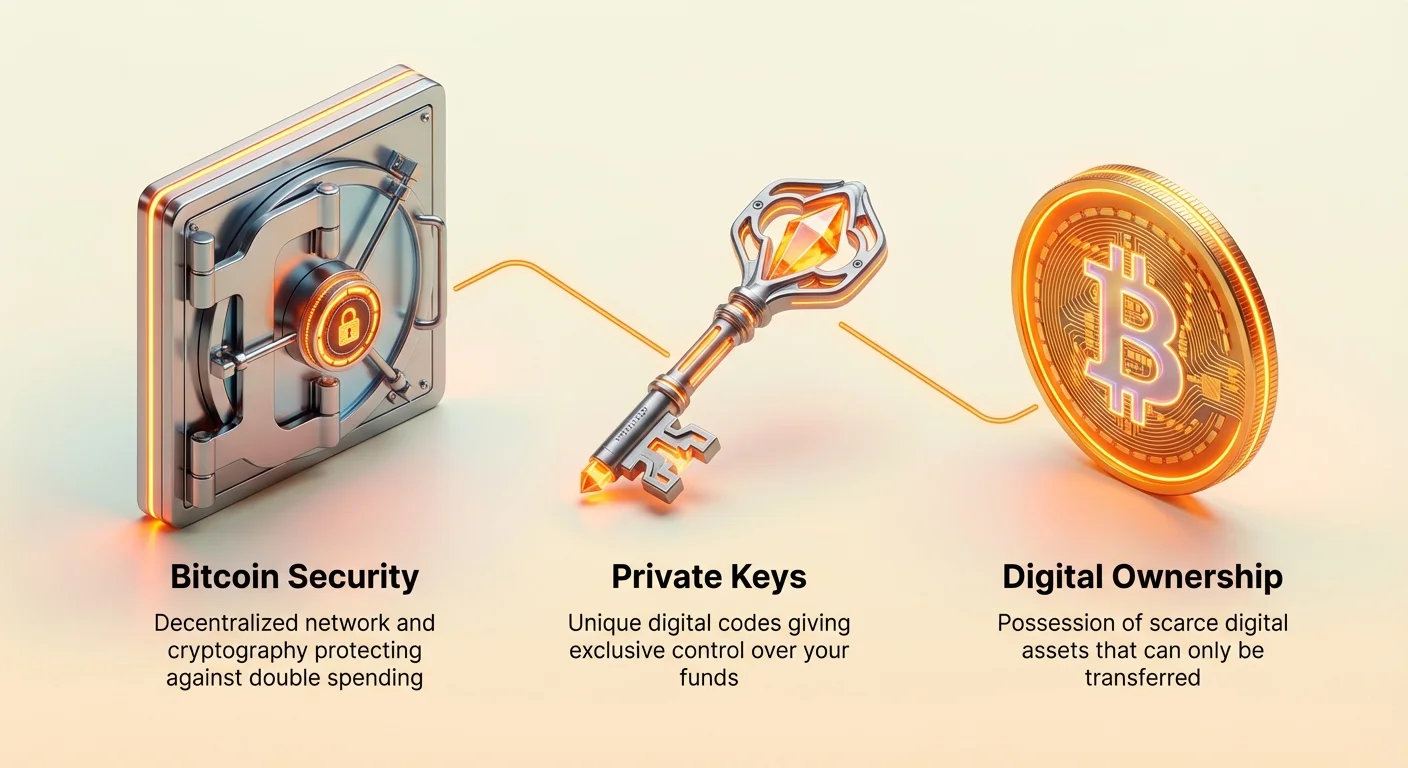
Bitcoin changed this paradigm by solving the double-spend problem without a central administrator. It replaced the trusted third party with a combination of cryptography, economic incentives, and a public ledger known as the blockchain. Understanding how Bitcoin achieves this requires looking under the hood at the mechanisms of trust, verification, and network consensus.
The Mechanics of the Double-Spend Problem
To understand why Bitcoin’s solution is revolutionary, one must first fully grasp the threat of double spending. In a digital cash system, a token is essentially a string of data. Without a central check-and-balance system, a malicious actor could theoretically broadcast a transaction sending one bitcoin to a merchant while simultaneously sending that same bitcoin to a second wallet they control.
If the network accepts both transactions as valid, the attacker has effectively created money out of thin air. They have received goods from the merchant while retaining their funds in a different address. If this fraud were possible, the currency would instantly lose all value. No merchant would accept a payment that could be invalidated or duplicated moments later. Trust in the monetary supply would collapse.
In traditional finance, this is solved through clearance periods and centralized oversight. When you swipe a debit card, the bank checks your database entry. If you have the funds, they freeze that amount and transfer it. If you try to swipe again elsewhere with an empty account, the bank’s central computer rejects the request. The trust is placed entirely in the bank’s ability to maintain an accurate ledger.
Bitcoin operates in an environment where no single entity has the authority to reject a transaction or update a balance. Instead, the network must collectively agree on which transactions occurred and in what order. If two conflicting transactions are broadcast, the network needs a concrete rule to decide which one is valid and which one is a lie. This is where the blockchain serves as the ultimate arbiter of truth.
The Blockchain as a Timestamp Server
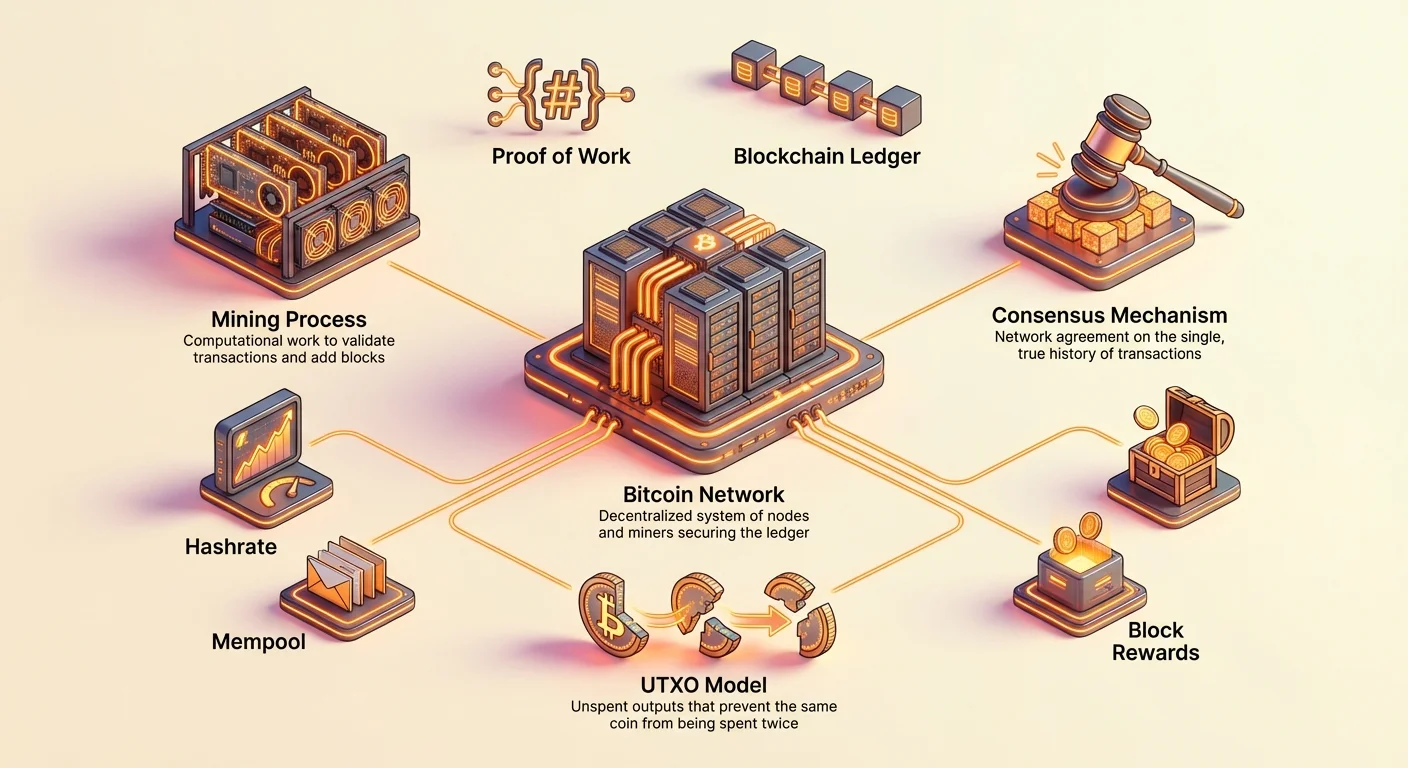
The blockchain acts as a decentralized, public ledger that records every transaction ever made. However, it is more than just a list of payments. It functions as a decentralized timestamp server. The primary reason double spending is possible in peer-to-peer networks is the lack of a unified timeline. Without a central clock, it is difficult to prove which of two conflicting transactions happened first.
Bitcoin groups transactions into containers called blocks. These blocks are chained together chronologically. Each block contains a cryptographic reference to the block that came before it. This creates an unbroken chain back to the very first block, known as the genesis block. Once a transaction is included in a block and that block is added to the chain, the transaction has a definite place in history.
If an attacker tries to spend coins that were already spent in a previous block, the network nodes will reject it. The nodes reference the blockchain history and see that the specific digital coins in question have already been moved. The history is transparent and shared across thousands of computers globally.
The real challenge arises when an attacker tries to broadcast two conflicting transactions at the exact same time. This is where the process of mining and block creation becomes the deciding factor. Miners select transactions from a waiting area called the mempool. Once a miner includes one version of the transaction in a block and solves the cryptographic puzzle to publish it, that version becomes the official history.
Proof of Work: The Cost of Fraud
The blockchain provides the history, but Proof of Work (PoW) provides the security that makes that history immutable. For a distributed ledger to be trusted, it must be incredibly difficult to rewrite. If rewriting history were cheap, an attacker could spend Bitcoin, wait for the merchant to ship the goods, and then reorganize the blockchain to erase the transaction.
Proof of Work imposes a physical cost on the creation of new blocks. Miners must expend vast amounts of electricity and computing power to solve complex mathematical puzzles. This process is competitive. The first miner to solve the puzzle gets to add the next block and claim the block reward.
This energy expenditure acts as a defensive wall. To reverse a transaction, an attacker would need to redo the work for the block containing that transaction. Furthermore, they would have to redo the work for every subsequent block added to the chain. Because the honest network continues to extend the chain, the attacker would need to control more computing power than all other miners combined to catch up.
This is often referred to as the 51% attack. While theoretically possible, the economic incentives make it impractical for a network as large as Bitcoin. The cost of acquiring the necessary hardware and electricity to overpower the network would likely exceed the potential gains from double spending. This economic barrier is what secures the decentralized ledger against tampering.
| Feature | Centralized System | Decentralized (PoW) System |
|---|---|---|
| Ledger Control | Bank/Company | Distributed Nodes |
| Security Source | Legal/Institutional Trust | Energy/Computational Cost |
| Double Spend Fix | Database Check | Consensus & Confirmation |
Inputs, Outputs, and the UTXO Model
Bitcoin does not use accounts and balances in the way a traditional bank does. Instead, it uses a model known as Unspent Transaction Outputs (UTXO). This technical distinction is vital for preventing double spending at the protocol level. When you look at a Bitcoin wallet balance, you are actually seeing the sum of all UTXOs that your private keys can unlock.
When you initiate a transaction, you are not simply deducting a number from a total. You are taking specific chunks of bitcoin that you received in the past (inputs) and creating new chunks (outputs). Imagine melting down gold coins to cast new ones of a specific weight. The old coins (inputs) are destroyed in the process, and new coins (outputs) are created.
Every full node on the network maintains a database of this "UTXO set." This is a comprehensive list of every valid, spendable chunk of bitcoin in existence. When a new transaction is broadcast, nodes do not just check your balance. They check to ensure the specific inputs you are trying to spend exist in the UTXO set.
If a transaction is confirmed, those inputs are removed from the UTXO set. If you try to reference those same inputs in a second transaction, nodes will see they are no longer in the valid set and reject the request immediately. This binary state—an output is either unspent or spent—removes ambiguity. There is no "pending balance" that can be tricked; the specific digital coins either exist for use or they do not.
The Role of Bitcoin Script
To ensure that only the rightful owner can spend a UTXO, Bitcoin uses a scripting system. Bitcoin Script is a simple, stack-based programming language. It is not a general-purpose language like Python or C++. It is intentionally limited in scope to prioritize security and determinism. It does not allow for infinite loops, which prevents attackers from clogging the network with complex code.
Every transaction output contains a locking script. This script essentially places a mathematical lock on the funds. It specifies the conditions that must be met for these funds to be spent in the future. Typically, this condition is providing a valid digital signature that corresponds to a specific public key or Bitcoin address.
When a user wants to spend those funds, their wallet software generates an unlocking script. This script contains the digital signature and public key. The network nodes run these two scripts together. If the unlocking script successfully satisfies the conditions of the locking script, the result is "True," and the transaction is valid.
This scripting language allows for more than just simple transfers. It enables complex spending conditions, such as Multi-Signature (Multi-Sig) wallets. In a Multi-Sig setup, the locking script might require two out of three specific signatures to unlock the funds. This flexibility enhances security and allows for decentralized custody solutions without relying on third-party trust.
The Waiting Room: Mempool Dynamics
Before a transaction is cemented into the blockchain, it lives in the mempool. The mempool (memory pool) is a holding area for unconfirmed transactions. Every node on the network maintains its own version of the mempool. When a user broadcasts a transaction, it propagates across the network and sits in these pools, waiting to be picked up by a miner.
The mempool is where the double-spend attack is most likely to be attempted. An attacker might broadcast a transaction with a low fee to the merchant and a conflicting transaction with a higher fee to themselves. Miners are economically rational actors. They generally prioritize transactions with higher fees to maximize their profits.
If the merchant accepts the transaction before it is confirmed in a block, they are at risk. The miner might see the higher-fee conflict and include that one in the block instead. This is why "zero-confirmation" transactions are considered insecure for high-value transfers. The payment has been announced but not yet verified by the consensus mechanism.
Congestion in the mempool can complicate this further. During periods of high network activity, the mempool fills up. Transactions with low fees may wait hours or even days for confirmation. This delay can create anxiety for users, but it does not inherently compromise security. As long as the user waits for confirmation, the funds remain safe.
Confirmations and Finality
In the world of Bitcoin, security is not binary; it is cumulative. A transaction is considered "confirmed" when it is included in a block. However, a single confirmation is not theoretically irreversible. In rare instances, two miners might find a block at the exact same time. This creates a temporary fork in the blockchain, where two competing versions of history exist simultaneously.
The network resolves this by following the rule of the "longest chain" (technically, the chain with the most accumulated proof of work). Miners will build on top of the first valid block they receive. Eventually, one chain will grow longer than the other, and the shorter chain will be abandoned. Transactions in the abandoned block (orphan block) are returned to the mempool.
To protect against the risk of a block being orphaned, recipients generally wait for multiple confirmations. The industry standard for absolute security is six confirmations. This means the transaction has been buried under six blocks of computational work.
At this depth, the energy required to reorganize the chain and reverse the transaction becomes astronomically high. For small payments, like buying a coffee, one confirmation (or even zero, if the risk is acceptable) might suffice. For buying a house or a car, waiting for six confirmations (approximately one hour) ensures that the transfer is mathematically permanent.
| Confirmations | Security Level | Typical Use Case |
|---|---|---|
| 0 | Low (Risky) | Small, instant retail items |
| 1 | Medium | Daily purchases, transfers |
| 6 | Very High | Large payments, exchanges |
The Network of Nodes: Decentralized Validators
Miners often get the credit for securing Bitcoin, but the non-mining nodes are the true enforcers of the rules. A full node is a computer that stores a copy of the entire blockchain and verifies every transaction against the protocol’s rules. There are tens of thousands of these nodes scattered globally.
When a miner proposes a new block, they broadcast it to the network nodes. The nodes do not blindly accept this block. They independently verify every transaction within it. They check that no double spending occurred, that the cryptographic signatures are valid, and that the miner solved the proof-of-work puzzle correctly.
If a miner attempts to cheat—for example, by giving themselves extra bitcoin or including an invalid transaction—the nodes will reject the block. It does not matter how much computing power the malicious miner has. If the block breaks the rules, it is discarded by the network. This balance of power prevents miners from exerting tyranny over the protocol.
Running a node is permissionless. Anyone with a standard computer and internet connection can do it. This accessibility is vital for decentralization. If running a node required expensive data center hardware, only large corporations could verify the ledger. By keeping the hardware requirements reasonable, Bitcoin ensures that average users can audit the supply and enforce the rules.
Hashrate: The Shield of the Network
The total computational power protecting the Bitcoin network is measured in hashrate. Hashrate represents the number of guesses (hashes) per second that miners are throwing at the mathematical puzzle. A higher hashrate implies a more secure network. It means that more energy and hardware are dedicated to preserving the current state of the ledger.
As the value of Bitcoin grows, mining becomes more profitable. This draws in more miners, increasing the hashrate. As the hashrate rises, the difficulty of the mining puzzle automatically adjusts. This difficulty adjustment occurs roughly every two weeks. It ensures that blocks are produced every ten minutes on average, regardless of how much computing power joins the network.
This self-regulating mechanism is crucial for stability. If the difficulty did not adjust, a surge in mining power would result in blocks being found too quickly. This would flood the market with new coins and destabilize the monetary policy. Conversely, if miners left and difficulty stayed high, the network could grind to a halt.
The immense hashrate of the Bitcoin network is what makes the immutable ledger possible. It is the physical barrier that separates Bitcoin from a simple database. To rewrite a database, you need administrative credentials. To rewrite the Bitcoin blockchain, you need to outspend the energy output of small nations.
Economic Incentives and Halving
The security model of Bitcoin relies heavily on economic incentives. Miners do not secure the network out of altruism; they do it for profit. The protocol rewards them in two ways: block rewards and transaction fees. The block reward consists of newly minted bitcoin. This is the only way new currency enters the supply.
To control inflation and enforce scarcity, the block reward is cut in half roughly every four years. This event is known as the Halving. It reduces the rate of new supply issuance, making Bitcoin a deflationary asset over time. Eventually, the block reward will reach zero (around the year 2140).
As the block reward decreases, transaction fees become the primary incentive for miners. When users send transactions, they attach a fee to incentivize miners to include their data in the next block. This creates a fee market. When demand for block space is high, fees rise.
This transition from block rewards to fee-based security is a long-term sustainability plan. It ensures that miners will always have a reason to dedicate hashrate to the network. Even after the last bitcoin is mined, the desire to process transactions and collect fees will keep the digital walls of the blockchain high and secure.
Conclusion
The double-spend problem was the defining technical failure of early digital currencies. By solving it, Bitcoin proved that value could be transferred globally without a central intermediary. The combination of a transparent public ledger, Proof of Work consensus, and the UTXO model created a system where trust is derived from math and physics rather than corporate reputation.
This decentralized architecture ensures that no single entity can manipulate the monetary supply or reverse valid transactions. While the mechanics of mining, nodes, and scripting are complex, they work in unison to provide a simple outcome: a digital asset that is as scarce and final as physical gold. The blockchain is not just a database; it is the foundation of a new era of automated, trustless economic cooperation.
Bitcoin turns energy into security, effectively creating the first digital object that cannot be copied, only transferred.