
The core promise of blockchain technology is to allow strangers across the globe to agree on the state of a shared ledger without needing a central authority—like a bank or government—to mediate trust. But how do thousands of independent computers decide which transactions are valid, in what order they occurred, and, crucially, that everyone has the same, immutable record?
The answer lies in Consensus Mechanisms. These mechanisms are the foundational engines of blockchain networks, providing the rules and incentives necessary to achieve synchronized agreement across a decentralized system. They are the essential guardrails that prevent cheating, double-spending, and malicious manipulation of the chain. Without a robust consensus mechanism, a decentralized ledger is simply a messy spreadsheet susceptible to immediate fraud.
Understanding consensus is crucial because the choice of mechanism dictates a network’s entire character: its energy footprint, its transaction speed, its security model, and its inherent trade-offs within the context of the Blockchain Trilemma (Decentralization, Security, and Scalability). This deep dive explores the two dominant paradigms—Proof-of-Work (PoW) and Proof-of-Stake (PoS)—and analyzes the fundamental engineering choices and economic incentives that secure the digital economy.
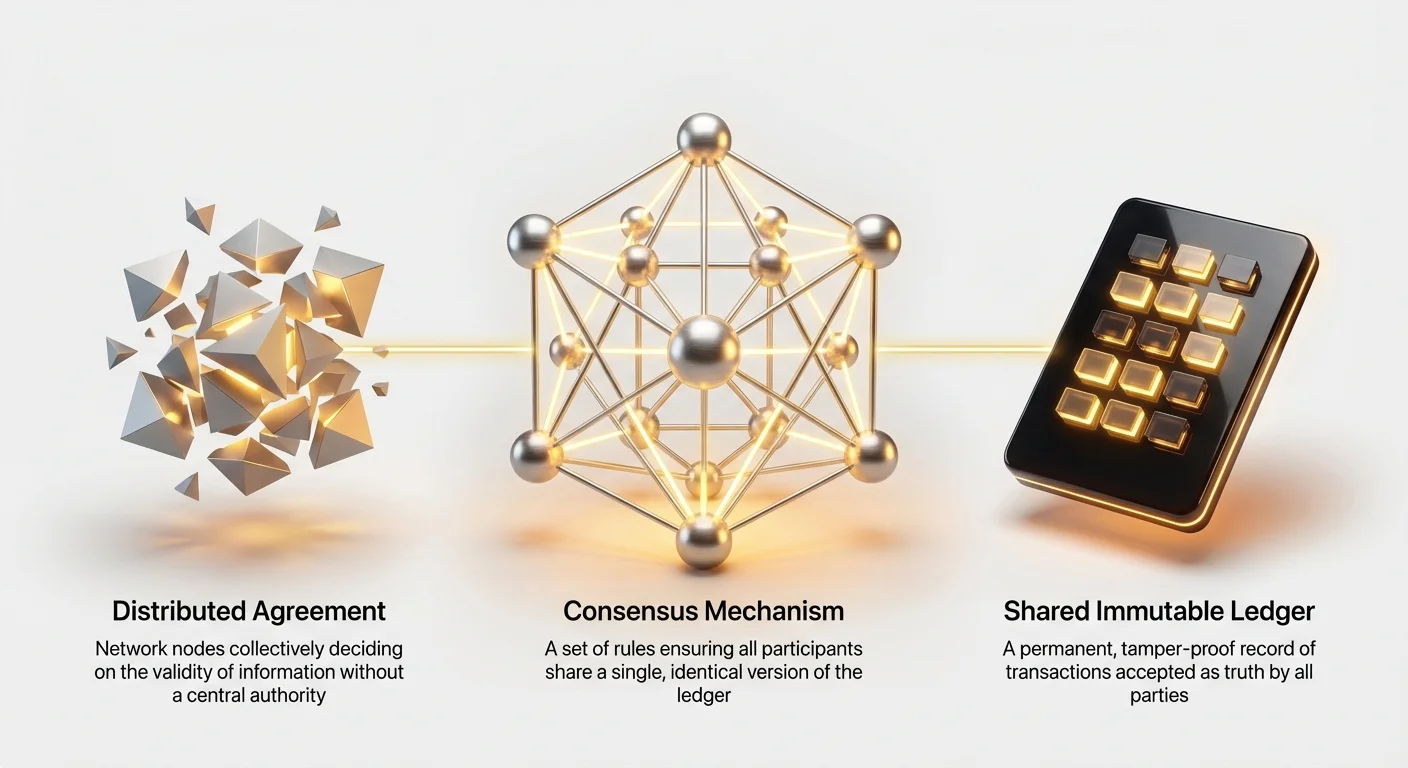
The Foundation: What is a Consensus Mechanism?
At its heart, a consensus mechanism is a sophisticated system designed to solve a very old problem in distributed computing known as the Byzantine Generals’ Problem. Imagine a group of military generals surrounding a city, communicating only through messengers. They must all agree on a single plan (attack or retreat) despite some messengers possibly being intercepted, and despite the possibility that some of the generals themselves might be traitors.
In the context of cryptocurrency, the "generals" are the thousands of nodes (computers) running the software, and they must agree on the validity and chronological order of transactions. A consensus mechanism ensures that even if up to one-third of the participants are malicious or faulty, the network can still reliably reach an agreement, maintain its integrity, and continue processing transactions.
Solving the Double-Spend Problem
The single most important task of any consensus mechanism is preventing the "double-spend problem." In the physical world, spending a dollar bill means you no longer possess it. In the digital world, data is easily copied. How do you prevent someone from sending the same digital asset to two different people simultaneously?
Consensus solves this by creating an absolute, shared history. Once a transaction is validated and included in a block, and that block is added to the chain, the entire network agrees on that specific order of events. The mechanism ensures that only the first instance of a transaction is accepted, eliminating the possibility of double-spending and guaranteeing the scarcity of the digital asset.
The Role of Byzantine Fault Tolerance (BFT)
The success criteria for a consensus mechanism are often defined by its level of Byzantine Fault Tolerance (BFT). A system is BFT if it can continue to operate correctly and securely, even in the presence of faulty, malicious, or non-responsive actors (the "Byzantine Generals").
In practice, achieving BFT means satisfying two critical requirements:
- Safety: All honest nodes must agree on the same history and never confirm conflicting transactions.
- Liveness: The network must continue processing new transactions and adding blocks to the chain, meaning the consensus process cannot completely halt due to a few bad actors.
Both Proof-of-Work and Proof-of-Stake achieve high degrees of BFT, but they use vastly different resources and economic models to do so.
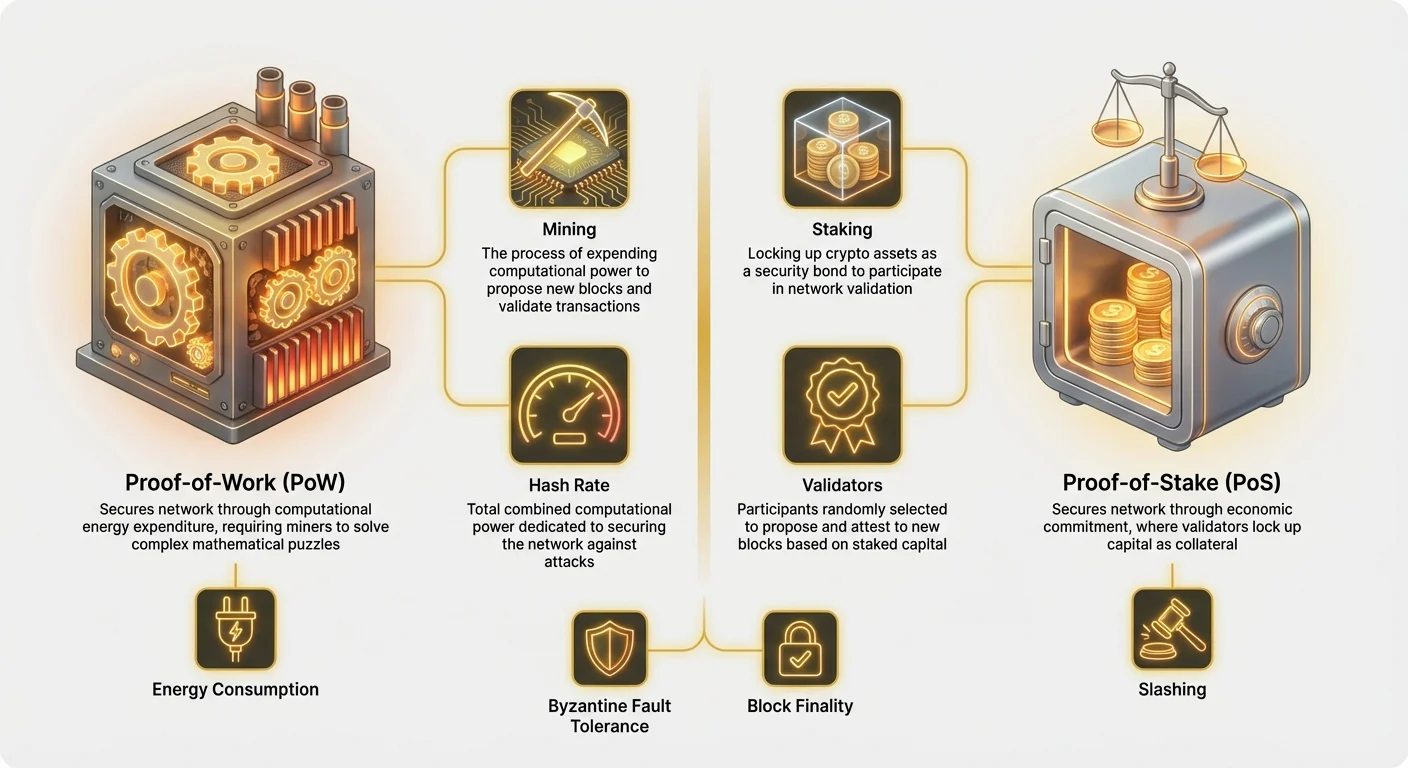
Paradigm 1: Proof-of-Work (PoW) – The Original Engine
Proof-of-Work, pioneered by Bitcoin, is the oldest and, arguably, the most battle-tested consensus mechanism. It secures the network by requiring participants—called "miners"—to expend real-world computational energy to solve a complex mathematical puzzle. This process is often likened to a digital lottery where immense effort is spent to win the right to propose the next block of transactions.
How PoW Secures the Network (Mining and Hash Rate)
Mining is the process of guessing a cryptographic output (a "hash") that meets specific difficulty criteria set by the network. This is a computationally expensive task, requiring vast amounts of trial and error. The first miner to find the correct hash wins two things:
- The right to propose the next block of validated transactions.
- A block reward (newly minted coins) plus the transaction fees.
The key to PoW’s security is the requirement for verifiable, external work. Since the puzzle difficulty is extremely high, succeeding requires significant capital investment in hardware and ongoing electricity costs. This cumulative energy expenditure is often referred to as the network’s Hash Rate. The higher the hash rate, the more expensive it is for an attacker to overpower the honest miners.
Resource Consumption and Economic Trade-offs
PoW’s security is inextricably linked to its energy consumption. Critics often point out that networks like Bitcoin use enormous amounts of electricity, rivaling entire countries. This expenditure is the core economic security feature; it makes mounting a successful attack prohibitively expensive.
To successfully execute a 51% attack (where an attacker controls the majority of the network’s mining power and can reverse transactions or censor others), the malicious actor would need to acquire, deploy, and constantly power hardware exceeding the combined power of every other honest miner worldwide. The cost in electricity and hardware procurement alone acts as the massive financial deterrent.
Advantages and Disadvantages of PoW
Advantages:
- Maximum Decentralization: Anyone, anywhere, can participate by acquiring hardware and electricity. There are no prerequisites based on asset ownership.
- High Security/Immutability: The historical record is secured by physical energy expenditure, making blocks practically irreversible once buried deep under subsequent blocks.
- Simple Economic Model: Incentives (rewards) and costs (electricity) are clear and externally verifiable.
Disadvantages:
- Poor Scalability: PoW mechanisms are inherently slow because they must wait for large groups of miners to synchronize and confirm work, limiting transaction throughput (TPS).
- Environmental Cost: The heavy energy usage creates significant sustainability concerns.
- High Barrier to Entry: Mining has become centralized in large pools due to economies of scale, raising concerns about geographical concentration of hash power.
Paradigm 2: Proof-of-Stake (PoS) – The Economic Engine
Proof-of-Stake emerged as the dominant alternative to PoW, most notably adopted by Ethereum after its "Merge." PoS replaces energy consumption with economic commitment. Instead of competing to solve computational puzzles, participants—now called validators—compete to be selected to propose and attest to new blocks based on how many of the network’s native coins they have "staked," or locked up, as collateral.
How PoS Secures the Network (Staking and Validators)
In a PoS system, security is maintained by financial incentives and penalties. To become a validator, a participant must commit a minimum required amount of the network’s native cryptocurrency (e.g., 32 ETH on Ethereum). This staked capital serves as a bond.
Validators are chosen randomly to propose a new block, proportionate to the amount they have staked. The process is much more efficient than mining because it involves digital signing and voting rather than brute-force computation.
The system ensures security by making two assumptions:
- An honest validator has a strong economic incentive to participate and earn rewards (staking yield).
- A dishonest validator faces immediate and painful economic losses if they try to cheat.
The Concept of Slashing (Economic Deterrents)
Slashing is the foundational economic deterrent in PoS networks. If a validator attempts to cheat—for example, by proposing two conflicting blocks simultaneously (trying to double-spend) or going offline and neglecting their duties—the network automatically detects this behavior and immediately confiscates (or "slashes") a portion of their staked assets.
The possibility of slashing transforms the security cost model:
- In PoW, attacking the network costs energy and hardware, which can be resold.
- In PoS, attacking the network costs the loss of capital (the staked coins) permanently, aligning the validator’s economic self-interest directly with the network’s health.
For an attacker to execute a 51% attack on a PoS network, they would need to acquire 51% of the total circulating cryptocurrency and stake it. The moment they attempt to cheat, the network would slash a massive portion of their holdings, potentially making the attack financially ruinous before it even succeeds.
Advantages and Disadvantages of PoS
Advantages:
- High Energy Efficiency: PoS consumes dramatically less energy than PoW, as validation requires minimal computation.
- Better Scalability and Finality: PoS typically allows for much faster transaction processing and confirmation (finality) because blocks are ratified through swift digital signatures, not slow computational races.
- Stronger Coordination: PoS protocols often integrate mechanisms that allow validators to reach a state of absolute "finality" faster than PoW, meaning transactions are confirmed and guaranteed to be irreversible sooner.
Disadvantages:
- Concentration of Wealth: PoS can potentially lead to centralization because participants with the most capital earn the most rewards, which they can then stake to earn even more, potentially creating a "rich get richer" scenario.
- Limited Participation: Not everyone can afford the minimum staking requirement, and staking often requires technical know-how or relying on third-party pooling services, which can reintroduce centralization risk.
- "Nothing at Stake" Problem (Historical): Early PoS designs faced the challenge that validators had no real cost to vote for conflicting chains. Slashing mechanisms are the modern solution to this by imposing a high financial cost.
A Critical Comparison: PoW vs. PoS Metrics
While both mechanisms successfully achieve BFT and secure massive value, their performance across key metrics—especially concerning the Blockchain Trilemma—differs fundamentally.
| Feature | Proof-of-Work (PoW) | Proof-of-Stake (PoS) |
|---|---|---|
| Security Model | External physical expenditure (Energy & Hardware) | Internal economic commitment (Staked Capital) |
| Primary Incentive | Block reward for solving the hash puzzle | Staking yield/interest on locked assets |
| Cost of Attack | Highly expensive upfront hardware and ongoing electricity costs. | Acquisition of 51% of circulating supply and guaranteed loss (slashing) upon malicious action. |
| Energy Consumption | Extremely high | Negligible (Up to 99.95% more efficient than PoW) |
| Transaction Speed | Slower (Requires waiting for multiple confirmations) | Significantly faster and more efficient |
| Centralization Risk | Concentration in large mining pools/hardware manufacturers. | Concentration among large holders (whales) and staking pools. |
Energy Consumption and Sustainability
The most striking difference is environmental impact. PoW is resource-intensive by design. Its security is defined by the energy used. While much energy used by Bitcoin mining now comes from renewable sources or previously wasted energy (like flared gas), the mechanism still necessitates continuous, high power consumption.
In contrast, PoS is highly energy efficient. Because validating a block involves cryptographic signing and network communication rather than intensive computation, the energy footprint of a major PoS network can be comparable to that of a single small corporation. This efficiency is a major driver for networks aiming for large-scale, mainstream adoption.
Security Model: Cost of Attack
The security of a blockchain is judged by the cost required to successfully mount a 51% attack.
PoW Cost: The attack cost is tied to the rental or purchase price of sufficient ASIC hardware and the electricity required to maintain it perpetually. This cost is external to the network's native asset price, making it highly dependent on global energy markets.
PoS Cost: The attack cost is tied directly to the price of the native asset. An attacker must purchase 51% of the liquid supply. Furthermore, because of slashing, the attack is self-destructive: the attacker's capital is destroyed the moment the malicious behavior is detected, guaranteeing a massive, permanent loss. This makes the PoS security model generally considered stronger against internal actors, provided the circulating supply is well-distributed.
Finality and Transaction Speed
Finality refers to the guarantee that a confirmed transaction will never be reversed.
PoW achieves Probabilistic Finality. A transaction is only guaranteed to be final when it is buried deep within the chain (e.g., after six blocks are added on top of it). While statistically sound, there is always a tiny possibility that a longer chain (created by miners who didn't see the original block) could overturn the current chain.
PoS protocols, especially modern variants like Casper in Ethereum, often achieve Economic Finality faster. The network's validators collectively vote on the block, and once two-thirds of the staked supply attests to the block, it is considered finalized. To revert a finalized block would require an attacker to coordinate a majority vote among validators and accept catastrophic slashing penalties, providing a strong, near-instantaneous guarantee of irreversibility.
Beyond the Basics: Hybrid and Alternative Consensus Models
While PoW and PoS are the two major foundational models, many successful blockchains utilize variations or hybrid models designed to solve specific scalability or speed issues by tweaking the balance of the Trilemma. These mechanisms often introduce specialized roles or controlled environments to improve performance.
Delegated Proof-of-Stake (DPoS)
DPoS is a variation of PoS popularized by platforms like EOS and Tron. It is structured more like a representative democracy than a direct democracy.
How it Works: Instead of thousands of individuals running their own validator nodes, token holders vote for a smaller, fixed number of "delegates" or "witnesses" (usually 20 to 100). These elected delegates are responsible for block production and validation.
Trade-offs: DPoS dramatically improves speed and scalability because the network only needs consensus from a small group of known participants. However, this comes at the direct cost of decentralization. Since only a few entities control block creation, DPoS chains are faster but potentially more susceptible to collusion or regulatory pressure than pure PoS or PoW chains.
Proof-of-Authority (PoA) and Practical BFT
Proof-of-Authority (PoA) takes the centralization trade-off one step further, often used in private or permissioned enterprise blockchains (though some public chains use variations).
How it Works: Instead of mining or staking, validators are vetted, known entities who are granted "authority" to validate transactions based on their identity and reputation. There is no economic incentive (like a block reward) necessary; the incentive is maintaining reputation and access to the network.
Practical BFT (pBFT): Many high-speed layer-1 and layer-2 solutions leverage variations of Practical BFT, which is an optimized version of the original Byzantine Fault Tolerance concept. These systems prioritize speed by relying on a small, fixed set of validators to vote quickly in synchronized rounds, achieving high throughput and instant finality.
Trade-offs: PoA and pBFT-based systems are incredibly fast and efficient but offer low decentralization. They are suitable for environments where trust is required or identity is known (e.g., supply chain management or internal bank settlements) but are not appropriate for truly permissionless, global public money like Bitcoin or Ethereum.
Hybrid Models
Some networks attempt to combine the robust security of PoW with the speed and finality of PoS. For example, some early systems used PoW purely for securing the blockchain structure and timestamping, while utilizing PoS for governance and transaction confirmation.
The key purpose of hybrid models is usually to address a weakness in one system—often using PoW's heavy energy security to anchor the chain, while using PoS to boost transaction capacity and speed.
Conclusion
Consensus mechanisms are the beating heart of blockchain technology. They are not merely technical choices; they represent fundamental decisions about a network's values, trade-offs, and vision for the future.
Proof-of-Work, epitomized by Bitcoin, is the gold standard for maximal security and decentralization, anchoring itself with verifiable energy expenditure. Proof-of-Stake, utilized by modern networks like Ethereum, aims for greater efficiency and scalability by replacing energy costs with economic collateral and slashing penalties. Finally, hybrid and delegated systems demonstrate the wide range of engineering solutions available, prioritizing speed and governance structure at the expense of absolute permissionlessness.
As the crypto landscape evolves, developers continue to innovate, seeking new mechanisms that can navigate the treacherous waters of the Decentralization Trilemma. But regardless of the innovation, the core challenge remains the same: ensuring that a global, trustless network of computers can always, securely, and efficiently agree on the single truth of the ledger.