
The evolution of blockchain technology has progressed through distinct phases, beginning with the launch of Bitcoin in 2009. While Bitcoin introduced the revolutionary concept of decentralized peer-to-peer value transfer, subsequent innovations sought to expand the utility of blockchain technology beyond simple currency. The introduction of Ethereum brought programmable smart contracts to the forefront, enabling decentralized applications (dApps) and decentralized finance (DeFi). However, as adoption grew, early networks faced significant challenges regarding scalability, transaction speeds, and costs.
These limitations created a market opportunity for a new generation of Layer 1 blockchains. Often referred to as high-performance ecosystems, networks like Solana, Avalanche, and Near emerged to address the bottlenecks of earlier systems. These platforms prioritize high throughput and low latency, aiming to support global-scale applications that require instant finality and minimal fees. Understanding the trade-offs these systems make is essential for investors, developers, and users navigating the crypto landscape.
The pursuit of performance involves complex architectural decisions. Unlike the initial generation of blockchains that prioritized extreme decentralization and security above speed, modern high-performance chains often adjust these parameters to achieve better user experiences. This analysis explores the technical and economic trade-offs inherent in these ecosystems, examining how they balance the competing demands of the blockchain trilemma while attempting to capture market share from established incumbents.
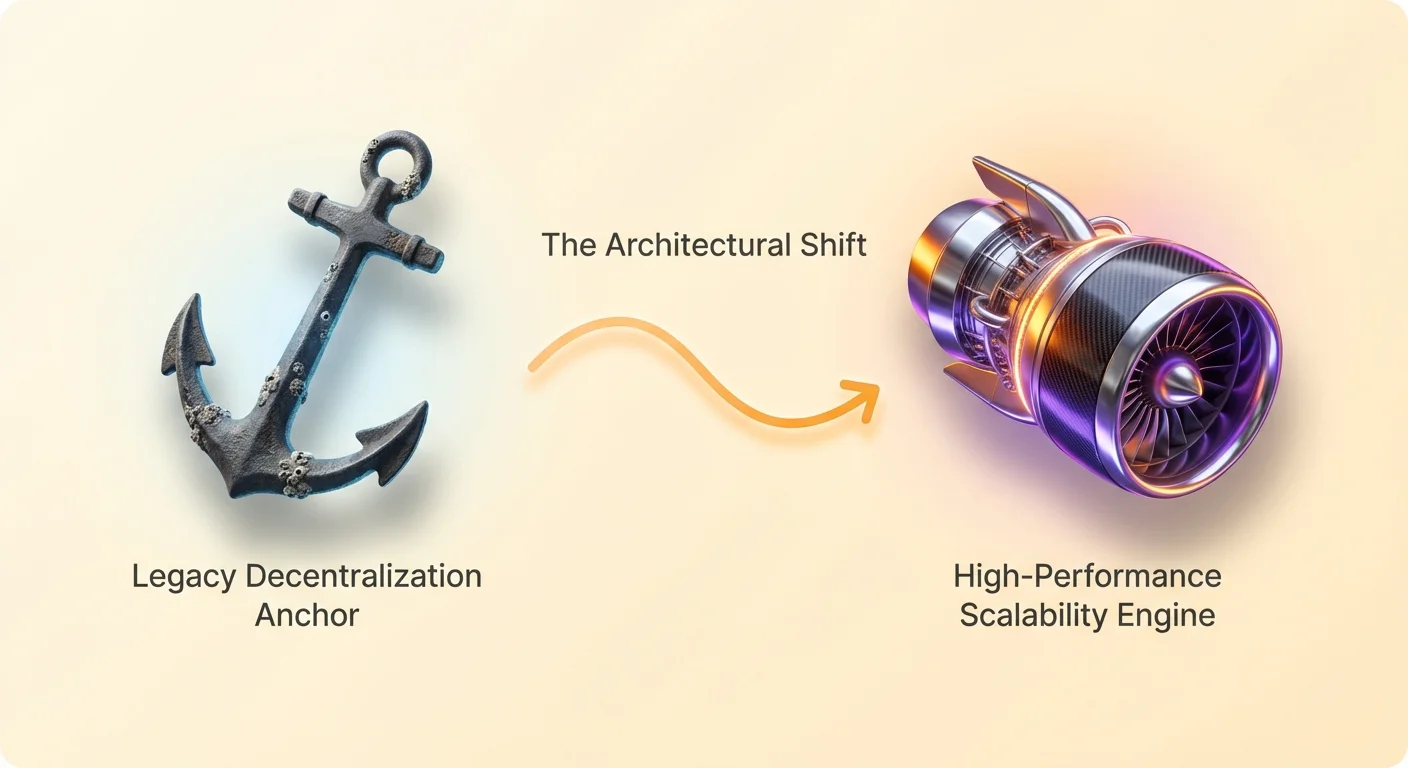
The Blockchain Trilemma and Scalability
The fundamental framework for analyzing high-performance ecosystems is the blockchain trilemma. This concept posits that a decentralized network can only simultaneously achieve two of three core properties: decentralization, security, and scalability. Bitcoin and Ethereum traditionally favored decentralization and security, resulting in lower transaction throughput and higher costs during periods of network congestion.
High-performance chains like Solana and Avalanche explicitly target the scalability vertex of this triangle. By implementing novel consensus mechanisms and architectural structures, they attempt to process thousands of transactions per second (TPS). This stands in stark contrast to the single-digit or low double-digit TPS capabilities of legacy Proof of Work networks. The primary goal is to create an environment where blockchain interaction feels as seamless as using a centralized web application.
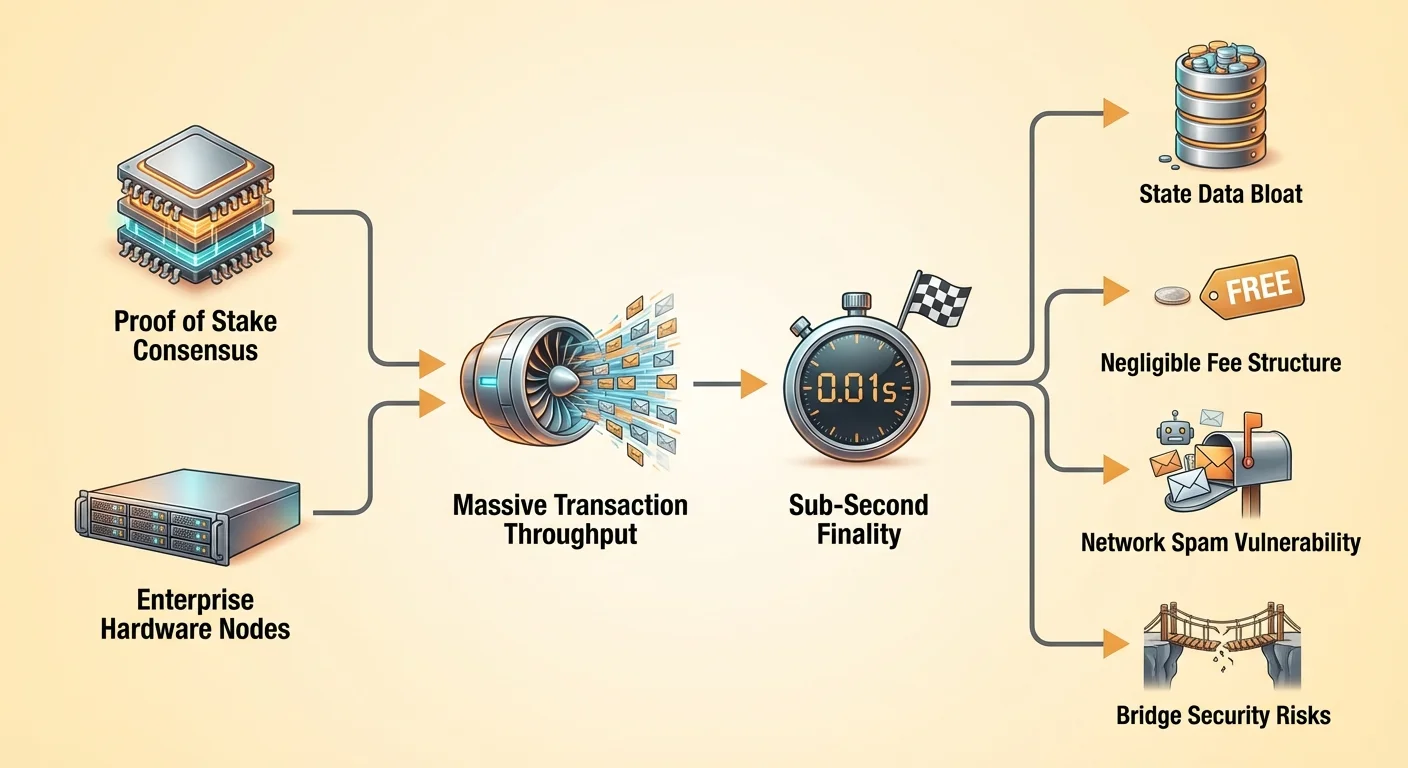
However, increasing scalability often requires compromises in other areas. To achieve rapid consensus and block propagation, networks may require high-end hardware for validators. This increases the barrier to entry for participating in network security, potentially leading to a smaller, more centralized set of validators compared to Bitcoin or Ethereum. This centralization risk is the primary trade-off for achieving sub-second transaction finality.
Hardware Requirements and Node Operation
In a decentralized network, nodes are the computers that store the blockchain history and validate transactions. For networks like Bitcoin, the software is designed to run on relatively modest consumer hardware, ensuring a vast and diverse network of participants. This resilience prevents any single entity from exerting undue influence over the protocol.
High-performance ecosystems often require significantly more powerful hardware to process the massive volume of data they generate. Validators may need enterprise-grade servers, massive solid-state storage, and high-speed fiber internet connections to keep up with the network state. This capital intensity means fewer individuals can afford to run nodes independently.
The reliance on specialized data centers introduces a potential point of failure. If a significant portion of a network's validators are hosted by the same cloud infrastructure providers, the network becomes vulnerable to external outages or censorship. This architectural choice prioritizes the user experience of the end consumer over the maximal censorship resistance favored by earlier crypto purists.
Throughput vs. State Bloat
High throughput leads to rapid data accumulation, known as state bloat. As a blockchain processes thousands of transactions per second, the size of its history grows exponentially. Storing this history becomes a technical challenge, as validators must maintain access to the ledger to verify new transactions.
Ecosystems like Near and Solana implement different strategies to manage this data load, such as sharding or historical data archival solutions. However, the sheer weight of the data can make it difficult for new nodes to join the network and sync with the current state. If syncing takes too long or requires too much storage, the network relies heavily on long-standing validators.
This trade-off impacts long-term sustainability. While low fees and high speeds attract users and developers initially, the cost of maintaining the infrastructure to support that activity must be paid eventually. This often manifests in complex fee structures or state rent, where users must pay to keep data stored on-chain over time.
Consensus Mechanisms: Beyond Proof of Work
The shift from Proof of Work (PoW) to Proof of Stake (PoS) is a defining characteristic of high-performance ecosystems. Bitcoin relies on PoW, where miners use energy-intensive hardware to solve puzzles and secure the network. This process is intentionally slow and expensive to ensure security, but it limits throughput.
Solana, Avalanche, and Near utilize variations of Proof of Stake. In these systems, validators secure the network by locking up (staking) native tokens rather than expending energy. This eliminates the physical bottleneck of mining and allows for much faster consensus. Validators are selected to create blocks based on the amount of capital they have staked.
PoS enables faster block times and finality. Finality refers to the moment a transaction is irreversible. In Bitcoin, this is probabilistic and can take up to an hour for high certainty. In high-performance PoS chains, finality is often achieved in under two seconds. This speed is crucial for financial applications like high-frequency trading or point-of-sale payments.
| Mechanism | Primary Resource | Speed | Energy Efficiency |
|---|---|---|---|
| Proof of Work | Computing Power | Slow | Low |
| Proof of Stake | Staked Capital | Fast | High |
| Hybrid Models | Mixed | Variable | Medium |
The Role of Validators and Staking
Staking transforms the economic model of the blockchain. Users who hold the native coin (e.g., SOL, AVAX) can delegate their tokens to validators. In return, they receive a portion of the staking rewards, which are essentially inflation paid out by the protocol. This aligns the incentives of token holders with the security of the network.
However, this system can lead to wealth concentration. Large stakeholders receive the most rewards, which they can restake to compound their influence. Over time, this can result in a plutocracy where a small group of wealthy entities controls the network's governance and consensus.
Networks attempt to mitigate this through slashing mechanics. If a validator acts maliciously or has significant downtime, a portion of their staked tokens can be destroyed. This financial penalty ensures that validators have a tangible "skin in the game" to maintain uptime and honesty, effectively replacing the energy cost of PoW with a capital cost.
Innovation in Consensus Protocols
Each high-performance ecosystem brings unique innovations to PoS. Avalanche, for example, utilizes a novel consensus protocol based on random subsampling, which allows it to reach consensus quickly without every node needing to talk to every other node. This allows the network to scale to thousands of validators without slowing down.
Solana's architecture introduces Proof of History (PoH), a cryptographic clock that helps nodes agree on the timing of events without constant communication. This reduction in communication overhead is what allows for its theoretical high throughput. These innovations represent a departure from the traditional synchronous blockchain models.
Near Protocol focuses on sharding, a technique that splits the network into smaller partitions (shards). Each shard processes a fraction of the total transactions, allowing the network to scale horizontally. As more nodes join, the network can theoretically support more shards and thus more transactions, addressing the scalability limit directly.
The Ecosystem Economy: Coins and Tokens
Understanding the distinction between coins and tokens is vital when analyzing these ecosystems. The native asset of the blockchain (SOL, AVAX, NEAR) is a coin. It is used to pay for transaction fees, secure the network through staking, and serves as the base unit of account within that specific digital economy.
Tokens, on the other hand, are assets created on top of these blockchains using smart contracts. For example, a stablecoin like USDC can exist as a token on Solana, Avalanche, and Near simultaneously. These tokens inherit the security and speed properties of the underlying chain but do not validate the network themselves.
The relationship between the coin and the tokens drives the ecosystem's value. As more successful dApps and tokens launch on a chain, demand for the native coin increases because users need it to pay for gas fees. This creates a virtuous cycle where utility drives value, which in turn funds further security and development.
DeFi and Automated Market Makers (AMMs)
Decentralized Finance (DeFi) is the primary driver of activity on high-performance chains. The low fees and high speeds allow for financial products that are impossible on slower networks. On Ethereum, high gas fees can make small trades or frequent rebalancing prohibitively expensive for retail users.
High-performance ecosystems enable efficient Automated Market Makers (AMMs) and order book exchanges. An AMM allows users to trade assets against a liquidity pool rather than a traditional buyer and seller. On fast chains, these pools can update prices instantly, reducing slippage and improving capital efficiency for traders.
Yield farming strategies also become more dynamic. Users can move assets between different lending and staking protocols rapidly to maximize returns without fear of transaction fees eating into their profits. This velocity of money is a key feature of high-performance DeFi, attracting liquidity from slower chains.
NFTs and Gaming
The non-fungible token (NFT) sector benefits immensely from high throughput. Minting thousands of NFTs on Ethereum can cost a fortune in gas fees and congest the network. High-performance chains allow creators to mint and distribute digital collectibles for fractions of a penny.
This cost efficiency is particularly critical for blockchain gaming. A game that records every item pickup or character movement on-chain requires a network that can handle massive volume at negligible cost. Solana and Avalanche have cultivated strong gaming communities because their infrastructure can support the high frequency of interactions required by modern video games.
However, the permanency of these assets is a trade-off. If the underlying high-performance network struggles with long-term sustainability or centralization issues, the immutable ownership of the NFTs stored on them could be at risk compared to those secured by the massive energy wall of Bitcoin or the widespread distribution of Ethereum.
User Experience and Fee Markets
The user experience on high-performance chains is fundamentally different due to the fee structure. On Ethereum, fees fluctuate wildly based on demand, sometimes costing nearly $100 to execute a simple smart contract interaction. This prices out many users and forces developers to optimize code for gas efficiency above all else.
Solana, Avalanche, and Near maintain fees that are typically fractions of a cent. This democratizes access to DeFi and Web3 applications. A user with $50 can participate in lending, borrowing, and trading just as effectively as a whale. This inclusivity is a major selling point for adoption in emerging markets.
The downside of negligible fees is spam. If transactions are nearly free, malicious actors can flood the network with millions of junk transactions, clogging the pipes and potentially causing outages. This has happened historically to several high-performance networks.
| Feature | High Fee Chain | Low Fee Chain |
|---|---|---|
| Barrier to Entry | High | Low |
| Spam Risk | Low | High |
| Developer Focus | Optimization | Speed/Features |
Evolving Fee Models
To combat spam, many networks are evolving their fee markets. Some implement dynamic fee structures similar to Ethereum's EIP-1559, where a base fee is burned, and costs rise during congestion. This helps regulate demand without permanently raising the barrier to entry.
Avalanche uses a distinct structure with its subnets. Developers can create custom blockchains (subnets) with their own fee rules and tokens, isolating their traffic from the main network. This prevents a popular game from clogging up the network for DeFi traders, effectively isolating fee spikes to specific applications.
The economic sustainability of low fees is also a question. If fees are too low, they may not generate enough revenue to pay validators for their hardware costs. Consequently, the network might rely on high token inflation to subsidize security. This inflation dilutes the value of the coin for holders over time, representing a hidden cost of low fees.
Interoperability and Bridging Risks
No blockchain exists in isolation. The ability to move assets between Bitcoin, Ethereum, and high-performance chains is crucial for a unified crypto economy. This is achieved through cross-chain bridges, protocols that lock assets on one chain and mint a wrapped version on another.
For example, a user might lock Bitcoin to receive Wrapped Bitcoin (WBTC) on Ethereum, or bridge ETH to Avalanche. While this unlocks liquidity, bridges introduce significant security risks. They are centralized points of failure and frequent targets for hackers. If the bridge is compromised, the backing assets are stolen, rendering the wrapped tokens on the destination chain worthless.
High-performance ecosystems often rely heavily on bridges to attract liquidity from Ethereum. This dependence means their security is partially tied to the security of the bridging infrastructure. Users must trust not only the consensus of the Solana or Near blockchain but also the smart contract code of the bridge they used to transfer their funds.
Multi-Chain Future
The vision for the future is often described as "multi-chain." In this scenario, users interact with applications without needing to know which blockchain is running in the background. Wallets and interfaces abstract away the bridging and gas payment processes.
Projects like Near allow for "chain abstraction," where a user's account can control assets on other chains. This interoperability focuses on reducing friction. Instead of maximizing the performance of a single chain, the goal shifts to maximizing the connectivity between specialized chains.
Avalanche’s subnet architecture aligns with this view. It envisions a world of thousands of interoperable blockchains, each optimized for specific use cases (compliance, gaming, enterprise), all sharing a common security layer. This modular approach attempts to solve the trilemma by separating execution from consensus.
Smart Contract Risks and Development
Building on high-performance chains requires different developer skills. Ethereum uses Solidity and the Ethereum Virtual Machine (EVM). Avalanche C-Chain and Near's Aurora layer are EVM-compatible, meaning developers can easily copy-paste their Ethereum applications to these faster networks. This ease of migration helps bootstrap the ecosystem.
Solana, however, uses the Rust programming language and a different execution environment. While this allows for parallel processing and higher speeds, it creates a steeper learning curve for developers. It also means tooling and security practices must be built from scratch, potentially leading to undiscovered vulnerabilities in early applications.
The speed of development on these chains can also be a double-edged sword. The "move fast and break things" culture, combined with complex new architectures, can lead to smart contract exploits. Users need to be aware that while the Layer 1 blockchain might be secure, the applications built on top carry their own distinct risks.
Audit and Security Standards
Security audits are essential for any smart contract deployment. However, the complexity of high-performance architectures can make auditing more difficult. The interaction between parallel transactions and shared states can create race conditions that do not exist on sequential blockchains like Ethereum.
As these ecosystems mature, the standards for security are improving. Formal verification methods and better developer tooling are reducing the frequency of hacks. Nevertheless, the immutable nature of blockchains means that a bug can lead to irreversible loss of funds.
Users protecting their assets in these ecosystems should utilize hardware wallets and practice self-custody. Relying solely on the speed and low cost of the network should not come at the expense of basic security hygiene. Understanding the custody model of the assets—whether they are native coins or bridged tokens—is critical for risk management.
Conclusion
The landscape of high-performance ecosystems represents a significant leap forward in blockchain utility. Solana, Avalanche, and Near offer compelling alternatives to the established order, providing the speed and cost efficiency necessary for global adoption. By prioritizing scalability, they have opened the door for use cases in gaming, micro-transactions, and high-frequency finance that were previously impossible on decentralized networks.
However, these benefits are not free. The trade-offs regarding hardware centralization, state management, and network complexity are real and must be weighed carefully. While Ethereum focuses on a modular scaling path via Layer 2s, high-performance Layer 1s attempt to solve the problem at the base layer. Both approaches have merit, and the market is likely large enough to support multiple winners with different specializations.
Ultimately, the choice between ecosystems depends on user needs. For high-value, settlement-layer security, traditional chains remain strong. For consumer-facing applications requiring instant interaction, high-performance chains are indispensable. As the technology matures, the friction between these trade-offs may decrease, but for now, understanding the balance between speed, security, and decentralization is the key to navigating the crypto economy.
High-performance blockchains trade extreme decentralization for speed and low fees to enable consumer-scale applications.