
Ethereum revolutionized the digital asset landscape by introducing the concept of a programmable blockchain. Before its launch in 2015, cryptocurrency was primarily synonymous with Bitcoin, which functioned almost exclusively as a store of value and medium of exchange. Ethereum expanded this utility by embedding a Turing-complete programming language directly into its protocol. This innovation allowed developers to write code, known as smart contracts, that executes automatically when specific conditions are met.
The network functions as a global, decentralized virtual machine. It maintains a shared state that everyone on the network agrees upon. This infrastructure enabled the creation of decentralized applications (dApps) that operate without central servers. These applications range from financial protocols to digital art marketplaces. The platform’s native currency, Ether (ETH), serves as the fuel for these operations. Every computational step requires a fee, ensuring that the network resources are priced efficiently and protecting against spam attacks.
As the ecosystem matured, Ethereum established itself as the primary benchmark for all subsequent layer-1 (L1) blockchains. Its first-mover advantage created a massive network effect. The vast majority of decentralized finance (DeFi) value and non-fungible token (NFT) volume resides on Ethereum or networks compatible with its standards. However, this popularity came with significant costs, primarily in the form of network congestion and high transaction fees. This scalability bottleneck sparked the development of both layer-2 scaling solutions and alternative layer-1 blockchains.
The Virtual Machine Standard
The Ethereum Virtual Machine (EVM) is the runtime environment for smart contracts in the Ethereum system. It is the engine that understands and executes code written in languages like Solidity. The EVM’s influence extends far beyond the Ethereum mainnet. Because Ethereum was the first viable smart contract platform, its architecture became the industry standard. Many competing blockchains adopted "EVM compatibility" as a core feature to attract developers.
EVM compatibility allows developers to deploy code written for Ethereum onto other blockchains with minimal changes. This reduces the switching costs for builders. They can use the same tools, wallets, and libraries they are already familiar with. This dominance has made the EVM the de facto operating system of the crypto economy. Even networks with radically different underlying architectures often build layers to translate EVM code for their own systems.
Economic Security and Monetary Policy
Ethereum transitioned from a Proof-of-Work (PoW) consensus mechanism to Proof-of-Stake (PoS) in an event known as "The Merge." This shift fundamentally changed how the network is secured. Instead of energy-intensive mining, security is provided by validators who lock up, or "stake," ETH as collateral. This model significantly reduced the network's energy consumption and altered the economic properties of the asset.
The issuance of new ETH is balanced against a fee-burning mechanism introduced in update EIP-1559. A portion of every transaction fee is permanently removed from circulation. During periods of high network activity, more ETH is burned than is created. This dynamic can make the asset deflationary. This monetary policy is designed to align the security of the network with the value of the underlying asset, creating a robust economic moat that is difficult for younger chains to replicate.
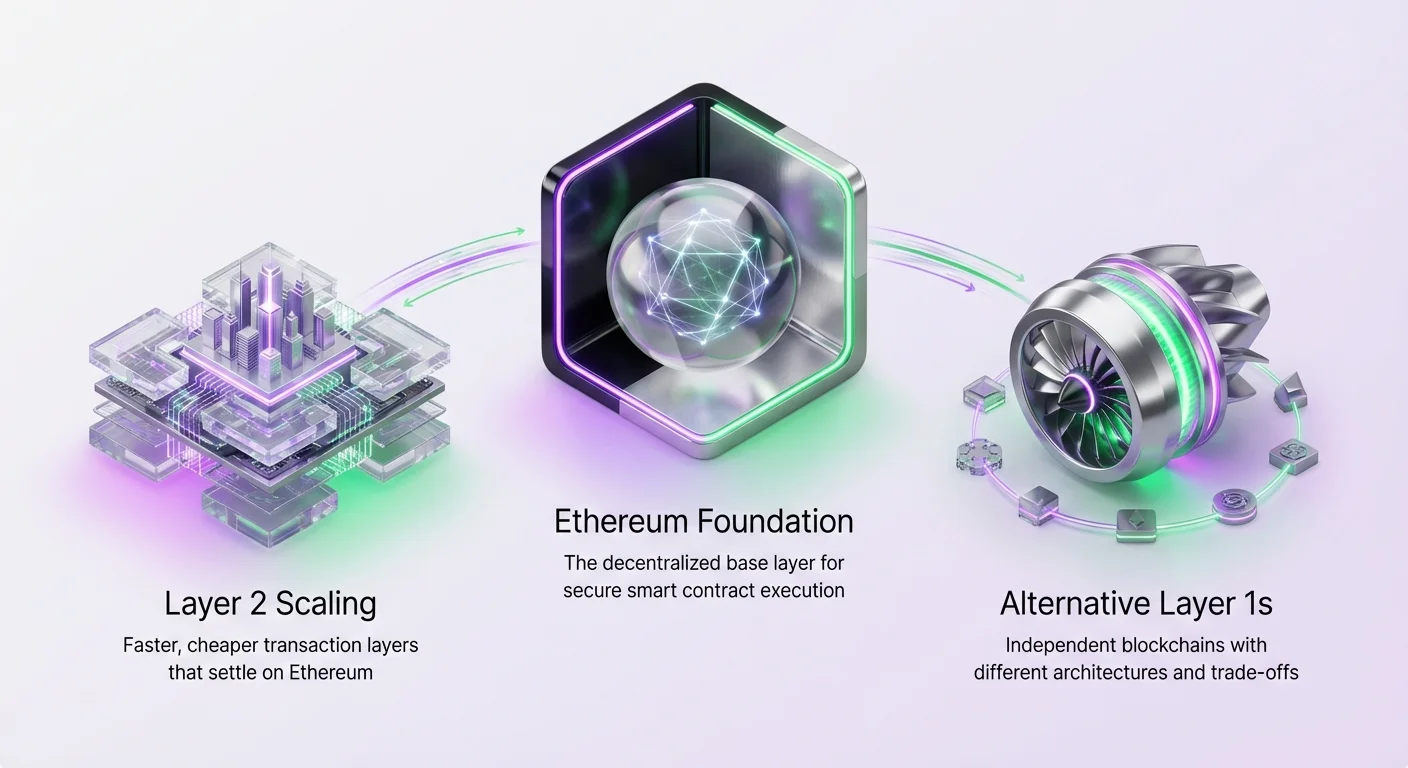
Scaling Through Layer 2 Solutions
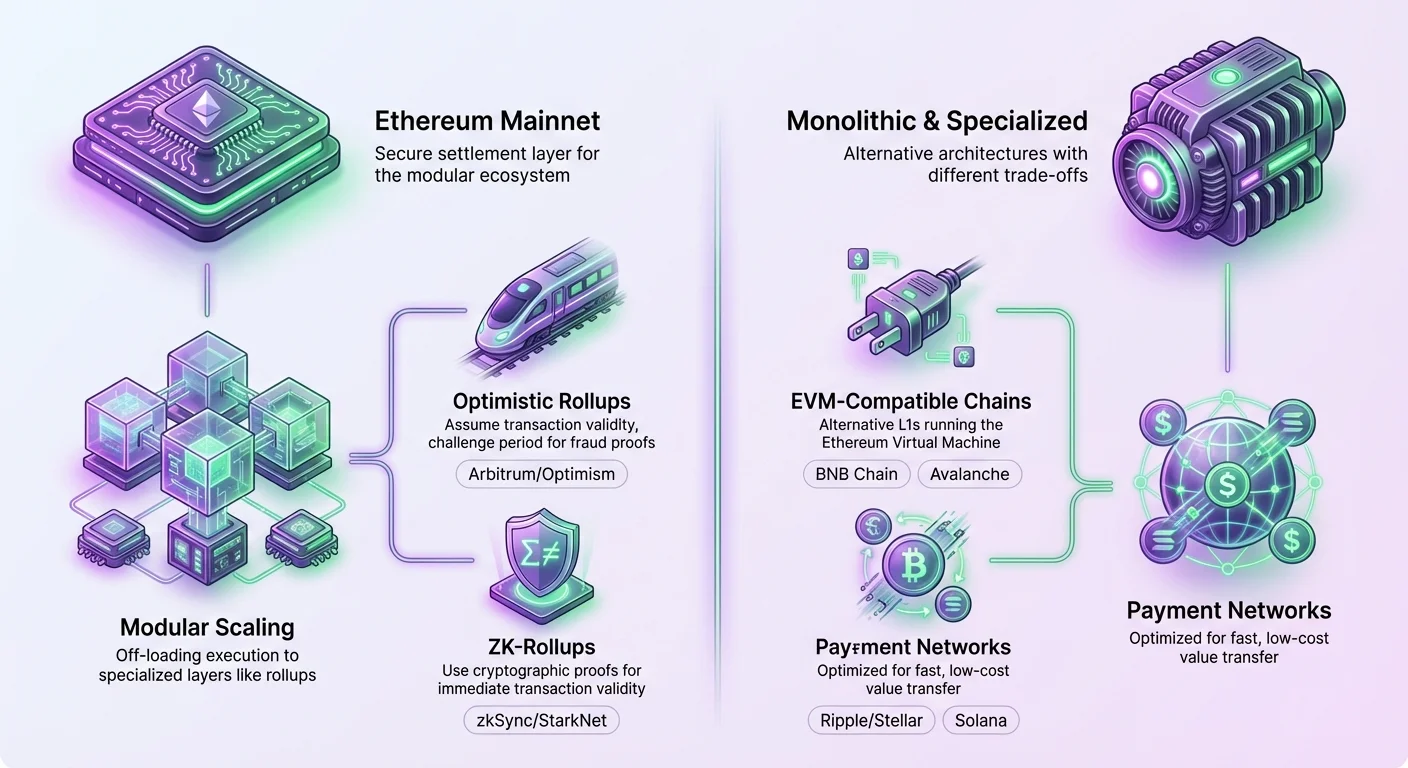
The primary challenge facing the Ethereum mainnet is scalability. The network can only process a limited number of transactions per second. To solve this without compromising decentralization, the ecosystem has adopted a rollup-centric roadmap. This approach moves the heavy lifting of transaction execution off the main chain to secondary layers, known as Layer 2 (L2) solutions. These layers process transactions rapidly and cheaply, then bundle them together to settle the final results on Ethereum.
Layer 2s inherit the security of the main Ethereum network. Users do not have to trust the L2 operator with their funds in the same way they trust a centralized exchange. The cryptographic proofs posted to the mainnet ensure that the state of the L2 is valid. This architecture allows Ethereum to function as a secure settlement layer while the L2s handle the day-to-day traffic of users interacting with applications.
Optimistic and Zero-Knowledge Rollups
There are two primary types of rollups: Optimistic and Zero-Knowledge (ZK). Optimistic rollups assume that transactions are valid by default. They only run computations to verify transactions if someone challenges them. This "innocent until proven guilty" approach allows for high speed and compatibility. Networks like Arbitrum and Optimism utilize this technology to provide a user experience that feels exactly like Ethereum but with a fraction of the cost.
ZK-rollups take a different approach. They generate complex cryptographic proofs for every batch of transactions. These proofs mathematically demonstrate that the transactions are valid before they are finalized on the mainnet. While more computationally intensive to generate, ZK-proofs offer higher security guarantees and faster finality since there is no need for a challenge period. This technology is often viewed as the long-term endgame for blockchain scaling due to its mathematical efficiency.
The Rise of High-Performance Alternatives
While Ethereum focused on modular scaling, other blockchains emerged with a monolithic approach. Solana is the most prominent example of this philosophy. Instead of breaking the network into layers, Solana aims to handle all activity on a single, high-performance blockchain. It achieves this through a unique architectural innovation called Proof-of-History (PoH). This mechanism creates a historical record that proves an event has occurred at a specific moment in time.
Proof-of-History allows validators to organize transactions without waiting for constant communication with other nodes. This parallel processing capability enables Solana to handle thousands of transactions per second with extremely low fees and sub-second finality. This speed makes it attractive for high-frequency use cases like decentralized order book exchanges and real-time gaming, which are difficult to build on slower networks.
However, this performance comes with trade-offs. The hardware requirements to run a Solana validator are significantly higher than those for Ethereum. This has led to debates regarding the centralization of the network. Critics argue that fewer individuals can afford to participate in the consensus process. Despite these concerns, Solana has carved out a significant niche, particularly in the sectors of decentralized finance (DeFi) and non-fungible tokens (NFTs), where low costs are critical for user adoption.
| Feature | Ethereum (Modular) | Solana (Monolithic) |
|---|---|---|
| Throughput | Low on L1, High on L2 | Very High on L1 |
| Validator Cost | Moderate hardware | High-end server hardware |
| Consensus | Proof-of-Stake | PoS + Proof-of-History |
EVM-Compatible Competitors
Several layer-1 blockchains have adopted a strategy of modifying Ethereum's codebase to improve performance while maintaining compatibility. The BNB Smart Chain (BSC) is a prime example. It utilizes a consensus mechanism called Proof of Staked Authority (PoSA). This hybrid model relies on a limited number of elected validators to secure the network. By restricting the validator set, BNB Chain achieves shorter block times and lower fees than Ethereum’s mainnet.
This compatibility allowed BNB Chain to rapidly grow its ecosystem. Developers could easily port existing Ethereum applications to the network. The chain also benefits from its integration with the wider Binance ecosystem. The native token, BNB, serves dual utility as both the gas token for the blockchain and a utility token for the centralized exchange. This synergy provided immediate liquidity and a massive user base for the network’s launch.
Avalanche takes a slightly different approach to compatibility. It introduces a novel consensus protocol that relies on repeated random sampling of the network. This allows for extremely fast finality. Avalanche also utilizes a subnet architecture. This design enables the creation of custom, application-specific blockchains that remain interoperable with the primary network. While the main "C-Chain" runs the EVM, subnets can be customized with different rules and virtual machines to suit specific enterprise or gaming needs.
Specialized Payment Networks
Not all blockchains aim to be general-purpose world computers. Some were designed specifically to solve the problem of payments and value transfer. Ripple (XRP) and the XRP Ledger (XRPL) focus on the needs of the financial services industry. The XRPL uses a unique consensus algorithm where a network of trusted validators agrees on the order of transactions. This design prioritizes speed and settlement certainty, making it suitable for cross-border remittances and interbank settlements.
Stellar (XLM) shares a common ancestry with Ripple but targets a different demographic. The Stellar network is optimized for connecting financial institutions in developing markets. It uses the Stellar Consensus Protocol (SCP) to facilitate low-cost, multi-currency transactions. A key feature of Stellar is its built-in decentralized exchange, which allows for the seamless conversion of different fiat currencies and digital assets. This capability makes it a powerful tool for remittances and financial inclusion.
Litecoin (LTC) represents an earlier generation of payment networks. Created as a "lite" version of Bitcoin, it utilizes the Scrypt hashing algorithm and boasts faster block generation times. Litecoin does not support complex smart contracts natively in the same way Ethereum does. Instead, it focuses on being a reliable, peer-to-peer medium of exchange. Its longevity and fair launch have earned it a reputation as a reliable testbed for Bitcoin upgrades and a liquid asset for payments.
Academic Rigor and Layered Architecture
Cardano (ADA) represents a distinct philosophical approach to blockchain development. Unlike the "move fast and break things" ethos of many tech startups, Cardano emphasizes peer-reviewed academic research and formal verification methods. The project is built on a foundation of scientific philosophy, with every major upgrade undergoing scrutiny by computer scientists and cryptographers before implementation.
The architecture of Cardano is separated into two distinct layers. The Cardano Settlement Layer (CSL) handles the ledger of accounts and balances. The Cardano Computation Layer (CCL) handles smart contracts and computation. This separation is intended to improve flexibility and security. Updates to the smart contract layer can be made without disrupting the settlement layer. The network uses a Proof-of-Stake protocol called Ouroboros, which was one of the first to be mathematically proven secure.
Despite its rigorous approach, Cardano has faced criticism for its slow development pace. The insistence on formal verification means that features often take longer to roll out compared to competitors. However, proponents argue that this method reduces the risk of catastrophic bugs and hacks. The network has slowly built a DeFi ecosystem, leveraging its unique eUTXO (extended Unspent Transaction Output) model, which differs significantly from Ethereum's account-based model.
The Content and Entertainment Focus
TRON (TRX) carved out a niche by focusing specifically on the digital entertainment and content sharing industries. The network uses a Delegated Proof-of-Stake (DPoS) consensus mechanism. In this system, token holders vote for "Super Representatives" who validate transactions. This highly efficient model allows for high throughput and zero transaction fees for users who stake enough tokens to earn energy and bandwidth resources.
TRON acquired BitTorrent, a major peer-to-peer file-sharing protocol, integrating it into its ecosystem. This move underscored its commitment to decentralized content distribution. The network has also become a dominant infrastructure for stablecoins, particularly USDT. A significant percentage of global stablecoin transactions occur on TRON due to its low fees and fast settlement speeds. This utility has made it a critical rail for traders and users in emerging markets who need access to digital dollars.
The Developer Gravity and Moat
The concept of "developer gravity" refers to the tendency for builders to congregate where the tools, users, and liquidity already exist. Ethereum possesses the strongest developer gravity in the industry. The availability of mature developer tools like Truffle, Hardhat, and extensive documentation creates a welcoming environment for new engineers. The large community means that problems are often already solved and code libraries are readily available.
This gravity creates a powerful moat. Even if a competing blockchain offers faster speeds or lower fees, it often lacks the composability of Ethereum. Composability is the ability for different applications to interact with each other seamlessly. On Ethereum, a lending protocol can easily integrate with a decentralized exchange and a yield aggregator. This interconnected web of applications creates value that is greater than the sum of its parts.
While competitors have attempted to siphon off this talent through incentive programs and EVM compatibility, the core innovation often remains on Ethereum. New standards for tokens, such as ERC-20 for fungible assets and ERC-721 for NFTs, originated here. These standards provided the blueprint for the entire industry. Most innovations in decentralized finance, decentralized autonomous organizations (DAOs), and governance mechanisms are pioneered on Ethereum before being adopted elsewhere.
Future Scaling and The Endgame
The future of the crypto landscape depends heavily on the success of scaling roadmaps. Ethereum is pursuing "Danksharding," an upgrade that will drastically reduce the cost of data storage for rollups. This will make Layer 2 networks even cheaper, potentially bringing transaction costs down to sub-cent levels. This evolution aims to preserve the security of the decentralized base layer while enabling consumer-grade applications to run on top.
Alternative Layer 1s will likely continue to specialize. High-performance chains like Solana may dominate sectors requiring massive throughput, such as high-frequency trading or decentralized physical infrastructure networks (DePIN). Specialized chains like Stellar and Ripple will likely deepen their integration with traditional banking and payment corridors. The market is moving away from a "winner takes all" scenario toward a multi-chain future where different networks serve different optimized purposes.
Interoperability and Bridging
As the number of viable blockchains grows, the ability to move assets between them becomes critical. Bridges are protocols that allow tokens and data to transfer from one network to another. However, bridges have historically been the most vulnerable points in the crypto ecosystem, suffering from numerous high-profile hacks. Secure cross-chain messaging protocols are the next frontier for connecting these isolated networks.
The vision of a seamless "interchain" experience involves users interacting with applications without needing to know which blockchain they are using. Wallets and interfaces effectively abstract away the complexity of bridging and gas fees. In this future, Ethereum may serve as the high-security global settlement layer, while users interact primarily with fast, specialized execution environments on Layer 2s or other integrated Layer 1 networks.
Conclusion
The blockchain ecosystem has evolved into a diverse landscape of specialized protocols, with Ethereum serving as the central gravitational force. While Ethereum established the standard for smart contracts and decentralized applications, its limitations in scalability opened the door for a variety of competitors. High-performance networks like Solana challenge the modular thesis with raw speed, while platforms like Avalanche and BNB Chain leverage EVM compatibility to offer familiar environments with different trade-offs.
Meanwhile, purpose-built networks like Ripple and Stellar continue to optimize for specific use cases like cross-border payments, proving that general-purpose computation is not the only path to relevance. The industry is maturing into a complex web of interconnected chains, each optimizing for different variables of the blockchain trilemma: security, scalability, and decentralization. As scaling solutions mature and interoperability improves, the friction between these networks will decrease, benefitting the end user.
A successful blockchain ecosystem requires a balance of security, developer activity, and distinct utility to survive long-term.