
Ethereum is a decentralized, open-source blockchain platform that has fundamentally shifted how we perceive digital ownership and computation. While Bitcoin introduced the concept of peer-to-peer digital currency, Ethereum expanded this vision to create a programmable network. Ether (ETH) serves as the native cryptocurrency of this platform. It acts as the fuel for a vast ecosystem of applications that operate without central authorities. The network functions not merely as a ledger for financial transactions but as a foundation for a new internet iteration.
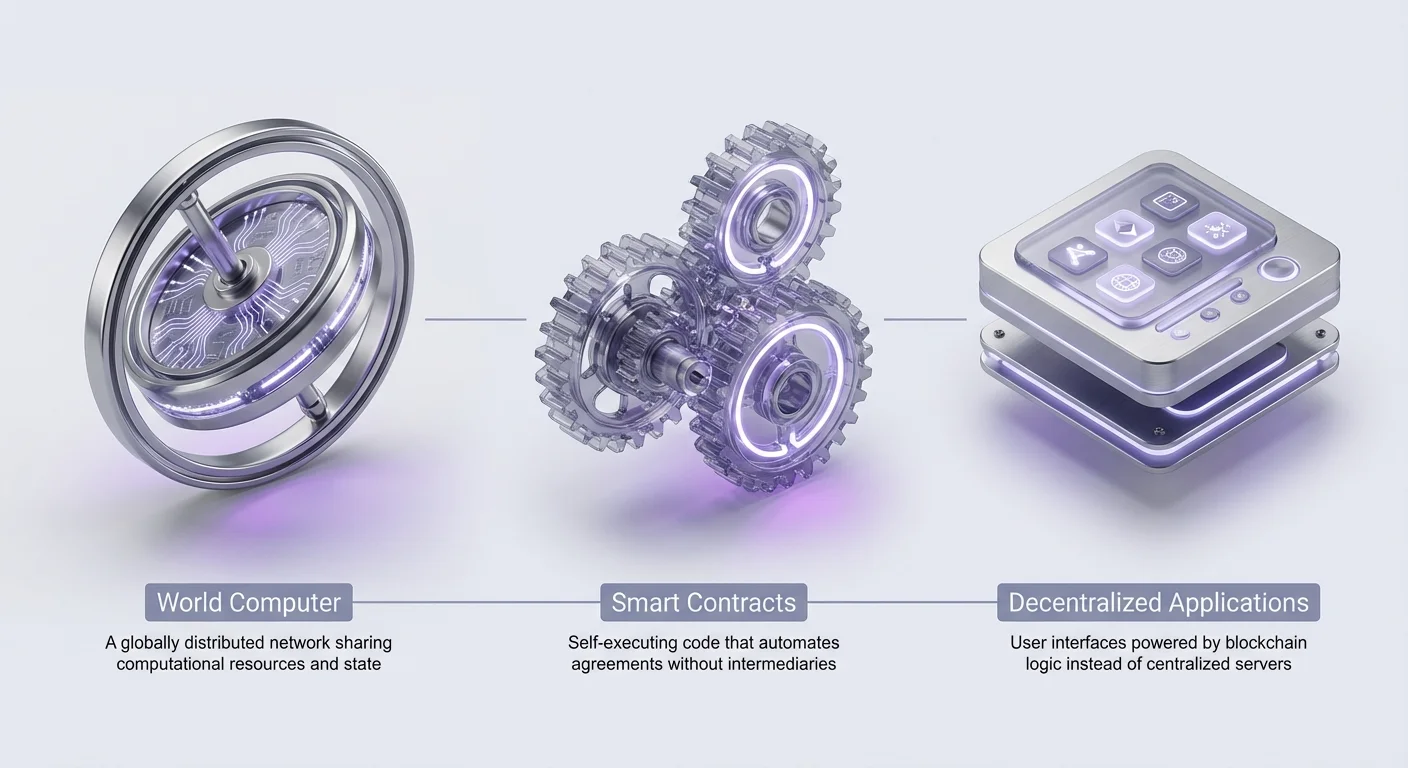
This platform is often described as the world's computer. This analogy highlights its ability to execute code and manage data across a distributed network of nodes. Unlike a traditional supercomputer which resides in a specific location, Ethereum's resources are spread globally. This distribution ensures that the network remains resilient and accessible to anyone with an internet connection. It transforms the blockchain from a simple database into a dynamic environment where complex interactions occur.
The primary actors within this network state are the accounts that initiate and execute transactions. These actors interact within a system designed to be open and permissionless. The network does not discriminate based on geography or status. Instead, market forces and code determine access to resources. This structure empowers developers to build applications that are transparent and immutable. It effectively removes the need for gatekeepers in financial and social interactions.
The Concept of the World Computer
The idea of a "world computer" suggests a shared resource available to all. In traditional computing, software runs on proprietary servers owned by specific companies. These entities control the data and the logic of the applications. Ethereum flips this model by allowing applications to run on a public network. The state of this computer is maintained by thousands of independent participants rather than a single corporation.
However, this analogy has limitations regarding raw processing power. Ethereum is not designed to replace high-performance supercomputers for tasks like analyzing astronomical data. It cannot process massive images or perform complex scientific simulations efficiently. Its strength lies not in speed or raw calculation but in trust and verification. We should view it as a shared platform for secure, verifiable logic rather than a workhorse for data processing.
The core purpose of this platform is to maintain a shared "state" that everyone agrees on. In computing, state refers to the current information stored in the system. This changes based on interactions between external inputs and internal logic. On Ethereum, this state includes account balances, contract codes, and the data stored by applications. Once the network agrees on a state, it becomes a permanent record that is extremely difficult to alter.
Characteristics of the Network State
Open and Permissionless Access
The Ethereum network operates on a principle of radical openness. Anyone is free to create, run, and use applications on the platform. There is no requirement to create an account with a centralized provider or ask for permission to deploy software. The resources of this shared computer are delegated purely by market forces. Anyone willing to pay the required fees can access the network's processing power.
Transparency and Immutability
Every transaction and line of code on the network is visible to the public. There are no hidden algorithms or proprietary software logic that users cannot inspect. This transparency allows participants to evaluate the details of applications before interacting with them. Furthermore, once the network agrees upon a state, it becomes a permanent record. This immutability provides a high degree of assurance that fraud is not being committed and history is not being rewritten.
Credible Neutrality
The protocol evolves through a quasi-political process that aims for credible neutrality. This means the platform adapts to the needs of its participants without prioritizing one group over another. The goal is to ensure that the rules apply equally to everyone. Users can trust that they will have fair access to the network's resources regardless of their background or intent. This neutrality is essential for a global platform aiming to serve as a foundation for diverse applications.
Evolution from Calculator to Computer
To understand the actors on Ethereum, it helps to compare the network to Bitcoin. Bitcoin was launched in 2009 as a digital alternative to traditional currencies. Its primary design goal was to facilitate the decentralized transfer of value. You can think of Bitcoin as a decentralized calculator. It is incredibly efficient at one specific task: tracking who owns how much money. Its scripting language is intentionally limited to ensure security for simple transactions.
Ethereum, proposed in late 2013 by Vitalik Buterin, introduced a broader vision. Buterin aimed to create a "Turing complete" blockchain. This term describes a system capable of running any type of application given enough time and resources. While Bitcoin manages programmable money, Ethereum manages programmable code. This distinction is what allows for the existence of complex accounts and smart contracts that go beyond simple value transfers.
The launch of the Ethereum mainnet in 2015 marked the transition from specific-use blockchains to general-purpose platforms. Developers could now use the blockchain's infrastructure to build their own projects. This was not possible on Bitcoin due to its rigid architecture. The Ethereum network allows peer-to-peer contracts to run without interference. This capability created a new environment where the actors are not just people sending money, but programs interacting with other programs.
| Feature | Bitcoin | Ethereum |
|---|---|---|
| Primary Purpose | Store of value | Decentralized platform |
| Capability | Digital Calculator | Turing Complete Computer |
| Throughput | ~7 transactions/sec | ~30 transactions/sec |
The Logic of Smart Contracts
A smart contract serves as the backbone of activity on the Ethereum network. It is a computer program that is stored and runs on the blockchain. These contracts act as autonomous actors within the system. Once deployed, they behave exactly as programmed, without the need for human intervention. They are often described using the "if this, then that" logic found in traditional programming.
The term "smart contract" can be slightly misleading. They are not always "smart" in the sense of artificial intelligence, nor are they always legal contracts. They are simply scripts that execute actions when specific conditions are met. For example, a contract could be programmed to hold funds until a certain date. Once that date arrives, the code automatically releases the funds to a designated recipient. No lawyer or bank is required to enforce this agreement.
These digital actors enable trustless interactions. "Trustless" does not mean you do not trust the system. It means you do not need to trust the counterparty or a third-party intermediary. You only need to trust the code. Because the code is transparent and runs on a decentralized network, anyone can verify its logic. This reduces the risk of error or manipulation by a central authority.
Deploying a smart contract involves sending a transaction that contains the code to the network. This action creates a special address for the contract. This address functions similarly to a user's account address but is controlled by code rather than a private key. Users interact with the contract by sending assets or data to this address. This triggers the contract's functions, causing it to execute its pre-defined rules.
The Ethereum Virtual Machine (EVM)
The Execution Engine
The Ethereum Virtual Machine (EVM) is the engine that powers the network's actors. It is a virtual environment that executes the smart contracts. Every node in the Ethereum network runs a copy of the EVM. This redundancy ensures that every transaction and contract execution is verified by the entire network. The EVM interprets the code compiled from smart contracts and updates the network state accordingly.
Bytecode and Isolation
Smart contracts are typically written in high-level programming languages. However, the EVM does not understand these languages directly. The code must be compiled into "bytecode," a low-level language that machines can read. The EVM executes this bytecode in a sandboxed environment. This isolation is crucial for security. It ensures that code running in the EVM cannot access the internal file system of the node or affect other processes.
Gas and Economics
Every operation performed by the EVM requires computational effort. This effort is measured in a unit called "gas." Users must pay for this gas using Ether. This mechanism prevents infinite loops and malicious code from clogging the network. It ensures that the actors on the network pay for the resources they consume. The complexity of the smart contract determines the amount of gas required for execution.
Decentralized Applications (dApps)
The interaction between user accounts and smart contracts forms the basis of Decentralized Applications, or dApps. A dApp is a software application that runs on a decentralized computing system. It typically consists of a smart contract backend and a user interface frontend. The frontend looks like a standard website or mobile app. However, the backend logic runs on the blockchain rather than a centralized server.
These applications rely on the interaction of three main components: smart contracts, the blockchain, and tokens. The smart contracts handle the business logic and state changes. The blockchain provides the secure, immutable ledger. Tokens are used to pay for gas fees and facilitate value transfer within the application. This architecture allows for permissionless innovation.
For instance, in a decentralized finance (DeFi) dApp, a user might interact with a lending protocol. The user sends assets to a smart contract address. The contract automatically calculates interest and issues a token representing the deposit. The entire process occurs without a bank manager or loan officer. The smart contract acts as the administrator, enforcing the rules transparently and autonomously.
Because these applications run on a public network, they benefit from the platform's inherent security. There is no single point of failure that hackers can target to take down the entire system. Additionally, because the data is on a public ledger, users maintain control over their assets. They do not have to hand over custody to a centralized entity that might misuse their funds.
The Web3 Vision
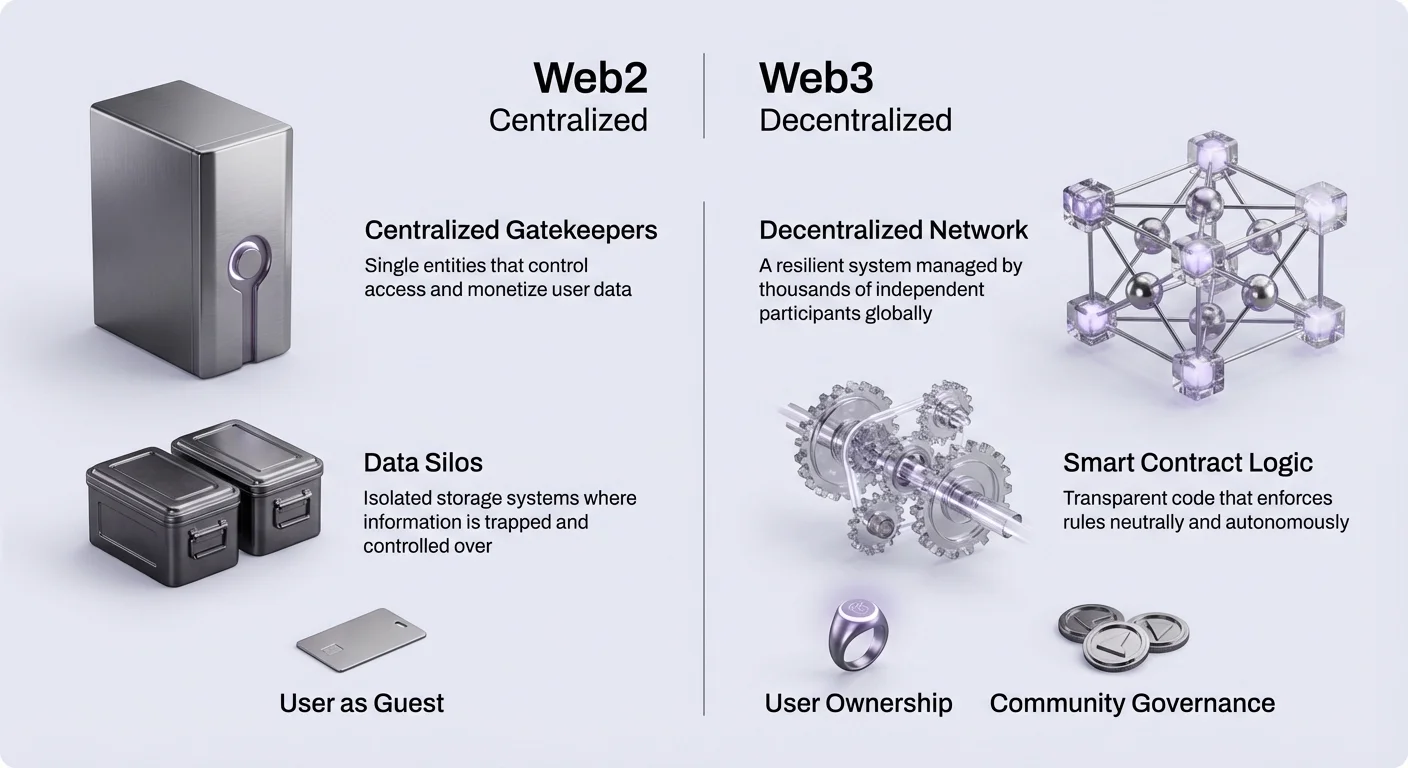
If Ethereum accounts and contracts are the actors, the stage they play on is Web3. This term refers to the next evolution of the internet. The current internet, Web2, is dominated by centralized platforms. Companies like Google and Facebook act as gatekeepers. They control access to services and monetize user data. Users are merely guests on these platforms, with little say in how they are governed.
Web3 aims to change this dynamic by introducing user ownership. On Ethereum, the actors—the users and builders—own the network. Through the use of tokens and governance rights, participants can influence the direction of the platform. This model reduces the power of rent-seeking intermediaries. It allows creators to interact directly with their audiences and retain more of the value they create.
Vitalik Buterin has noted that blockchain can put intermediaries out of a job. Instead of a taxi company controlling drivers, a Web3 platform could allow drivers and passengers to transact directly. The smart contract handles the payment and reputation systems. This shift towards peer-to-peer interaction distributes wealth and power more evenly. It creates a system where the rules are known to everyone and cannot be arbitrarily changed by a CEO.
This vision is supported by the concept of "credible neutrality." When developers build on Web2 platforms, they face "platform risk." A centralized entity can change its API or rules overnight, destroying a business. In the Web3 model, the rules are baked into the blockchain. Developers can build with confidence, knowing that the underlying platform is neutral and durable. This stability encourages innovation and long-term investment in the ecosystem.
Expanding the Ecosystem
Decentralized Finance (DeFi)
DeFi creates an open financial system where accounts interact with financial protocols. Users can borrow, lend, and trade assets globally. Smart contracts replace traditional banks. This removes barriers to entry and allows anyone with a wallet to participate in global markets. Transparency ensures that reserves and collateralization ratios are always visible to the public.
Non-Fungible Tokens (NFTs)
NFTs represent unique digital assets verified on the blockchain. They allow accounts to prove ownership of art, collectibles, or virtual real estate. Unlike fungible tokens like Bitcoin, each NFT is distinct. This standard has revolutionized digital rights management. It enables creators to monetize their work directly without relying on galleries or streaming services.
Decentralized Autonomous Organizations (DAOs)
DAOs are organizations governed by code rather than executives. Members use tokens to vote on decisions. The rules of the organization are enforced by smart contracts. This structure allows for global collaboration on projects and investments. It represents a new way for human actors to coordinate resources and goals transparently.
Conclusion
Ethereum has established a digital landscape where accounts and smart contracts function as the primary actors. By moving beyond the simple ledger capabilities of Bitcoin, it has created a Turing-complete environment. This platform empowers users to engage in complex interactions without relying on trusted intermediaries. The combination of the Ethereum Virtual Machine and smart contract logic provides the infrastructure for a decentralized internet.
The shift from Web2 to Web3 represents a fundamental change in control and ownership. Through the use of transparent, immutable code, individuals gain sovereignty over their data and assets. While the technology faces challenges in scalability and complexity, the vision of a permissionless world computer continues to drive innovation. The actors on this network are redefining the boundaries of finance, governance, and digital society.
Code allows strangers to cooperate securely without needing to know or trust one another.