
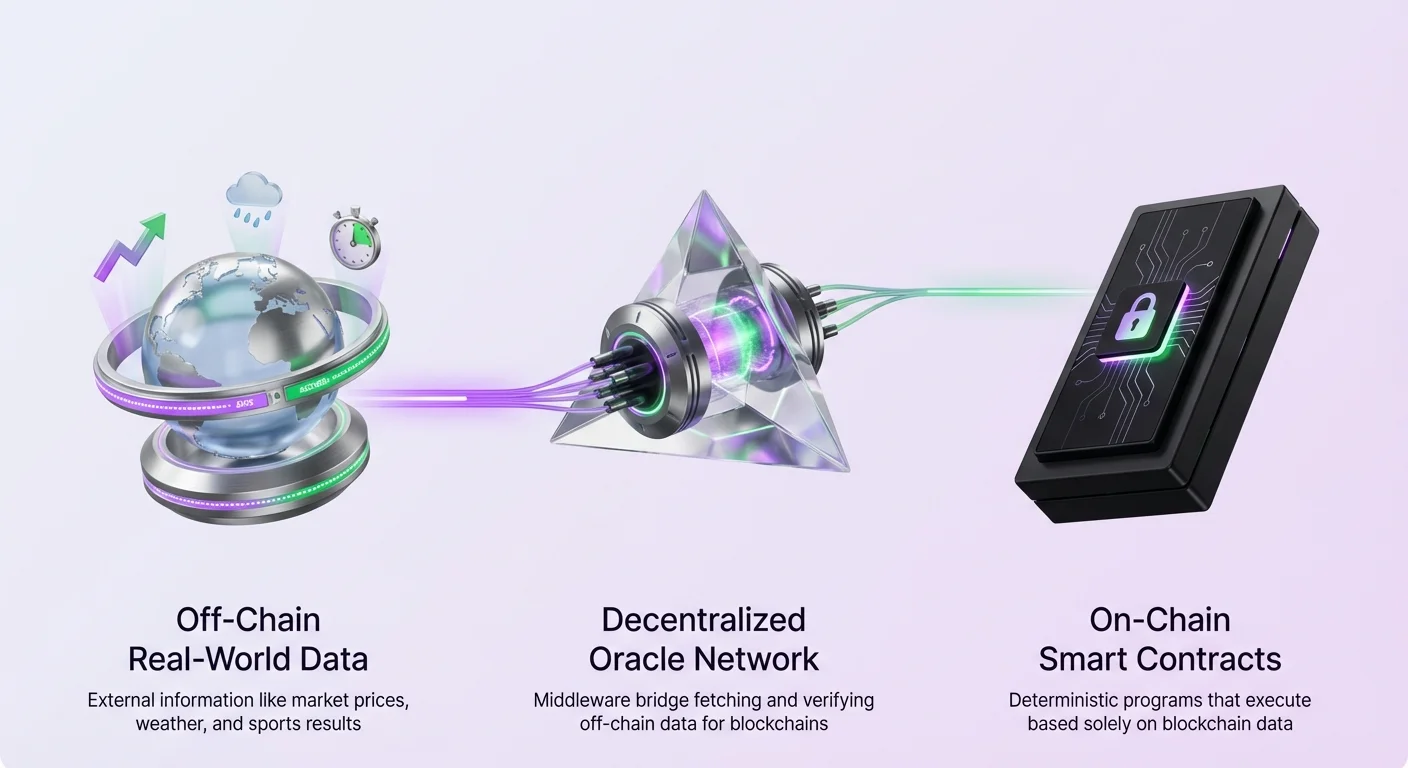
Smart contracts operating on blockchain networks function as self-contained ecosystems. They are deterministic, meaning they execute code exactly as programmed based solely on data present within their own ledger. This isolation provides security and immutability, but it creates a significant limitation known as the oracle problem.
Without external assistance, a blockchain cannot access data from the outside world. It does not know the current price of gold, the result of a football match, or the temperature in London. This information exists "off-chain," while the smart contract lives "on-chain."
For decentralized applications to offer meaningful utility in finance, insurance, or supply chain management, they must bridge this gap. This is where decentralized oracle networks enter the equation. They serve as secure middleware that fetches, verifies, and delivers off-chain data to on-chain smart contracts.
Understanding how these networks function requires analyzing two distinct areas. First, we must look at the economic incentives that compel participants to provide accurate data. Second, we must map the potential attack vectors that bad actors might use to manipulate this data for profit.
The Mechanics of Data Bridging
The Request and Retrieval Cycle
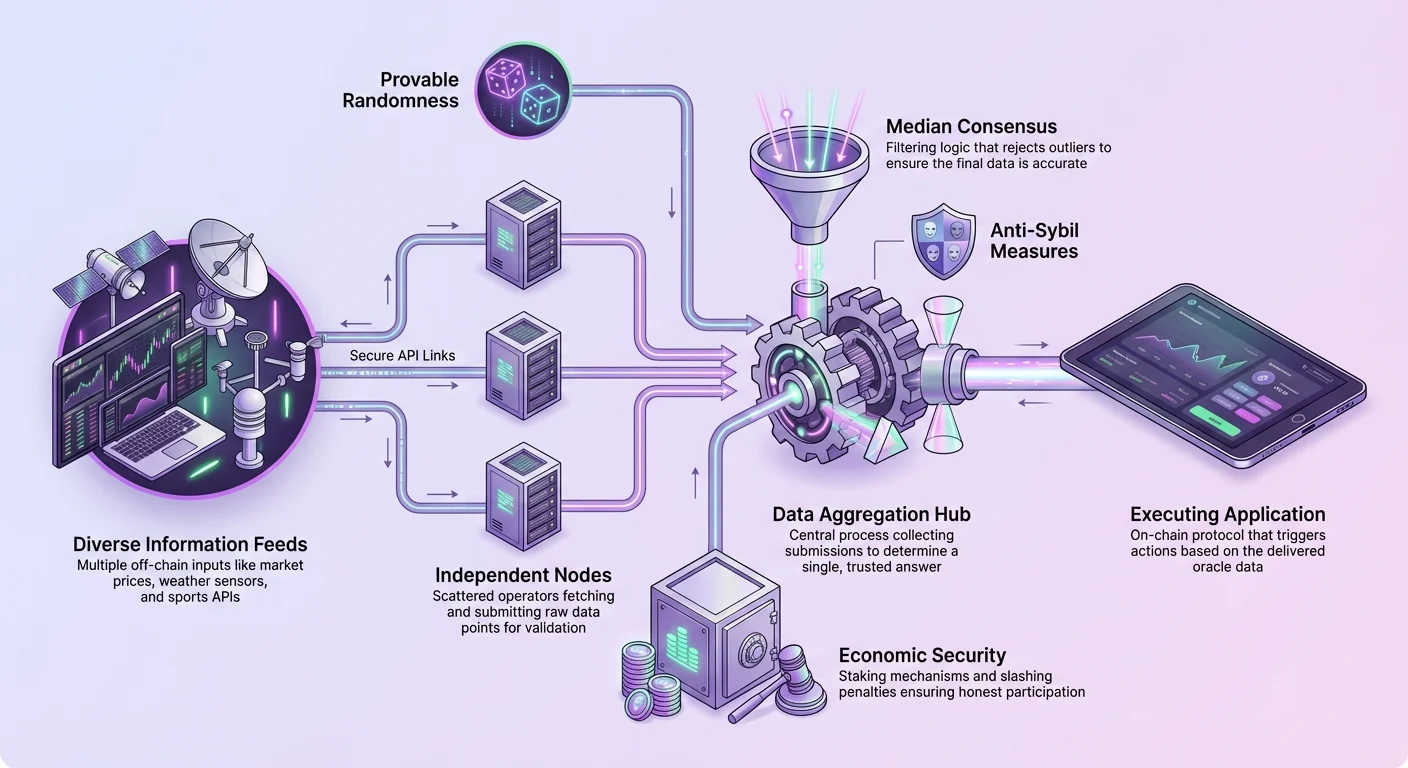
The process of bridging data begins when a user smart contract initiates a request. This contract might need to know the current market price of Ethereum in US dollars to process a loan. It sends a request to the oracle network, specifying the data needed and the parameters for delivery.
This request is picked up by an oracle smart contract on the blockchain. This contract emits an event that off-chain nodes—servers running oracle client software—can detect. These nodes act as the bridge between the two worlds.
Upon seeing the request, the nodes connect to external APIs, data feeds, or traditional payment systems. They retrieve the requested information. In a decentralized setup, multiple nodes perform this action independently to ensure redundancy.
Once the data is retrieved, the nodes submit their answers back to the blockchain. This submission process often involves a transaction fee, paid in the network's native token or the blockchain's base currency. The data is then processed for accuracy before final delivery.
Aggregation and Consensus
If a single node provided the data, the system would be centralized and vulnerable. If that one node went offline or decided to lie, the smart contract relying on it would fail or execute a fraudulent transaction. To solve this, decentralized networks employ aggregation.
Multiple independent nodes fetch the same data point from different sources. For example, ten nodes might check the price of Bitcoin across five different exchanges. They each submit their findings to the on-chain aggregating contract.
The aggregating contract uses a predefined logic to determine the final answer. A common method is taking the median value of all submissions. This filters out outliers. If one node reports a price of $0 and another reports $1,000,000, while the rest report $50,000, the median stays accurate.
This consensus mechanism ensures that no single entity can manipulate the data feed. For a successful attack, a malicious actor would need to compromise a significant majority of the nodes simultaneously.
Delivery and Execution
After the data is aggregated and validated, it is delivered to the requesting smart contract. This triggers the execution of the contract's logic. In a decentralized finance (DeFi) lending protocol, this might mean updating the value of a user's collateral.
If the new data shows the collateral value has dropped below a certain threshold, the contract might automatically trigger a liquidation. This entire process happens without human intervention, relying entirely on the accuracy of the oracle's report.
The speed of this delivery is critical. In volatile markets, a delay of even a few minutes can lead to significant discrepancies between the on-chain price and the real-world market price. High-performance networks prioritize low-latency updates to mitigate this risk.
Economic Incentives for Data Provision
Staking and Skin in the Game
Decentralized networks rely on crypto-economic security to ensure honesty. Node operators are often required to stake tokens to participate in the network. This stake serves as a security deposit. It represents "skin in the game," aligning the operator's financial interests with the network's health.
If a node operator provides malicious data or fails to maintain uptime, their staked tokens can be slashed. Slashing involves confiscating a portion or all of the staked assets as a penalty. This creates a direct financial loss for dishonest behavior that outweighs the potential gain from manipulation.
The staking mechanism transforms the problem of trust into a problem of economics. A user does not need to trust the moral character of a node operator. They only need to trust that the operator acts rationally to preserve their own capital.
Token Rewards and Revenue Models
In exchange for their services and the risks associated with staking, node operators earn rewards. These rewards are typically paid in the network's native utility token. For instance, in the Chainlink ecosystem, node operators are paid in LINK tokens for fulfilling data requests.
The value of the reward must be sufficient to cover the costs of operation. These costs include server maintenance, electricity, and the gas fees required to submit transactions on the blockchain. If the rewards are too low, rational operators will leave the network, reducing security.
This creates a circular economy. As the demand for secure data grows, the potential revenue for nodes increases. This attracts more operators to the network, which in turn increases decentralization and security. Higher security attracts more high-value smart contracts, further driving demand.
Reputation Systems and Future Work
Beyond immediate financial penalties, reputation plays a crucial role in long-term incentives. Oracle networks often track the historical performance of nodes. Metrics such as uptime, response time, and accuracy are recorded on-chain.
Smart contracts can be programmed to select only nodes with high reputation scores. A node that behaves poorly not only loses its stake but also loses future revenue opportunities. Once a reputation is tarnished, it is difficult and costly to rebuild.
This reputation data is immutable and transparent. Anyone can audit the performance of a node operator. This transparency forces operators to maintain high standards consistently, as their track record is permanently visible to potential clients.
Mapping Attack Vectors
The Sybil Attack
A Sybil attack occurs when a single entity creates multiple fake identities to gain control over a network. in the context of oracles, an attacker might spin up dozens of nodes that appear independent but are actually controlled by one person.
If these Sybil nodes gain enough influence to constitute a majority in the aggregation process, they can manipulate the final data feed. They could coordinate to report a false price, triggering wrongful liquidations or allowing the attacker to buy assets at an artificially low price.
Networks mitigate this through strict entry requirements. High staking minimums make it expensive to spin up multiple nodes. Additionally, many networks use a permissioned or semi-permissioned launch phase where known, reputable security teams run the initial nodes before opening up to the public.
Mirroring and Freeloading
Freeloading is a subtler form of attack that degrades network quality rather than manipulating data directly. A lazy node operator might decide to save on the cost of expensive API subscriptions. Instead of fetching data from the source, they simply watch what other nodes submit and copy their answers.
This "mirroring" undermines the diversity of the network. If all nodes copy one primary data source, the network effectively becomes centralized around that single source. If the primary source makes an error, every mirroring node repeats the error, and the aggregation mechanism fails to filter it out.
To combat this, networks may implement commit-reveal schemes. In this system, nodes first submit a hashed version of their answer (the commit). Once all nodes have committed, they reveal the actual data. This prevents nodes from seeing and copying others' answers before submission.
Source-Level Manipulation
Even if the oracle network functions perfectly, the data it delivers is only as good as the source. If an attacker can manipulate the data at the source—for example, on a centralized exchange—the oracle will accurately report the manipulated price. This is known as "garbage in, garbage out."
In low-liquidity markets, a wealthy attacker can execute a large trade to temporarily skew the price of an asset. If an oracle pulls price data from that specific market at that exact moment, it will report the skewed price to the smart contract.
This vector is particularly dangerous for DeFi protocols. An attacker might manipulate a token's price on an exchange, wait for the oracle to update, and then take out a massive under-collateralized loan on a lending platform before the price corrects.
DeFi and Systemic Risks
The Role of Automated Market Makers
Decentralized exchanges (DEXs) like Uniswap have introduced their own solutions to price discovery. They use Automated Market Makers (AMMs) which rely on mathematical formulas to determine prices based on the ratio of assets in a liquidity pool.
Early versions of AMMs were vulnerable to instantaneous price manipulation. An attacker could use a flash loan—a massive, uncollateralized loan that must be repaid in the same transaction—to buy a huge amount of a token, skewing the price. If another protocol used this spot price as an oracle, it would be instantly exploited.
To solve this, newer iterations like Uniswap v3 introduced Time-Weighted Average Prices (TWAP). TWAP calculates the average price of an asset over a specific period, such as 30 minutes. This makes it extremely expensive to manipulate the oracle, as an attacker would need to sustain a skewed price for a long duration.
Lending Protocol Dependencies
Lending platforms are perhaps the most critical consumers of oracle data. Protocols that allow users to borrow against their crypto assets rely entirely on price feeds to ensure solvency. They must know the real-time value of the collateral to calculate health factors.
If an oracle fails or is manipulated, the consequences are severe. If the reported price of collateral drops falsely, innocent users get liquidated, losing their funds. If the reported price stays high while the real market crashes, the protocol ends up holding bad debt—collateral worth less than the borrowed assets.
This dependency creates a systemic risk. A vulnerability in a widely used oracle network can cascade through the entire DeFi ecosystem. Multiple protocols relying on the same compromised feed would fail simultaneously, potentially causing a market-wide collapse.
Cross-Chain Complexity
As the industry moves toward a multi-chain world, the complexity of data provision increases. Layer 2 solutions like Polygon require data bridges that are as secure as the main Ethereum network. However, the latency and security models of different chains vary.
Attackers often look for the weakest link. A protocol might be secure on Ethereum Mainnet but vulnerable on a sidechain if the oracle implementation there is less robust. Cross-chain interoperability protocols attempt to standardize this, but transferring data securely between disparate consensus environments remains a high-risk frontier.
Advanced Implementations
Verifiable Randomness
Oracles are not limited to price data. Many applications, particularly in gaming and NFTs, require verifiable randomness. A smart contract cannot generate a truly random number on its own because the blockchain state is deterministic and visible to everyone.
If a developer uses a block hash as a source of randomness, a miner could potentially manipulate the block to influence the outcome. This is a significant vector for cheating in blockchain-based lotteries or rare item generation in games.
Decentralized oracles solve this by generating a random number off-chain and providing a cryptographic proof that the number was generated correctly. The smart contract verifies this proof before accepting the number. This ensures that neither the user, the node, nor the game developer can tamper with the result.
Zero-Knowledge Proofs
The integration of zero-knowledge (ZK) technology represents the next evolution in oracle security. ZK proofs allow a node to prove that it performed a computation correctly or retrieved data from a specific source without revealing the underlying data itself until necessary.
This technology enhances privacy and scalability. It allows oracles to verify complex off-chain computations—such as a credit score check or a bank balance verification—and submit only a succinct proof to the blockchain. This reduces the data load on the network while maintaining high security assurances.
ZK-based oracles can also prevent front-running. Since the content of the data can be hidden until the transaction is confirmed, bots scanning the mempool cannot see the oracle update and trade against it before it is finalized.
Comparative Analysis of Approaches
Decentralized vs. Internal Oracles
Protocols basically have two choices: use a third-party decentralized oracle network or build an internal one. Third-party networks like Chainlink offer broad market coverage and high security due to the diversity of nodes. They are "general purpose" solutions suitable for most high-value applications.
Internal oracles, such as the TWAP mechanism used by Uniswap, are specific to the liquidity of that platform. They are highly resistant to manipulation within their own ecosystem but do not reflect the broader market price if the DEX itself usually has lower volume than centralized exchanges.
| Feature | Decentralized Oracle Network | Internal DEX Oracle (TWAP) |
|---|---|---|
| Source Diversity | High (Multiple exchanges/APIs) | Low (Single DEX liquidity pool) |
| Manipulation Cost | Very High (Must skew global market) | High (Must sustain skew over time) |
| Latency | Variable (Depends on update frequency) | Real-time (Updates per block) |
The Cost of Security
Security acts as a trade-off with cost and speed. A highly decentralized oracle requiring consensus from 50 nodes will be more expensive to operate than one requiring 3 nodes. The gas fees for aggregating 50 signatures are significantly higher.
For high-value transactions, this cost is a necessary insurance premium. A DeFi protocol securing billions of dollars cannot cut corners on data quality. However, for lower-stakes applications, such as a casual gaming app, a lighter, faster, and less decentralized oracle solution might be acceptable.
Developers must assess the "Cost of Corruption" versus the "Profit from Corruption." If the amount of money that can be stolen by manipulating the oracle is lower than the cost to manipulate it, the system is considered economically secure.
Future Trends in Data Provision
The Rise of Specialized Oracles
As blockchain use cases expand, the demand for specialized data grows. We are moving beyond simple asset prices into complex datasets like weather patterns for insurance, sports results for betting markets, and supply chain logistics for enterprise tracking.
These specialized networks may require different incentive structures. A node reporting weather data might need distinct hardware sensors, verified via "Proof of Location," rather than just API connections. This diversifies the hardware requirements for the oracle ecosystem.
Interoperability Standards
The fragmentation of liquidity across Layer 1 and Layer 2 blockchains creates a need for standardized communication. Protocols like the Cross-Chain Interoperability Protocol (CCIP) aim to create a universal standard for messaging and data transfer.
This standardization allows for the creation of "chain-agnostic" applications. A user could deposit collateral on Ethereum and take out a loan on Polygon, with the oracle network securely transmitting the state of the collateral between the two chains.
Assessing Long-Term Viability
The long-term viability of any oracle network depends on its ability to scale without compromising security. As transaction volumes on blockchains increase, oracle networks must process more data points faster. Innovations in off-chain computation and data compression will be essential.
Furthermore, the economic model must be sustainable. If a network relies heavily on token emissions to subsidize node operators, it may face inflation issues. Ideally, the fees paid by data consumers should eventually cover the full cost of operation, creating a self-sustaining marketplace for information.
Conclusion
Decentralized oracle networks act as the nervous system of the blockchain industry. They translate the chaotic, unpredictable events of the real world into the rigid, deterministic language of smart contracts. Without them, the utility of blockchain technology would remain confined to simple token transfers. However, their role as a bridge introduces complex risks that combine computer science vulnerabilities with economic game theory.
The security of these systems does not rely on the benevolence of participants but on carefully engineered incentives. By balancing staking penalties, token rewards, and reputation mechanics, these networks create an environment where honesty is the most profitable strategy. While attack vectors like collusion and front-running persist, innovations in cryptography and consensus logic continue to raise the bar for potential attackers.
Ultimately, the reliability of decentralized finance depends entirely on the integrity of the data that fuels it.