The landscape of digital asset acquisition has evolved significantly beyond simple bank transfers to centralized entities. As the cryptocurrency market matures, a diverse array of access methods has emerged to cater to different user needs regarding privacy, control, and convenience.
Traders now have the option to utilize platforms that prioritize anonymity, peer-to-peer interaction, and liquidity aggregation. Understanding the distinctions between these access points is essential for navigating the modern crypto economy safely and effectively.
The Spectrum of Digital Asset Exchanges
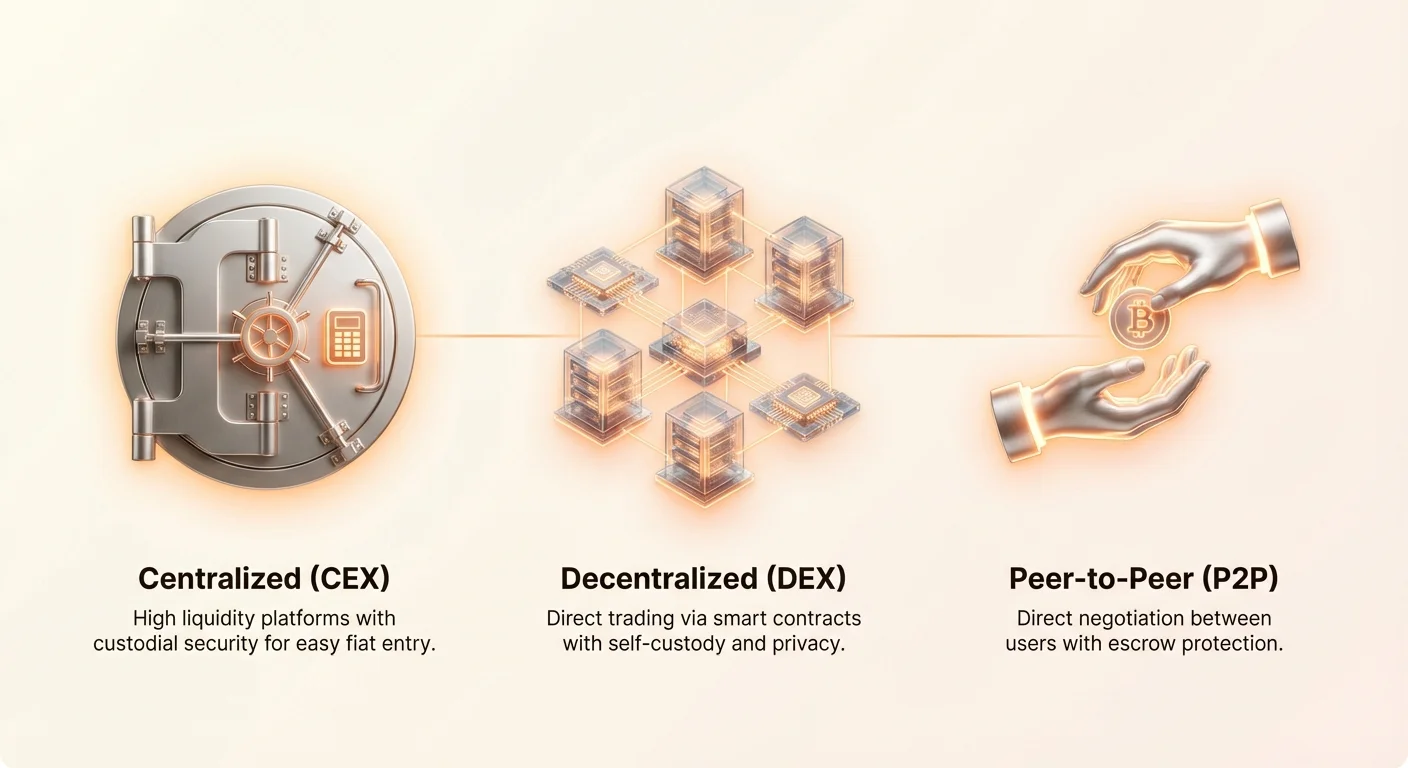
The cryptocurrency ecosystem is no longer limited to a single type of trading venue. Users can choose between centralized authorities, decentralized protocols, and direct peer-to-peer marketplaces.
Centralized Exchanges (CEX)Centralized exchanges function as traditional intermediaries. These platforms are operated by companies that facilitate the buying, selling, and trading of cryptocurrencies. They offer high liquidity and user-friendly interfaces, making them a common entry point for beginners converting fiat currency to crypto. However, users must trust the exchange with their funds, which introduces counterparty risk.
Decentralized Exchanges (DEX)
Decentralized exchanges operate without a central governing authority. They allow users to trade directly with one another through smart contracts on the blockchain. These platforms enhance privacy and security by allowing users to maintain control over their private keys and funds throughout the trading process. They eliminate the need for a middleman but often require a higher level of technical knowledge to navigate effectively.
Hybrid and P2P Models
Hybrid exchanges attempt to combine the high liquidity and usability of centralized platforms with the security and privacy benefits of decentralized systems. Peer-to-peer (P2P) exchanges take a different approach by facilitating direct trades between users. These platforms match buyers and sellers who negotiate terms independently, often utilizing escrow systems to secure the transaction until both parties are satisfied.
The Mechanics of Anonymous Trading Platforms
Anonymous crypto exchanges cater to traders who prioritize privacy above all else. These platforms facilitate the buying, selling, and trading of digital assets with minimal or no personal information required.
Unlike traditional financial institutions that strictly adhere to Know Your Customer (KYC) regulations, anonymous exchanges often employ various techniques to obscure user identities and transaction details. This approach appeals to individuals seeking to protect their financial data from third-party observation.
Operational Privacy Measures
To maintain anonymity, these platforms minimize data collection and storage. They frequently support cryptocurrency-only transactions, eliminating the need to link bank accounts or provide government-issued identification.
Many employ non-custodial models, ensuring that users retain absolute control over their private keys. Advanced privacy features may include coin mixing services or the integration of privacy-focused networks like Tor to mask IP addresses and location data.
Pseudonymity vs. Anonymity
It is important to distinguish between pseudonymity and true anonymity. Most platforms offer pseudonymity, where transactions are linked to a digital address rather than a real-world identity.
While this provides a layer of privacy, advanced blockchain analysis can potentially trace transactions back to individuals if they interact with compliant fiat gateways. True anonymity often requires the use of specialized privacy coins and rigorous operational security practices by the user.
Peer-to-Peer (P2P) Marketplaces Explained
Peer-to-peer exchanges represent a fundamental shift in how assets are exchanged, moving away from automated order books to human-centric negotiation. These platforms act as bulletin boards where buyers and sellers post advertisements for crypto trades.
Users can filter offers based on price, payment method, and seller reputation. This direct interaction allows for greater flexibility in terms of settlement, often supporting payment methods that traditional exchanges cannot process.
The Role of Escrow SystemsTrust is the primary challenge in P2P trading. To mitigate the risk of fraud, these platforms utilize escrow services. When a trade is initiated, the seller's cryptocurrency is locked in a secure smart contract or third-party wallet held by the platform.
The funds are only released to the buyer once the seller confirms that the fiat payment has been received. This mechanism protects both parties, ensuring that the buyer does not pay without receiving coins and the seller does not release coins without receiving payment.
Dispute Resolution Mechanisms
Despite escrow protection, disputes can arise. P2P platforms typically provide dispute resolution services where platform administrators review evidence, such as payment receipts and chat logs, to arbitrate conflicts.
This human element differentiates P2P platforms from automated decentralized exchanges. The reputation system is also vital, as users build trust scores based on their history of successful trades and response times, helping others identify reliable trading partners.
Cryptocurrency Brokers vs. Direct Exchanges
While exchanges facilitate trading between users, cryptocurrency brokers act as intermediaries that sell assets directly to the client. This distinction fundamentally changes the trading dynamic and fee structure.
Brokerage Operational Model
Brokerage platforms act as the counterparty to every trade. When a user buys Bitcoin from a broker, they are purchasing it from the broker's inventory rather than from another trader on an open market.
This simplifies the process significantly for beginners, as there is no need to understand order books, liquidity depth, or order types. The broker sets the price, often including a spread, and the user executes the transaction instantly.
Pros and Cons of Brokerage Access
The primary advantage of brokers is simplicity. They often offer integrated educational resources and personalized support, making them ideal for those new to the market. However, this convenience usually comes at a cost.
Brokers typically charge higher fees compared to direct exchanges, often hiding these costs within the spread between the buy and sell prices. Additionally, users may have less control over the specific price execution compared to trading on an open exchange with limit orders.
Hybrid Platforms and Liquidity Aggregation
Hybrid exchanges represent an evolution in trading infrastructure, attempting to solve the liquidity fragmentation issues found in decentralized markets while maintaining non-custodial security.
These platforms often utilize aggregation technology to scan multiple exchanges and liquidity pools simultaneously. By routing orders through various sources, aggregators ensure that traders receive the best possible price with minimal slippage.
This is particularly useful for large orders that might otherwise move the market price on a single exchange. Hybrid models may also incorporate off-chain order matching with on-chain settlement.
This allows for the speed and user experience of a centralized exchange while ensuring that the actual settlement of funds occurs on the blockchain, preserving the security benefits of self-custody.
Fee Structures Across Different Platforms
Understanding the cost of access is crucial for preserving capital. Different access methods employ varying fee models that can significantly impact profitability.
Maker and Taker Fees
On standard exchanges, fees are often categorized into "maker" and "taker" charges. Makers are traders who place limit orders that are not immediately filled, adding liquidity to the order book.
Takers are those who execute market orders that match with existing orders, removing liquidity. Exchanges typically incentivize makers with lower fees to ensure there is enough liquidity for smooth trading. Anonymous and P2P exchanges may use this model or opt for flat-fee structures depending on their architectural design.
Network and Service Fees
Beyond trading commissions, users must navigate network fees. These are costs paid to miners or validators to process transactions on the blockchain.
On non-custodial and decentralized platforms, users are directly responsible for these gas fees, which can fluctuate wildly based on network congestion. Centralized brokers and exchanges may absorb some of these costs or bundle them into a flat withdrawal fee.
| Fee Type | Description | Typical Payer |
|---|---|---|
| Maker Fee | Charged for adding liquidity | Limit Order Placer |
| Taker Fee | Charged for taking liquidity | Market Order Placer |
| Network Fee | Paid to blockchain validators | Sender/Withdrawal |
Security Protocols and Custody Models
Security remains the paramount concern when selecting an access method. The distinction between custodial and non-custodial platforms dictates who holds the ultimate responsibility for asset safety.
Custodial Security Measures
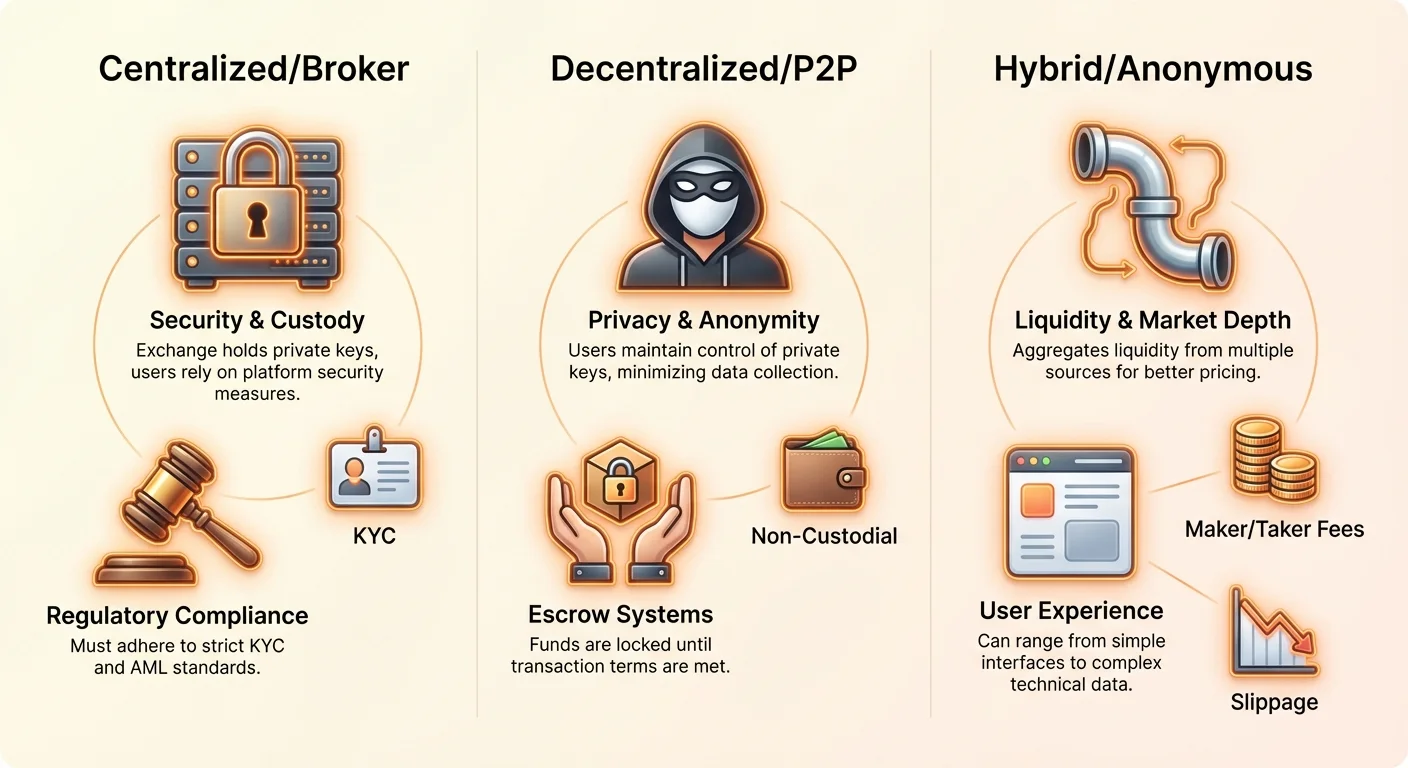
Centralized exchanges and brokers operate as custodians. They hold the private keys to user funds. To secure these assets, reputable platforms employ cold storage, keeping the vast majority of funds offline in air-gapped devices resistant to hacking.
They also utilize multi-signature technology, requiring multiple approvals for internal transfers. Users on these platforms rely on account-level security such as two-factor authentication (2FA) and email confirmations to protect their individual balances.
Non-Custodial and Self-Sovereignty
Anonymous, DEX, and P2P platforms often default to non-custodial models. Here, the user is responsible for their own private keys and security. This eliminates the risk of a central exchange hack resulting in loss of user funds.
However, it shifts the burden entirely to the individual. If a user loses their private key or recovery phrase, the assets are unrecoverable. Security in this context involves secure hardware wallets and rigorous personal cybersecurity hygiene.
The Role of Payment Gateways
The method used to fund a crypto account significantly influences the choice of platform and the level of privacy maintained.
Fiat On-Ramps and Privacy
Traditional banking methods like wire transfers and credit cards are widely accepted on centralized exchanges and brokers. These methods offer speed and convenience but create a permanent financial trail linking the user's real-world identity to their crypto holdings.
This integration is mandatory for compliance with anti-money laundering (AML) laws on regulated platforms. For users seeking privacy, these payment trails defeat the purpose of using anonymous trading venues.
Alternative Payment Methods
P2P exchanges shine in their support for alternative payment methods. Users can trade crypto for gift cards, cash deposits, or digital payment services like PayPal.
While PayPal offers speed and fraud protection, it still links a user's identity to the transaction. Cash trades or decentralized payment networks offer higher levels of anonymity but come with increased logistical challenges and potential risks of physical security or fraud.
Navigating Liquidity and Market Depth
Liquidity refers to the ease with which an asset can be bought or sold without affecting its stable price. It is a critical factor in platform selection.
Liquidity in Centralized Venues
Top-tier centralized exchanges and brokers generally offer the highest liquidity. They attract professional market makers and institutional capital, resulting in deep order books.
This ensures that even large trades can be executed instantly with minimal price slippage. For beginners and active traders, high liquidity provides a stable environment where entry and exit prices are predictable.
Liquidity Challenges in Alternative Markets
Anonymous exchanges and P2P marketplaces often struggle with lower liquidity compared to their centralized counterparts. In P2P markets, liquidity is fragmented across individual offers.
A user looking to buy a large amount of Bitcoin might need to execute multiple trades with different sellers, each at varying prices. This can make the process slower and potentially more expensive. Aggregators attempt to mitigate this by pooling liquidity, but the depth may still lag behind major centralized hubs.
Regulatory Landscape and Compliance
The legal environment surrounding cryptocurrency access is complex and constantly shifting. Platforms operate under varying degrees of regulatory oversight depending on their structure and location.
Compliance on Regulated Platforms
Centralized exchanges and brokers are increasingly subject to strict financial regulations. They must adhere to KYC and AML standards, requiring users to verify their identities with government documents.
These regulations are designed to prevent illicit activities but can be viewed as intrusive by privacy advocates. Compliance ensures that the platform operates legally within its jurisdiction, offering users a degree of consumer protection and recourse in disputes.
The Gray Area of No-KYC Platforms
Anonymous and no-KYC exchanges operate in a regulatory gray area. While they offer enhanced privacy, they face increasing scrutiny from global regulators.
Users should be aware that the legal status of these platforms can change rapidly. In some jurisdictions, accessing unregulated exchanges may be restricted or prohibited. Furthermore, the lack of compliance measures means these platforms offer limited protection against fraud or platform insolvency compared to regulated entities.
Risks Specific to Alternative Access
While alternative access methods offer unique benefits, they also introduce specific risks that traders must navigate carefully.
Counterparty and Scams Risks
P2P platforms inherently involve trusting strangers. While escrow services mitigate this, sophisticated scams involving chargebacks or fake payment proofs still exist.
Users must be vigilant in verifying the reputation of their trading partners. On anonymous exchanges, the risk of exit scams—where the platform operators disappear with user funds—is higher due to the lack of regulatory oversight and identifiable leadership.
Technical and Support Risks
Decentralized and anonymous platforms often lack robust customer support. If a transaction fails or funds are stuck, there may be no central authority to contact for assistance.
Users are often left to rely on community forums or automated documentation. Additionally, the technical complexity of using non-custodial wallets and interacting with smart contracts increases the risk of user error, such as sending funds to the wrong address or losing access keys.
User Experience and Interface Considerations
The user interface (UI) serves as the bridge between the trader and the complex underlying technology of the blockchain.
Simplicity in Centralized Design
Brokers and major exchanges prioritize user experience to attract mass adoption. Their interfaces are designed to be intuitive, resembling traditional banking or stock trading apps.
Features are clearly labeled, and complex processes like wallet management are handled in the background. This accessibility reduces the learning curve for new entrants, allowing them to focus on investment decisions rather than technical mechanics.
Complexity in Alternative Interfaces
Privacy-focused and decentralized platforms often prioritize functionality over aesthetics. The interfaces can be stark and packed with technical data that may overwhelm a novice.
Users might need to manually manage gas fees, approve token allowances, and navigate complex settings to preserve anonymity. However, for advanced users, these interfaces offer granular control that streamlined apps cannot provide.
Conclusion
The diverse ecosystem of cryptocurrency platforms offers a wide range of access methods, each tailored to specific user priorities. From the high liquidity and ease of use found in centralized exchanges and brokers to the privacy and autonomy offered by anonymous and P2P platforms, there is no single solution that fits every trader.
Understanding the mechanical differences between these access points—ranging from custody models and fee structures to security protocols and regulatory compliance—is essential. Users must weigh the convenience of managed services against the control of self-custody, and the safety of regulated environments against the privacy of anonymous networks.
Ultimately, the choice of platform defines the security, privacy, and efficiency of your digital asset journey.