
Leverage trading is one of the most powerful—and risky—tools in the financial landscape, allowing traders to control large positions with a relatively small amount of capital. By borrowing funds, you can amplify potential profits significantly. However, leverage acts as a double-edged sword, magnifying potential losses just as effectively.
For the novice trader stepping into the world of derivatives, understanding the underlying mechanics is not optional; it is essential for survival. This complexity is often hidden behind slick exchange interfaces, but the fundamental concepts of margin calculation, liquidation triggers, and risk management ratios are the engineering bedrock of every trade. Without a thorough grasp of these formulas, you are not trading—you are gambling.
This guide moves beyond simple definitions to provide a deep dive into the financial engineering of leverage. We will dissect the formulas used to calculate margin requirements, determine the precise point at which a trade is forcibly closed (liquidation), and outline quantitative methods for maintaining control over risk. Mastery of these mechanics transforms trading from a speculative activity into a calculated risk management endeavor.
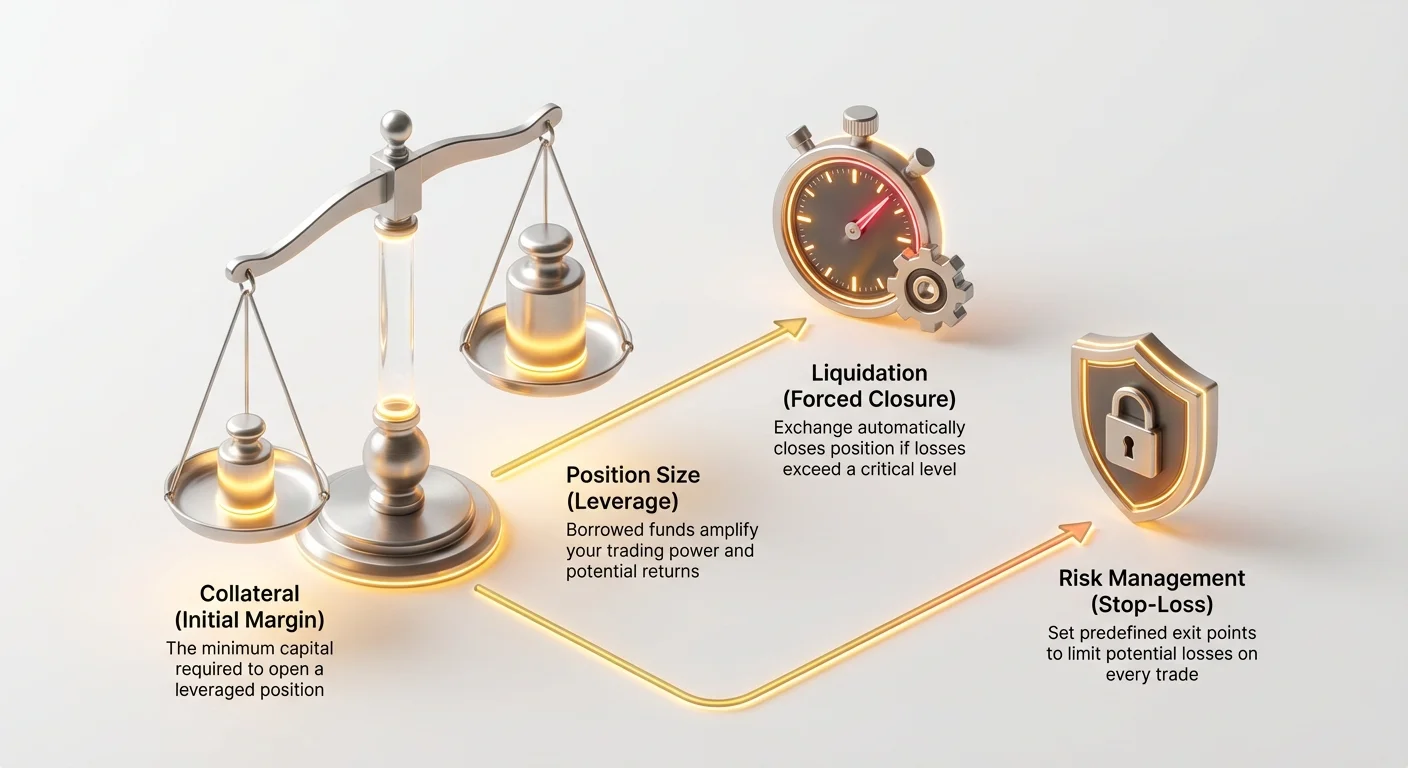
The Foundations of Leverage Trading
Leverage trading fundamentally involves using borrowed capital to increase the potential return of an investment. In the crypto market, this is typically facilitated through derivative instruments, such as futures or perpetual contracts, rather than direct ownership of the underlying asset.
Leverage Defined: Borrowing Power
When you apply leverage, you are defining a ratio that determines how much capital you are borrowing versus how much capital you are putting up (your margin).
For instance, if you want to open a 10,000$ Bitcoin position but only have1,000$ of your own capital, you are using 10x leverage. You are putting up 10% of the total position value, and the platform is lending you the remaining 90%.
- 10x Leverage: For every 1$ of your capital, you control10$ worth of the asset.
- 100x Leverage: For every 1$ of your capital, you control100$ worth of the asset.
The higher the leverage, the smaller the price movement required to either double your initial margin or wipe it out entirely.
The Role of Derivatives
In cryptocurrency trading, leverage is almost exclusively accessed through derivatives. A derivative is a contract whose value is derived from an underlying asset (like Bitcoin or Ethereum).
The most common derivative used for leverage trading are perpetual futures contracts. Unlike traditional futures, perpetual contracts do not have an expiry date, allowing traders to hold positions indefinitely as long as their margin remains above the maintenance level. They are designed to closely track the spot price of the underlying asset, primarily through a mechanism called the Funding Rate (a concept explored in depth in related advanced trading material).
Long vs. Short Positions
Leverage allows traders to capitalize on movements in both directions:
- Long Position: The trader speculates that the price of the asset will increase. They "buy" the contract now, hoping to sell it later at a higher price.
- Short Position: The trader speculates that the price of the asset will decrease. They essentially "borrow" the asset, sell it immediately at the high price, and plan to buy it back later at a lower price to repay the loan.
In both long and short scenarios, leverage amplifies the profit or loss.
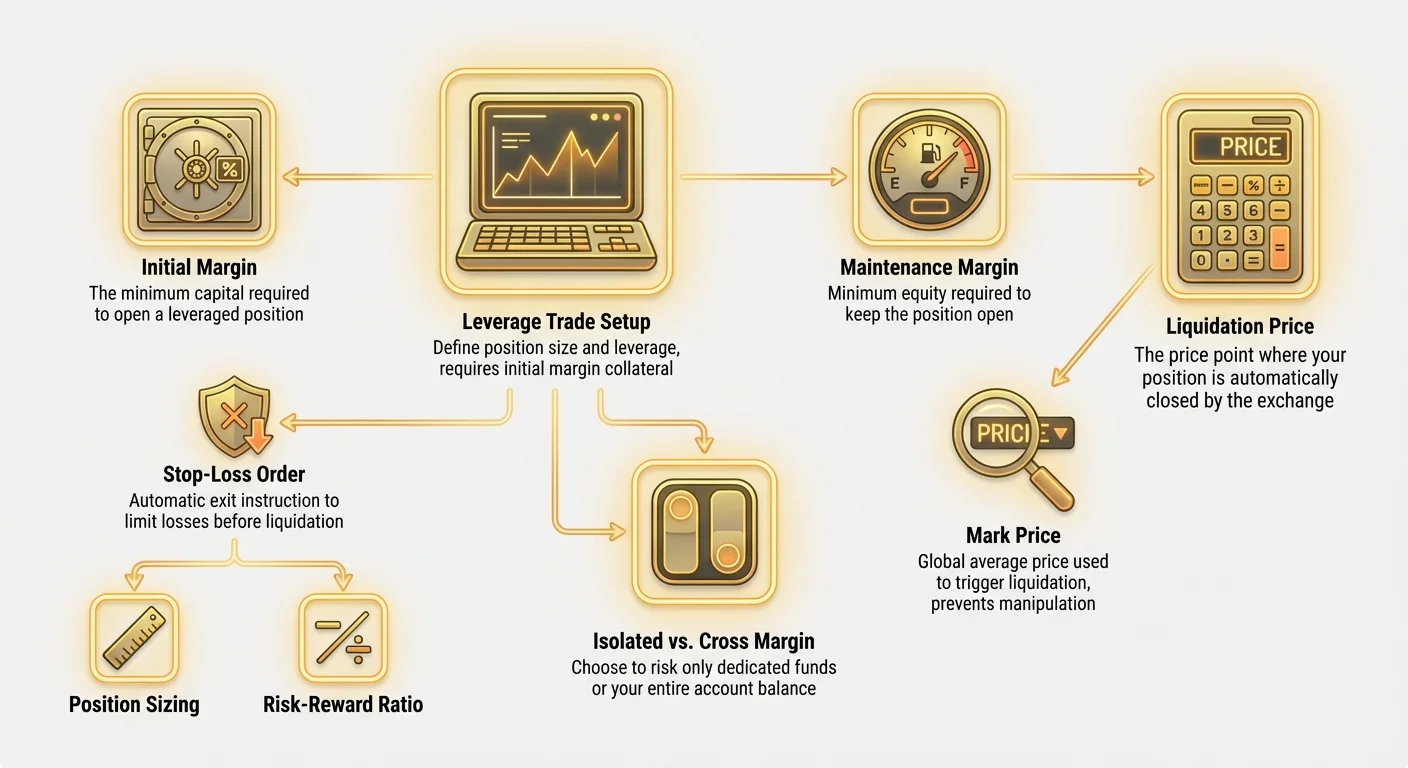
Understanding Margin: The Collateral Requirement
Margin is the capital you must commit to an exchange as collateral to cover potential losses on your leveraged position. It is the key financial barrier protecting the exchange from absorbing your losses if the market moves against you.
There are two critical margin levels you must track: Initial Margin and Maintenance Margin.
Initial Margin (IM): The Entry Requirement
The Initial Margin is the minimum amount of capital required to open a leveraged position. It acts as the down payment on your trade. The required initial margin is directly tied to the chosen leverage level.
Formula 1: Calculating Initial Margin (IM)
Where:
- Notional Value: The total size of the trade (e.g., 1 BTC at $50,000).
- Leverage Used: The multiple selected (e.g., 10 for 10x).
Practical Example:
Assume the price of Bitcoin is 50,000$. You want to open a 1 BTC long position using 20x leverage.</p> <p>\text{IM} = \frac{50,000}{20} =2,50050,000$ position, you must have at least 2,500$ in your trading account to serve as the Initial Margin.</p> <h3>Maintenance Margin (MM): The Safety Net</h3> <p>The Maintenance Margin is the minimum equity required in your account to keep the position open. If your account equity falls below this level due to unfavorable price movements, the exchange will trigger liquidation.</p> <p>The Maintenance Margin requirement is usually expressed as a small percentage of the total notional value, and this percentage is determined by the exchange’s risk engine and the size of your position (larger positions typically require higher MM rates).</p> <p>\text{Maintenance Margin Amount} = \text{Notional Value} \times \text{MM Rate}50,000$. Assume the exchange's Maintenance Margin Rate is 0.5%.
' in math mode at position 20: …t{MM Amount} =̲50,000 \times 0…" style="color:#cc0000">\text{MM Amount} = 250
You must maintain at least 250$ in equity for this specific position. Your initial margin was2,500$. This means you can absorb 2,250$ in losses (2,500 - $250$) before the liquidation process begins.
Equity and Unrealized Profit & Loss (P&L)
Your account's health is measured by its Equity, which is the sum of your Initial Margin and your current Unrealized P&L.
- Unrealized P&L: The theoretical profit or loss on your open position based on the current market price. Since you haven't closed the trade, the P&L is "unrealized."
- Equity: Represents the actual funds you have backing the trade at any moment.
\text{Equity} = \text{Initial Margin} + \text{Unrealized P&L}
If the market moves against you, your Unrealized P&L becomes negative, reducing your Equity. When Equity drops to the Maintenance Margin Amount, you are in danger of liquidation.
The Liquidation Trigger: When the Game Ends
Liquidation is the forced closing of a leveraged position by the exchange. This mechanism exists to prevent the trader’s losses from exceeding their margin and shifting the deficit onto the exchange or other traders (in the case of socialized losses).
For the leveraged trader, understanding the precise liquidation price is the single most critical piece of knowledge.
Defining Liquidation
When your position moves against you to the point that your Equity equals or falls below the Maintenance Margin Amount, the exchange’s system takes over. The position is immediately closed at the prevailing market price to release the remaining Maintenance Margin funds, ensuring the exchange does not incur a loss.
In high-volatility cryptocurrency markets, this process can happen in milliseconds.
Calculating the Mark Price
A crucial concept in calculating liquidation is the Mark Price. Most derivatives exchanges use the Mark Price rather than the Last Traded Price (LTP) to trigger liquidation.
Why the Mark Price?
The LTP is the most recent price at which a trade occurred on that specific exchange. If a single large trader manipulates the price on one platform (a common technique called "wicking" or "spoofing"), that spike could unfairly liquidate thousands of traders.
The Mark Price is calculated using a basket of price data, often including:
- The Average Spot Price across several major exchanges.
- The exchange's own Moving Average Price.
This mechanism protects traders from sudden, spurious price spikes unique to one platform, ensuring liquidation is based on the genuine global market value of the asset. Liquidation is only triggered when the Mark Price crosses the calculated Liquidation Price.
The Liquidation Price Formula
The Liquidation Price is the specific asset price point where your total equity matches the Maintenance Margin required for that position.
While exact formulas vary slightly between exchanges, the core principle is consistent. For a simple long position (where the MM rate is and the leverage is $L$), the liquidation price moves lower than the entry price.
Formula 2: Approximate Liquidation Price (Long Position)
Note: This simplified formula assumes zero transaction fees or funding rate influence. Advanced risk models would incorporate these factors.
Detailed Liquidation Example:
| Variable | Value | Notes |
|---|---|---|
| Entry Price (P_entry) | 10,000$</td> <td align="left">Price of BTC when opening the trade.</td> </tr> <tr> <td align="left">Position Size</td> <td align="left">1 BTC</td> <td align="left">Notional value is10,000$. | |
| Leverage (L) | 10x | Used to calculate Initial Margin. |
| Initial Margin (IM) | 1,000$</td> <td align="left">10,000 / 10x$ | |
| Maintenance Margin Rate () | 1.0% (0.01) | Standard rate set by the exchange. |
Step 1: Calculate the Maintenance Margin Amount
' in math mode at position 20: …t{MM Amount} =̲10,000 \times 0…" style="color:#cc0000">\text{MM Amount} = 100
Step 2: Calculate the Maximum Tolerable Loss (MTL)
Your total margin cushion before hitting MM is: ' in math mode at position 45: …t{MM Amount} =̲1,000 - 100 = …" style="color:#cc0000">\text{MTL} = \text{IM} - \text{MM Amount} =1,000 - $100 = $900
You can lose 900$ before liquidation.</p> <p><strong>Step 3: Determine the Percentage Price Drop that Causes MTL</strong></p> <p>A loss of900$ on a notional position of 10,000$ is a 9% drop.\text{Price Drop %} = \frac{\text{MTL}}{\text{Notional Value}} = \frac{900}{10,000} = 0.09 \text{ or } 9%\text{Liquidation Price} = 9,1009,100$, your equity will be 100$, triggering immediate liquidation.</p> <hr> <h2 id="risk-isolation-cross-margin-vs-isolated-margin">Risk Isolation: Cross Margin vs. Isolated Margin</h2> <p>Exchanges typically offer two distinct modes for managing margin: Isolated and Cross. Choosing the correct mode dictates how much of your overall account balance is put at risk for any single trade.</p> <h3>Isolated Margin</h3> <p><strong>Isolated Margin</strong> means that the collateral committed to a specific position is <em>isolated</em> from the rest of your trading account balance.</p> <p><strong>How it works:</strong> If you commit500$ as initial margin to an isolated position, that 500$ is the absolute maximum you can lose on that trade. If the trade moves against you and reaches the liquidation point, only the500$ is lost, and the rest of the funds in your wallet remain safe.
- Pros: Clear risk control. You know exactly the maximum loss potential for each trade. Ideal for high-leverage trades or experimental strategies.
- Cons: Higher risk of liquidation. Since the margin is limited, the liquidation price is closer to your entry price. If you want to avoid liquidation, you must manually add more margin to the position.
Use Case: A beginner who wants to test high leverage (e.g., 25x) on a small portion of their capital without risking their entire account.
Cross Margin
Cross Margin uses the entire available balance in your designated margin account or wallet as collateral for all open positions. The margin is "crossed" or shared across multiple trades.
How it works: If one position begins to incur losses, the system automatically pulls available funds from the remaining account balance (which is serving as margin for other trades) to prevent liquidation.
- Pros: Lower risk of immediate liquidation. By sharing collateral, the liquidation price is pushed further away from the entry price, giving trades more room to breathe during market volatility.
- Cons: Catastrophic risk potential. If the market undergoes a rapid, systemic crash, all your cross-margined positions could liquidate simultaneously, resulting in the loss of your entire account balance.
Use Case: Experienced traders who run hedged portfolios (where losses in one position are offset by gains in another) or those using very low leverage (e.g., 2x or 3x) and seeking maximum flexibility.
Choosing the Right Mode for Your Strategy
| Feature | Isolated Margin | Cross Margin |
|---|---|---|
| Risk Exposure | Limited to the specific margin committed. | Exposure to the entire available balance. |
| Liquidation Price | Closer to entry (higher risk of short-term closure). | Further from entry (lower risk of short-term closure). |
| Control | Requires manual intervention (adding margin). | Automated use of balance; high mental burden. |
| Beginner Recommendation | Highly recommended for beginners to cap losses. | Only suitable for experienced traders with sophisticated models. |
Beginner Tip: Always start with Isolated Margin. It enforces good risk hygiene by forcing you to pre-define your maximum acceptable loss for every single trade you open.
Advanced Mechanics: Risk Ratios and Position Sizing
Leverage allows you to maximize profits, but smart traders use financial engineering tools to minimize the chance of ruin. Risk management in leverage trading is primarily dictated by how you define your position size and how you assess potential gains versus losses.
Defining Risk Ratios
The primary metric used to evaluate a potential trade is the Risk-to-Reward Ratio (R:R Ratio). This ratio measures the potential profit (Reward) against the potential loss (Risk) if the trade hits your predefined Stop-Loss order.
If you enter a long position on BTC at 50,000$, set your Stop-Loss at49,000$ (Risk of 1,000$), and set your Take-Profit at53,000$ (Reward of 3,000$):</p> <p>\text{R:R Ratio} = \frac{3,000}{1,000} = 3:1\text{Max Position Size (Notional)} = \frac{\text{Total Capital} \times \text{Risk %}}{\text{Entry Price} - \text{Stop-Loss Price}} \times \text{Entry Price}20,000$
To maintain a 1% risk rule on this specific trade, your total notional position size must be 16,000$. If you choose 10x leverage, your Initial Margin commitment would be1,600$. This process determines your position size first, then determines the appropriate leverage to achieve that size.
Managing Systemic Risk in Perpetual Contracts
While margin and liquidation are controlled by price movement, perpetual futures introduce systemic risks that impact the cost of maintaining the position over time:
- Funding Rates: These are periodic payments made between long and short traders to keep the perpetual contract price aligned with the spot price.
- If the Funding Rate is positive, long traders pay short traders.
- If the Funding Rate is negative, short traders pay long traders.
- Risk: If you are in a high-leverage long position during a bullish phase, high positive funding rates can drain your margin balance over days, effectively moving your liquidation price closer to your entry.
- Slippage: This occurs during execution in highly volatile markets. If your liquidation is triggered, the exchange may not be able to close the position at the exact liquidation price, especially if the price drops too quickly.
- Risk: If significant slippage occurs, your actual loss could slightly exceed your initial margin, leading to what is called a "margin call" or negative balance (though modern exchanges often have insurance funds to cover such deficits).
Practical Risk Modeling and Management Exercises
Effective leverage trading requires more than just understanding the formulas; it demands that you actively model and stress-test your positions before opening them.
Exercise 1: Stress Testing Leverage
Let’s model how much a specific percentage move impacts your position at different leverage levels.
Scenario: You have a 1,000$ account balance. You open a long trade on BTC at40,000$. Maintenance Margin Rate is 0.5%.
| Leverage | Notional Position | Initial Margin | Max Loss Before Liquidation | Price Drop to Liquidation |
|---|---|---|---|---|
| 5x | 5,000$</td> <td align="left">1,000$ | 1,000 - (975$</td> <td align="left">\frac{975}{5,000} = 19.5%</td> </tr> <tr> <td align="left"><strong>10x</strong></td> <td align="left">10,000$ | 1,000$</td> <td align="left">950$ | \frac{950}{10,000} = 9.5% |
| 20x | 20,000$</td> <td align="left">1,000$ | 900$</td> <td align="left">\frac{900}{20,000} = 4.5%</td> </tr> <tr> <td align="left"><strong>50x</strong></td> <td align="left">50,000$ | 1,000$</td> <td align="left">750$ | \frac{750}{50,000} = 1.5% |
| 100x | 100,000$</td> <td align="left">1,000$ | $$500$ | \frac{500}{100,000} = 0.5% |
Observation: At 5x leverage, the price must drop 19.5% for you to be liquidated. At 100x leverage, a move of just 0.5% against you (equal to the Maintenance Margin Rate) is sufficient to wipe out your initial margin. High leverage eliminates your error tolerance.
Exercise 2: The Importance of Stop-Loss Orders
A Stop-Loss order is an instruction given to the exchange to automatically close your position if the price hits a certain unfavorable level.
Why Stop-Loss Orders are Non-Negotiable:
- Control over Loss: A Stop-Loss determines your risk before the market hits the catastrophic liquidation point. It ensures your loss remains within your defined 1-2% risk tolerance.
- Preventing Slippage: A Stop-Loss is usually an immediate market or limit order. While still susceptible to slippage in extreme cases, it typically executes cleanly. Liquidation, however, often occurs during peak volatility, increasing the risk of over-loss.
- Financial Integrity: Relying solely on the liquidation price means you are guaranteeing the loss of your entire initial margin. A Stop-Loss allows you to manage losses and preserve capital for future trades.
Modeling Stop-Loss vs. Liquidation:
If you set your stop-loss at 5% below your entry price on a 20x long position, you will exit the trade at the stop-loss with only a 5% loss (relative to the notional value, which equals your initial margin on a 20x trade).
- If you use a Stop-Loss: Loss is 100% of Initial Margin (Max defined loss).
- If you rely on Liquidation: Loss is 100% of Initial Margin + fees, and potentially more if slippage occurs near the liquidation trigger.
Best Practice: Treat the liquidation price as a mathematical failure point, not as your exit strategy. Your actual exit strategy (the Stop-Loss) should be based on your technical analysis and always set well inside the buffer zone between your entry and the calculated liquidation price.
Margin Calls and Adding Margin
If a trade moves against you and you are using isolated margin, the exchange may send a margin call—an alert indicating your equity is dangerously close to the Maintenance Margin level.
You have two options at this point:
- Add Collateral: Deposit more funds into the isolated margin pool. This increases your equity, pushing the liquidation price further away from the current market price, giving the trade more room to potentially recover.
- Close/Reduce Position: Partially or fully close the position to reduce the notional value and, consequently, reduce the required Maintenance Margin. This frees up collateral and lowers risk exposure.
Choosing to add margin (a strategy called "averaging down") is extremely high-risk, as it means doubling down on a losing trade. It should only be done if the underlying fundamental or technical thesis for the trade remains intact. For beginners, reducing or closing the position is usually the safer choice.
Conclusion
Leverage is often misunderstood as a tool for making more money; in reality, it is a finely tuned financial instrument for maximizing capital efficiency while accepting increased, defined risk. The difference between a profitable leverage trader and one who quickly blows up their account lies not in market foresight, but in mechanical diligence.
Mastering the calculation of Initial Margin, Maintenance Margin, and the precise Liquidation Price is paramount. By actively using the formulas detailed in this guide, stress-testing your trades, and adhering rigidly to risk control mechanisms like the 1% rule and mandatory Stop-Loss orders, you shift the odds in your favor.
Never approach a leveraged trade without knowing its exact liquidation threshold and the maximum loss you stand to incur. Use Isolated Margin to limit exposure, treat high leverage with extreme caution, and recognize that in the world of derivatives, risk management is the highest form of skill.