
Welcome to the cutting edge of decentralized finance (DeFi). Becoming a Liquidity Provider (LP) is one of the foundational ways to earn passive yield in the crypto space, essentially getting paid to facilitate trading. For many years, this process was relatively passive—deposit tokens into a pool, and collect fees.
However, the technology underpinning Decentralized Exchanges (DEXs) has rapidly evolved. The introduction of concentrated liquidity models, popularized by platforms like Uniswap V3, transformed liquidity provision from a passive hobby into an active, strategic profession. This new generation of Automated Market Makers (AMMs) allows LPs to target specific price ranges, dramatically increasing capital efficiency but simultaneously introducing significant operational complexity.
This guide moves beyond the basics of depositing tokens. We will explore the advanced strategies required to thrive in a concentrated liquidity environment, focusing on how to optimize yield, select the best pairs and fee tiers, and manage the constant need for rebalancing. By mastering these techniques, you will transition from a passive provider to a sophisticated capital manager, maximizing returns while diligently mitigating risks like impermanent loss mitigation strategies and high gas costs.
The Evolution of Liquidity Provision: From V2 to Concentrated Models (V3)
To understand advanced strategies, we must first grasp the fundamental shift in how liquidity is provided in modern DEXs. This evolution centered on solving the problem of capital inefficiency.
How Traditional V2 Pools Worked (The Passive Model)
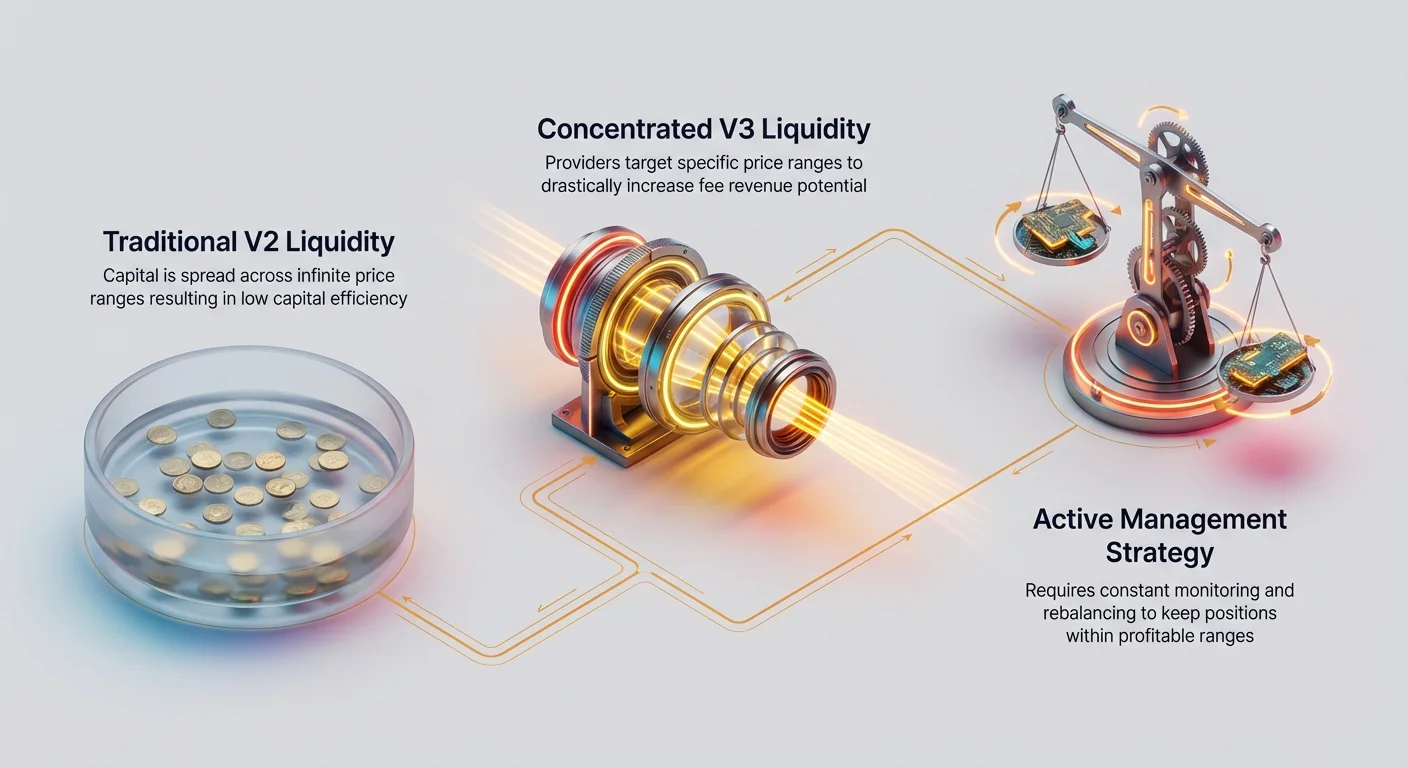
Traditional AMMs, often referred to as V2 models (like the original Uniswap V2 or SushiSwap), distributed capital across the entire possible price range—from zero to infinity.
Imagine a pool containing ETH and a stablecoin (USDC). If the current price of ETH is $3,500, most of the liquidity deposited at prices like $1 or $10,000 is sitting dormant. It is technically available, but it is unlikely to be used unless the market experiences a massive, catastrophic move.
LPs in V2 enjoyed simplicity: they deposited their tokens and left them. The drawback was low capital efficiency. To generate $100 in trading fees, V2 LPs had to commit a vast amount of collateral, much of which was never actively used by traders.
The Efficiency Revolution: Concentrated Liquidity Explained
Concentrated liquidity, pioneered by platforms like Uniswap V3, changed the paradigm. Instead of distributing funds across the entire 0 to infinity range, LPs can now specify a narrow price range where their capital should be active.
Example: An LP believes the ETH price will trade between $3,000 and $4,000 for the next month. They deposit their ETH and USDC specifically into this range.
- Result: Their capital is 100% focused on facilitating trades happening right now.
- The Benefit: Since their capital is being used more frequently than the V2 LP whose funds are spread thin, the V3 LP earns a far greater share of the trading fees, even if they contributed less total capital to the entire pool. This dramatically increases potential Annual Percentage Yield (APY).
The Trade-off: Higher Risk, Higher Reward, Active Management
Concentrated liquidity provision is not a "set it and forget it" strategy. The increased efficiency comes at the cost of required active management:
- Increased Impermanent Loss (IL) Exposure: If the token price moves outside the LP’s chosen range, two things happen:
- The LP’s position converts entirely to the less valuable asset (e.g., if ETH rises above $4,000, the LP holds only USDC).
- The LP stops earning trading fees completely, as their capital is now passive again.
- Constant Rebalancing: To keep earning fees, the LP must constantly monitor their position. If the price moves out of range, they must pay gas fees to "rerange" (close the old position and open a new one centered on the current market price).
This necessity for timing, monitoring, and re-entry makes V3 liquidity provision a game of strategy, not just holding.
Step 1: Strategic Position Selection and Optimization
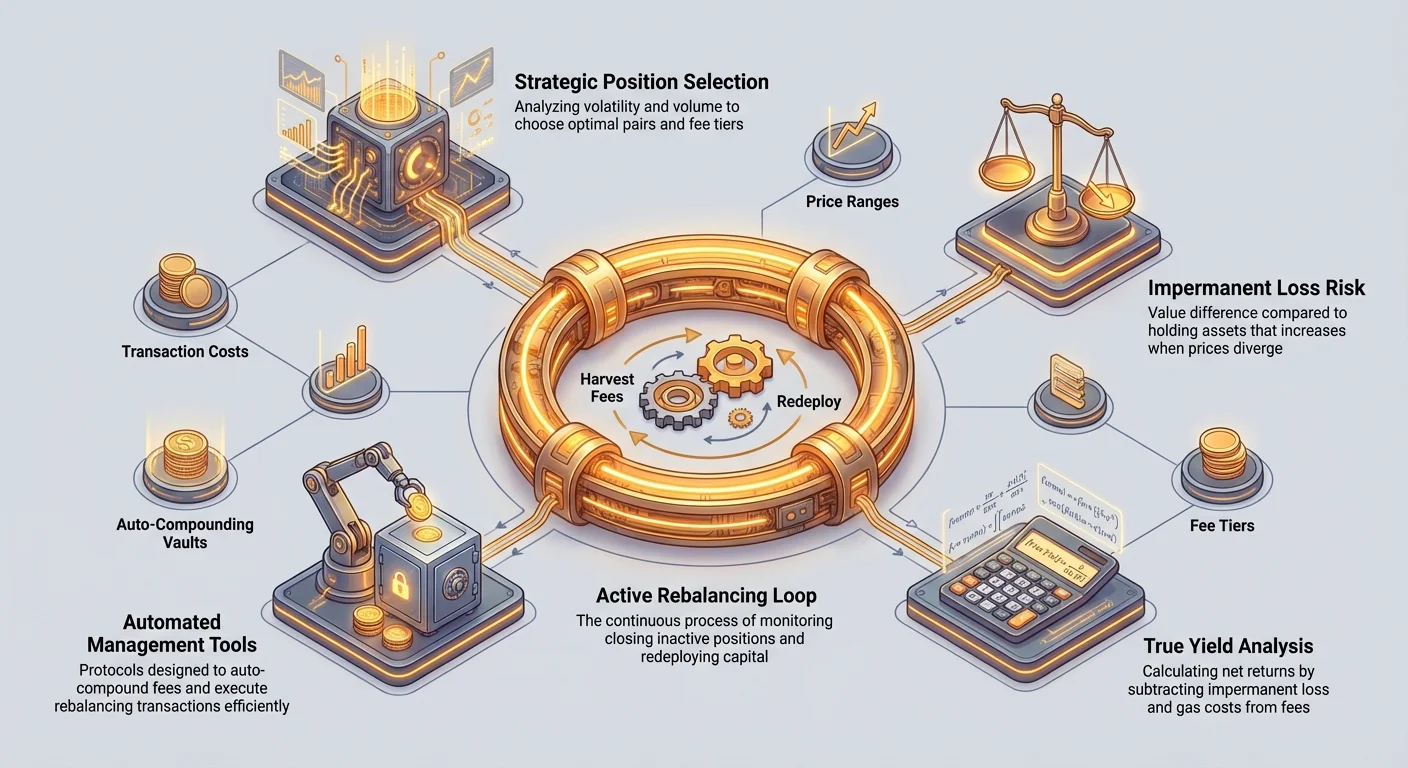
Before deploying capital, an advanced LP must carefully analyze the market to select the best environment for their concentrated position. This involves analyzing volatility, volume, and the available fee structure.
Analyzing Trading Pairs: Volume vs. Volatility
The profitability of an LP position is determined by two opposing forces:
- Trading Volume (The Fee Generator): The total amount of trading activity within the pool. High volume generates high fees. LPs should prioritize pairs with consistent daily trading volume (e.g., major stablecoin pairs like USDC/USDT or top-tier blue-chip pairs like ETH/BTC).
- Volatility (The Impermanent Loss/Rebalancing Cost): How quickly and drastically the price of the assets changes. High volatility increases the risk of the price shooting out of your concentrated range, forcing costly rebalances and exacerbating Impermanent Loss (IL).
Strategic Choice:
- Stable Pairs (Low Volatility, Moderate Volume): Pairs like ETH/stETH (staked Ethereum) or two major stablecoins (USDC/DAI). These pairs require less frequent rebalancing because they tend to stick close to the $1.00 ratio or trade in tight correlation. They offer lower fees but higher stability.
- Volatile Pairs (High Volatility, High Volume): Pairs like ETH/Small-Cap Altcoin. These offer very high fee potential, but the price could exit your range in hours, resulting in devastating IL or rapid conversion to the single asset. These require the tightest management.
Choosing the Optimal Fee Tier
Modern AMMs offer different fee tiers for the same pair (e.g., on Uniswap V3, an ETH/USDC pool might have 0.01%, 0.05%, 0.30%, and 1.00% options). Choosing the right tier is crucial for maximizing yield.
The trading fee tier reflects the perceived risk and volatility of the pair:
| Fee Tier | Typical Use Case | Trade-off for LP |
|---|---|---|
| 0.01% | Very stable pairs (e.g., USDC/DAI or two forms of wrapped BTC). | Lowest fees, but minimal IL/rebalancing risk. Only worth it if volume is immense. |
| 0.05% | Highly correlated pairs (e.g., ETH/stETH or BTC/ETH). | Standard fee for high capital efficiency, low-risk pairs. Requires moderate management. |
| 0.30% | Standard high-volatility, non-correlated pairs (e.g., ETH/USDC, BTC/USDC). | Highest fee revenue potential, but maximum exposure to IL and rebalancing costs. |
| 1.00% | Exotic, illiquid, or newly launched tokens. | Very few trades, high execution risk for traders. LP revenue can be erratic. |
The Strategy:
Do not blindly choose the highest fee tier (0.30%). An LP who chooses the 0.05% pool for ETH/USDC but manages a tight range will often earn a higher net APY than an LP in the 0.30% pool whose range is constantly exceeded due to volatility. Analyze which fee tier has the highest Total Value Locked (TVL) and current trading volume relative to the other tiers, as this indicates where the majority of trading activity is occurring, crucial for Advanced Liquidity Provision.
Defining Your Price Range: Tight vs. Wide Strategy
Once the pair and fee tier are selected, the LP must define the boundaries of their liquidity position.
1. The Tight (Aggressive) Strategy
- Range Definition: A very narrow range (e.g., ETH $3,450 to $3,550).
- Pros: Maximum capital efficiency. The LP earns the highest possible share of fees during the time the price stays within this tight band.
- Cons: Extremely high risk of exiting the range. Requires constant, sometimes daily, monitoring and expensive rebalancing. If you miss a quick price swing, you sit idle while paying significant gas fees to adjust later. Suitable only for active, highly skilled managers or automated bots.
2. The Wide (Conservative) Strategy
- Range Definition: A significantly broader range (e.g., ETH $2,500 to $5,000).
- Pros: Reduces the frequency of rebalancing and the risk of the position becoming inactive. Lower gas costs over time.
- Cons: Lower fee revenue compared to the tight strategy, as the capital is spread thinner.
- Best Use Case: When you believe the asset is consolidating but want protection against medium-term volatility, or when gas fees are prohibitively high and rebalancing is expensive.
The Mid-Range (Optimal) Strategy
The most common successful strategy is dynamically setting a range based on technical analysis (TA), often centering on short-term support and resistance levels.
- If ETH is $3,500, setting the range between the recent resistance ($3,800) and the nearest strong support ($3,200) allows the LP to capture volatility within established market boundaries while minimizing the chance of immediate deactivation.
Mastering Concentrated Liquidity Management (V3 Rebalancing)
The real work of an advanced LP begins after the position is deployed. This is a constant operational challenge known as range management or rebalancing.
The Rebalancing Imperative: Why LPs Must Adjust
When the asset price moves outside the LP’s established range, the position is deactivated. All capital converts to the single, remaining asset, and fee generation stops.
Example Scenario (ETH/USDC, Range $3,000–$4,000):
- Price at $3,500: LP holds 50% ETH, 50% USDC, actively earning fees.
- Price Rises to $4,500: The position is now inactive. The LP holds 100% USDC. The LP missed out on fees earned between $4,001 and $4,500, and is earning zero fees going forward.
The LP must decide whether to wait for the price to return (risking further missed fee opportunities) or to rebalance the position.
Active vs. Passive Range Management Techniques
Advanced LPs utilize two primary approaches to dealing with positions that have exited the range:
1. Passive Hold (The Waiting Game)
If the LP has a strong conviction that the price move is temporary (a quick spike or flash crash), they may choose to wait for the price to return to their original range.
- When to Use: During high-volatility events, when rebalancing immediately might just lead to another out-of-range position within minutes.
- Calculation: Compare the potential gas cost of reranging against the short-term lost fees. If gas costs are high and the waiting time is short, holding may be profitable.
2. Active Reranging (The Reset)
This involves closing the old, inactive position, withdrawing the single asset, swapping a portion of it back into the second token, and then opening a brand-new concentrated position centered on the new, current market price.
The "Harvest and Rerange" Loop:
- Close: Withdraw tokens and accumulated fees from the old position. (Fees are realized yield.)
- Analyze & Swap: Determine the current market price and your new optimal range (e.g., $4,200–$4,800). Swap half the asset back into the correlated asset to achieve the 50/50 ratio required for the new range.
- Deploy: Open the new concentrated position.
Active reranging is the key to maintaining yield in a trending market, but it introduces transaction costs (gas fees and swap fees) that must be consistently overcome by the newly earned trading revenue.
The Art of "Harvesting and Reranging"
Successful LPs treat rebalancing as a cost-benefit calculation. They must determine the optimal frequency for reranging to maximize Net APY (APY minus transaction costs).
Key Considerations for Timing:
- The Gas Threshold: LPs should set a personal gas fee threshold. If the fee cost to rerange is high (e.g., $100), the position must generate significantly more than $100 in fees before it becomes necessary to adjust.
- The Fee Multiplier: Since concentrated liquidity positions earn many times more than V2 positions, the high fee revenue often justifies frequent reranging, provided the chain's gas costs are reasonable (e.g., using Layer 2 networks like Arbitrum or Optimism).
- Profit Realization: The fees earned in V3 positions are not automatically reinvested; they are realized as collected tokens. Reranging is often the ideal time to harvest and realize those fees, or to use them to compound the position (a process known as compounding).
Advanced Concepts: Analyzing True Yield and Managing Risks
Beyond mechanical rebalancing, sophisticated LPs must understand how to accurately track their performance and anticipate systemic risks unique to concentrated liquidity.
Analyzing True LP Returns: Beyond Simple APR calculation
Many DEX trackers display a pool's raw Annual Percentage Rate (APR), which is based only on the fees generated by the pool relative to the TVL. However, this figure is misleading for a concentrated LP.
The true yield calculation for an advanced LP must incorporate three key variables:
1. Impermanent Loss (IL)
IL is the value difference between simply holding the two assets outside the pool versus providing them as liquidity. If IL is higher than the fees earned, the LP is effectively losing money.
Advanced LPs track this closely. If IL is consistently outpacing fees, the position must be closed and redeployed into a less volatile pair or a wider range.
2. Transaction Costs (Gas and Swap Fees)
Every interaction—initial deployment, reranging, fee harvesting, and compounding—costs gas. These costs, especially during periods of network congestion, can eat significantly into profits.
- Optimization Tip: Utilize Layer 2 (L2) networks whenever possible. L2s drastically reduce gas costs for interactions, making frequent reranging and compounding economically viable, which is essential for V3 success.
3. Time-Weighted Average (TWA) APY
Because a concentrated position earns fees only when the price is in range, LPs should calculate their yield based on the actual time spent in range. If a position was active for only 60% of the month, the fee APR needs to be adjusted down accordingly.
Understanding Just-In-Time (JIT) Liquidity Attacks
Just-In-Time (JIT) liquidity is a sophisticated form of arbitrage and front-running that targets V3 concentrated liquidity pools. While highly technical, LPs need to understand this risk.
How JIT Liquidity Works:
- A massive trade (a swap) is pending on the blockchain.
- A specialized bot detects this large trade.
- The bot quickly deposits a massive amount of liquidity (JIT liquidity) into a narrow range right before the large swap is executed.
- The large swap uses this JIT liquidity, generating substantial fees for the bot.
- Immediately after the trade is confirmed, the bot withdraws its capital and the accumulated fees, often within the same block.
The JIT provider earns a huge slice of the fees for that specific, large transaction, diluting the fee share of long-term, passive LPs in the pool.
Mitigating JIT Risks: How to Protect Your Yield
While JIT is difficult to eliminate entirely, LPs who use narrow, concentrated ranges are less affected than LPs who provide liquidity across the entire spectrum. The most effective mitigation strategy is to ensure your position is highly active:
- Narrow Ranges: JIT attacks generally target the very specific price point where the large trade is executed. By using well-defined, profitable concentrated ranges, LPs maximize their continuous fee capture, making the JIT bot's brief fee-take less impactful on overall yield.
- Focus on L2s: Because L2 block times and transaction speeds are different, they can slightly disrupt the timing advantage necessary for JIT bots, although the practice still exists.
- Consider Protocols with Anti-JIT Features: Some newer DEX models are developing features designed specifically to penalize or prevent rapid deposit/withdrawal cycles, prioritizing long-term liquidity commitment.
Leveraging Automated Management Tools and Yield Vaults
The demands of V3 concentrated liquidity—constant monitoring, complex fee-to-gas calculations, and mandatory reranging—can be overwhelming for individual retail investors. This has spurred the growth of specialized LP management tools and yield vaults.
The Role of LP Management Protocols (Automated Reliquification)
LP management protocols (often decentralized applications or smart contracts) automate the most difficult parts of advanced LP strategy.
Key Services Offered:
- Auto-Reranging: When the price moves outside the optimal range, the protocol automatically closes the old position, performs the necessary token swap, and deploys a new position centered on the current price. This saves the LP time and potential missed fees.
- Auto-Compounding: Fees earned by the position are automatically harvested and reinvested back into the active range, maximizing the power of compound returns without the LP having to manually pay gas and calculate swap ratios every time.
- Fee Optimization: These tools are often programmed to only rerange when the expected future fee revenue will exceed the gas cost of the transaction, optimizing the Net APY.
Examples of Use: A new LP can deposit their ETH and USDC into a Vault that handles the active management, effectively turning a V3 position back into a "set it and forget it" passive experience, while retaining V3’s high capital efficiency.
Strategies for Yield Aggregation and Auto-Compounding
Advanced LPs often prefer aggregated vaults because they eliminate the recurring high gas costs of manual compounding.
When compounding manually, an LP pays gas to:
- Collect fees.
- Swap half the fees into the second asset.
- Add the combined fees back into the liquidity position.
Yield aggregators bundle these transactions across many users. By executing a single transaction for hundreds of users, the vault amortizes the high gas cost across the group, dramatically lowering the effective cost of compounding for each LP. This is especially vital on expensive Layer 1 chains like Ethereum.
Evaluating the Cost of Automation (Gas and Platform Fees)
While automation tools are powerful, they are not free. LPs must factor in the platform’s charges when calculating true yield:
- Performance Fees: Vaults typically take a percentage (e.g., 10%–20%) of the yield generated by the position. This is the fee for the service of auto-management and compounding.
- Management Fees: Some platforms charge a small annual fee on the total assets locked (TVL), though performance fees are more common.
Strategic Assessment: An LP must determine if the efficiency gained (higher compounding frequency, lower gas costs through batching, and continuous fee generation) outweighs the cost of the platform's performance fee. For most concentrated V3 positions, especially those on high-gas networks, the value of automation far outweighs the cost.
Risk Management and Security Best Practices for Advanced LPs
Operating as an advanced LP means taking on the responsibilities of a professional asset manager. This requires diligence in security and a clear understanding of financial risk, essential for institutional digital asset management.
Stress-Testing Your Impermanent Loss Scenario
Before deploying any capital, LPs should model the worst-case Impermanent Loss scenario for their chosen range.
The Exit Test: Determine the expected IL if the price moves exactly to the boundary of your chosen range, and compare that loss against the expected fee revenue during the anticipated lifespan of the position.
- Rule of Thumb: If the predicted IL at the range boundary exceeds 50% of your projected fee income, your range is too volatile or too narrow for that pair, and you should widen it significantly or choose a more stable asset.
- Delta-Neutral Hedging: Highly sophisticated LPs often mitigate IL risk by opening a perpetual futures position (a hedge) that offsets the price change of the underlying assets. This is complex and introduces margin risk, but it is the ultimate way to lock in trading fees while removing volatility exposure.
Smart Contract Audits and Platform Vetting
When using decentralized protocols, you are trusting the underlying code. Advanced LPs interact not only with the DEX smart contract (like Uniswap) but also with the third-party management vault smart contract.
Best Practices:
- Look for Audits: Never use an LP management protocol or DEX that has not been professionally audited by reputable blockchain security firms (e.g., CertiK, Trail of Bits).
- Examine Lockup Periods: Ensure you understand if the vault requires a lockup period for your capital. Concentrated liquidity requires flexibility, so highly rigid lockup terms can be dangerous.
- Check for Admin Keys: Review the protocol documentation to determine if the creators retain administrative keys (God mode) that could allow them to freeze funds or upgrade contracts without community consent. Fully decentralized, immutable smart contracts are generally safer.
Tax Implications of Active Trading (Harvesting Fees)
Active liquidity provision generates numerous taxable events that passive LPs often overlook. Consult a tax professional familiar with DeFi, but generally, note the following:
- Fee Harvesting: When you collect or harvest the earned trading fees, that act is usually considered a taxable income event, valued at the market price of the tokens at the time of collection.
- Rebalancing Swaps: When reranging, the required internal swap (e.g., swapping ETH to USDC to re-enter the 50/50 balance) is considered a disposal of assets, resulting in a capital gain or loss that must be tracked.
- Compounding: If using an auto-compounding vault, the internal compounding event may also qualify as a taxable event, depending on local regulations.
Treating LP activities as active trading operations, rather than passive holding, is crucial for financial and regulatory compliance. For a detailed breakdown of international requirements, explore our guide on global digital asset tax compliance.
Conclusion
The shift from passive V2 to active, concentrated V3 liquidity provision represents a maturation of the DeFi landscape. While modern AMMs offer unprecedented capital efficiency, they require LPs to evolve from simple depositors into sophisticated portfolio managers.
Mastering advanced LP strategies hinges on three pillars: meticulous analysis (selecting the optimal fee tier and pair), active management (dynamic rebalancing to maximize time-in-range), and leveraging automation (using vaults to overcome gas costs and compounding challenges).
By applying these advanced techniques—understanding your true net APY, stress-testing for impermanent loss, and utilizing smart automation—you are positioned to unlock the highest potential yields that decentralized finance has to offer, securing your place as a savvy, professional liquidity provider in the decentralized economy.