
Navigating the landscape of cryptocurrency taxes can feel like tackling advanced calculus, especially once you move beyond simple buying and selling. For many early adopters and power users, digital assets are no longer just a speculative holding; they are integrated into daily life through staking, Decentralized Finance (DeFi) lending, and crypto-backed card rewards. These complex activities generate multiple, often small, income streams that must be accurately tracked and reported.
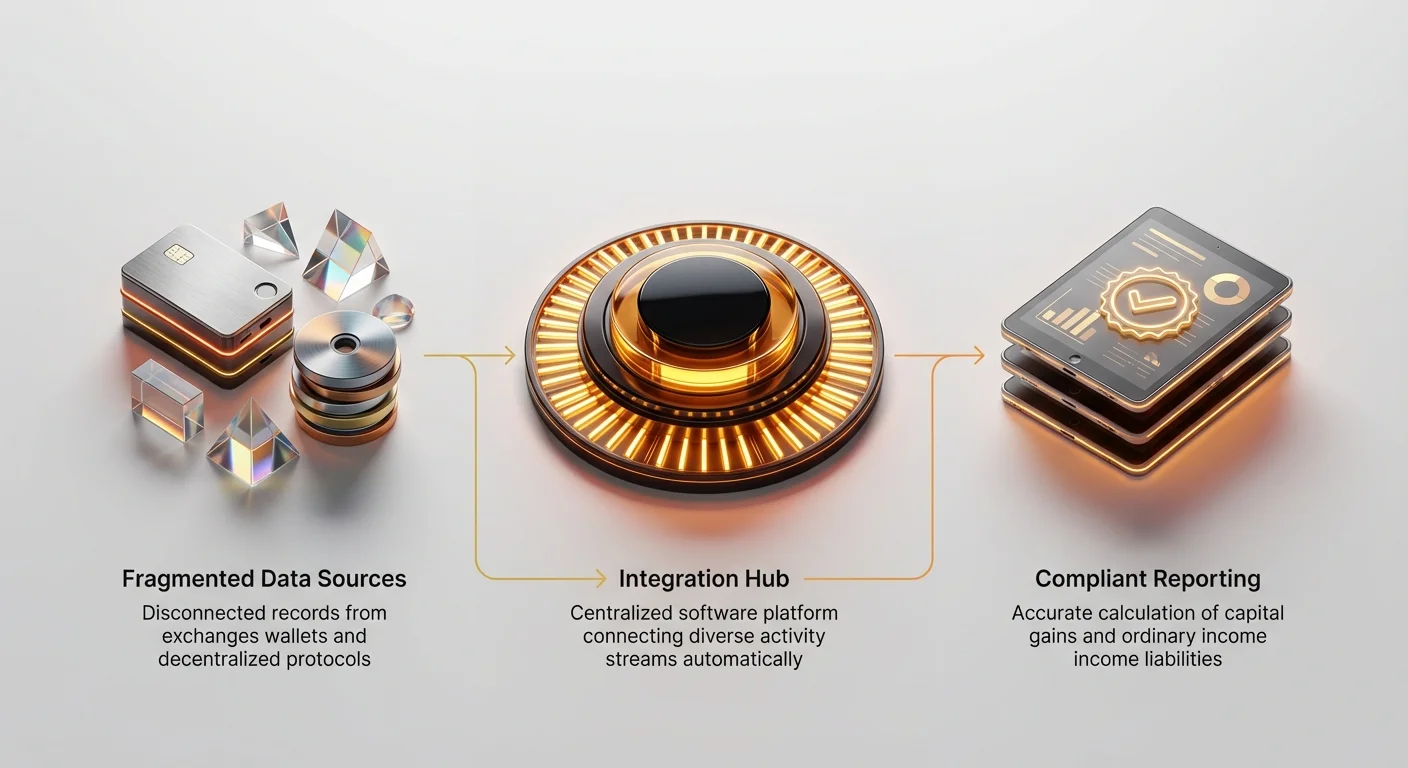
This guide provides a comprehensive roadmap for integrating your diverse crypto activities—from staking yield to everyday card cashback—into specialized tax software. Our goal is to bridge the crucial gap between accumulating sophisticated digital earnings and achieving full tax compliance, ensuring you maximize your utility while minimizing the stress of tax season.
We will move step-by-step, starting with the fundamental differences between capital gains and income, before diving into the technical mechanics of API integration, mastering CSV imports, and troubleshooting the trickiest areas of decentralized finance. By establishing a robust, year-round tracking system, you can transform tax compliance from a painful annual chore into a streamlined process.
1. Understanding the Foundational Tax Concepts of Crypto
Before integrating any software, it is essential to understand what the tax authorities are looking for. Not all crypto activity is taxed the same way. The IRS (in the US) and similar regulatory bodies globally typically categorize crypto events into two primary buckets: Capital Gains/Losses and Ordinary Income. This requires understanding the mechanics of global tax compliance.
1.1 Capital Gains vs. Ordinary Income
The distinction between how an asset is sold (Capital Gain) and how income is earned (Ordinary Income) is the cornerstone of crypto tax compliance.
Capital Gains and Losses
A capital gain or loss occurs when you dispose of a crypto asset that you held for investment purposes. Disposal includes selling crypto for fiat (USD, EUR), trading one cryptocurrency for another (BTC for ETH), or using crypto to purchase goods and services.
- Short-Term Gain: Applied if you held the asset for one year or less. These gains are usually taxed at your standard income tax rate.
- Long-Term Gain: Applied if you held the asset for more than one year. These gains benefit from preferential, lower tax rates.
The calculation always relies on the cost basis (the original value, including fees, that you paid for the asset) and the fair market value (FMV) at the time of disposal. If the FMV exceeds the cost basis, you have a gain, such as when using crypto to purchase goods and services.
Ordinary Income Events
Ordinary income is generated when you receive crypto as payment for services, mining rewards, staking rewards, or interest from lending. These events are taxed immediately upon receipt, based on the fair market value of the crypto at the exact moment it entered your wallet.
Examples of ordinary income streams that require meticulous tracking include:
- Staking Rewards: Income received for validating transactions.
- Lending Interest: Interest earned from depositing assets into a lending protocol (like Aave or Compound).
- Airdrops: Tokens received for free (though the rules for cost basis can be complex; generally, it’s taxed as income upon receipt).
- Crypto Card Rewards/Cashback: These are often treated as income or rebates, depending on the structure (discussed in Section 4).
1.2 The Problem of Tracking: Why Software is Necessary
If you only buy Bitcoin on a centralized exchange (CEX) and hold it, tracking is easy. But once you engage in advanced utility actions, tracking becomes impossible without automated software.
- Micro-Transactions: Staking and lending can generate hundreds of small, frequent payments (sometimes hourly or daily). Manually logging the FMV for each reward is impractical.
- Transaction Interoperability: A power user might buy ETH on Coinbase, transfer it to a self-custodial wallet (MetaMask), stake it on Lido, and then use the resulting stETH as collateral on MakerDAO. This involves multiple addresses, chains, and protocols.
- Cost Basis Dilution: Every time you receive new crypto income, you generate a new cost basis for that specific asset. If you later sell all your ETH, the software must differentiate between the ETH you bought, the ETH you mined, and the ETH you received as staking income, often using accounting methods like FIFO (First In, First Out) or LIFO (Last In, First Out).
Specialized crypto tax software (like Koinly, CoinTracker, TokenTax, etc.) solves this by integrating directly with these complex sources and automating the FMV calculation for every transaction on every supported blockchain. Automated platforms provide essential tools for automating the FMV calculation.

2. Choosing and Setting Up Your Compliance Tool
Selecting the right crypto tax software is critical, especially for users engaged in high-volume, multi-chain, or DeFi activities.
2.1 Key Features for Power Users
While basic software handles CEX transactions, power users need specific capabilities to manage yield and utility streams effectively.
| Feature | Importance for Yield/Utility Users |
|---|---|
| DeFi Protocol Support | Essential. The software must recognize smart contract interactions (like liquidity pool deposits, staking mechanisms, and yield farming swaps) and categorize them correctly (e.g., as a taxable swap vs. a non-taxable transfer). |
| Multi-Chain Compatibility | Must support all chains you use (Ethereum, Solana, Polygon, Arbitrum, etc.). Transfers between chains (bridges) are common and must be tracked accurately to avoid double-counting. |
| Robust Tagging & Labeling | The ability to manually review and tag transactions (e.g., classifying a transfer as "Gas Fee," "Lost Funds," or "Gift") is vital when automated tools misinterpret a complex DeFi interaction. |
| Accounting Methods Flexibility | Must allow you to select your preferred accounting method (FIFO, LIFO, HIFO), as this can significantly impact your final tax liability. |
2.2 Overview of Top Software Choices
While the optimal choice depends on jurisdiction and specific activity, certain platforms stand out for their robust integration capabilities and support for complex transactions:
- Koinly: Highly regarded for its clean interface and strong support for DeFi, staking, and international tax rules. Excellent at interpreting complex smart contract interactions.
- CoinTracker: Known for its ease of use and long history. Provides good portfolio tracking alongside tax reports, often favored by users who stick primarily to major exchanges and mainstream DeFi protocols.
- TokenTax: Offers specialized support and expert CPA review services, often appealing to very high-volume traders or those with highly complex, nuanced tax situations (such as managing a crypto fund or receiving substantial airdrops).
2.3 Pricing, Scalability, and Tiers
A common mistake is assuming the "Free" tier is sufficient. Free or basic tiers typically support only a limited number of transactions (e.g., 100 or 500) and often restrict features like DeFi integration or advanced report generation.
If you are actively staking, lending, or using a crypto card daily, you will rapidly exceed the free tier limit. The cost of the mid-range or "Unlimited" tier is a necessary compliance expense, especially if it prevents costly manual reconciliation or an audit due to errors. Look closely at the transaction limits before committing.
3. Integration Methods: API vs. CSV Mastery
The critical step in using tax software is feeding it your transaction data. There are two primary methods: direct API connection (the easiest) and CSV/manual imports (the necessary fallback).
3.1 The Power of API Integration
API (Application Programming Interface) integration allows the tax software to communicate directly with a centralized exchange (CEX) or major wallet service to pull transaction history automatically.
Setting Up API Keys Securely
When integrating via API, you are granting the tax software access to your financial data. This must be handled with extreme security.
- Generate Read-Only Keys: When creating an API key on your exchange (e.g., Binance, Kraken, Coinbase), always ensure that the key is restricted to Read-Only access. This means the tax software can view your trades and balances but absolutely cannot initiate withdrawals, trades, or transfers.
- Enable Two-Factor Authentication (2FA): Ensure 2FA is active on the exchange account before generating the keys.
- Delete Old Keys: Once tax season is over or if you switch providers, delete the unused API keys from your exchange to minimize the potential attack surface.
Pros of API Integration:
- Automation: New transactions are synchronized automatically.
- Accuracy: Reduces the chance of human error in data entry.
- Speed: Imports thousands of transactions instantly.
Cons of API Integration:
- Limited Scope: APIs often only cover trade history and basic transfers. They rarely pull full KYC information or accurately categorize staking rewards if those rewards are generated off-platform (i.e., external staking vs. staking through the exchange’s integrated service).
- Security Risk: If a key is compromised, your data (though read-only) could be exposed.
3.2 Mastering CSV Imports for Gaps and Complex Data
While APIs are convenient for CEX data, CSV (Comma Separated Values) imports are essential for linking decentralized activities, smaller wallets, and complex utility streams that lack direct API support.
When to Rely on CSV Imports
You must use CSV imports when:
- Connecting to Unsupported Exchanges or Wallets: Many smaller CEXs or custom DeFi front-ends lack tax software APIs.
- Bridging Protocols: Data pulled directly from blockchain explorers (like Etherscan) to track specific smart contract interactions.
- Correcting Errors: If the API missed a transaction or miscategorized a transfer, a CSV import can override or supplement the data.
- Handling Specific Income Streams: Sometimes, card reward providers (like debit card services) only offer a CSV export of monthly rewards, which must be imported separately and tagged as "Ordinary Income."
The Required CSV Data Fields
To be usable, a CSV file must contain the minimum necessary data fields, typically following a structure template provided by your tax software:
| Required Field | Explanation | Example |
|---|---|---|
| Timestamp (Date/Time) | The exact moment the transaction occurred. Critical for determining the FMV and cost basis. | 2024-03-15 14:30:00 UTC |
| Transaction Type | Defines the action (Trade, Transfer, Deposit, Withdrawal, Income, Fee). | Income (Staking Reward) |
| Asset | The cryptocurrency involved (ETH, BTC, USDC). | ETH |
| Amount | The quantity of the asset moved or received. | 0.015 |
| Source/Destination | Where the crypto came from or went (often a wallet address or internal tag). | Wallet X / Staking Pool Y |
| Fee | Any transaction fee (Gas) paid, usually in the native chain token. | 0.0005 ETH |
| Note/Tag | Essential for complex transactions (e.g., "Liquidity Deposit," "Airdrop Claim"). | Aave Interest Payment |
Best Practice: Never try to create a CSV file from scratch. Always download the template from your chosen tax software and strictly adhere to its formatting requirements (especially for date/time and decimal points). A single formatting error can break the entire file.
4. Integrating Complex Utility Streams
The greatest challenge for power users is accurately reporting income generated through passive yield and utility services—activities that often involve non-custodial wallets and smart contracts.
4.1 Staking and Lending Rewards Integration
Staking and lending are the most common sources of complexity because they generate income continuously and in fluctuating quantities.
Defining the Taxable Moment
For tax purposes, staking rewards (PoS yield) and lending interest are considered ordinary income at the moment they are received into your control. This means:
- The quantity of crypto received.
- The USD fair market value at the exact time of receipt.
If you receive 1 SOL at 9:00 AM when SOL is valued at $100, you have $100 of taxable income. That $100 now becomes the cost basis for that 1 SOL. If you sell it later for $110, you owe capital gains tax on the $10 gain.
Linking Decentralized Staking Protocols
When staking through a self-custodial wallet (e.g., staking ETH through Lido or Rocket Pool), the rewards are not tracked by an exchange API. You must link the wallet address directly to the tax software.
- Wallet Integration: Tax software can often import all transactions from a public wallet address (e.g., an Ethereum wallet) by scanning the blockchain.
- Software Interpretation: The software then reads the complex smart contract interactions. A robust platform (like Koinly) should be able to automatically identify transactions from the staking contract as "Staking Income."
- Validation and Tagging: After the import, you must manually review the first few staking reward transactions. Ensure the software correctly identified the type ("Income") and the cost basis (FMV upon receipt). If it tagged the reward merely as a "Deposit," you must override the tag to "Income" for correct reporting.
4.2 Handling Crypto Card Rewards and Cashback
Crypto debit and credit cards that offer rewards (often in BTC, ETH, or a native token) present a unique tax challenge because their treatment can vary based on the specific reward mechanism and jurisdiction.
Cashback vs. Rebate Income
Most tax authorities treat crypto card rewards in one of two ways:
- Treated as a Rebate/Discount (Non-Taxable Event): If the reward is viewed as a reduction in the purchase price of the goods or services bought. For example, if you spend $100 and receive $2 back instantly.
- Treated as Ordinary Income (Taxable Event): If the reward is viewed as compensation or payment, similar to interest earned on a bank account. This is usually the case if the reward token is a native governance token or if the reward is disproportionately high.
Strategy for Integration:
- Identify the Stream: If the card issuer provides a dedicated monthly statement detailing the rewards earned, use that CSV export.
- Tagging Strategy: If the rewards are treated as income (the safest default unless otherwise advised by a tax professional), tag the transactions as "Income" upon receipt. Use the FMV at the time of deposit.
- Capital Gains Tracking: Crucially, once you receive the reward, that crypto now has a cost basis. When you later sell or spend the accumulated rewards, you incur a capital gain or loss based on the difference between the FMV at receipt and the FMV at sale.
4.3 Airdrops, Hard Forks, and New Utility Tokens
Airdrops—free distribution of tokens to active community members—are a common utility reward for power users but are highly complex to report.
Airdrop Reporting
Generally, Airdrops are taxed as ordinary income based on the fair market value of the token at the time you gain control of it (i.e., when it appears in your wallet).
- Integration Challenge: Tax software often struggles to determine the FMV of a new, low-liquidity token immediately upon receipt.
- Solution: You must manually find the first verifiable market price (e.g., on a decentralized exchange aggregator) close to the time of receipt and input that price manually into the tax software as the token's initial cost basis and income value. Tag the transaction clearly as "Airdrop Income."
Hard Forks
When a blockchain splits (like BTC and BCH), the resulting new token is often treated similarly to an airdrop—taxed as ordinary income at the moment you gain control of the new token, based on its FMV. Ensure your software imports both the original chain's transaction history and the subsequent history of the newly forked chain.
5. Advanced Scenarios and Troubleshooting Deep Dive
The fully automated integration is a myth, especially when dealing with complex DeFi operations. Power users must be prepared to manually adjust and troubleshoot data imports.
5.1 Navigating Decentralized Finance (DeFi) Complexity
DeFi protocols are the ultimate integration challenge. When you interact with a smart contract, the transaction may be interpreted by tax software in several incorrect ways:
- Liquidity Pool (LP) Transactions: When you deposit ETH and USDC into an LP, the software might see two withdrawals (ETH out, USDC out) and one deposit (LP token in). It might incorrectly flag the initial deposit as a taxable swap or sale, rather than a non-taxable asset exchange (exchange of ETH for the LP token).
- Solution: You must manually tag the ETH/USDC withdrawals as "Transfer to LP" and the LP token deposit as "LP Acquisition."
- Wrap/Unwrap Operations: Moving between standard ETH and WETH (Wrapped ETH) is generally not a taxable event, as the underlying asset value is unchanged. If the software treats this as a sale, you must manually change the transaction type to "Transfer" or "Swap (Non-Taxable)."
- Gas Fees and Network Costs: Transaction fees paid to the network (Gas) are generally considered non-deductible personal expenses in many jurisdictions unless you are classified as a trader or business. The software must clearly separate the fee paid from the asset traded.
The Role of Wallet Addresses vs. Exchange IDs
When importing data, ensure you link every address you have used. If you transfer crypto from Exchange A to MetaMask Wallet B, and then use Wallet B for DeFi, the tax software must see the transfer from A to B as a non-taxable internal transfer. If Wallet B is not linked, the software will see a "withdrawal" from Exchange A (potential sale) and an unaccounted "deposit" into Wallet B (potential income).
Actionable Tip: Create a complete list of every wallet address, exchange, lending account, and card service you have ever used and systematically link them all to the tax software, even if they have zero balance today.
5.2 The Necessity of Transaction Tagging and Labeling
Transaction tagging is arguably the most critical, time-consuming, and compliance-enhancing activity you will perform in the tax software. Automated tagging is unreliable for non-standard transactions.
Structuring Custom Tags
Most tax software allows you to use specific predefined tags (Trade, Income, Gift, Transfer). However, complex users benefit from custom, descriptive tags to maintain clear records:
- Example Custom Tags:
- Self-Custody Transfer: For moving assets between your own wallets/exchanges.
- Yield Farming Claim: For claiming tokens earned in a farm.
- Burn/Destroy: For tokens removed from circulation (e.g., paid for a service).
- Lost Funds: For transactions sent to the wrong address, crucial for claiming a potential capital loss (if allowable in your jurisdiction).
By reviewing and manually labeling ambiguous transactions, you create a defensible and auditable transaction history.
5.3 Dealing with Missing Cost Basis
The most common software error for advanced users involves a "Missing Cost Basis." This happens when the software sees an asset sold or traded, but it cannot find the original purchase record. Strategies exist to manage a Missing Cost Basis.
Causes of Missing Cost Basis
- Transfer from Unlinked Source: The asset was transferred from an old exchange or wallet that was never integrated into the tax software.
- Legacy Transactions: Assets acquired years ago that occurred before the exchange or wallet offered accessible transaction history.
- Gifting/Inheritance: Assets received as a gift or inheritance, requiring a specific cost basis rule (often based on the donor's basis or the FMV at the time of death).
Strategies for Resolution
- Source the Original Data: If possible, link the missing exchange/wallet, even if you have to request archived data from the service provider.
- Manual Input: If the original transaction is irretrievable, you must manually input the cost basis based on verifiable data (bank records, old receipts).
- The Worst-Case Scenario: If the cost basis cannot be determined, tax law usually dictates that the cost basis is $0.00. This means the entire proceeds from the sale are treated as capital gain (or ordinary income, if applicable). While painful, it is better to report a $0 cost basis than to fail to report the transaction entirely.
6. Best Practices for Year-Round Compliance and Audit Readiness
Tax integration is not a last-minute chore; it is an ongoing maintenance process. Integrating compliance into your crypto routine maximizes rewards and minimizes audit risk.
6.1 Year-Round Maintenance: Avoiding Tax Season Panic
Waiting until March to aggregate a year's worth of transactions across five exchanges, three wallets, and ten DeFi protocols is a recipe for error.
Quarterly Synchronization
Commit to synchronizing your tax software quarterly. This ensures:
- Data Freshness: If an exchange or protocol changes its API or format, you catch the error early.
- Reduced Volume: Dealing with 1,000 transactions four times a year is much easier than tackling 4,000 at once.
- Accurate Tagging: Your memory of complex swaps or unusual income streams will be fresh, leading to more accurate manual tagging.
Proactive Error Checking
After each sync, run the reconciliation report provided by the software. This report flags any transactions labeled "Missing Cost Basis," "Uncategorized Deposit," or "Possible Loop." Addressing these errors immediately prevents them from compounding.
6.2 Reconciliation and Cross-Verification
The final step before generating the tax report is comparing the software's summary against your real-world data sources.
Step 1: Verify Wallet Balances
Ensure the final balance shown in your tax software for major holdings (BTC, ETH, stablecoins) matches the sum of the balances across all your linked wallets and exchanges as of December 31st (or the end of your fiscal year). Discrepancies often indicate a missing transfer or a miscategorized transaction.
Step 2: Cross-Reference Income Totals
If you earned $500 in staking rewards, check that the total "Ordinary Income" reported by the tax software aligns with your records for those rewards. If you used a crypto card, ensure the reported income (if applicable) aligns with the card statements.
Step 3: Utilize AI Automation for Review
While not a replacement for human oversight, tools mentioned in related resources (like dedicated AI automation platforms) can often perform high-level checks for anomalies, alerting you if a specific transaction type (e.g., a "Transfer" tag) occurs too frequently in a way that suggests misclassification.
6.3 Preparing for an Audit
If you are a power user generating high volumes of yield and using multiple complex protocols, the likelihood of a compliance inquiry increases. Robust integration prepares you for this scenario.
Document Retention Strategy
Tax software generates reports (e.g., Form 8949, detailed Capital Gains reports) that must be filed with your tax return. However, true audit readiness means retaining the underlying data. Ensure you have the appropriate crypto accounting standards documentation.
- Export Raw Data: Download and archive the raw, final CSV files and the full transaction reports from your tax software annually.
- Keep Source Documents: Maintain backups of exchange transaction histories, staking reports, card reward statements, and any manual documentation (like screenshots or notes) detailing unique DeFi transactions.
- Hold API Keys (Deactivated): Retain the inactive API keys used for synchronization; this confirms your method of data transfer was secure and read-only.
By having a clean audit trail—showing exactly where the data came from, how it was processed, and how you verified its accuracy—you significantly simplify any correspondence with tax authorities.
Conclusion: Compliance as the Foundation of Crypto Utility
The transition from holding crypto to utilizing it actively through staking, lending, and spending generates rewarding complexity. However, this complexity demands disciplined tracking.
Crypto tax software integration is not merely a tool for generating forms; it is the essential compliance bridge between high-yield earning and secure financial integration. By moving beyond basic exchange API linkages and mastering the intricacies of CSV imports, manual tagging, and year-round reconciliation, you can transform the daunting task of crypto taxes into a structured, manageable process.
Achieving accurate reporting for staking income, card rewards, and DeFi movements ensures that you can continue to strategically maximize your crypto returns without the risk of future compliance challenges, solidifying the foundation for your long-term digital asset success.