
Moving from manually buying and selling cryptocurrencies to automating complex strategies is a major milestone for any retail investor. While basic trading bots execute simple limit orders or dollar-cost averaging (DCA), advanced algorithmic systems allow traders to capitalize on market inefficiencies, manage risk, and maintain portfolio balance with professional precision.
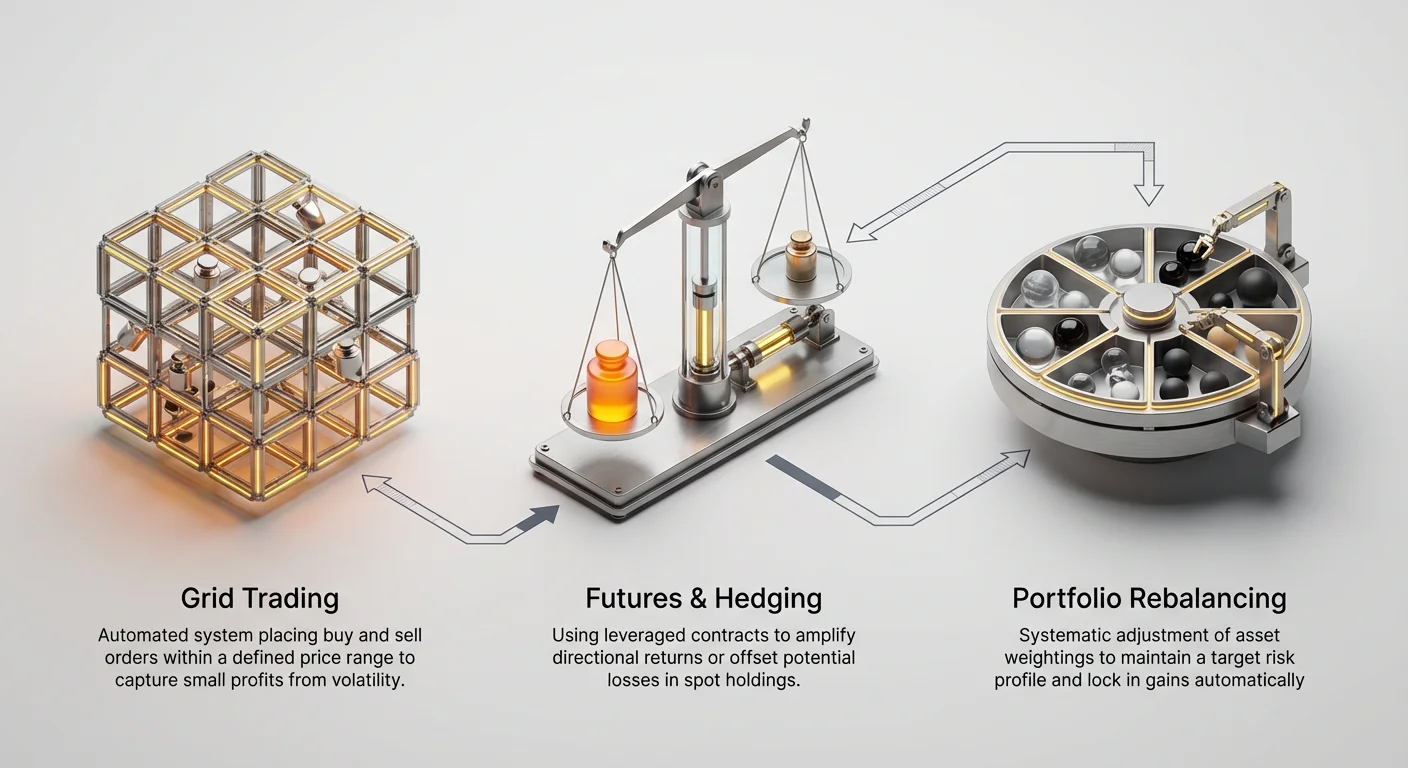
This guide moves beyond the fundamental mechanics of trading bots and dives deep into three specific, powerful strategies often deployed by experienced traders: Grid Trading, Futures Bots for hedging, and automated Portfolio Rebalancing. These tools are typically accessed through the advanced feature sets of major centralized exchanges (CEXs) and dedicated bot providers, offering ways to navigate both volatile and consolidating markets efficiently.
Our focus here is on implementation—understanding the logic, setting the crucial parameters, and knowing when these strategies are most effective. By learning to deploy these algorithms, you can transform your approach from reacting to the market to proactively structuring profitable opportunities.
The Foundation: Why Advanced Bots Matter
In high-speed, 24/7 markets like crypto, human limitations—such as slow reaction times, emotional bias, and the inability to monitor dozens of assets simultaneously—become severe disadvantages. Advanced trading bots solve these problems by executing complex strategies with speed, precision, and discipline.
Bridging the Gap Between Manual and Automated Trading
Before the advent of user-friendly bot interfaces, implementing strategies like arbitrage or high-frequency trading automation required deep coding knowledge and specialized infrastructure. Today, centralized exchanges and integrated platforms offer pre-built templates for complex algorithms, making advanced techniques accessible to everyday traders.
These advanced bots allow you to:
- Remove Emotion: Bots execute rules precisely. They do not panic-sell during a flash crash or become greedy during a rapid pump.
- Ensure Consistency: Algorithms follow your defined strategy 24/7, maximizing opportunities even while you sleep.
- Manage Risk Systematically: Parameters for stop-losses, trade sizes, and position limits are coded into the strategy, guaranteeing defined risk exposure.
Understanding Different Exchange Types and Tools
The advanced strategies discussed below—especially those involving leverage and futures—are predominantly executed on Centralized Exchanges (CEXs) like Binance, Coinbase Pro, Kraken, or specialized platforms built around exchange APIs.
These CEXs provide the necessary liquidity, infrastructure stability, and tools (like futures contracts and margin trading) required for complex algorithmic execution. While Decentralized Exchanges (DEXs) are growing, CEXs currently remain the hub for high-volume, automated strategy deployment due to better order books and lower slippage for large trades.
Strategy 1: Grid Trading Bots
Grid trading is one of the most popular algorithmic strategies for new and intermediate traders because its logic is straightforward and highly effective in a specific type of market condition: volatility without a strong directional trend (a "sideways" or "ranging" market).
The Core Concept of Grid Trading
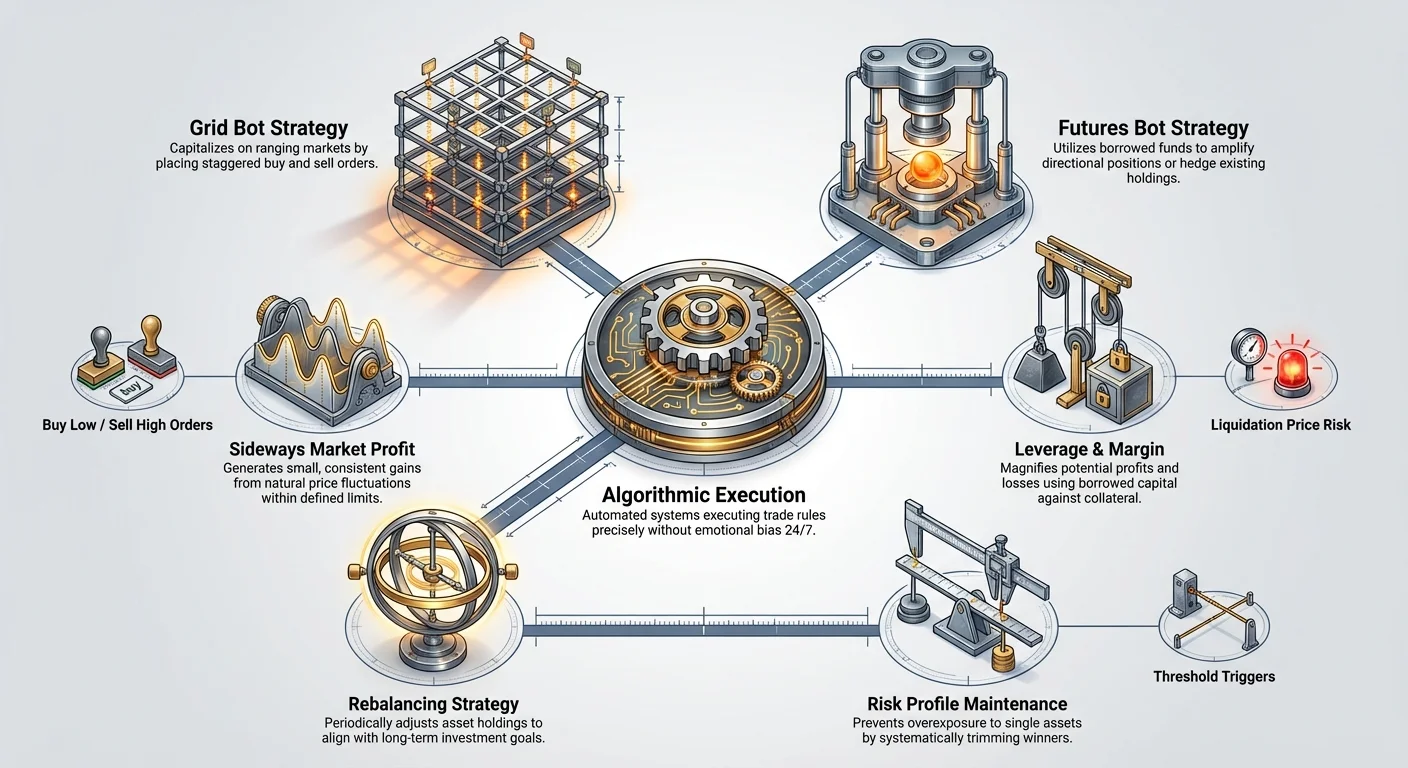
A Grid Trading Bot systematically places a series of staggered buy and sell orders around a chosen central price point, creating a "grid."
How it works:
- Define a Range: The trader sets a minimum (lower limit) and maximum (upper limit) price for the grid.
- Create Levels: The bot distributes buy and sell orders evenly within this range.
- Execute Trades:
- If the price falls to a buy level, the bot automatically buys a set amount.
- If the price subsequently rises to the next sell level, the bot sells the newly acquired asset, locking in a small profit (the difference between the buy and sell lines).
- The bot immediately replaces the executed orders to keep the grid running.
Essentially, the bot profits from the natural, small fluctuations (volatility) that occur as the price bounces up and down within the defined range.
Setting Up a Grid: Parameters and Risk Management
The success of a grid strategy hinges entirely on setting the right parameters.
1. Range Definition (Upper and Lower Limits)
This is the most crucial step. Analyze the market history to determine the expected trading channel for the asset (e.g., BTC/USDT).
- Example: If Bitcoin has been trading consistently between $60,000 and $70,000 for the last two weeks, you might set your grid limits slightly wider, say $59,000 to $71,000, to account for potential wicks.
2. Number of Grids (Density)
This determines how many buy/sell levels are placed within your range.
- More Grids (Dense): Higher trade frequency, smaller profit per trade, but requires lower movement to trigger execution. Ideal for highly volatile, tight ranges.
- Fewer Grids (Sparse): Lower trade frequency, larger profit per trade, but requires bigger price movements. Safer for broader, less predictable ranges.
3. Grid Spacing (Profit %)
This is the percentage difference between each grid level. If you set a 1% spacing, every time the price moves 1%, a trade executes. This 1% profit must be large enough to cover trading fees and still leave a net profit.
4. The "Out of Range" Risk
The biggest risk in grid trading is the asset breaking sharply outside the defined range.
- If the price breaks above the upper limit: The bot will have sold all its remaining assets. The bot stops trading, and you miss out on further upward movement (opportunity cost).
- If the price breaks below the lower limit: The bot will have bought all the set capacity. The bot stops trading, and you are left holding a large, depreciating asset (potential loss).
- Best Practice: Always set a hard Stop-Loss slightly below your lower grid limit to protect capital in case of a major breakdown.
When to Use (and Avoid) Grid Strategies
| Market Condition | Suitability | Why |
|---|---|---|
| Sideways / Ranging Market | Excellent | This is the optimal environment. Small, consistent fluctuations guarantee constant execution and profit accumulation. |
| Strong Upward Trend | Poor | The bot will sell all assets early and stop, causing you to miss most of the upward rally. |
| Strong Downward Trend | Dangerous | The bot will relentlessly buy assets until the lower limit is hit, resulting in a large, underwater position. |
| Extreme Low Volatility | Poor | If the price is flat, no grid lines are crossed, and the bot generates zero profit (fees may still accrue if the platform charges for placement). |
Tip for Implementation: Use an asymmetrical grid if you have a slight directional bias. For example, place more buy orders than sell orders if you are slightly bullish on the asset over the long term.
Strategy 2: Leveraging Futures Bots for Advanced Trading
Futures trading is inherently more complex than spot trading, as it involves concepts like leverage and contract expiration. However, when automated, Futures Bots become powerful tools for two main purposes: amplifying returns on directional bets and implementing risk-mitigating hedging strategies.
What are Crypto Futures Contracts? (Beginner explanation)
In simple terms, a futures contract is an agreement to buy or sell an asset (like BTC) at a predetermined price at a specific time in the future. In crypto, "Perpetual Futures" are most common; they never expire, allowing traders to hold positions indefinitely but requiring periodic funding payments.
Trading futures requires placing collateral (margin) to open a position. Crucially, CEXs allow traders to use leverage—borrowed funds—to increase the size of their position beyond their own capital. While leverage can multiply profits, it also multiplies losses and significantly increases the risk of liquidation (where the exchange forcibly closes your position to protect its loan).
Implementing Directional Futures Bots
Directional futures bots are used when a trader has a high conviction about the market's future movement. These bots automate complex entries, exists, and risk management using leverage.
The Leveraged DCA Bot
A common futures strategy is a modified Dollar-Cost Averaging (DCA) bot designed for market volatility.
- Goal: Accumulate a large, leveraged position at a better average price when the market moves against you, and then sell the entire position when the price recovers.
- Mechanism:
- The bot initiates a small long position (e.g., $1,000 at 5x leverage).
- If the price drops 1%, the bot automatically opens a second, larger long position (e.g., $1,500 at 5x leverage).
- This continues, systematically lowering the average entry price of the total position.
- The bot has a pre-set Take Profit order (e.g., 2% above the average entry price).
- Risk: While this lowers the average price, it drastically increases total exposure and moves the liquidation price closer to the current market price with every new entry. This strategy requires substantial capital set aside to cover potential margin calls.
Advanced Technique: Hedging Strategies with Futures Bots
Hedging is the practice of using one investment to offset the risks of another. Futures bots are ideally suited for this because they allow simultaneous, automated management of two opposing positions.
The Spot-Futures Hedge
This strategy is perfect for long-term investors holding a portfolio of assets who want protection against short-term volatility without selling their core holdings.
Scenario: You hold 1 BTC in a cold wallet (Spot position). You believe a short-term correction is imminent but do not want to realize capital gains or pay trading fees to sell and rebuy your spot BTC.
Bot Implementation:
- Deploy a Short Futures Bot: The bot automatically opens a short position on BTC futures (e.g., selling 1 BTC) using minimal leverage (1x or 2x).
- Market Drop: If BTC’s spot price drops by $5,000, your cold wallet suffers a $5,000 loss in value.
- Futures Profit: Simultaneously, the short futures bot gains approximately $5,000 in profit.
- Net Result: Your total portfolio value remains virtually unchanged, successfully hedging against the downturn.
- Bot Closure: When the downturn is deemed over, the bot automatically closes the profitable short position, allowing the original spot holding to capture the ensuing recovery rally.
This automated hedge provides insurance, protecting capital during bear markets or heavy corrections. It is a critical tool for serious portfolio management.
Strategy 3: Portfolio Rebalancing Automation
While Grid and Futures bots focus on maximizing short-term trading profits, a Portfolio Rebalancing Bot serves a strategic, long-term purpose: maintaining your desired risk profile and asset allocation. This strategy is essential for any investor holding more than one type of crypto asset.
The Philosophy of Portfolio Rebalancing
Imagine you decide on a target allocation: 50% Bitcoin (BTC) and 50% Ethereum (ETH).
If Bitcoin performs well over a month, its value might rise rapidly, shifting your portfolio allocation to 60% BTC and 40% ETH. While this seems like a win, your portfolio is now riskier, as it is overexposed to a single, rapidly appreciating asset.
A rebalancing bot automatically sells the winners (BTC) and buys the losers (ETH) to restore the original 50/50 ratio.
The Benefits of Rebalancing:
- Disciplined Risk Management: It prevents "risk creep" by consistently trimming assets that have grown too large relative to your target.
- Automated "Buy Low, Sell High": By systematically selling high (winners) and buying low (assets lagging behind), the bot forces you into the classic investment principle without emotional input.
Types of Rebalancing: Time-Based vs. Threshold-Based
Rebalancing bots are typically triggered based on one of two methods:
1. Time-Based Rebalancing (Periodic)
This method ignores price movement and executes the rebalance strictly according to a schedule.
- Schedule Examples: Daily, weekly, monthly, or quarterly.
- Use Case: Ideal for investors who prioritize simplicity and predictability, aligning their crypto portfolio management with traditional financial schedules.
- Drawback: If a major market crash or pump happens the day after a rebalance, the portfolio remains imbalanced until the next scheduled date, potentially missing optimal selling/buying opportunities.
2. Threshold-Based Rebalancing (Drift)
This method is dynamic and executes a rebalance only when an asset’s weight drifts outside a defined tolerance.
- Mechanism: If your target is 50% BTC, you might set a threshold of 5%. If BTC's allocation hits 55% or falls to 45%, the bot immediately triggers a rebalance back to 50%.
- Use Case: Superior for fast-moving crypto markets. It ensures your portfolio never strays far from your intended risk profile, maximizing the "buy low, sell high" characteristic of rebalancing.
- Drawback: Can lead to higher trading fees if the market is extremely volatile and the bot triggers multiple times per day.
Practical Guide to Setting Up a Rebalancing Bot
Implementing a rebalancing bot requires meticulous setup on the chosen platform (many CEXs or third-party bot services offer this feature).
Step 1: Define Target Allocation
Determine the percentages for all assets you wish to hold.
- Example: BTC (40%), ETH (30%), SOL (20%), USDC (10%).
Step 2: Choose Your Trigger Method
Decide between time-based (e.g., "rebalance every Sunday at midnight") or threshold-based (e.g., "rebalance if any asset deviates by more than 3%"). For crypto, the threshold method is generally recommended.
Step 3: Fund the Bot and Account for Fees
The bot requires all necessary assets and enough base currency (e.g., USDT or USD) to pay for transactions. Remember that every time the bot trades, you incur fees. When choosing your threshold, ensure the potential profit from the rebalance outweighs the accumulated trading costs.
Step 4: Monitor for Structural Change
A rebalancing bot assumes your initial asset choices (BTC, ETH, SOL) remain fundamentally sound. If you lose faith in an asset (e.g., SOL), you must manually pause the bot, update the target allocations, and restart it. The bot maintains the ratios, but it does not perform due diligence on the underlying assets.
Essential Skills: Testing and Optimizing Your Bot Strategies
The difference between a sophisticated algorithmic trader and a beginner running a template bot is the commitment to testing, simulation, and iterative optimization. Simply activating a bot and walking away is a recipe for catastrophic loss.
The Critical Role of Backtesting
Backtesting is the process of testing your algorithmic strategy using historical market data. It answers the question: "How would this exact strategy have performed over the last year, two years, or five years?"
Methodology for Effective Backtesting
- Select the Right Data Period: Test your strategy across different market cycles. A strategy that performs well in a 2021 bull market may fail entirely in a 2022 bear market. Test bull runs, bear markets, and extended sideways consolidation.
- Incorporate Realistic Fees: Trading fees (taker/maker fees) and funding rates (for futures) significantly erode profitability, especially for high-frequency strategies like dense grids. Ensure your backtesting tool accurately accounts for these costs.
- Factor in Slippage: Slippage occurs when the execution price is different from the expected price, often due to low liquidity or high market volatility. If your bot places very large orders, simulated slippage must be included to gauge true performance realistically.
- Analyze Drawdown: Drawdown is the largest peak-to-trough decline during a specific period. A strategy might be highly profitable overall, but if it has a 50% maximum drawdown, it means you risked losing half your capital at one point. Understanding drawdown is key to assessing the real risk of the strategy.
Note: Backtesting proves viability, but it does not guarantee future results. Market conditions change, and past performance is never predictive of the future.
Simulation and Paper Trading
Once a strategy has passed the historical analysis of backtesting, the next step is live simulation, often called Paper Trading or Demo Trading.
Paper trading involves running your live bot strategy on a real exchange platform using simulated, non-existent capital. The bot uses real-time market data, real order books, and real latency, but the trades are never executed on the actual blockchain.
Why Paper Trading is Crucial
- Testing Infrastructure: It confirms that the bot's connection to the exchange (via API keys) is stable, reliable, and executing orders at the intended speed.
- Validating Assumptions: It verifies that the fees and slippage observed in the backtest match real-world conditions.
- Adjusting Parameters: You can fine-tune threshold levels, grid spacing, or leverage amounts in a risk-free environment before deploying actual capital.
Run a paper trading test for at least two weeks to capture a wide range of intraday and weekly volatility before committing real funds.
Monitoring and Iteration (Managing Slippage and Fees)
Algorithmic trading is not a set-it-and-forget-it activity. Once deployed, strategies require continuous monitoring and iteration.
1. Real-Time Fee Analysis
High-frequency bots can easily rack up significant trading fees. Regularly check the total fee expenditure against the gross profit. If fees consume more than 30% of your profits, you must adjust the strategy (e.g., use fewer, wider grids to reduce trade frequency, or try to qualify for lower VIP tier exchange fees).
2. Managing Asset Volatility for Grid Bots
If a grid bot’s target asset suddenly enters a strong trend (up or down), the grid must be manually stopped and potentially reset or switched off entirely. A bot cannot fundamentally change its strategy based on macro conditions; that decision must be made by the operator. Regular monitoring prevents large losses when a sideways market transitions into a trending one.
3. Handling Liquidation Risk in Futures Bots
For leveraged futures bots, continuously monitor the Liquidation Price. If the bot’s position accumulates to the point where the liquidation price is dangerously close to the current market price, the operator must manually inject more collateral (margin) to push the liquidation price further away, or reduce the position size. Automated risk management helps, but human oversight is the final safeguard against catastrophic loss.
Conclusion
Advanced algorithmic trading strategies—Grid, Futures, and Rebalancing bots—provide crypto investors with the tools to implement sophisticated, disciplined financial plans. They move the trader beyond emotional decision-making, allowing systems to manage volatility (Grid), hedge systemic risks (Futures), and maintain long-term capital preservation goals (Rebalancing).
Successful deployment, however, relies not just on clicking "start," but on mastering the underlying principles: accurate backtesting, rigorous paper trading, and continuous monitoring of risk parameters and fees. By combining these advanced automation tools with a deep understanding of market dynamics, novice investors can begin to execute trading strategies previously reserved only for institutional players.