
The crypto landscape is evolving rapidly, moving past simple exchanges and into highly specialized decentralized ecosystems. For the newcomer, navigating this world often starts with a simple question: "Which exchange is best?" However, in the realm of decentralized finance (DeFi), the smarter question is: "Which exchange infrastructure is best suited for my specific goal?"
Decentralized Exchanges (DEXs) are not all created equal. They operate using fundamentally different mathematical models, known as Automated Market Makers (AMMs), which dictate everything from trading fees and asset selection to slippage and the risk for liquidity providers. The dominant DEXs today—Uniswap, Curve, and Balancer—represent unique approaches to solving the problem of decentralized liquidity.
This comprehensive guide will move beyond superficial rankings. We will explore the leading DEX ecosystems based on their underlying technology, compare their unique liquidity models, and provide the insights you need to choose the safest and most efficient platform for buying, selling, or providing liquidity across various digital asset classes in 2025.

The Foundation: How Decentralized Exchanges (DEXs) Work
Before diving into the specifics of ecosystem models, it is essential to understand the core infrastructure that distinguishes a DEX from traditional financial institutions or centralized crypto exchanges (CEXs).
Centralized vs. Decentralized: A Key Difference
A traditional centralized exchange (like Coinbase or Binance) acts as a custodian, holding your funds in its own wallet. When you trade, you are placing an order on the exchange's private internal database.
A Decentralized Exchange, conversely, is non-custodial. It is built using smart contracts on a blockchain (like Ethereum or Solana). When you use a DEX, your funds remain in your personal wallet throughout the process. Instead of trading with the exchange itself, you are interacting directly with the smart contract, which handles the swap between tokens. This reliance on code eliminates the need for trust in a middleman and defines custody risk tradeoffs.
The Role of Automated Market Makers (AMMs)
Centralized exchanges use an Order Book system, where buyers and sellers list prices they are willing to transact at. DEXs, however, primarily rely on Automated Market Makers (AMMs).
An AMM replaces traditional buyers and sellers with a massive pool of funds, known as a Liquidity Pool. This pool is funded by users (Liquidity Providers, or LPs) who deposit equal values of two or more tokens (e.g., ETH and USDC).
The price of an asset is not set by external bids and offers, but by a mathematical formula (the invariant) that ensures the ratio of tokens in the pool remains constant according to the formula. When you buy ETH with USDC, the pool gets more USDC and loses ETH, causing the price of ETH to automatically increase according to the AMM formula.
The difference in approach leads to the four major technological ecosystems we explore below: specialized AMMs, generalized AMMs, and optimized order books.
Ecosystem 1: Uniswap and the Power of Concentrated Liquidity
Uniswap is arguably the largest and most influential decentralized exchange. Its evolution from a simple constant product model to its complex V3 architecture defines much of the modern DeFi landscape.
The Mechanics of Constant Product AMM (V2 Recap)
Uniswap’s original model, often called the Constant Product Market Maker (CPMM), is defined by the formula: $X * Y = K$.
- $X$ = Quantity of Token A
- $Y$ = Quantity of Token B
- $K$ = A constant value
This formula ensures that the total value of liquidity ($K$) remains the same after any trade. In practice, this means liquidity is spread evenly across the entire price range, from zero to infinity.
While simple and robust, this approach was capital-inefficient. For example, if ETH is trading at $3,000, 99% of the liquidity deposited between $1 and $1,000,000 is never used, sitting idle and earning no fees. This leads to higher slippage on large trades.
Introducing Concentrated Liquidity (V3 and beyond)
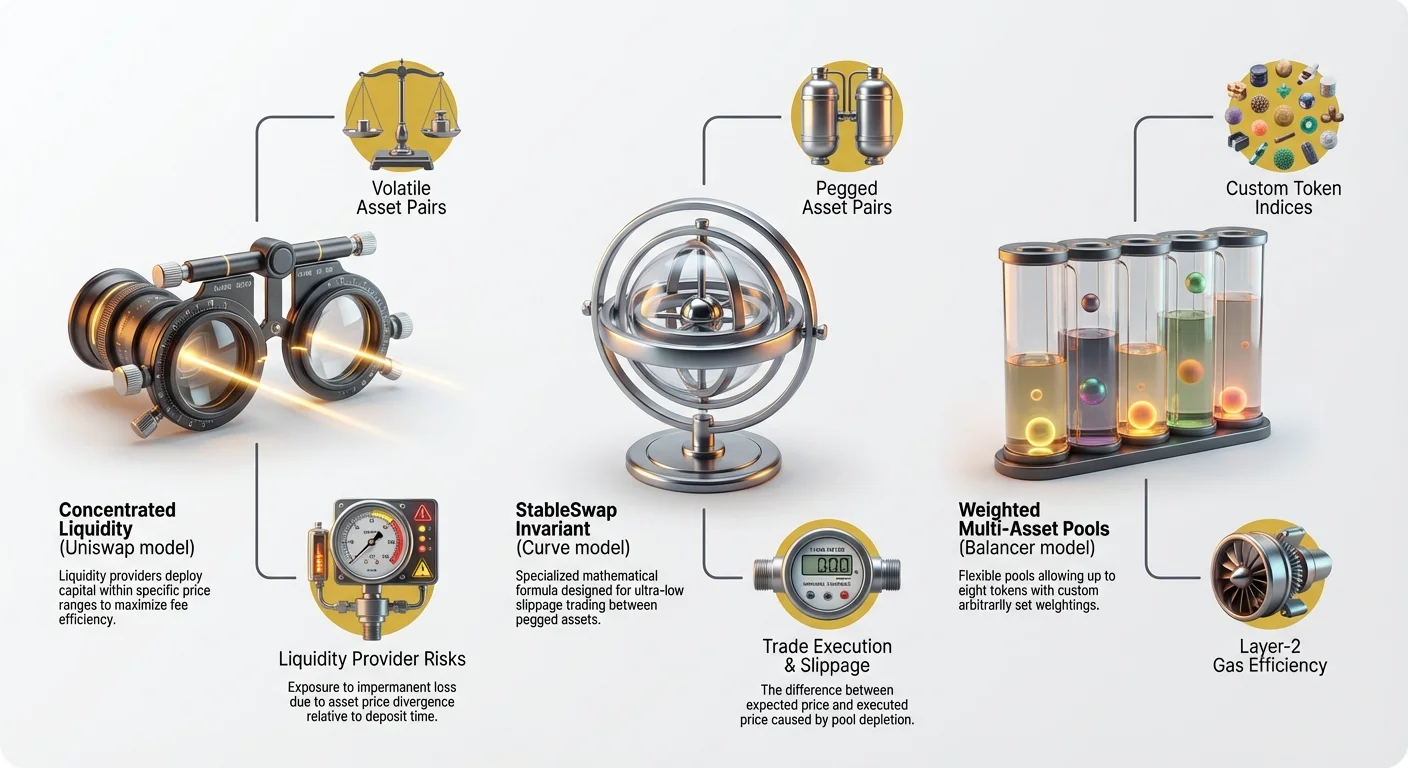
Uniswap V3 introduced Concentrated Liquidity, a breakthrough that fundamentally changed how AMMs operate. Instead of requiring LPs to provide liquidity across the entire price spectrum, LPs can now choose a specific, narrow price range in which their funds will be deployed, requiring Optimizing Concentrated Liquidity.
How Concentrated Liquidity Works:
- If a user believes ETH will trade between $2,800 and $3,200 for the foreseeable future, they can place 100% of their capital within that range.
- When a trade occurs within this range, the liquidity is significantly deeper than in a V2 pool, resulting in extremely low slippage—often comparable to centralized exchanges.
- LPs earn far higher fees on their capital, as their funds are actively used 100% of the time they are in range.
This model is critical for capital efficiency. LPs can replicate the depth of a V2 pool with significantly less underlying capital, making Uniswap V3 the primary destination for trading volatile, uncorrelated assets (like ETH/BTC or ETH/USDC).
Practical Benefits and Risks for Users
Benefits:
- Lowest Slippage: For swaps involving assets trading near their current price, V3 offers unparalleled efficiency.
- Deepest Liquidity: Due to high capital efficiency, Uniswap V3 often aggregates the largest volume of effective liquidity across major pairs.
Risks (Primarily for Liquidity Providers):
- Increased Impermanent Loss (IL) Risk: While IL is inherent to all AMMs, the risks are magnified in V3. If the asset price moves outside the LP’s defined range, their liquidity is effectively converted entirely into the less-valuable asset, and they stop earning fees. They must then manually re-position their funds, incurring gas fees.
- Active Management Required: V3 demands active management, turning LPs into market makers who must constantly monitor and adjust their positions. This complexity makes V3 less accessible for passive, beginner LPs.
Best Use Case: High-volume trading of volatile assets (e.g., blue-chip tokens like ETH, BTC, and major altcoins) where capital efficiency is prioritized.
Ecosystem 2: Curve and Optimized Swaps for Pegged Assets
While Uniswap excels at general trading, the Curve Finance ecosystem specializes entirely in maximizing efficiency for assets that should maintain a stable value relative to each other—a category known as "pegged assets."
The Need for StableSwap Invariants
When trading two stablecoins like USDC and DAI (both pegged to $1 USD), the ideal trade scenario involves zero slippage. In a standard Uniswap V2 pool, even small trades cause price deviation because the CPMM formula ($X * Y = K$) demands that the curve approach infinity quickly.
Curve solved this problem by pioneering the StableSwap Invariant formula. This formula is designed to keep the price ratio extremely close to 1:1, offering a near-flat exchange rate for most of the pool’s capacity.
Analogy: Imagine pushing a bowling ball (your trade) across a flat table (Curve pool) versus pushing it up a steep hill (Uniswap V2 pool). In Curve, the effort required (slippage/cost) remains minimal until the pool’s reserves are extremely unbalanced.
How Curve Minimizes Slippage on Stable Pairs
Curve’s formula uses a hybrid approach, combining aspects of the constant sum model (perfectly flat, ideal for 1:1 trading) and the constant product model (robust, preventing one pool side from emptying completely).
This specialized formula allows Curve to handle colossal trade volumes of stablecoins (USDC, USDT, DAI) and wrapped tokens (wBTC, renBTC) with significantly lower slippage than any general-purpose AMM, especially when bridging various wrapped tokens.
Ecosystem Focus: Curve’s core focus is infrastructure for highly efficient swaps between similar assets. Its ecosystem has expanded to include multi-asset pools for yield-bearing tokens (like those generated by staking protocols) and synthetic assets, but the stablecoin focus remains paramount.
Ideal Use Cases and Ecosystem Function
For Traders: Curve is the definitive destination for swapping large sums of stablecoins or bridging between various wrapped tokens (e.g., exchanging wBTC for renBTC). The low slippage makes it the cheapest route for these specific transactions.
For Liquidity Providers (LPs): Providing liquidity on Curve is often seen as lower risk than on Uniswap V3 for two primary reasons:
- Lower Impermanent Loss: Since the assets are expected to stay pegged, the price ratio rarely changes dramatically, dramatically reducing IL compared to volatile pairs like ETH/USDC.
- Steady Yield: Curve pools often integrate other DeFi protocols, allowing LPs to earn not only trading fees but also base interest on the underlying stablecoins (e.g., depositing DAI into a Curve pool that simultaneously lends that DAI on Compound).
Best Use Case: Trading and pooling capital for assets designed to maintain parity (stablecoins, tokenized derivatives, wrapped tokens).
Ecosystem 3: Balancer and Flexible Multi-Asset Pools
Balancer provides a highly generalized framework for liquidity, often described as an "N-dimensional AMM" or a customizable index fund creation tool. While Uniswap focuses on efficiency for two volatile assets and Curve focuses on efficiency for two stable assets, Balancer focuses on flexibility and diversity.
Beyond 50/50: Customizing Pool Weights
The standard AMM requires a 50/50 split of the two assets. Balancer shattered this constraint, allowing pools to be created with up to eight different tokens, each assigned a custom weight.
Example: A standard pool might be 50% ETH and 50% DAI. A Balancer pool could be 60% wBTC, 20% ETH, 10% LINK, and 10% DAI.
These weighted pools are governed by a generalized version of the constant product formula that accounts for $N$ assets and their custom weights.
The Power of Weighted Pools (Index Funds)
Weighted pools introduce powerful capabilities for both traders and LPs:
Self-Balancing Index Funds: For LPs, depositing into a weighted pool is akin to holding a diverse crypto portfolio. Crucially, every time a trader uses the pool, they are essentially rebalancing the LP’s portfolio back to the desired weights, and the LP collects a fee for this rebalancing service.
- Use Case: If the price of ETH rises significantly in a 60/40 BTC/ETH pool, arbitrageurs will buy the cheaper ETH from the pool, rebalancing the weights and depositing more BTC. The LP receives the trading fee and has their portfolio automatically rebalanced without manual intervention.
Custom Collateral: Weighted pools are ideal for use cases where one asset needs to be heavily dominant, such as a liquidity pool designed to launch a new project. A new token might be paired with ETH in a 98/2 pool (98% new token, 2% ETH), maximizing the concentration of the new asset while still providing immediate liquidity.
Smart Pools and Dynamic Asset Management
Balancer’s infrastructure allows for the creation of various sophisticated pool types, extending its utility beyond basic swaps:
- Managed Pools: These pools are controlled by a designated entity (a smart contract or a multi-signature wallet) that can dynamically adjust the pool's parameters, such as weights, fees, or even the underlying assets themselves. This is crucial for protocols that need to actively manage their treasury or liquidity.
- Composable Stable Pools: Balancer integrates technologies similar to Curve's StableSwap for efficient swaps between pegged assets, offering the best of both worlds in one ecosystem.
Best Use Case: Creating custom token indices, treasury management, launching new tokens with flexible liquidity ratios, and advanced liquidity provision across multiple uncorrelated assets.
Ecosystem 4: Order Book DEXs and Centralized Efficiency
While AMMs dominate the DeFi landscape, a growing segment of decentralized exchanges—often built on Layer-2 solutions—rejects the AMM model and returns to the classic Order Book system. Examples include dYdX, Loopring, and some centralized exchange offshoots.
Why Use an Order Book on a Blockchain? (CEX Simulation)
The Order Book model is familiar to traditional traders: it lists open buy orders (bids) and sell orders (asks) at various price levels. When a bid and ask match, the trade executes.
Advantages of Order Books:
- Guaranteed Pricing: Unlike AMMs, where price is determined by the pool's composition after the trade, order books allow traders to set limit orders at exact desired prices.
- High Capital Efficiency: Liquidity is only needed at the specific price points where orders are placed, meaning zero wasted capital.
- Advanced Trading Tools: Order books natively support advanced trade types like limit orders, stop-limit orders, and sophisticated derivative products (futures, perpetuals), which are complex to implement on standard AMMs.
Layer-2 Solutions and Scaling Order Books
The major challenge for order books on a decentralized network is speed and cost. On primary Layer-1 blockchains like Ethereum, placing and cancelling an order requires an expensive, slow transaction (a gas fee). This makes rapid, professional trading impossible.
Order Book DEXs overcome this by implementing Layer-2 (L2) scaling solutions: specifically relying on optimistic or ZK rollups (see Ethereum's modular scaling strategy) to move transactions off the main chain.
- Off-Chain Matching: The order matching (the placement and cancellation of bids/asks) is handled off the main blockchain, which allows for instant, zero-cost updates.
- On-Chain Settlement: Only the final settlement of the trade (the transfer of tokens) is recorded on the Layer-1 blockchain, secured by the underlying network’s cryptographic proofs (e.g., ZK-Rollups or Optimistic Rollups).
This hybrid approach allows L2 Order Book DEXs to offer CEX-like speed (hundreds or thousands of transactions per second) with the security and non-custodial nature of DeFi.
Trade-offs: Speed vs. Decentralization
The primary trade-off in using an L2 Order Book DEX relates to the level of decentralization in the order matching process:
| Feature | AMM DEX (e.g., Uniswap) | Order Book DEX (e.g., dYdX) |
|---|---|---|
| Liquidity Source | Decentralized, anonymous LPs | Centralized market makers/traders |
| Order Matching | Fully on-chain via smart contract | Off-chain operator/sequencer |
| Speed/Fees | Slower (L1) or moderate (L2), varying gas | Very fast, near-zero trading fees |
| Custody | Non-custodial | Non-custodial |
While the funds remain secure in the user’s wallet (non-custodial), the user relies on a centralized operator to manage the order book itself. For professional traders who value speed and specific price execution above all else, this compromise is often acceptable.
Best Use Case: High-frequency trading, trading complex derivatives (perpetual futures), and users demanding precise price execution (limit orders) without high gas costs.
Key Factors for Choosing a DEX Ecosystem
A beginner should approach the selection process by considering their assets and their specific financial goals, rather than simply looking at daily trade volume.
Asset Type and Trading Goal
The nature of the tokens you intend to swap should immediately narrow down your choice:
| Trading Goal | Asset Type | Recommended Ecosystem | Why? |
|---|---|---|---|
| General Swaps (Volatile) | ETH, BTC, SOL, Major Altcoins | Uniswap (V3) | Highest capital efficiency and deepest effective liquidity for uncorrelated assets. |
| Stable Swaps (Pegged) | USDC, DAI, USDT, wBTC | Curve or Balancer (Stable Pools) | Specialized formulas minimize slippage on assets that should trade 1:1. |
| Portfolio Management | Basket of 3+ tokens, Index funds | Balancer (Weighted Pools) | Enables automatic rebalancing and customizable asset ratios. |
| Advanced Trading | Futures, high-frequency, limit orders | Order Book DEXs (L2) | Allows for precise price entry/exit and rapid execution. |
Network Fees and Routing Efficiency
The ecosystem is inseparable from the blockchain network it operates on, which dictates transaction cost and speed (gas fees).
- Ethereum Mainnet (L1): While home to the largest liquidity pools (Uniswap, Curve), high gas fees make it prohibitive for small trades. Swaps on L1 are generally reserved for high-value transactions or large liquidity deposits/withdrawals.
- Layer-2 (L2) Networks: Most major DEX ecosystems (Uniswap, Balancer, and all Order Book DEXs) have deployed on popular L2 solutions like Arbitrum, Optimism, and Polygon. These L2s use compression technology to lower gas fees to mere cents, making DeFi accessible to retail users.
- Alternative Blockchains: Ecosystems like Solana or Avalanche host similar AMM structures but rely on entirely different consensus mechanisms for speed. These networks typically offer ultra-low fees, though usually with less deep liquidity than Ethereum L2s for major tokens.
Best Practice: For routine swaps of under $10,000, always prioritize a DEX deployed on a major Layer-2 network to maximize capital retention by minimizing gas costs.
Security and Auditing
A DEX is only as secure as the underlying smart contract. Since there is no central party to protect you if the code is exploited, security audits are paramount.
- Code Audits: Reputable ecosystems like Uniswap, Curve, and Balancer have undergone multiple rigorous third-party security audits (by firms like ConsenSys or CertiK). Always confirm that the DEX you use has been audited and battle-tested over time.
- Decentralization Score: Highly decentralized protocols are generally safer. If a protocol relies on a multi-signature wallet held by a few founders to make crucial updates, it carries a higher centralized risk (a "god mode" key).
- Insurance: While rare, some DEXs or DeFi aggregators offer limited insurance pools to protect against smart contract failure, though this is not standard and requires careful review.
Navigating Advanced DEX Features and Risk
For those stepping into DeFi, understanding the mechanics of a swap and the inherent risks of providing liquidity is essential for successful interaction with any DEX ecosystem.
Understanding Liquidity Provider (LP) Risk
If your goal is to earn fees by depositing capital into a DEX pool, you become a Liquidity Provider, which exposes you to specific risks, primarily Impermanent Loss (IL). For LPs, it is essential that they grasp the core concepts of Understanding Impermanent Loss.
IL occurs when the price ratio of the assets in your pool changes relative to the ratio when you deposited them. If the price of one asset skyrockets while the other stays flat, you would have been financially better off simply holding the two assets in your wallet (HODLing). The losses incurred from the price divergence (the opportunity cost) are known as impermanent loss.
Risk Mitigation by Ecosystem:
- Curve: Lowest IL risk, as assets are expected to remain pegged 1:1.
- Balancer: IL risk is spread across multiple assets, potentially smoothing volatility, but the overall complexity increases.
- Uniswap V3: Highest IL risk due to the concentration mechanism. You risk being entirely pushed out of range and holding only the depreciating asset if the market moves sharply.
Best Practices for Swap Execution
When interacting with a DEX, you are executing a trade against a highly specialized smart contract. Optimizing this process means mastering two core concepts: slippage and routing.
1. Controlling Slippage
Slippage is the difference between the expected price of a trade and the price at which the trade actually executes. Slippage occurs because large trades deplete the liquidity pool, causing the price formula to react instantly.
- Tolerance Setting: Every DEX allows you to set a Slippage Tolerance (usually 0.5% to 5%). This is the maximum adverse price movement you are willing to accept.
- If you set tolerance too low (e.g., 0.1%): The transaction will likely fail if the price moves even slightly before execution, wasting your gas fee.
- If you set tolerance too high (e.g., 5%): You risk being exploited by Maximal Extractable Value (MEV) bots that observe your pending large transaction and insert their own transaction ahead of yours to capitalize on the price movement you caused.
Tip: For major pairs (like ETH/USDC) on deep pools (Uniswap L2), 0.5% to 1% is usually safe. For small-cap tokens with shallow liquidity, you might need 2% or higher.
2. Understanding Routing (Aggregators)
DEXs do not operate in a vacuum. A single token swap might be routed through three different DEX protocols and multiple pools to find the absolute best price.
DEX Aggregators (like 1inch or Paraswap) are sophisticated tools that automatically scan all available liquidity across all DEX ecosystems (Uniswap, Curve, Balancer, etc.) and split your trade across various pools to minimize slippage and transaction costs. Learning how to optimize DEX aggregator usage is critical for best execution.
Example of Efficient Routing: You want to swap $100,000 of DAI for ETH.
- The Aggregator determines that swapping $50,000 of DAI for USDC on Curve (low slippage for stables) and then swapping that USDC for ETH on Uniswap V3 (best ETH liquidity) results in more final ETH than simply using the DAI/ETH pool on one single DEX.
Best Practice: Always use a trusted DEX aggregator for routine swaps to ensure you are benefiting from the specialized strengths of all DEX ecosystems simultaneously, rather than limiting yourself to a single platform.
Conclusion
The evolution of decentralized exchanges from the simple 50/50 model to today's specialized ecosystems marks a significant maturity point for DeFi. The key takeaway for any crypto beginner is that the "best" exchange is not a single name, but rather the underlying technological model that best suits the asset you are trading.
Whether you are prioritizing ultra-low slippage on stablecoins using Curve’s specialized invariant, maximizing capital efficiency for volatile assets via Uniswap V3’s concentrated liquidity, building a custom portfolio on Balancer’s flexible architecture, or requiring CEX-level speed from an L2 Order Book—the power of DeFi lies in its modularity and specialization.
By understanding these core infrastructure differences, you transition from being a passive user to an informed participant, capable of utilizing the decentralized financial system safely and optimally.