
Welcome to the most crucial stage of your crypto journey. You have learned what crypto is and how wallets function. Now, it’s time to move from theory to practice and determine which specific custody solution is right for you.
Choosing a crypto wallet is not a one-size-fits-all decision. The optimal solution for a long-term Bitcoin investor (a "HODLer") who rarely transacts is fundamentally different from the solution required by an active decentralized finance (DeFi) participant (a "Degen") or a community manager responsible for a decentralized autonomous organization (DAO) treasury.
This guide provides a comprehensive framework—the Custody Assessment—to match your unique risk tolerance, activity level, and asset value with the perfect wallet archetype. By synthesizing the principles of control, convenience, and security, we will help you select an actionable solution that minimizes risk without sacrificing your ability to manage your digital assets effectively.
1. The Foundation: Understanding the Custody Continuum
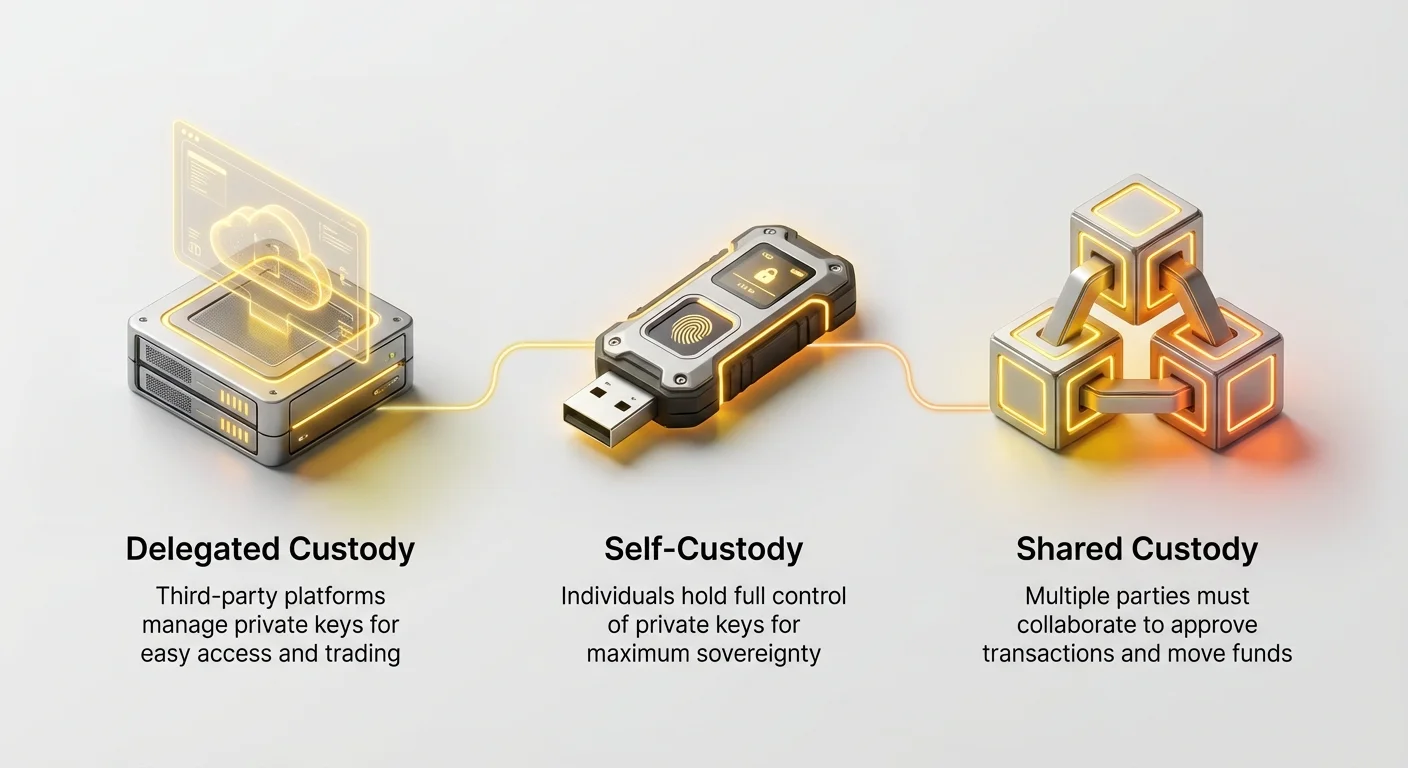
Before assessing your needs, we must first establish the major categories of digital asset custody based on who holds the cryptographic keys (the private keys) that control the funds. Every choice you make exists on this continuum, balancing absolute control against ease of use.
Delegated Custody (Maximum Convenience)
This model involves trusting a third party—typically a centralized cryptocurrency exchange (CEX) like Coinbase or Kraken—to hold and manage your private keys on your behalf.
- Pros: Extreme ease of use, simple recovery process (password reset), immediate access for trading.
- Cons: You do not own the keys; your funds are exposed to the risks of the platform (hacks, regulatory shutdown, insolvency).
- Best For: New users experimenting with very small amounts, or those whose primary activity is high-frequency trading where funds must be immediately available on an exchange.
Self-Custody (Maximum Control)
This is the core tenet of cryptocurrency: holding your own private keys. If you lose the keys, your funds are gone. If you protect the keys perfectly, your funds are unseizable.
- Pros: Complete sovereignty, immunity from exchange insolvency or censorship.
- Cons: High responsibility (zero margin for error), complex security setup (e.g., storing seed phrases physically).
- Best For: Long-term investors, privacy advocates, and those holding significant value.
Shared or Hybrid Custody (Balanced Control)
This model splits the control over the keys, often requiring multiple parties or devices to approve a transaction. This mitigates the risk of a single point of failure (like one lost seed phrase or one compromised device). Key technologies here are Multi-Signature (Multi-Sig) and Multi-Party Computation (MPC).
- Pros: Built-in redundancy, distributed risk, ideal for group management or enterprise use.
- Cons: Slower transaction approval, higher initial setup complexity, requires coordinating multiple signers/devices.
- Best For: DAOs, family funds, high-net-worth individuals, and organizational treasuries.
2. The Custody Assessment Matrix: Risk vs. Frequency
The most effective way to choose a wallet archetype is to quantify two primary variables: the value of the assets you are securing and how often you need to interact with those assets.
Assessing Asset Value (The Stakes)
How much money are you holding? This dictates the level of physical and digital security you must employ.
| Asset Value Category | Description | Security Priority |
|---|---|---|
| Pockets Money | Less than $1,000 | Convenience and immediate access. |
| Savings Account | $1,000 to $10,000 | Balanced security; the transition point to self-custody. |
| Life Savings/Retirement | Over $10,000 | Maximum physical security, redundancy, and cold storage is mandatory. |
If your assets fall into the "Life Savings" category, you must prioritize the security and redundancy of a cold storage solution (like a Hardware Wallet or advanced MPC setup) above all else.
Assessing Transaction Frequency (The Activity Level)
How often do you need to move or spend your crypto? This dictates the required accessibility of your keys.
| Frequency Category | Description | Custody Implication |
|---|---|---|
| Low Activity (HODLing) | Transactions are rare (once every 6–12 months or less). | Keys should be completely offline (cold). High friction for access is desirable. |
| Medium Activity (Trading/Staking) | Transactions weekly or monthly (e.g., moving funds to an exchange, staking rewards). | Warm storage or dedicated, isolated hot wallets are acceptable. |
| High Activity (DeFi/Gaming) | Transactions daily or multiple times per day (e.g., yield farming, arbitrage, micro-transactions). | Hot wallets are necessary, but must be managed with extreme caution and high operational security (OPSEC). |
A high-value asset that requires high frequency access (e.g., managing a $500,000 DeFi fund) presents the highest security challenge and almost always requires a sophisticated shared custody solution (MPC or Multi-Sig) to prevent catastrophic loss due to a single mistake or hack.
3. Defining the Archetypes and Their Needs
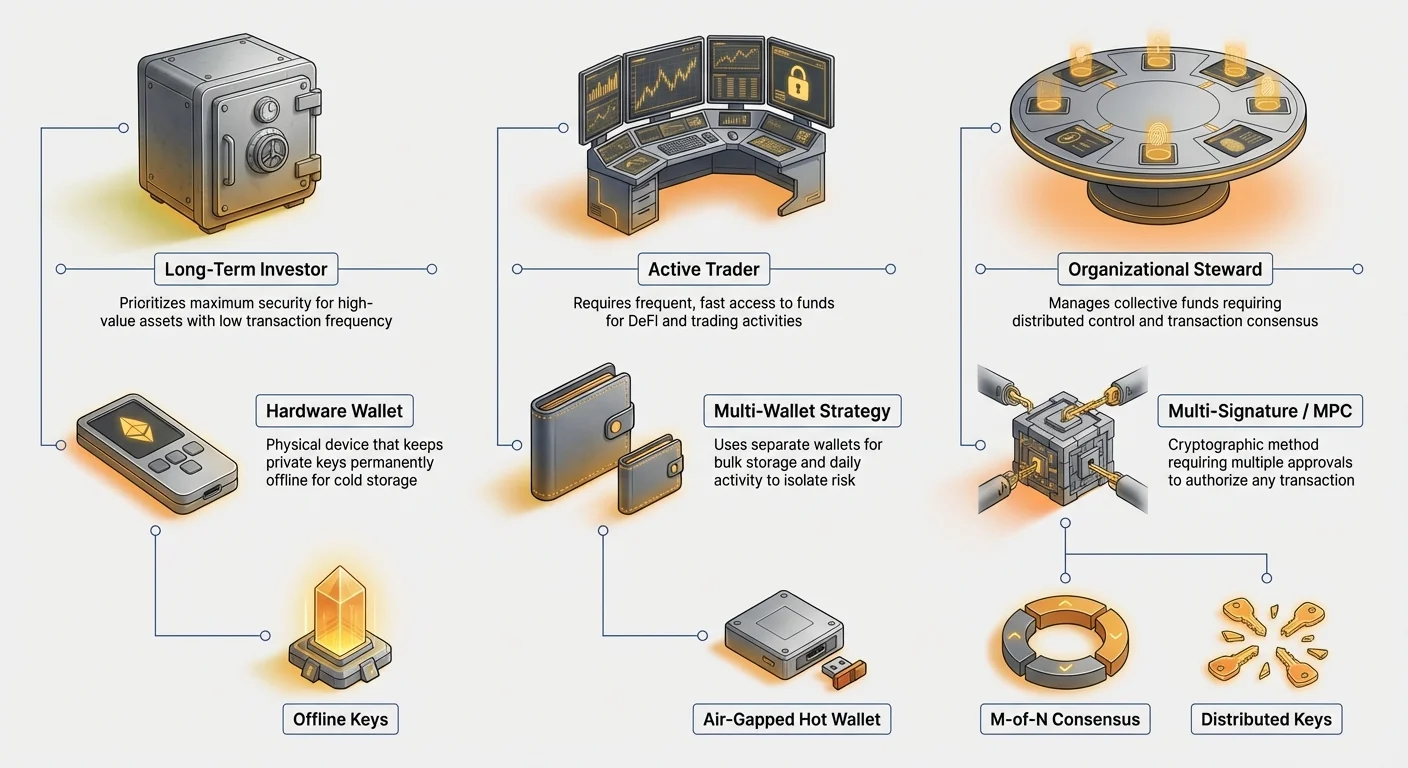
Based on the assessment matrix, we can categorize crypto users into three primary archetypes, each requiring a fundamentally different wallet setup.
Archetype 1: The Long-Term Investor (The HODLer)
Profile: Low transaction frequency, high asset value (Life Savings/Retirement). This user is focused purely on securing their principal investment against digital threats, physical theft, and institutional risk over several years. Primary Goal: Maximum Security and Durability. Risk Tolerance: Zero tolerance for key loss or digital compromise; high tolerance for inconvenience.
Optimal Solution Path:
- Solution: Hardware Wallet (Cold Storage).
- Strategy: Dedicated device stored in a secure location; seed phrase stored separately with extreme redundancy (e.g., metal storage for fire/water protection).
- Key Action: Establish a rigorous operational security (OPSEC) procedure for the rare instances when funds need to be moved.
Archetype 2: The Active Trader/DeFi User (The Degen)
Profile: High transaction frequency, medium to high asset value (Savings Account to Life Savings). This user regularly interacts with decentralized applications (DApps), exchanges, and smart contracts, requiring fast, internet-connected access to funds. Primary Goal: Security through Segregation and Isolation. Risk Tolerance: Moderate tolerance for smart contract risk; low tolerance for losing their entire stack instantly.
Optimal Solution Path (The Layered Approach):
- Solution: Adopt a multi-wallet strategy.
- Layer 1 (The Vault): Use a Hardware Wallet for the bulk of assets (90-95%)—this remains untouched.
- Layer 2 (The Checking Account): Use a dedicated, air-gapped hot wallet (only used for DeFi/DApps) funded with small, disposable amounts. This separation ensures that even if the "active" wallet is compromised, the main savings are secure.
- Key Action: Never connect the Layer 1 (Hardware Wallet) directly to high-risk DApps.
Archetype 3: The Organizational Steward (The DAO Treasurer)
Profile: Medium to high asset value, medium transaction frequency, requires consensus for action. This user needs a mechanism where no single person can unilaterally control the funds, typically managing a treasury for a business, a family, or a decentralized organization. Primary Goal: Distributed Control and Redundancy. Risk Tolerance: Low tolerance for loss; high need for accountability and audit trails.
Optimal Solution Path:
- Solution: Shared Custody via Multi-Signature (Multi-Sig) or Multi-Party Computation (MPC).
- Strategy: Require M of N signers (e.g., 3 out of 5 designated individuals) to approve any transaction. This prevents internal fraud and protects against the compromise of any single signer's device.
- Key Action: Clearly define the quorum (M) needed and ensure all signers use a highly secure method (like individual hardware wallets) to store their signing keys.
4. Mapping Archetypes to Solutions (The Decision Tree)
Once you have identified your archetype, this section guides you to the specific technology that best supports your security needs.
Low Activity, High Value: The Hardware Wallet (Pure Cold Storage)
If your priority is absolute, long-term security against hackers, malware, and institutional seizure, the physical security of a hardware wallet is unmatched.
- How it works: The private keys are generated and stored inside a specialized microchip that is physically isolated from the internet. Transactions are prepared on a computer or phone but must be physically signed/approved by pressing buttons on the device itself.
- Key Advantage: The seed phrase (the key to the keys) is generated offline and should never touch an internet-connected device.
- Trade-off: High friction. Every transaction requires locating the device, connecting it, and manually verifying the recipient address on the small screen—a necessary obstacle against impulse or compromised transactions.
High Activity, Low/Medium Value: The Dedicated Hot Wallet
Hot wallets (software wallets connected to the internet) are essential for interacting with the blockchain, but they must be used tactically.
- The Mobile Wallet: Great for spending small amounts or daily transactions (like using the Lightning Network for fast, cheap Bitcoin payments). Treat it like a physical wallet—only carry what you need for the day.
- The Browser Extension Wallet (e.g., MetaMask): Essential for accessing DeFi and Web3. This is the highest risk wallet type because it is constantly connected to the internet and vulnerable to phishing, malicious smart contracts, and browser-based attacks.
- Best Practice: Never reuse seed phrases across different hot wallets, and keep the value stored in active hot wallets to the bare minimum needed for current activity.
High Activity, High Value/Shared Access: Multi-Party Computation (MPC) and Multi-Sig
When complexity and value scale up, you need security features that eliminate the single point of failure inherent in a standard seed phrase.
Multi-Signature (Multi-Sig)
Multi-sig technology requires multiple, independently generated private keys to sign a transaction before the funds can move.
- Scenario: A 3-of-5 Multi-Sig setup means five distinct keys exist, but only three signatures are required to approve a transaction.
- Ideal Use Case: DAOs and businesses where keyholders might be geographically diverse, or where internal controls require multiple department heads to approve large expenditures.
- Complexity: Requires all signers to maintain their key security perfectly. If too many keys are lost (e.g., 3 keys in a 3-of-5 setup), the funds are permanently locked.
Multi-Party Computation (MPC) Wallets
MPC wallets are an evolution of multi-sig that uses advanced cryptography to distribute control without ever forming a single private key. The private key is essentially shattered into multiple "shares" during creation.
- Scenario: A provider might hold one share, and the user holds another, or the shares can be stored across multiple user devices.
- Ideal Use Case: High-value individuals seeking a balance between security and recovery. If a user loses a device, the wallet service provider may use their share to help the user regenerate access (a form of key backup) without the provider ever having full control over the funds.
- Key Advantage: Superior usability and recovery features compared to traditional multi-sig, while still eliminating the single seed phrase risk.
5. Implementation Checklist and Best Practices
Once you have chosen your optimal wallet archetype, use this checklist to ensure your setup is executed securely.
Secure Key Management
- Never Digitize the Seed Phrase: Write down your recovery phrase (seed phrase) on paper or etch it into metal. Never save it on a computer, phone, cloud storage (Google Drive, Dropbox), or password manager.
- Geographic Redundancy: Store the recovery phrase in at least two separate, physically secure locations (e.g., a home safe and a safety deposit box) to protect against fire, flooding, or localized theft.
- Use a Passphrase (25th Word): If your hardware or software wallet supports it, utilize a 25th word or passphrase. This turns your 12 or 24-word seed into a "decoy key." Even if someone finds your 24 words, they cannot access your funds without the secret 25th word.
- Practice Recovery (Small Amounts): Before depositing substantial funds, perform a dry run. Wipe your wallet device or software, then use your stored recovery phrase to restore access and verify that a small amount of test funds are accessible.
Operational Security (OPSEC) for Transactions
- Dedicate Devices: Use a separate, dedicated device (a cheap laptop or old phone) for initiating high-value crypto transactions. Do not use this device for browsing, email, or social media.
- Double-Check Addresses: Always copy and paste addresses, but then manually verify the first four and last four characters. Wallet malware can silently swap the intended recipient address (a clipboard hijack attack).
- Send a Test Transaction: For any high-value transfer (over $1,000), always send a minimal amount first (e.g., $10) to confirm the address is correct and the transaction is processed successfully before sending the remainder.
- Limit Access for Hot Wallets: When using DeFi, revoke smart contract permissions regularly. This limits the damage a compromised DApp can inflict by preventing it from accessing your tokens indefinitely.
Centralized Service Security
If you rely on Delegated Custody (Exchanges):
- Enable 2FA: Use a physical security key (like YubiKey) or an authentication app (like Google Authenticator) for two-factor authentication (2FA). Never rely on SMS (text message) 2FA, which is vulnerable to SIM-swapping attacks.
- Use Withdrawal Whitelisting: Enable withdrawal protection, restricting withdrawals only to specific, pre-approved wallet addresses.
Conclusion: Custody is a Process, Not a Product
Choosing your crypto custody solution is the single most important security decision you will make. It requires honesty about your own habits and technical skills. There is no shame in using a custodial solution for small amounts if self-custody feels too intimidating, provided you understand the risks involved.
The key takeaway is that your custody solution should evolve with your holdings and activities. Start small with a basic mobile hot wallet, transition to a multi-wallet system when your savings grow, and finally, integrate hardware wallets or shared custody solutions when your crypto wealth truly becomes significant. By treating custody as an ongoing risk assessment process, you ensure the safety and sovereignty of your digital assets for the long term.