
The world of cryptocurrency moves at lightning speed. For the early pioneers, managing crypto meant meticulously tracking transactions on spreadsheets, manually calculating taxes, and constantly refreshing charts. As the ecosystem matured, encompassing dozens of blockchains, thousands of tokens, complex decentralized finance (DeFi) protocols, and NFTs, this manual approach became impossible.
Today, thanks to advancements in Artificial Intelligence (AI) and machine learning, crypto users no longer have to drown in data. AI automation tools are emerging as the essential solution for anyone looking to navigate digital assets efficiently, securely, and compliantly. These specialized tools are designed not for speculative trading, but for the practical tasks that define responsible crypto ownership: tracking every asset across every platform, accurately calculating tax liabilities, and streamlining routine portfolio adjustments.
This guide will focus specifically on how AI can be integrated into your daily crypto life to solve common pain points, turning complex, time-consuming chores—like annual tax preparation and multi-chain portfolio tracking—into simple, automated processes. We will explore the utilitarian side of AI, offering practical steps to harness these technologies to become a more optimized crypto consumer.
The Core Problem AI Solves: The Complexity of Crypto Data
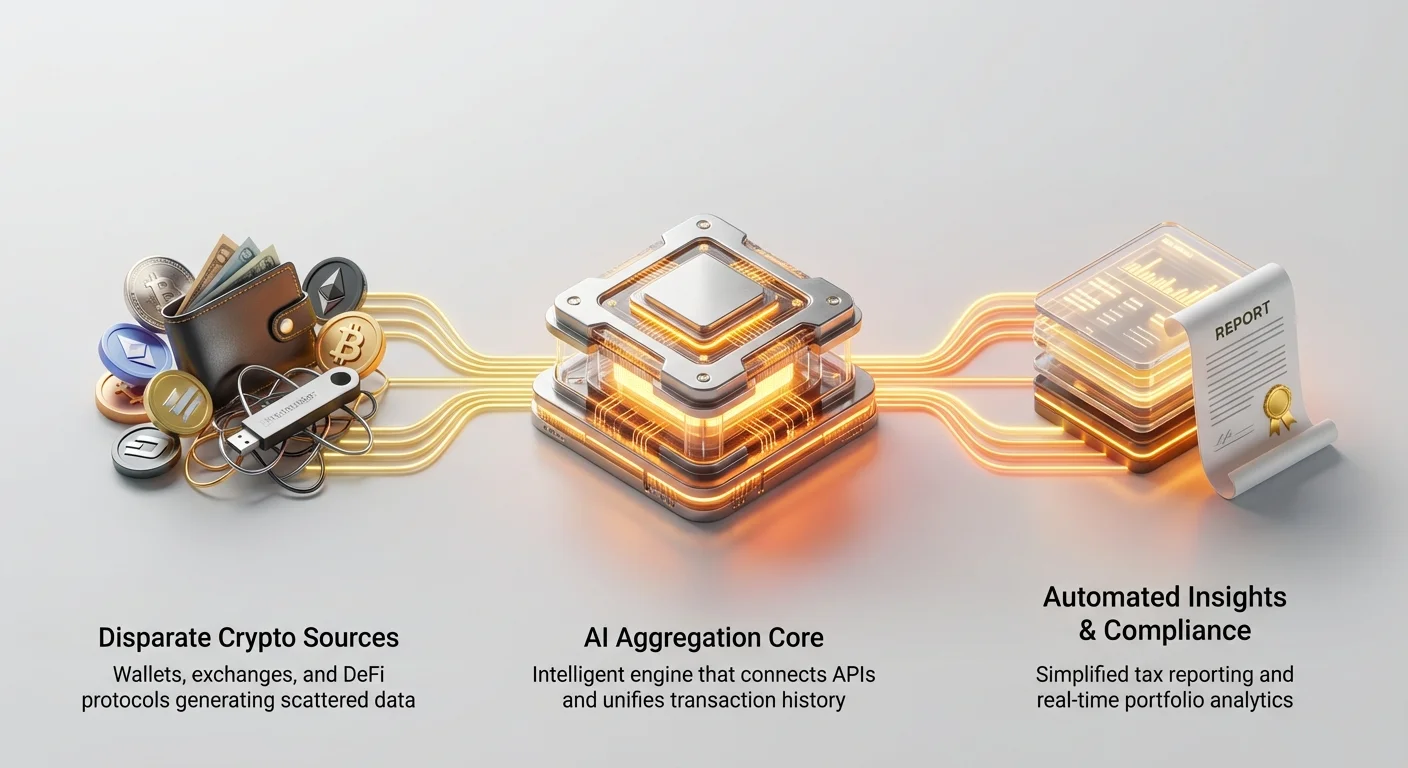
For traditional finance, managing assets often means dealing with one or two centralized bank statements and a brokerage account. In the crypto world, however, a single user might interact with ten different different exchanges, three non-custodial wallets, liquidity pools on five different blockchains, and an array of staking protocols. This sheer volume and dispersion of data is the primary hurdle that AI is engineered to overcome.
Managing Multiple Wallets and Exchanges
The foundation of secure crypto ownership is diversification, often requiring users to spread assets across multiple centralized exchanges (CEXs) and self-custodial wallets (like MetaMask or Ledger).
If you are manually tracking transactions, you must log into each CEX, download CSV files, and then comb through blockchain explorers for every wallet address you own. AI automation tools eliminate this friction. They use secure APIs (Application Programming Interfaces) to connect instantly to dozens of platforms simultaneously.
How AI Connects the Dots:
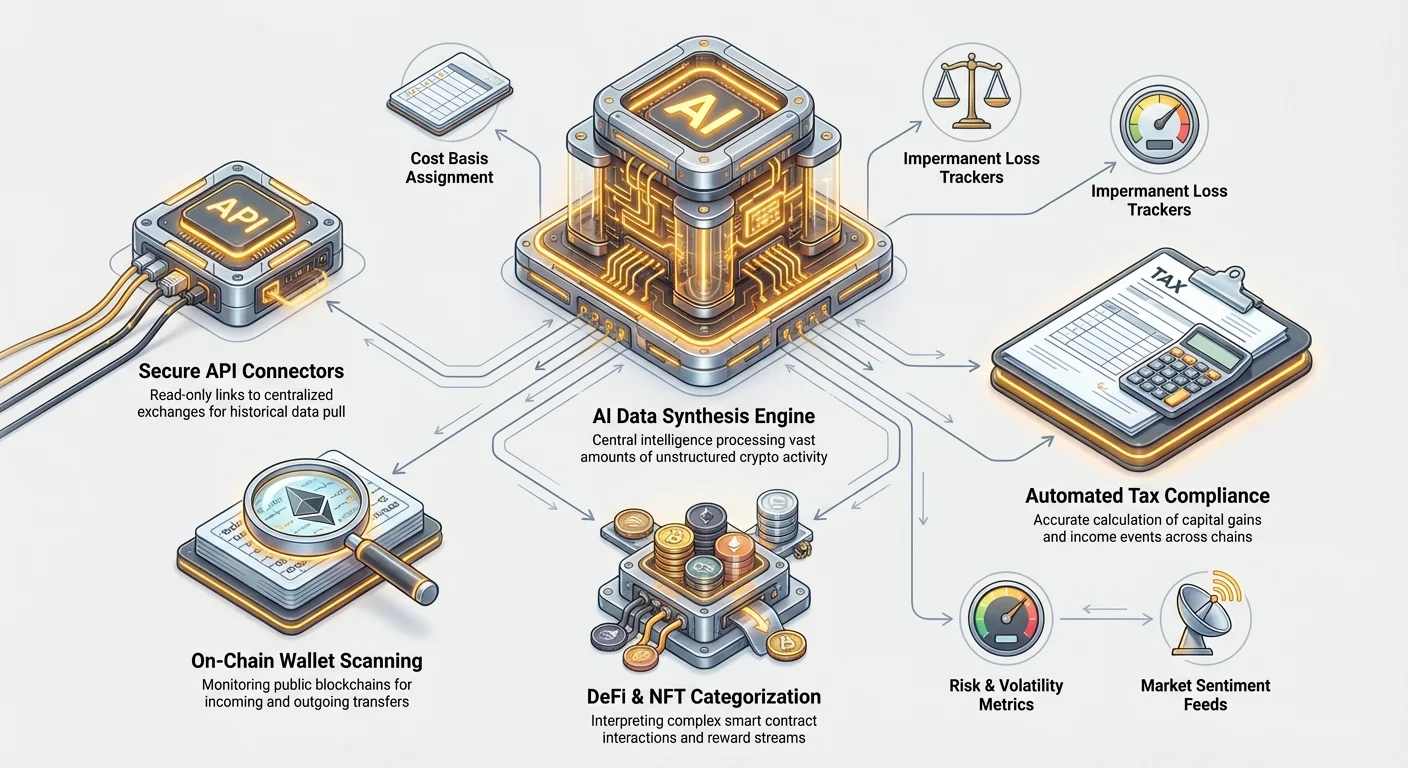
- API Integration: The AI platform securely links to your CEX accounts (e.g., Coinbase, Binance, Kraken) to pull all transaction history, trade data, and withdrawal records.
- Wallet Watch: You provide your public wallet addresses (which are safe to share, as they only reveal transaction history, not private keys). The AI continuously scans the relevant blockchains (Ethereum, Solana, Polygon, etc.) to record every incoming and outgoing transfer.
- Data Unification: The AI engine merges these disparate streams into a single, cohesive timeline, identifying transfers between your own accounts and filtering out irrelevant spam transactions.
Tracking DeFi and NFT Interactions
Decentralized Finance (DeFi) interactions are significantly more complex than simple exchange trades. When you deposit assets into a liquidity pool, farm tokens, or borrow stablecoins, you are executing complex smart contract interactions that might involve multiple steps and corresponding gas fees. Traditional tracking methods often fail here because they only see the initial and final steps, missing the middle movements that determine cost basis and potential tax events.
Similarly, NFT transactions, including minting, bidding, and selling, involve unique market fees and royalties, all of which must be logged accurately.
AI tools are specifically trained to interpret the logic of smart contracts. For instance, when you move $1,000 into a staking pool, the AI doesn't just see the transfer; it recognizes the event type (Staking), calculates the gas fee required to execute the transaction, and logs the current market value of the staked asset—all crucial inputs for accurate reporting and performance review.
AI for Seamless Crypto Tax Preparation
Tax compliance is arguably the most daunting task for any active crypto user. Regulations vary wildly across jurisdictions, but the fundamental requirement remains the same: accurately calculate the capital gains or losses realized from every disposal (selling, trading, using crypto for payment) and report income derived from activities like staking or mining. AI tools have transformed this process from a costly, month-long headache into a manageable, integrated annual task.
Automated Transaction Aggregation and Categorization
The primary function of AI crypto tax software is to handle the tedious work of aggregation and categorization. When you trade one cryptocurrency for another (e.g., ETH for BTC), this counts as a taxable disposal of ETH, requiring you to calculate the cost basis of the ETH sold.
Manual tracking often fails because users lose track of the original purchase price (the cost basis) of the specific coins they sold. AI systems use advanced accounting methodologies, like FIFO (First-In, First-Out) or LIFO (Last-In, First-Out), to automatically match the disposed assets with their corresponding cost basis, even across hundreds or thousands of transactions.
How the Categorization Engine Works:
- Ingestion: The tool imports data from all connected sources (wallets, exchanges).
- Classification: The AI reads the metadata of the transaction and assigns a legal category:
- Trade: Taxable Capital Gain/Loss Event.
- Transfer: Non-taxable movement between your own wallets.
- Gift/Donation: Potentially non-taxable (recipient) or a disposal event (sender).
- Income (Staking/Mining): Taxable ordinary income event.
- Cost Basis Assignment: Using the chosen accounting method (user selectable), the AI links the sale or trade to the specific coins originally bought, generating the precise gain or loss figure.
Handling Complex Tax Events (Yield, Staking, Airdrops)
Traditional tax software is ill-equipped to handle the nuances of decentralized yield generation. If you participate in DeFi, the income stream is often irregular and denominated in various non-fiat tokens.
- Staking and Yield: When you receive staking rewards, the IRS and many global tax authorities treat this as ordinary income, taxed at the fair market value (FMV) of the token at the moment it was received. An AI tool continuously monitors your staking rewards, logging the exact date, time, and USD value of every small reward received, compiling thousands of tiny income events into a single report.
- Airdrops: Airdrops (free tokens distributed to users) are often considered ordinary income upon receipt, also calculated at the FMV at the time of the drop. AI tools are essential for identifying and valuing these often-unexpected events.
- Borrowing/Lending: The interest paid or received through decentralized lending protocols must be tracked. AI accurately distinguishes between the principal loan amount (not a taxable event) and the accrued interest (taxable income).
Integrating AI Tools with Standard Tax Software
The final step in the AI tax automation pipeline is generating standardized, ready-to-file documents. Most leading crypto tax platforms integrate directly with popular tax software (like TurboTax or TaxAct) or generate official tax forms required in various jurisdictions (e.g., IRS Form 8949 in the US or similar reports globally).
This integration ensures that the complex calculations performed by the AI are translated into a format your government requires, minimizing the risk of audit or filing errors due to manual data entry. For the beginner, this feature is invaluable, bridging the gap between the complex blockchain world and the familiar world of tax filing.
Actionable Tip: Always check your jurisdiction’s specific rules. While AI automates the calculation, you must correctly inform the software whether staking rewards are treated as income upon receipt or upon disposal.
AI-Powered Portfolio Tracking and Analytics
Moving beyond static spreadsheets, AI tools offer dynamic, real-time insights into the health and performance of your crypto holdings. This goes far beyond just displaying a dollar value; it involves deep analysis of risk, cross-chain performance, and capital efficiency.
Real-Time Performance Monitoring and Alerts
A major challenge for active crypto users is staying informed without being overwhelmed. AI tracking dashboards pull together data streams (market prices, transaction history, blockchain data) to provide a holistic view of your portfolio's performance across different time frames.
Key Monitoring Features:
- True Return on Investment (ROI): AI calculates the true ROI by factoring in gas fees, trading commissions, and network costs associated with every transaction, giving a clearer picture than simple "token price change."
- Customizable Alerts: Instead of manually checking prices, AI allows you to set sophisticated alerts. For instance: "Alert me if the value of my Bitcoin holdings drops below 50% of my total portfolio," or "Notify me if the cost basis of my stablecoin yield farming is compromised by excessive gas fees."
- Automated Reporting: These tools can generate daily or weekly summaries detailing changes in asset allocation, major gains/losses, and recent fees paid, simplifying your routine review process.
Risk Assessment and Diversification Analysis
For the beginner investor, diversifying a portfolio often means holding several different cryptocurrencies. However, true diversification requires understanding the correlation between those assets and the underlying risks of the platforms holding them. AI tools help visualize this risk.
- Concentration Risk: AI can analyze your portfolio and tell you if your funds are overly concentrated in one asset, one blockchain (e.g., 80% of assets are on Ethereum), or one DeFi protocol. This helps users mitigate "single point of failure" risk.
- Volatility Metrics: By analyzing historical price movements, AI assigns a volatility score to your overall portfolio and highlights assets that are contributing disproportionately to risk. If your portfolio is too volatile for your goals, the AI can suggest rebalancing options.
- Smart Contract Risk Rating: Some advanced platforms integrate security audits and vulnerability scanners. They can rate the smart contracts you interact with (e.g., a specific lending protocol) based on complexity and audit history, providing a risk score before you commit capital.
Identifying Impermanent Loss in Liquidity Pools
Liquidity pooling is a core activity in DeFi, allowing users to earn trading fees by depositing two assets (e.g., ETH/USDC) into a decentralized exchange (DEX). However, participants are exposed to impermanent loss (IL)—the potential difference between the value of holding the tokens in the pool versus simply holding them in a wallet. IL can negate the fees earned.
Calculating IL manually is extremely complex, requiring precise tracking of asset ratios and market prices since the moment of deposit. AI automation solves this instantly:
- Tracking Entry Point: The AI logs the exact quantity and price of the assets when they were deposited into the pool.
- Continuous Monitoring: It tracks the current market prices and the current asset ratio in the pool.
- IL Calculation: The AI generates a real-time dollar figure showing the impermanent loss (or gain) relative to a "holding" strategy. This crucial insight allows users to make informed decisions about when to withdraw assets to minimize losses or lock in gains.
Using AI for Market Sentiment and Research
While AI cannot predict the future, it excels at processing massive amounts of unstructured data—like news articles, social media posts, and trading volumes—to provide actionable insights into current market mood and trend momentum. For the beginner, this removes the need to constantly scroll through social feeds and news sites, offering filtered, synthesized information.
Sentiment Analysis and News Aggregation
Market sentiment is the collective emotional tone of the investment community toward a specific asset or the market as a whole (e.g., "bullish," "bearish," "fearful"). This feeling often drives short-term price movements.
AI platforms use Natural Language Processing (NLP) to scan millions of data points across social platforms, news outlets, and forums. It identifies keywords, analyzes tone (positive, negative, neutral), and aggregates this data into a measurable score or chart.
Practical Application: If Bitcoin’s price is dropping, traditional analysis might suggest panic. But if the AI sentiment tracker shows that social media discussion remains overwhelmingly positive and focused on long-term goals, this might indicate the dip is temporary institutional selling rather than widespread retail panic. This allows users to filter signal from noise.
Identifying Potential Market Trends
AI can track correlations and patterns faster than human analysts. It doesn't just read the news; it reads how the market reacts to the news.
For example, an AI tool might observe that every time a major regulatory body makes a positive statement about stablecoins, the trading volume for DeFi governance tokens on specific chains increases by 15% within 48 hours. By identifying these complex, multivariate relationships, the AI can highlight potential, predictable trend shifts, allowing the user to perform deeper personal research into why that correlation exists.
Interpreting On-Chain Data for Beginners
"On-chain data" refers to all the publicly available information recorded on a blockchain (transaction volume, wallet activity, network fees, smart contract deposits). While transparent, raw on-chain data is highly technical and intimidating for beginners.
AI tools simplify this data by creating digestible metrics:
- Whale Tracking: Identifying large wallet addresses ("whales") and reporting significant movements of funds (e.g., "A wallet that has held 10,000 ETH for three years just moved 50% to an exchange"). This often signals potential major market moves.
- Network Health: Providing simple summaries of transaction congestion and average fees. If the AI detects a sudden spike in gas fees on Ethereum, it alerts the user that network demand is high, which may signal increased interest or an upcoming event.
- Exchange Flow: Tracking net inflows and outflows from centralized exchanges. If a large amount of Bitcoin is moving off exchanges into private wallets, the AI signals a potential supply shock (people are holding, not selling), which is generally bullish.
Implementing Simple AI Automation Strategies
AI automation is not restricted to complex algorithms used by high-frequency traders. For the average crypto consumer, AI provides simple, strategic tools that enforce financial discipline and manage risk automatically, removing the emotional element from investing.
Dollar-Cost Averaging (DCA) Automation
Dollar-Cost Averaging (DCA) is a powerful, low-risk strategy where an investor commits to buying a fixed dollar amount of an asset at regular intervals (e.g., $100 of Bitcoin every Friday), regardless of the current price. This evens out the cost basis over time and mitigates the risk of buying only at the market peak.
While traditional DCA requires manual execution or setting up recurring bank transfers, AI automation takes this a step further:
- Smart Schedule: AI-driven DCA allows for dynamic scheduling. Instead of a fixed time, you can instruct the bot: "Buy $100 of ETH whenever the price drops 10% below its 30-day moving average," or "Buy $50 of SOL every Tuesday at 9 AM, but only if the gas fees are below $5."
- Platform Flexibility: These tools can execute DCA trades across multiple connected exchanges simultaneously, ensuring the user always benefits from the best available price and deepest liquidity pool at the time of purchase.
Rebalancing Tools for Consistent Allocation
A diversified portfolio, especially for long-term holding, should maintain a target allocation (e.g., 50% BTC, 30% ETH, 20% Altcoins). Over time, asset prices change, causing the allocation to drift. If Bitcoin performs well, it might grow to 65% of the portfolio, increasing your risk concentration.
AI rebalancing tools automate the correction process:
- Define Target: The user sets their ideal percentage allocation (e.g., 60% BTC, 40% ETH).
- Monitor Drift: The AI continuously monitors the portfolio.
- Automated Correction: If BTC rises to 70%, the AI automatically sells a small amount of BTC and uses the proceeds to buy ETH, bringing the portfolio back to the 60/40 ratio. This strategy is crucial for maintaining a desired risk profile without emotional intervention.
Security and Privacy Considerations for AI Tools
The use of AI tools requires granting external platforms access to sensitive financial data. It is crucial to understand the security measures in place.
- API Security (Read-Only Access): When connecting CEX accounts for tracking or tax preparation, ensure you only grant read-only access via the API key. This means the AI tool can view transaction data but cannot execute trades or initiate withdrawals, protecting your funds even if the platform is compromised.
- Self-Custodial Data: When connecting non-custodial wallets, AI tools only require your public wallet addresses. Since blockchain data is public, sharing the address poses no security risk to the funds stored within. Your private keys should never be shared with any third-party software, including AI trackers.
- Data Encryption: Choose platforms that prioritize enterprise-level data encryption (AES-256 or higher) and follow global data protection standards (like GDPR), ensuring your consolidated financial data is protected both in transit and at rest.
Best Practices for Adopting Crypto AI Tools
Integrating AI into your crypto management routine is a strategic move, but it requires thoughtful execution. For beginners, adopting these tools effectively means balancing automation with due diligence.
Starting Small: Pay-as-You-Go Models
Many AI crypto services, especially tax and portfolio trackers, offer tiered pricing or "pay-as-you-go" models, often based on the number of transactions tracked. This is ideal for beginners.
Instead of committing to an expensive annual subscription for a high-volume trading plan, start with a basic plan that accommodates your current activity level.
Tip for Adoption: Begin by linking only your main exchange and primary wallet. Run a trial tax report to familiarize yourself with the platform’s interface and categorization process before paying for a full report covering all your history. This minimizes initial cost and ensures the tool meets your specific needs.
Verifying AI Output (The Human Check)
While AI is incredibly powerful at processing high volumes of data, it is not infallible. Errors can occur due to data ingestion issues, ambiguous smart contract transactions, or misinterpretations of regulatory gray areas.
Always perform a critical human check on AI-generated reports, especially tax forms.
- Review Outliers: Look for transactions the AI flagged as "Uncategorized" or "Needs Review." These are often complex DeFi interactions or missing data points where the AI needs human clarification (e.g., "Was this transfer intended to be a gift or an investment?").
- Check Cost Basis: Spot-check a few major sales transactions. Confirm that the cost basis assigned by the AI matches your original purchase records. If the AI is confused about how you acquired a specific asset (perhaps you transferred it from a wallet it wasn't tracking), manual correction may be necessary.
- Validate Income Streams: Ensure that income events (staking, yield) are correctly valued at the time of receipt, as this is a common area for discrepancies.
The role of AI is to automate 95% of the work; the user’s role is to verify the remaining 5% to ensure 100% accuracy.
Prioritizing Security and Data Access
The utility of these tools hinges on the security of the platforms themselves. Before connecting sensitive data, follow a rigorous security checklist:
- Two-Factor Authentication (2FA): Always enable 2FA on the AI platform itself, using an application like Google Authenticator or Authy, not SMS.
- Reputation and Audits: Use platforms that are well-established, have positive user reviews, and are transparent about their security protocols and professional audits.
- Minimizing Access: As mentioned previously, strictly limit API keys to "read-only" status. If a platform pressures you to grant trading or withdrawal permissions for a simple tracking or tax service, view this as a red flag.
Conclusion
The integration of AI automation is redefining what it means to be a competent crypto user. For beginners, these tools remove the two greatest barriers to adoption and sustained engagement: the paralyzing complexity of data management and the crippling fear of tax compliance.
By harnessing AI for automated transaction aggregation, real-time risk assessment, and precise tax reporting, users can shift their focus from laborious administrative tasks to strategic decision-making. AI allows you to maintain clean, compliant records and adopt disciplined strategies like automated DCA and rebalancing, ensuring that your journey in the world of digital assets is optimized for both efficiency and security. As the crypto landscape continues to evolve, AI automation will remain the indispensable partner for navigating its opportunities responsibly.