
Ether (ETH) serves as far more than just a digital currency or a store of value. It functions as the lifeblood of a vast, decentralized digital ecosystem. While Bitcoin is often compared to digital gold, Ether acts as the fuel for a global, shared computer known as the Ethereum network. This network is designed to execute arbitrary code, allowing developers to build applications that run exactly as programmed without any possibility of downtime, censorship, or third-party interference.
The utility of ETH has evolved significantly since the network's inception, particularly following major upgrades like the transition to Proof-of-Stake. Today, ETH is required to pay for computational resources, secure the network through staking, and serve as the primary form of collateral in decentralized finance protocols. It enables a permissionless economy where users can transact directly with one another without relying on banks or payment processors.
The value proposition of ETH is deeply tied to the demand for the Ethereum network itself. Every time a user interacts with a decentralized application, mints a digital asset, or transfers tokens, they must expend ETH. This creates a direct link between the adoption of the platform and the economic utility of the asset. As the ecosystem expands to include complex financial markets and digital ownership layers, the role of ETH continues to diversify beyond simple peer-to-peer payments.
The Mechanics of Gas and Network Fees
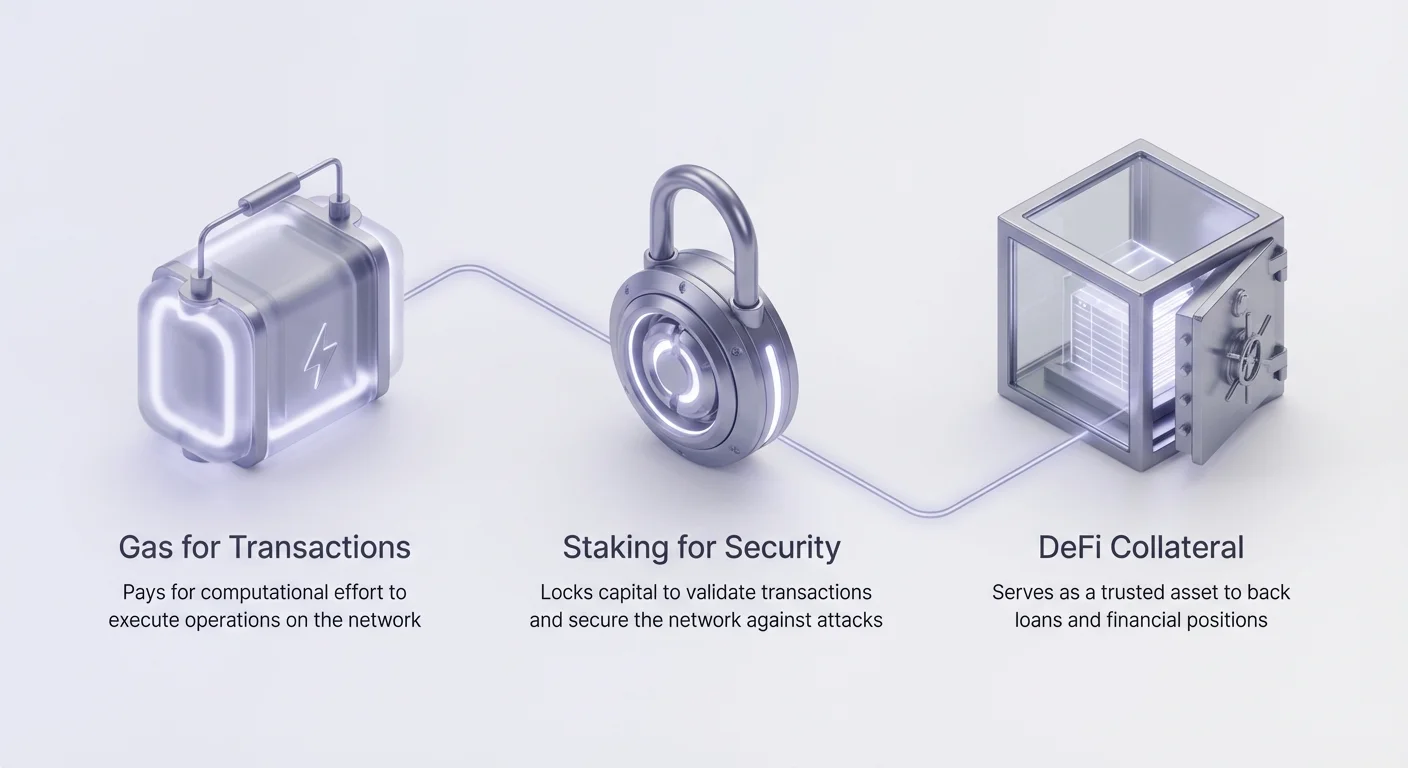
The concept of "gas" is fundamental to understanding how Ethereum operates and why ETH is necessary for every transaction. Gas is not a token itself but a unit of measurement. It quantifies the amount of computational effort required to execute a specific operation on the network. Just as a car requires more fuel to drive a longer distance or carry a heavier load, complex Ethereum transactions require more gas than simple ones.
Calculating Transaction Costs
Transaction fees are paid in ETH, but the cost is determined by the amount of gas used multiplied by the price of gas. A simple transfer of ETH from one wallet to another typically consumes 21,000 units of gas. However, interacting with a smart contract, such as swapping tokens on a decentralized exchange or borrowing assets, involves more complex code execution. These actions require significantly more computational power and consequently consume higher amounts of gas.
The price of gas fluctuates based on supply and demand for block space. When many users try to transact simultaneously, the network becomes congested. This competition drives up the price users are willing to pay to have their transactions processed quickly. The total fee is not arbitrary; it is a reflection of the network's current load and the complexity of the request being made.
The Fee Structure Post-EIP-1559
In August 2021, the network implemented a major upgrade known as Ethereum Improvement Proposal 1559 (EIP-1559). This changed how fees are calculated and paid. Previously, fees worked on a simple auction system where users bid against each other. The new system introduced a "base fee" and a "priority fee."
| Fee Type | Recipient | Purpose |
|---|---|---|
| Base Fee | Burned (Destroyed) | Mandatory cost to include transaction |
| Priority Fee | Validator | Tip to incentivize priority processing |
| Gas Limit | N/A | Max computation allowed for the task |
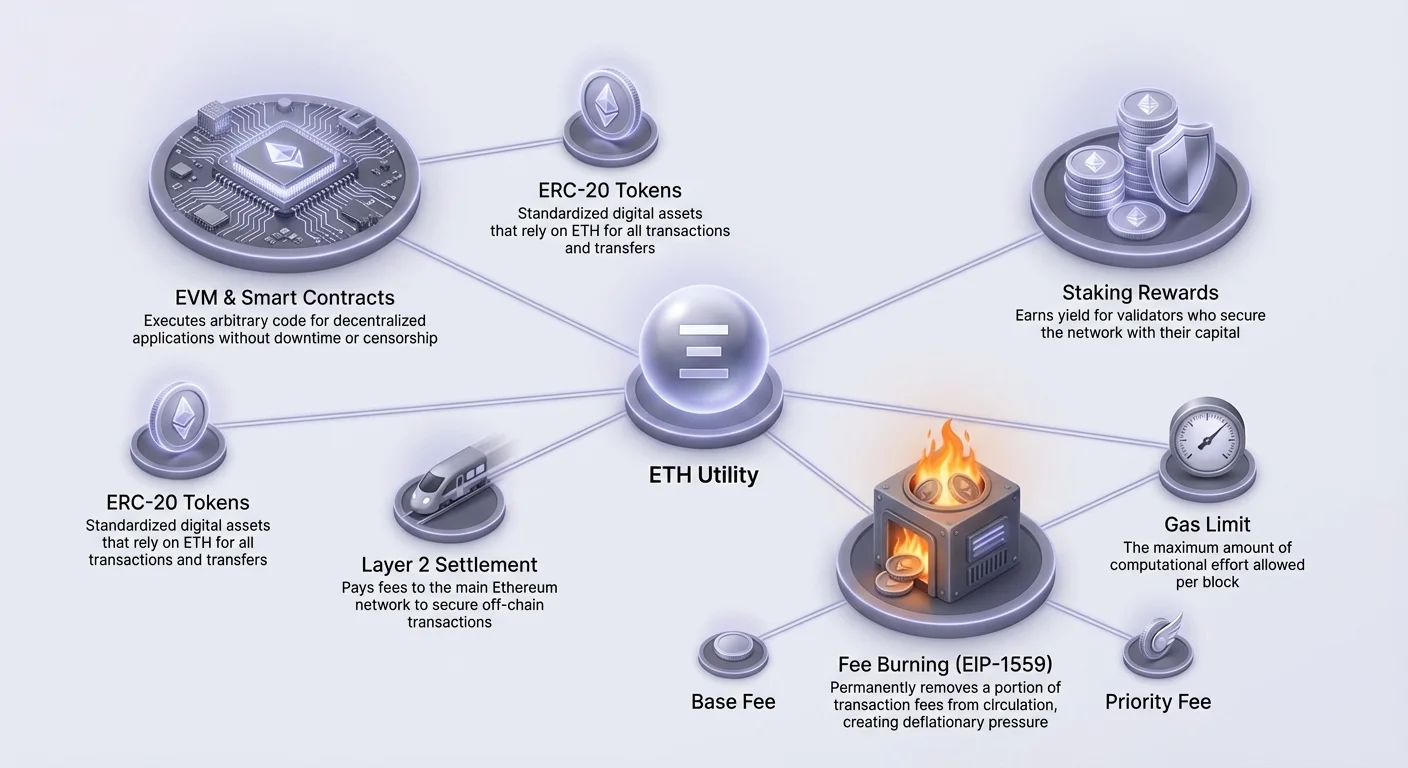
The base fee is an algorithmically determined price that adjusts block-by-block based on network congestion. If a block is full, the base fee increases for the next block; if it is empty, the fee decreases. Crucially, this base fee is permanently removed from circulation, or "burned." The priority fee acts as a tip to the validator to encourage them to prioritize the transaction over others. This split structure makes fee estimation more predictable for users while directly impacting the monetary supply of ETH.
Ethereum’s Monetary Policy and Supply Dynamics
Unlike Bitcoin, which has a hard cap of 21 million coins, Ethereum does not have a fixed maximum supply. Instead, its monetary policy is dynamic and has changed over time to ensure the security and sustainability of the network. The issuance of new ETH and the removal of existing ETH are governed by the protocol rules, which are collectively decided by the community through upgrades.
The Evolution of Issuance
The rate at which new ETH enters circulation has decreased significantly throughout the network's history. When the network launched in 2015, the block reward was 5 ETH per block. This meant a high inflation rate initially to distribute tokens and secure the network. Over time, upgrades reduced this reward to 3 ETH and subsequently to 2 ETH per block. These reductions lowered the inflation rate as the total supply grew, a process that slowly increased the asset's scarcity relative to its adoption.
The most significant change occurred during "The Merge" in September 2022, when Ethereum transitioned from Proof-of-Work (PoW) to Proof-of-Stake (PoS). Under PoW, the network had to issue large amounts of ETH to miners to cover their hardware and electricity costs. Under PoS, validators do not have these high overheads. Consequently, the network was able to reduce the issuance of new ETH by approximately 90%. This drastic drop in new supply fundamentally altered the economic profile of the asset.
The Burn Mechanism and Deflation
The combination of the issuance drop from the Merge and the fee burning from EIP-1559 created a unique economic dynamic. While new ETH is constantly created to reward validators, existing ETH is constantly destroyed every time a transaction occurs. The rate of burning depends entirely on network activity.
During periods of high demand, the amount of ETH burned via base fees often exceeds the amount of new ETH issued to validators. When this happens, the total circulating supply of ETH decreases. This creates a deflationary pressure on the asset. Conversely, during periods of low activity, issuance may exceed the burn, leading to slight inflation. This mechanism ensures that the supply adjusts dynamically based on the actual usage of the network.
Staking and Network Security
Following the transition to Proof-of-Stake, the utility of ETH expanded to include network security through staking. In this model, security is not derived from energy-intensive mining rigs but from capital commitment. Users who wish to participate in securing the network must lock up, or "stake," their ETH tokens. These staked tokens act as a security deposit that ensures validators act honestly.
The Role of Validators
Validators are responsible for processing transactions and proposing new blocks. To become a validator, a participant must stake 32 ETH. If a validator acts maliciously or fails to maintain their node uptime, a portion of their staked ETH can be slashed, meaning it is destroyed as a penalty. This economic disincentive prevents attacks on the network.
In return for locking their capital and performing these duties, validators earn rewards. These rewards come from two sources: the newly issued ETH and the priority fees (tips) from transactions. This creates a yield-bearing opportunity for ETH holders. Even users who do not have 32 ETH can participate by pooling their assets with others, allowing anyone to contribute to network security and earn a share of the rewards.
Economic Security
The security of the Ethereum network is directly correlated to the value of ETH and the total amount staked. The higher the value of ETH and the more tokens that are staked, the more expensive it becomes for an attacker to acquire enough influence to disrupt the network. This creates a virtuous cycle where the utility of the asset secures the platform it runs on. Staking transforms ETH from a passive asset into a productive capital asset that generates a return for its owners.
Smart Contracts and the EVM
The core engine of the network is the Ethereum Virtual Machine (EVM). This is the environment where all smart contracts live and execute. A smart contract is essentially a program that runs automatically when specific conditions are met. Unlike traditional software that resides on a centralized server, smart contracts are replicated across every node in the network.
When a developer deploys a smart contract, they pay a fee in ETH to store the code on the blockchain. When a user interacts with that contract, they pay ETH to execute the code. This mechanism prevents spam and ensures that network resources are allocated efficiently. If execution were free, a malicious actor could clog the network with infinite loops or useless computations. By requiring ETH for every computational step, the network remains efficient and accessible.
The flexibility of the EVM has allowed for the creation of decentralized applications (dApps). These applications range from financial tools and games to complex data management systems. Regardless of the application's purpose, ETH remains the underlying currency required to facilitate interactions within these systems.
ERC-20 Tokens and Interoperability
While ETH is the native currency, the Ethereum network supports the creation of other digital assets known as tokens. The most common standard for these assets is ERC-20. This standard defines a common set of rules that tokens must follow, ensuring they are compatible with wallets, exchanges, and other smart contracts.
Understanding Token Utility
ERC-20 tokens are "fungible," meaning each token is identical to another of the same type, much like one dollar bill is equal to another. These tokens can represent a wide variety of assets. Some represent fiat currencies (stablecoins), others represent governance rights in a protocol, and some serve as utility tokens for specific applications.
The creation and transfer of ERC-20 tokens depend entirely on ETH. Because these tokens exist within smart contracts on the Ethereum blockchain, sending an ERC-20 token from one address to another requires a transaction fee paid in ETH. This reinforces ETH's position as the foundational currency; even if a user only wants to transact in a stablecoin like USDC or a governance token, they must hold ETH to pay for the gas.
Wrapped Ether (WETH)
A unique quirk of the Ethereum ecosystem is the existence of Wrapped Ether (WETH). Because ETH is the native currency of the network, it was created before the ERC-20 standard existed. Consequently, native ETH does not follow the rules of ERC-20 tokens. This presents a challenge for decentralized applications, particularly trading platforms, which are designed to handle ERC-20 tokens uniformly.
To solve this, users can "wrap" their ETH. This process involves sending ETH to a specific smart contract, which then mints an equivalent amount of WETH. WETH is an ERC-20 compatible version of Ether. It is pegged 1:1 with ETH and can be redeemed for native ETH at any time. This allows ETH to be used seamlessly within the complex smart contracts of decentralized finance protocols that require the standardized behavior of ERC-20 tokens.
Decentralized Finance (DeFi) and Collateral
One of the primary utilities of ETH in the modern ecosystem is its role as collateral. Decentralized Finance (DeFi) refers to financial services built on the blockchain that operate without intermediaries. In these systems, users can lend, borrow, and trade assets directly with one another.
ETH as the Pristine Collateral
In DeFi lending protocols, users can borrow other assets by depositing collateral. ETH is the most widely accepted and trusted form of collateral in this ecosystem. Because it is the native asset of the network and has high liquidity, it is viewed as the "pristine" asset of the Ethereum economy. Users lock their ETH into smart contracts to mint stablecoins or borrow other tokens.
If the value of the collateral drops below a certain threshold relative to the borrowed amount, the protocol automatically liquidates the ETH to repay the debt. This system relies on the smart contract's ability to hold and manage ETH autonomously. The demand for ETH in DeFi reduces the circulating supply available on the market, as large amounts of ETH are locked in these contracts to back financial positions.
Layer 2 Scaling Solutions
As the Ethereum network grew in popularity, it faced challenges regarding capacity. High demand led to slower speeds and higher fees during peak times. To address this, Layer 2 scaling solutions were developed. These technologies operate on top of the main Ethereum blockchain (Layer 1) to handle transactions more efficiently.
Layer 2 solutions, such as rollups, process transactions off the main chain. They bundle hundreds of transactions together into a single batch and then post the final data back to the main Ethereum blockchain. This significantly reduces the cost for individual users while inheriting the security of the main network.
ETH remains integral to these Layer 2 ecosystems. Users typically pay fees in ETH on these networks, although the costs are much lower. Furthermore, Layer 2 networks must pay fees in ETH to the main Ethereum network to settle their batches of transactions. This means that even as activity moves to Layer 2 to improve speed and reduce costs, the demand for ETH as the underlying settlement currency persists.
Governance and Future Upgrades
The future utility of ETH is also tied to the governance of the network. While ETH itself is not a governance token in the traditional sense—holders do not vote on-chain for protocol upgrades—the community of stakeholders plays a vital role. Decisions regarding monetary policy, technical upgrades, and parameter adjustments are made through a social consensus process involving developers, validators, and users.
Ongoing Development
The Ethereum roadmap includes ambitious plans for further scaling and optimization. Future upgrades aim to introduce "sharding," which will split the network's database to increase capacity further. These technical improvements are designed to lower barriers to entry and make the network usable for a global audience.
As new features are added, the economic model may continue to be refined. Proposals are constantly being discussed to optimize gas costs, improve the efficiency of data storage, and enhance the user experience. Each of these developments reinforces the utility of ETH, ensuring it remains capable of supporting a growing ecosystem of decentralized applications and financial services.
Conclusion
The utility of ETH has transcended its original purpose as a simple payment method. It has matured into a multifaceted asset that functions simultaneously as a capital asset through staking, a consumable commodity through gas fees, and a store of value through its deflationary monetary policy. The transition to Proof-of-Stake and the implementation of fee burning have tightly aligned the asset's economic value with the usage of the network.
As the ecosystem expands through Layer 2 scaling, DeFi, and tokenization, ETH remains the gravitational center. It is the necessary component for security, settlement, and execution. Whether users are minting NFTs, interacting with complex financial derivatives, or simply transferring value, ETH is the prerequisite for participation in this decentralized economy.
ETH is the mandatory fuel that powers the secure, decentralized applications of the Ethereum network.