
The financial landscape is rapidly shifting. For decades, institutional investors—venture capital funds, hedge funds, and sophisticated asset managers—relied on established due diligence (DD) processes rooted in traditional finance: scrutinizing balance sheets, assessing management teams, and analyzing legal compliance. However, the rise of Web3 and decentralized protocols introduces a radical departure from these norms.
Decentralized projects (often referred to as protocols or DAOs) operate without a central corporate entity, rely on open-source code rather than proprietary systems, and govern themselves through cryptographic tokens rather than board meetings. This fundamental difference renders traditional DD frameworks insufficient, even irrelevant, in assessing core risks. A venture firm cannot simply ask for audited financial statements when the "business" is run by an immutable smart contract.
This guide outlines the specialized due diligence framework that professional investors employ to vet decentralized projects. We move beyond simple definitions to provide a structured methodology for assessing non-traditional risks, focusing on technical security, economic sustainability (tokenomics), decentralized governance, and community health. Understanding this framework is crucial for anyone looking to invest professionally or simply understand the inherent risks of sophisticated Web3 assets.
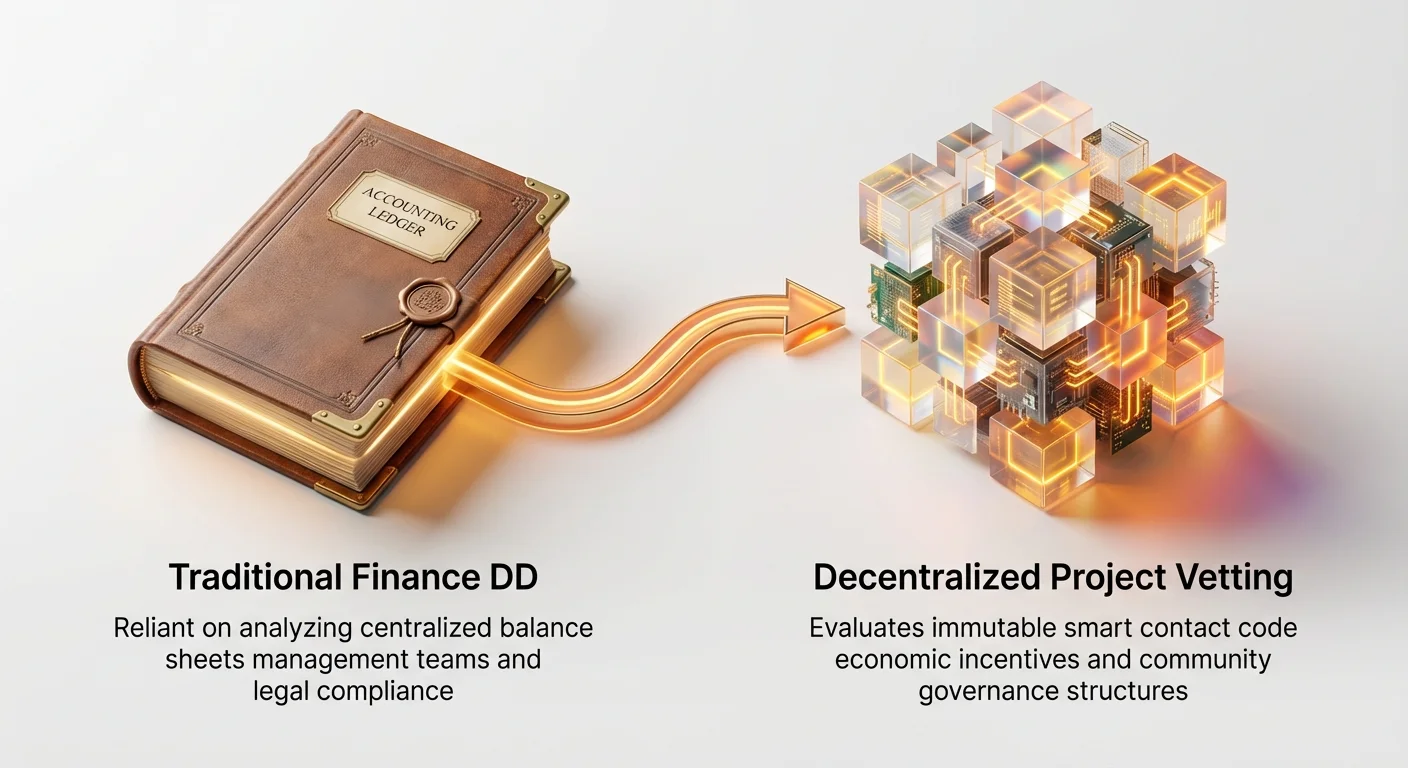
The Shift: From GAAP to Governance
Institutional due diligence, in the context of Web3, is the process of translating technical and community risks into quantifiable financial and operational risks. Before diving into the specifics, it is essential to recognize why a specialized approach is necessary.
The Traditional DD Checklist vs. Web3 Reality
In a typical Series A funding round for a tech startup, due diligence would heavily focus on these elements, which are nearly impossible to apply directly to a decentralized protocol:
- Financials (GAAP Compliance): Vetting revenue, margins, and projected growth using Generally Accepted Accounting Principles (GAAP).
- Web3 Reality: Protocols often don't have revenue in the traditional sense; cash flows are held in smart contracts and distributed according to code. Metrics focus on Total Value Locked (TVL), transaction volume, and fee capture rate.
- Management Team & Structure: Analyzing the leadership’s track record, employment contracts, and corporate structure.
- Web3 Reality: Leadership is often pseudonymous, globally dispersed, and decisions are made through voting mechanisms (DAOs) rather than CEO authority. DD shifts to the core developer team and governance participants.
- Intellectual Property (IP): Ensuring patents, trademarks, and proprietary code are protected.
- Web3 Reality: The core technology is usually open-source, meaning it is deliberately public and non-proprietary. The value lies in network effects, security, and community adoption, not legal ownership.
Identifying Non-Traditional Risk Pillars
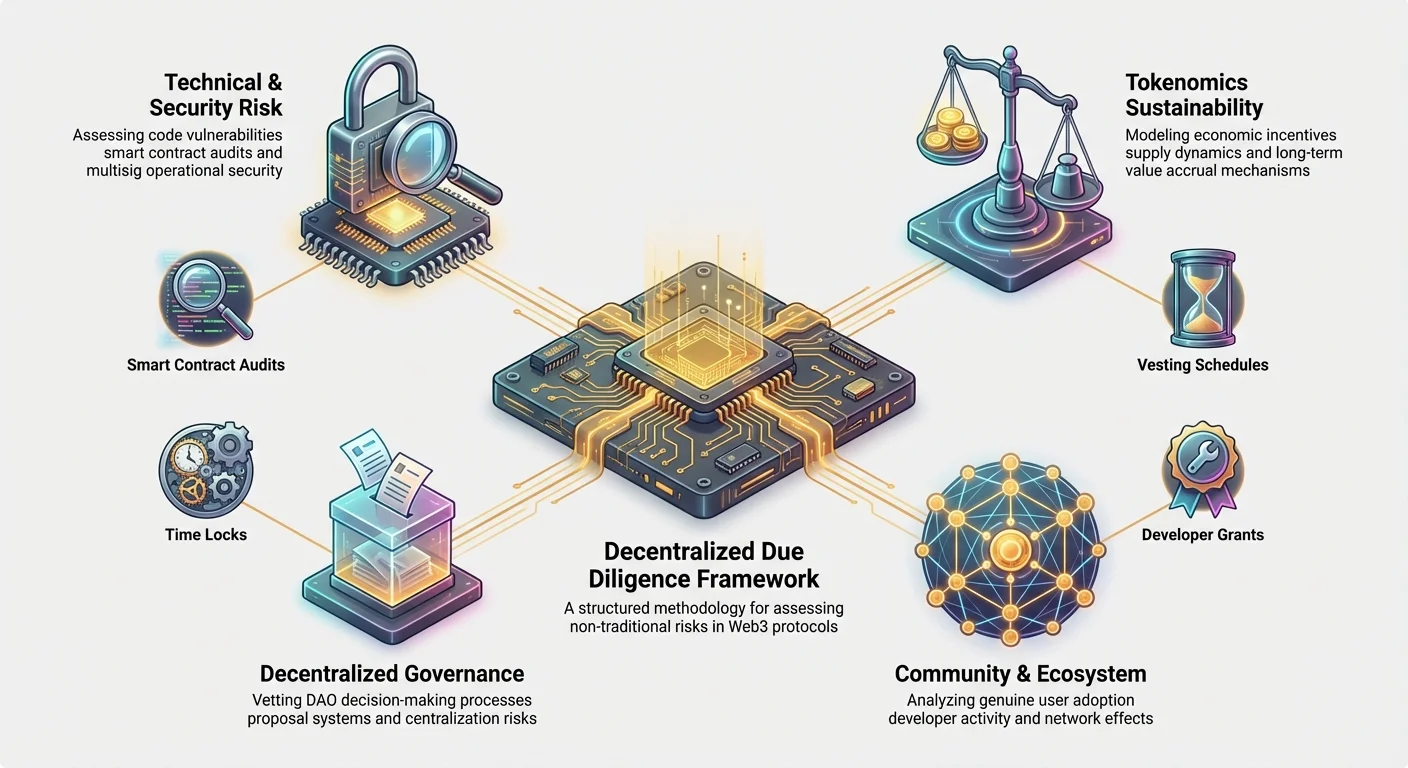
To manage these differences, institutional investors have established four core risk pillars unique to decentralized protocols. These pillars form the backbone of the crypto due diligence framework:
- Technical & Security Risk: The risk that the underlying code contains bugs or vulnerabilities that lead to loss of funds (e.g., smart contract hacks).
- Tokenomics Sustainability: The risk that the project's economic model (incentives, supply, and distribution) is unstable, inflationary, or fails to capture value for the token holders.
- Decentralized Governance Risk: The risk that the decision-making process (DAO) can be hijacked, manipulated, or lead to regulatory non-compliance or internal gridlock.
- Community & Ecosystem Risk: The risk that the project lacks sufficient decentralization, developer support, or genuine user adoption necessary for long-term survival.
Pillar 1: Technical & Security Risk Assessment
The code is the law in a decentralized protocol. Unlike a traditional software application that can be patched quickly by a central team, critical smart contracts often hold billions of dollars and are designed to be immutable once deployed. Therefore, the technical risk assessment is paramount. Institutional DD goes far beyond simply reading an audit report.
Analyzing Smart Contract Audits
A project receiving a "passed" audit from a reputable firm (like CertiK or Trail of Bits) is only the starting point. Vetting requires deeper scrutiny:
- Audit Scope and Depth: Was the entire protocol audited, or just a small, isolated component? Investors look for proof that the most critical, high-value contracts (e.g., those managing collateral or minting tokens) were given the highest scrutiny.
- The Auditor’s Reputation: Not all audit firms are equal. Investors prioritize audits from firms with a proven track record of finding sophisticated zero-day vulnerabilities in similar protocols.
- Fix Implementation Verification: The most overlooked step. A good audit includes identified weaknesses (findings). Investors demand proof that all critical and major findings were patched and, crucially, that the auditor verified the implemented fixes. A report that identifies severe issues but doesn't confirm remediation is a massive red flag.
Actionable Tip: Look for protocols that offer ongoing bug bounties (e.g., via platforms like Immunefi). This shows a commitment to continuous security, recognizing that code is never 100% secure.
Code Quality and Maintainability Review
Because most Web3 code is open-source (hosted publicly on platforms like GitHub), institutional teams perform specialized code reviews focusing on quality indicators. This assesses the project’s future viability and ease of integration.
- Documentation and Comments: Is the code well-documented? Poorly documented, spaghetti code is highly susceptible to future bugs and signals development sloppiness. High-quality protocols provide detailed, up-to-date developer documentation (APIs, integration guides) demonstrating maturity.
- Dependency Management: Protocols often build on components from other projects (e.g., using established libraries like OpenZeppelin). DD ensures that these dependencies are secure, well-maintained, and not subject to potential "supply chain attacks."
- Development Activity: VCs use tools to track GitHub commits, pull requests, and the size of the core development team over time. A healthy project shows consistent, active development, not just large bursts around launch, indicating long-term commitment.
Operational Security and Key Management
Even flawless code can be compromised if the administrative keys are poorly managed. Investors vet the protocol’s internal operational security (OpSec).
- Multisignature (Multisig) Setup: For critical functions (like updating the protocol or accessing the Treasury), a multisig wallet is essential. This requires several independent parties (often foundation members, auditors, or community leaders) to approve a transaction before it executes. Institutional DD verifies:
- The number of required signatures (e.g., 5 of 8).
- The identity and independence of the key holders.
- The security procedures used by key holders (e.g., geographical separation, hardware wallets).
- Time Locks: A time lock requires a mandatory delay between a governance vote (or team decision) and the execution of the change. This provides a crucial safety window for the community or investors to detect and potentially stop a malicious update. VCs assess the length of the time lock—a short time lock (e.g., 2 hours) offers little security, while a longer one (e.g., 48-72 hours) demonstrates prudent risk management.
Pillar 2: Tokenomics Sustainability Modeling
Tokenomics—the economic model governing the creation, distribution, supply, and use of a protocol’s native token—is the economic engine of a Web3 project. A flawed token design can doom a technically perfect protocol. Institutional investors use sophisticated tokenomics analysis tools to stress-test the model.
Understanding Token Distribution and Vesting Schedules
The way a token is initially distributed is a massive indicator of alignment between the founding team, investors, and the community.
- Investor and Team Lock-ups: Investors analyze the vesting schedule—the timeline over which early investors and team members receive their tokens. Long, cliff-based vesting schedules (e.g., 1-year cliff, 3-year linear unlock) are preferred, as they align the founders' long-term success with the protocol’s success and prevent a sudden, massive sell-off (a "rug pull").
- Community vs. Insider Allocation: DD scrutinizes the percentage of tokens allocated to the community, treasury, and staking rewards versus the percentage held by the founding team, VCs, and advisors. A heavily centralized initial distribution implies high potential manipulation and volatility.
- Liquidity Provision: How is initial liquidity established? If the protocol requires significant effort from the founding team to maintain market liquidity, it signals potential weakness. Institutional investors prefer models where the protocol itself incentives decentralized liquidity provision.
Use Case Example: If a founding team receives 20% of the token supply, but 50% of those tokens unlock on Day 1, the risk of a massive supply shock and price collapse is extremely high. Institutional frameworks demand staggered vesting to mitigate this immediate dilution risk.
Utility, Value Accrual, and Inflationary Pressure
A token must have a compelling reason to exist beyond speculation. VCs evaluate how the token captures value and manages its supply.
- Value Accrual Mechanism: Does holding the token provide a genuine benefit?
- Fee Capture: Does the token receive a share of the fees generated by the protocol (e.g., trading fees, lending interest)? This links the token’s value directly to the protocol's usage.
- Staking Rewards: Are the staking rewards sustainable? If rewards are paid out using newly minted tokens (inflation), investors must ensure the inflation rate is offset by network demand and usage.
- Governance Weight: While governance is a utility, VCs prefer models where governance participation is combined with economic incentives to encourage active, responsible participation.
- Supply Dynamics (Inflation/Deflation): Is the token supply fixed, inflationary, or deflationary?
- If inflationary (new tokens are constantly minted, often to pay stakers or miners), the DD framework requires proof that the demand for the protocol’s service will grow faster than the supply inflation, thus preserving token value.
- If deflationary (tokens are burned, often through fees), the DD analyzes the burning mechanism to ensure it is effective and sustainable.
Using Tokenomics Analysis Tools
Sophisticated investors don't rely on simple spreadsheets; they utilize specialized tokenomics analysis tools to model different market scenarios.
- Simulation Modeling: These tools run Monte Carlo simulations (thousands of random outcome scenarios) to test the token’s performance under stress, such as sudden market downturns, high-growth periods, or governance attacks.
- Sensitivity Analysis: This determines how sensitive the token price and project viability are to key external variables (e.g., Ethereum gas prices, competitor launch, decline in overall crypto market cap).
- Demand Elasticity: Investors model the required demand needed to offset inflation. For example, if a token has a 10% annual inflation rate, the DD framework asks: how much new user capital must enter the system annually just to maintain the current price? If the required demand seems unrealistic, the project is flagged as high risk.
Pillar 3: Decentralized Governance Framework Vetting
Decentralized Autonomous Organizations (DAOs) are intended to replace centralized management. However, decentralized governance introduces complex risks, particularly the risk of slow decision-making, regulatory uncertainty, or outright hostile takeovers.
Assessing Governance Attack Vectors
While traditional companies worry about hostile M&A, protocols worry about technical and economic attacks on the governance mechanism itself.
- Voter Apathy and Centralization: If a large percentage of token holders do not participate in voting, the power concentrates among a small number of active wallets (often the founding team, large VC funds, or whales). Institutional DD analyzes the Gini coefficient of voting power to ensure a minimum level of decentralized distribution. A low voter turnout is a major risk, as it makes the protocol vulnerable to attacks that only require buying up a small percentage of currently-voted tokens.
- Flash Loan Attacks: Some protocols allow governance tokens to be temporarily borrowed via flash loans (loans taken and repaid in a single transaction) to pass a malicious governance proposal without ever truly owning the tokens. DD must verify that the governance mechanism is immune to, or mitigates, this vector.
- The 51% Attack Threshold: Investors calculate the cost required to purchase 51% of the liquid, non-staked governance tokens. If this cost is relatively low (e.g., under $50 million for a multi-billion dollar protocol), the project is deemed vulnerable.
Mechanism Design and Proposal Process
How easily and safely can the protocol change? The design of the governance process reflects the project’s maturity and risk tolerance.
- Quorum Requirements: What percentage of the token supply must vote for a proposal to pass? A low quorum (e.g., 1%) makes it easy for a small group to control the future, while an extremely high quorum (e.g., 60%) can lead to governance gridlock, preventing necessary updates. DD seeks a balanced quorum that ensures legitimacy without paralyzing the protocol.
- Proposal Lead Time and Execution: Investors vet the procedural steps:
- Temperature Check: Informal discussion period.
- Formal Proposal: Token snapshot and on-chain voting.
- Execution Delay (Time Lock): The crucial safety buffer reviewed in Pillar 1.
- Emergency Mechanisms: Does the protocol have a pre-defined process for rapidly dealing with a critical security bug? While full decentralization is the goal, some emergency "pause" functions, controlled by a highly secure multisig, are often seen as prudent risk mitigation for billion-dollar DeFi protocols.
Centralization Risks and DAO Structure
Many DAOs are decentralized in name only (DINO). Investors analyze the legal and technical remnants of the founding team.
- Legal Entity Structure: Even if the protocol is decentralized, who handles taxes, legal filings, and real-world contracts? VCs examine the legal foundation (e.g., foundations in offshore jurisdictions) established to support the DAO and shield investors from personal liability.
- Key Dependencies: Does the protocol still rely on centralized infrastructure (e.g., using a single cloud provider for hosting the front-end interface, or requiring manual input from the founding team to deploy specific updates)? Dependencies on centralized choke points represent a single point of failure and regulatory risk.
- Treasury Management: VCs review how the DAO treasury (funds raised and protocol fees) is managed. Is it transparently invested according to community votes, or is control still effectively held by the initial core team?
Pillar 4: Community and Ecosystem Analysis
A decentralized project's competitive advantage lies in its community, network effects, and ability to attract builders. Institutional DD treats the community as a critical non-financial asset.
Measuring True Decentralization and Engagement
Simple metrics like the number of Telegram members are easily gamed. Sophisticated analysis probes deeper into the quality of interaction and decision-making.
- Active User Base Analysis: Investors use on-chain data to differentiate between speculative holding addresses and genuine utility users (e.g., addresses actively engaging with the core smart contracts, not just trading the token). DD focuses on usage metrics like daily active users (DAUs) and the number of unique wallets interacting with the protocol per month.
- Social Sentiment and Discourse Quality: Sentiment analysis tools are used to monitor community forums (Discord, Discourse, governance pages). Is the discussion constructive and technical, or dominated by price speculation and emotional outbursts? A toxic or purely speculative community signals poor long-term potential.
- Geographic and Demographic Diversity: Genuine decentralization means the project is not dominated by a single geographic region or a small, homogenous group. This reduces the project's vulnerability to regulatory actions in one specific jurisdiction.
Developer Activity and Contribution Pipeline
The ability of a project to attract and retain talented developers is the primary indicator of its long-term technological trajectory.
- External Developer Grants: Does the project have a robust, transparent grant program to fund developers outside the core team? A thriving ecosystem relies on third-party builders creating applications on top of the protocol (e.g., wallets, analysis tools, side protocols).
- Core Team vs. External Contributions: Institutional DD seeks to confirm that a significant portion of code contributions and bug fixes come from external, non-team contributors. If the project collapses if the core team leaves, it is centralized.
- Integration Metrics: How many other major crypto projects (or even traditional companies) have integrated or built using this protocol? Strong integrations signal that the protocol is viewed as reliable infrastructure within the broader Web3 ecosystem.
Competitor Analysis in the Web3 Landscape
Competitive analysis in Web3 differs because code is often forkable. Success is measured not just by current functionality, but by network defensibility.
- Forking Risk Assessment: Since competitors can copy the code, investors assess the barriers to entry for a potential "fork" (a copy of the codebase). These barriers include:
- Network effects (e.g., massive user base).
- Capital/Liquidity concentration (e.g., a dominant TVL).
- Proprietary data sets or unique technical innovations.
- Comparative Token Models: How do the project's tokenomics compare to direct competitors? If the competitor offers a fundamentally superior value accrual mechanism (e.g., higher real yield or lower inflation), the project under review is at a severe disadvantage, regardless of its current market share.
Integrating Findings and Calculating Risk Profile
The final step in institutional due diligence is synthesizing the findings from the four pillars into a holistic risk profile and investment recommendation. This moves from analysis to decision-making.
Assigning Weights to Web3 Risk Categories
Not all risks are equal, and the prioritization often depends on the fund's investment thesis (e.g., infrastructure funds, DeFi yield funds, or NFT funds).
| Risk Pillar | Typical Weighting | Priority for Investment Thesis |
|---|---|---|
| Pillar 1: Technical & Security | 35% - 40% | Highest weight for DeFi, Lending, or Layer 1 Protocols (where direct asset loss is the primary risk). |
| Pillar 2: Tokenomics Sustainability | 30% - 35% | Highest weight for Governance Tokens and Yield Protocols (where economic design determines long-term viability). |
| Pillar 3: Decentralized Governance | 15% - 20% | High weight for Infrastructure and DAO-operated Treasuries (where political/operational stability is key). |
| Pillar 4: Community & Ecosystem | 10% - 15% | Moderate weight for all projects; high weight for consumer-facing Web3 applications (where adoption drives value). |
Institutional investors use a scoring matrix, typically grading each sub-component (e.g., Audit verification, Vesting schedule alignment, Quorum sufficiency) on a scale of 1 to 5 (or A to D), then multiplying by the sector-specific weight to produce an overall risk score.
The Red Flags Protocol
While some issues can be mitigated or accepted, certain findings trigger an immediate termination of the investment process (Red Flags). These non-negotiable deal breakers include:
- Unauthorized Key Access: Evidence that a single individual or small, unaudited multisig holds key administrative rights (such as the ability to arbitrarily mint tokens or drain the treasury) without a time lock.
- Undisclosed Security Incidents: Discovering past exploits or hacks that the founding team failed to disclose to investors or the public. This signals a fundamental lack of trust and integrity.
- Regulatory Jurisdiction Ambiguity: If the core developer team or supporting foundation operates in a jurisdiction with immediate or unpredictable hostility toward crypto, the regulatory risk is deemed too high.
- Immediate Financial Instability: Tokenomics modeling shows that required liquidity or ongoing staking rewards will lead to runaway inflation and price collapse within 12–18 months without unrealistic usage growth.
Best Practice: Professional investors often negotiate specific protective measures based on the DD findings. If the governance is too centralized, for instance, a term sheet may require the protocol to implement a minimum 72-hour time lock before the investment is finalized. This is how institutional capital drives better security standards in Web3.
Conclusion
Institutional due diligence for decentralized projects represents a fascinating convergence of computer science, game theory, and traditional finance. It is a necessary evolution of investment practice that shifts the focus from centralized corporate reports to open-source code, aligned incentives, and decentralized governance structures.
For beginners, understanding this framework offers a powerful lens through which to evaluate any Web3 investment. By moving beyond hype and current market price, and instead analyzing the four pillars—Security, Tokenomics, Governance, and Community—investors can better assess the long-term viability, robustness, and true risk profile of decentralized protocols. As the Web3 space matures, these sophisticated, structured vetting methodologies will become the gold standard for capital deployment in the decentralized economy.