
The digital frontier of decentralized finance (DeFi) offers unparalleled opportunities for high returns through activities like yield farming, liquidity provision, and trading on novel protocols. But with high reward comes high risk. Unlike traditional banking, there are no safety nets, chargebacks, or corporate bailouts if you make a mistake. In the world of self-custody, your wallet is your entire security perimeter.
For casual crypto holders, basic security (a strong password and 2FA) might suffice. However, users who frequently interact with new decentralized applications (DApps), known affectionately as "Degens," must adopt a vastly superior set of protective measures known as Operational Security (OPSEC).
OPSEC is not just about choosing a wallet; it’s about strategically managing the trade-off between control and convenience. If you are frequently connecting your wallet to new, often unaudited smart contracts, you are significantly increasing your attack surface. This guide shifts the focus from which wallet is "best" to how you should structure your entire crypto identity to protect your core assets, even when engaging in high-risk, high-frequency activity.
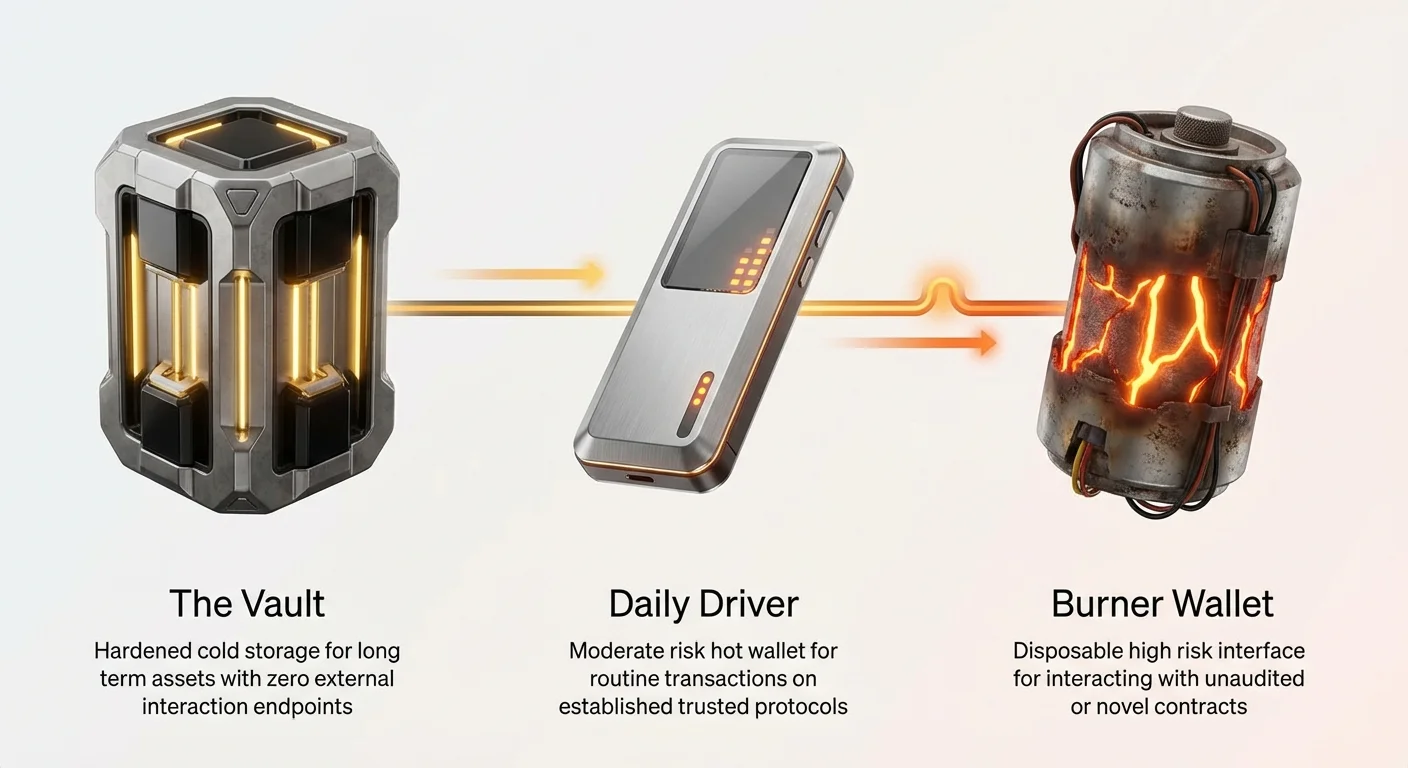
The Principle of Wallet Segregation: Why You Need Multiple Identities
The single most critical piece of Degen OPSEC is segregation. Think of your digital assets like your physical finances: you wouldn't carry your entire life savings in your pocket while visiting a crowded market. Yet, many crypto users use one primary wallet for everything—their long-term savings, their daily swaps, and their experimental farming.
A sophisticated user must adopt a tiered wallet structure, separating their assets based on risk tolerance and liquidity needs. This ensures that a compromise on your active, high-risk wallet does not lead to the loss of your retirement savings.
The Vault: Hardened, Long-Term Storage
The Vault is your ultimate security layer. It holds your core capital, legacy assets (like long-term Bitcoin or Ethereum holdings), and any assets you do not intend to touch for months or years.
Security Profile:
- Custody: Must be held on a hardware wallet (cold storage).
- Interaction: Zero interaction with DApps, smart contracts, or unfamiliar websites.
- Access: Accessed perhaps once or twice a year, ideally using a physically dedicated, air-gapped computer if possible.
- Funding: Only receives funds; never sends funds unless absolutely necessary.
The goal of the Vault is to maintain maximum isolation. Its seed phrase should be secured using highly resilient, offline methods (e.g., engraved metal, dispersed storage).
The Daily Driver: Convenience and Routine Transactions
This wallet serves as your checking account. It contains small to medium amounts of cryptocurrency needed for day-to-day transactions, paying fees (gas), or exchanging assets on highly trusted, well-established centralized exchanges (CEXs) or decentralized exchanges (DEXs) like Uniswap or established staking protocols.
Security Profile:
- Custody: Typically a software wallet (hot wallet) on a mobile device, or a dedicated, lower-cost hardware wallet.
- Risk: Moderate, based on usage frequency.
- Interaction: Limited to high-traffic, multi-audited DApps.
You should mentally budget how much you are comfortable losing in this wallet. If it is compromised, it should be inconvenient, but not catastrophic.
The Burner Wallet: The Essential Degen Shield
The Burner Wallet is specifically designed for high-risk activities: minting new NFTs from unknown projects, farming on new, unaudited protocols, testing smart contract integrations, or responding quickly to short-term opportunities.
The key mindset for the Burner is that it is disposable.
Security Profile:
- Custody: A freshly generated hot wallet, or ideally, a hardware-backed wallet whose keys are only ever exposed when signing a transaction for the Burner account.
- Risk: Extremely High. You assume this wallet will eventually be compromised or suffer an exploit.
- Funding: Funded only with the exact minimum amount needed for the transaction or yield farm (plus gas fees).
- Post-Transaction Strategy: Once assets are successfully transferred or the desired action is complete, assets should be moved out immediately, and the wallet should be drained of all residual funds (including the chain's native token used for gas).
By segregating your assets this way, a sophisticated exploit that drains your Burner Wallet will only claim a small percentage of your capital, while your Daily Driver and Vault remain safe and untouched.
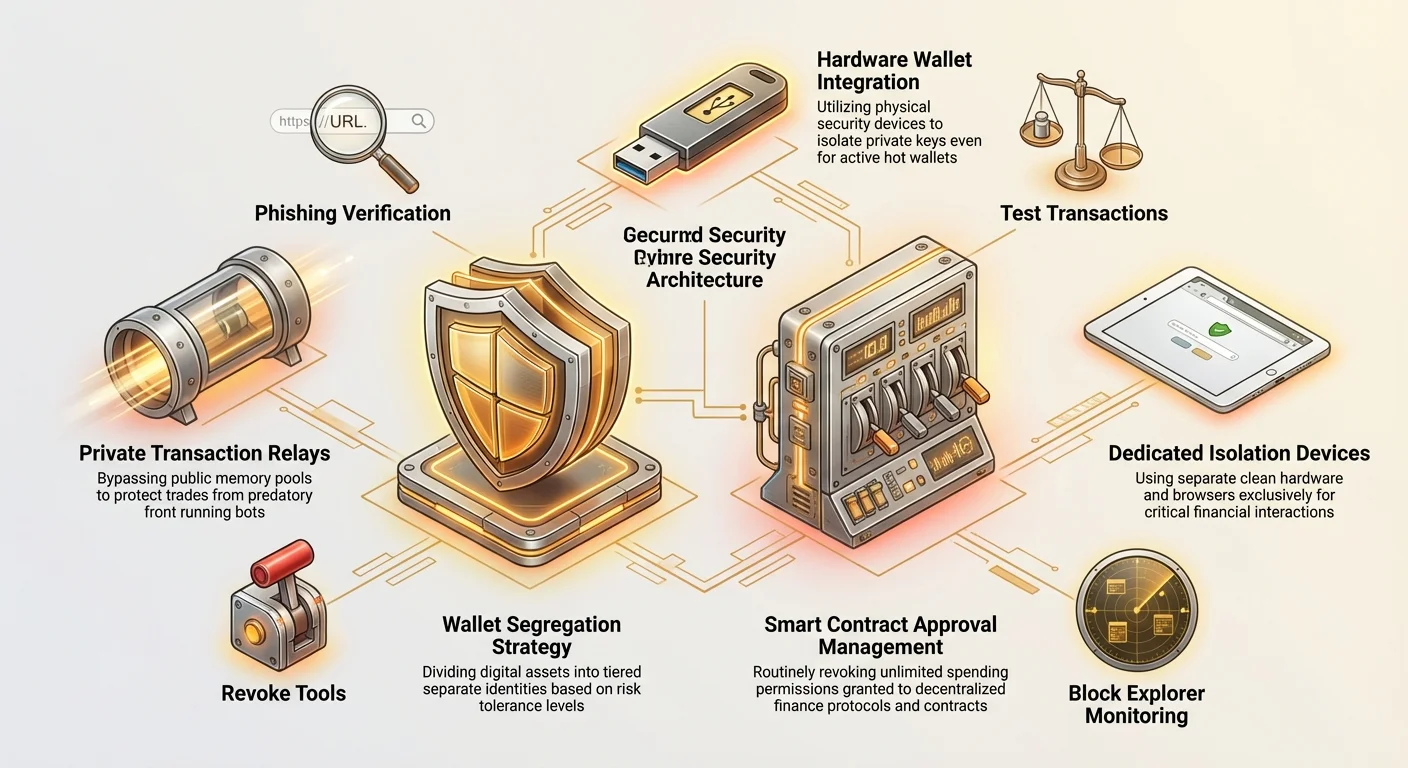
Understanding and Managing Smart Contract Risk
In traditional finance, security is about keeping intruders out of your account. In DeFi, security is about preventing the DApp (the smart contract) from doing more than you intended. When you interact with a new DeFi protocol, you aren’t just sending tokens—you are giving the contract permission to manage your tokens according to its programming.
How Token Approvals Work (The Unlimited Spender Trap)
When you want to trade or stake an ERC-20 token (like USDC or DAI) on a DEX or farming protocol, you must first grant that DApp permission to move the tokens on your behalf. This is done via the approve() function.
The danger lies in the typical default setting: Unlimited Approval.
When you approve a contract to spend your USDC, you often sign a transaction that grants the contract permission to spend an infinite amount of USDC from your wallet. If that contract is later hacked, malicious actors can use the existing unlimited approval you granted to drain your entire balance of that specific token, even if the funds were later moved back into your wallet.
This is why the Burner Wallet strategy is so vital: by keeping minimal funds, the scope of damage from unlimited approval is minimized.
The Crucial Practice of Revoking Approvals
Revoking an approval means resetting the contract’s spending limit to zero. This is a crucial security step that high-frequency users must perform routinely.
When to Revoke Approvals:
- After withdrawing funds: If you exit a farm or liquidity pool, the smart contract retains its unlimited approval. Revoke it immediately.
- After an exploit: If you hear that a protocol you previously used has been hacked, revoke that contract’s approval immediately, even if you weren't actively using it at the time of the hack.
- On a schedule: Make it a weekly or monthly routine to review all active approvals on your Daily Driver and Burner Wallets.
How to Revoke:
Revoking is a specific type of on-chain transaction that costs a small amount of gas. You can use decentralized tools built for this purpose, such as:
- Etherscan/BscScan/Polygonscan (Token Approvals Section): Block explorers now include dedicated sections where you can see all active contracts with spending allowances on your wallet and revoke them directly.
- DApp dashboards (e.g., Debank, Revoke.cash): These platforms connect to your wallet (read-only) and provide a user-friendly list of all active approvals, allowing for one-click revocation.
Always ensure you are using the official block explorer site or a widely trusted third-party tool, as malicious revocation sites are common phishing vectors.
Audits vs. Unaudited Protocols
Before interacting with any protocol, especially with the Daily Driver or Vault (which ideally shouldn't interact at all), check its audit status.
Audited Protocols: These have been reviewed by reputable third-party security firms (like CertiK or Trail of Bits). While an audit is not a guarantee against exploits, it significantly reduces the probability of obvious bugs or backdoors.
Unaudited Protocols (The Degen Domain): Many new or small farms launch without professional audits due to cost or time constraints. Interacting with these protocols belongs exclusively to the Burner Wallet. If you encounter an unaudited contract, assume there is a serious bug or a potential rug pull vector hidden within the code. Never commit significant capital to unaudited contracts.
Operational Security (OPSEC) for DApp Interaction
Wallet segregation protects you if a contract is faulty; high-level OPSEC protects you from yourself and from phishing/malware. These practices focus on maintaining a clean interaction environment.
Wallet Hygiene: Isolating Devices and Browsers
A common security breach occurs when malware or keyloggers installed on a computer intercept your seed phrase or private key during entry, or substitute the wallet address you are sending to.
Dedicated Browser: Use a completely separate, clean web browser (e.g., Firefox for crypto only, Chrome for everything else) that is exclusively for DApp interaction. Do not use this browser for email, social media, file downloads, or torrenting.
Device Isolation (The Ultimate Step): For critical actions (like moving funds into or out of the Vault), use a dedicated, wiped-clean laptop or mobile device that is never used for general browsing, email, or gaming. This reduces the risk of malware infiltration to near-zero.
Verify Before Signing: Always verify the transaction details on your hardware wallet screen (or software wallet pop-up) before confirming. Attackers use scripting methods to change the destination address after you have reviewed the details but before you click ‘confirm.’ A hardware wallet forces you to verify the final details on an isolated, trusted screen.
Phishing Prevention and URL Verification
Phishing remains the number one cause of fund loss in crypto. Degens are particularly vulnerable because they often rush to interact with new protocols based on hype or a short time window.
Triple-Check the URL: Criminals set up exact replicas of popular DEXs or DeFi protocols (e.g., uniiswap.org instead of uniswap.org). Before connecting your wallet, verify the URL character by character. If you receive a link via Discord, Telegram, or email, never click it directly. Instead, manually type the known, correct URL or access it via a trusted resource like CoinGecko.
Never Enter Your Seed Phrase Online: Your seed phrase (the 12 or 24 words) is the master key to your funds. Legitimate DApps, DEXs, or exchanges will never ask you to enter your seed phrase to connect. Any site asking for these words is an immediate and absolute scam.
Disconnecting vs. Revoking (The Critical Difference)
New users often confuse disconnecting their wallet from a DApp with revoking the contract approval. They are completely different actions:
- Disconnecting: This simply severs the browser connection (via WalletConnect or the browser extension) between your front-end wallet interface and the website. It prevents the website from requesting new transactions from you. It is essential for daily security hygiene but provides zero protection against a compromised smart contract.
- Revoking (The Smart Contract Approval): This is the on-chain action that cancels the smart contract’s permission to spend your tokens. This is the only action that provides security against a future exploit of the protocol you interacted with.
Always perform both: disconnect the browser interface, and then use a trusted block explorer tool to revoke the token approvals you granted.
Mitigating Advanced Network Risks (MEV and Front-Running)
As you move into high-frequency trading, arbitrage, or complex DeFi positions, you face risks that exist beneath the surface of the blockchain itself—risks related to transaction ordering and confirmation.
What is MEV and How Does it Affect Transactions?
MEV stands for Maximal Extractable Value. It refers to the profit miners (or validators, in Proof-of-Stake systems) can make by arbitrarily including, excluding, or changing the order of transactions within a block they are producing.
Front-Running: The most common form of MEV affecting Degen users is front-running. If you submit a large swap order, bots run by searchers or validators see your transaction in the public pending transaction pool (the mempool). They instantly submit two transactions of their own: one before yours (buying the asset you are about to buy, driving the price up) and one immediately after yours (selling the asset at the new, higher price). This essentially steals value from your trade by manipulating the market based on your known intent.
Using Private Relays to Hide Intent
To combat front-running, advanced Degen users leverage private transaction relays (like Flashbots for Ethereum).
When you send a transaction normally, it goes into the public mempool where MEV bots operate. When you use a private relay service:
- Your transaction is sent directly to a validator (block builder).
- The transaction bypasses the public mempool entirely.
- The validator only processes your transaction if it meets your requirements (e.g., specific slippage limits).
Using a private relay protects you from malicious front-running and provides a cleaner execution price, although it may require the use of specific wallet features or dedicated DApps that integrate these services.
Slippage Control and Execution Timing
When trading, you set a "slippage tolerance"—the maximum percentage the price can move against you before the transaction fails.
- Too High Slippage (e.g., 5%): Increases your risk of MEV extraction and bad execution price, as bots have a wide margin to profit within.
- Too Low Slippage (e.g., 0.1%): Protects your price but increases the chance of your transaction failing (wasting gas) during volatile market conditions.
Degen Tip: For large, high-value trades, always calculate the optimal slippage limit manually and avoid peak network congestion times (where gas wars and MEV activity are highest). If interacting with a low-liquidity pool, be prepared to pay a higher slippage tolerance, but consider breaking the transaction into smaller chunks spread over time to reduce the overall loss to slippage.
The High-Stakes World of Cross-Chain Bridging
As the crypto ecosystem has matured, assets have spread across multiple layer-1 and layer-2 networks (Ethereum, Solana, Arbitrum, Optimism, etc.). Moving assets between these chains requires a bridge, which is one of the single riskiest activities in modern DeFi.
Bridges are prime targets because they often custody vast pools of assets (liquidity) needed to swap tokens between chains, making them a "single point of failure" for billions of dollars. Historically, some of the largest crypto hacks have targeted bridge contracts.
Understanding Bridge Mechanics (Wrapped Assets vs. Liquidity Pools)
Not all bridges operate the same, and understanding the mechanism helps you assess the risk:
- Lock-and-Mint Bridges (Wrapped Assets): When you bridge ETH from Ethereum to Polygon, a contract on Ethereum locks the ETH, and an equivalent amount of 'wrapped' ETH is minted on the Polygon side. The risk here is the security of the locking contract and the multi-sig group responsible for validating the minting process. If the locking contract is compromised, your locked funds can be drained.
- Liquidity Pool Bridges (Swap Bridges): These operate more like DEXs. You deposit ETH on Chain A, and the protocol automatically sells or transfers ETH to buy native tokens already pooled on Chain B. The risk here is pool imbalance or compromise of the routing contracts.
Always prefer officially recognized and widely audited bridges (e.g., the official bridge for an L2 solution) over new, proprietary bridges from small protocols.
Security Checklist for Bridge Selection
Before committing large funds to a bridge, run through this checklist:
| Security Factor | Low-Risk Bridge (Use with Daily Driver) | High-Risk Bridge (Use with Burner Wallet Only) |
|---|---|---|
| Audit Status | Multiple audits by top firms (CertiK, Trail of Bits). | Unaudiated or single, unknown audit. |
| TVL (Total Value Locked) | High TVL (indicating broad use and security confidence). | Low TVL (may indicate a lack of trust or limited liquidity). |
| Team Transparency | Public, well-known team; official documentation. | Anonymous team, sparse documentation. |
| Protocol Age | Operating successfully for over 1 year. | New (launched in the last 6 months). |
| Withdrawal Requirements | Standard, automated withdrawal processes. | Requires manual validation or lengthy lockup periods. |
The Importance of Small Test Transactions
Given the complexity and risk, never send a large amount of crypto through a bridge on the first try.
The Test Transaction Strategy:
- Send the absolute minimum viable amount (e.g., $5-$10) across the bridge.
- Wait for the transaction to fully confirm on the destination chain.
- Ensure the assets are redeemable and appear correctly in your wallet.
- Once the test is confirmed successful, proceed with the larger transfer.
This costs marginally more in gas but can save 100% of your assets if the bridge is faulty, malicious, or if you accidentally selected the wrong network endpoint.
Advanced Tools for Degen Wallet Management
Implementing a rigorous OPSEC strategy requires more than just good habits; it requires leveraging the right tools that allow you to monitor and manage your wallet interactions efficiently.
Block Explorers as Your Security Dashboard
Block explorers (Etherscan, Arbiscan, etc.) are often seen only as tools to track transactions, but they are your primary security dashboard.
Monitoring Tools:
- The Approval Checker: As mentioned, use the 'Token Approvals' feature to routinely inspect permissions granted by your Degen Wallets.
- Transaction Status Review: When a DApp interaction feels suspicious, pull up the transaction hash on the explorer. Review the input data to ensure the function call and parameters match what you expected (e.g., checking that the amount being approved is correct, or that the destination address is the contract you intended).
- Checking Contract Source Code: For truly advanced users, the explorer shows the verified source code of the contract. While complex, a quick check can reveal if the code is verified or if it’s a proxy pointing to an unverified implementation, which is a significant red flag.
Using Hardware Wallets Strategically
While a hardware wallet is often associated with the Vault, its greatest utility for the Degen is acting as the security backbone for the Burner Wallet.
A hardware wallet allows you to generate multiple accounts (addresses) from a single master seed phrase. You can designate one address as the Vault (never used) and a completely separate address (on the same physical device) as the Burner Wallet.
Hardware-Backed Burner Benefits:
- Key Isolation: The private key for the Burner Wallet never leaves the secure chip of the hardware device, even though the wallet is actively interacting with high-risk DApps.
- Mandatory Verification: Every single transaction confirmation (including token approvals and revocations) must be physically confirmed on the device’s screen, preventing remote signing or malicious scripting.
Using a hardware-backed Burner maximizes OPSEC by combining the convenience of a hot wallet interface (like MetaMask) with the ironclad security of cold storage key management.
Multi-Sig as a Buffer Layer
For high-net-worth Degens or those managing shared capital for farming operations, a Multi-Signature (Multi-Sig) wallet should be used as the ultimate buffer between the Vault and the Daily Driver/Burner operations.
A Multi-Sig requires multiple private keys (or signatories) to approve any transaction (e.g., 2 out of 3 keys needed).
Multi-Sig Utility:
- Entry/Exit Gate: Any movement of large capital from the Vault must first go to a Multi-Sig intermediate wallet. Then, the Multi-Sig signs off on the transfer to the Daily Driver.
- Compromise Protection: If one of the three keys is compromised (e.g., a laptop is hacked), the attacker still cannot move funds without the other two keys signing off, providing redundancy.
(See our guide on Multi-Signature Wallets for Governance and Trust Models for a deeper dive into this architecture.)
Conclusion: OPSEC is a Continuous Process
The journey into DeFi, yield farming, and high-frequency crypto interaction is inherently risky, but the risks can be managed effectively through a continuous commitment to Operational Security.
The Degen Wallet strategy is not about choosing the "safest" brand of software; it is a philosophy built on isolation, verification, and revocation.
- Isolate: Separate your assets into tiered wallets (Vault, Daily Driver, Burner) based on risk exposure.
- Verify: Triple-check URLs, verify transaction details on your hardware device, and use private transaction relays to secure execution.
- Revoke: Treat unlimited smart contract approvals as temporary permissions; revoke them immediately upon exiting any DApp.
By adopting this strategic, multi-layered approach, you shift your identity from a target of opportunity to a hardened user, allowing you to responsibly navigate the most volatile and innovative sectors of the crypto economy while protecting your core capital.