
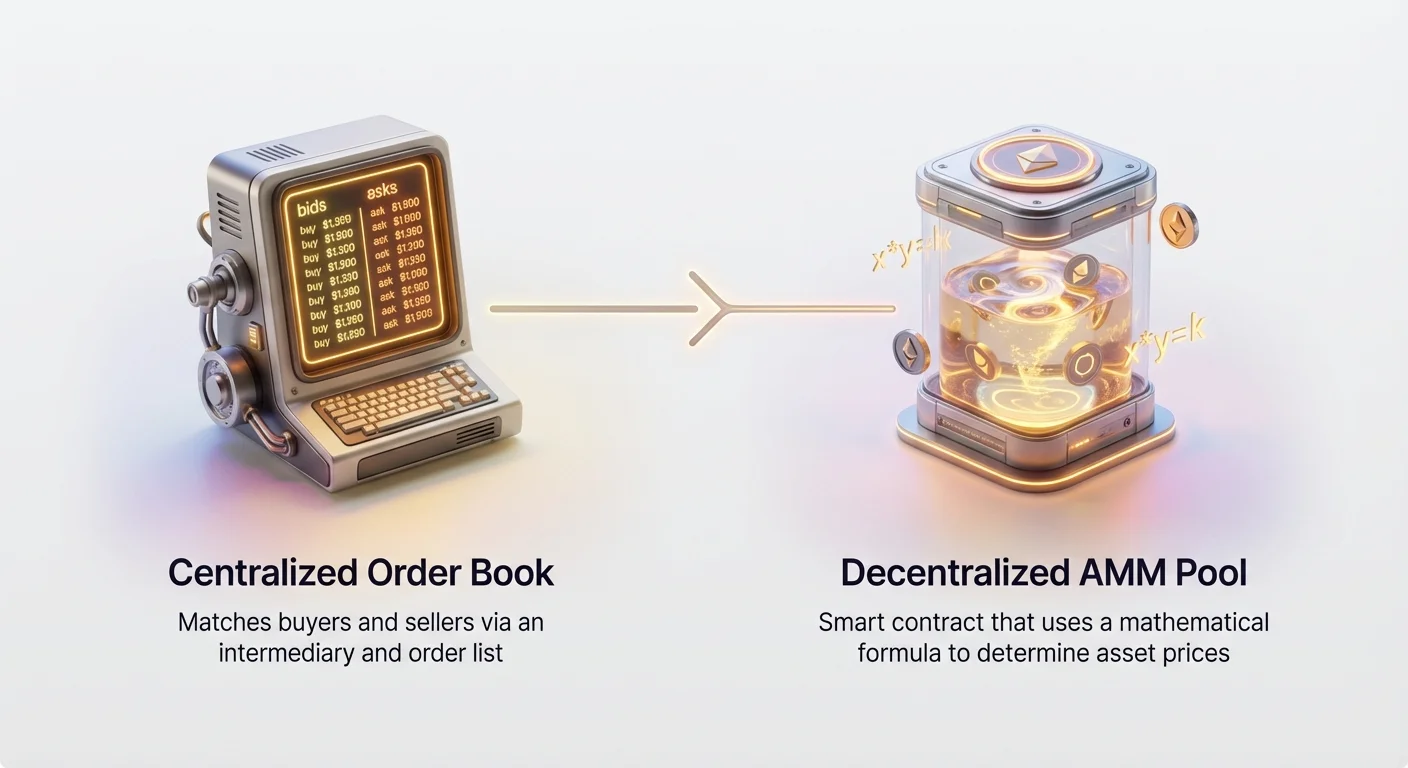
Iedomājieties, ka mēģināt apmainīt valūtu svešā valstī bez bankām, brokeriem vai centralizētām biržām. Tradicionālajā finanšu pasaulē aktīvu pirkšana un pārdošana balstās uz centrālu rīkojumu grāmatu, kurā pircējus (piedāvājumus pirkt) un pārdevējus (piedāvājumus pārdot) saskaņo starpnieks.
Kad kriptovalūtu pasaule pārgāja uz decentralizētām biržām (DEX), radās jauna problēma: kurš veic saskaņošanu un nodrošina, ka vienmēr ir kāds, kas ir gatavs tirgoties, 24/7, bez centrālās iestādes?
Risinājums ir Automatizētais Tirgus Uzturētājs (AMM). AMM ir galvenā infrastruktūra, kas darbina decentralizētās finanses (DeFi). Tie aizstāj tradicionālos pircējus un pārdevējus ar viedajiem līgumiem, kas matemātiski nosaka aktīvu cenas un automātiski izpilda darījumus. Kripto iesācējiem AMM izpratne ir kā ieskatīšanās zem DEX dzinēja pārsega – tas ir tas, kur patiesi notiek maģija, matemātika un nauda.
Šis ceļvedis soli pa solim iepazīstinās jūs ar tehnoloģiju, kas veicina apmaiņu, pretstatot oriģinālos, revolucionāros konstanto funkciju modeļus ar sarežģītākām, efektīvākām koncentrētas likviditātes sistēmām, kas mūsdienās dominē DeFi vidē.
The Foundations of Decentralized Trading
To understand why AMMs are necessary, we first need to appreciate the mechanism they replaced: the centralized order book.
Order Books vs. Liquidity Pools: The Problem AMMs Solved
In a traditional or centralized crypto exchange (like Coinbase or Binance), trading is facilitated by an order book.
Order Book: This is a list of all current offers to buy (bids) and sell (asks) a specific asset at various prices. When you place a market order, the exchange looks for a matching bid or ask in the book and executes the trade. This requires professional market makers (large firms or institutions) to constantly provide bids and asks to ensure enough assets are available for trading.
The Challenge in DeFi: Decentralized platforms cannot rely on a single, continuously updated, centralized order book. They need a decentralized, trustless, and always-on system.
AMMs solve this by introducing liquidity pools. Instead of matching buyers and sellers, traders interact directly with a pool of tokens locked within a smart contract. The price is not determined by the last bid/ask but by the ratio of the tokens remaining in the pool.
Defining the Automated Market Maker (AMM)
An Automated Market Maker (AMM) is simply a smart contract that manages a pool of two or more tokens and uses a mathematical formula (an algorithm) to determine the price relationship between them.
When a trader wants to swap Token A for Token B:
- They send Token A to the smart contract pool.
- The AMM uses its formula to calculate how much Token B they should receive based on the pool’s current ratio.
- Token B is released to the trader.
Because Token A was added and Token B was removed, the ratio within the pool changes, causing the price of Token B to increase relative to Token A. This process ensures the pool remains mathematically balanced and liquid.
The Role of Liquidity Providers (LPs)
AMMs are useless without tokens to swap. This is where Liquidity Providers (LPs) come in. LPs are everyday users (or institutions) who deposit an equal value of two different assets into the pool (e.g., $1,000 worth of ETH and $1,000 worth of USDC).
In return for providing this crucial liquidity, LPs receive:
- LP Tokens: These represent their share of the pool.
- Trading Fees: A small percentage fee is charged on every trade that occurs in that pool (usually 0.05% to 0.3%). These fees are collected by the pool and distributed proportionally to all LPs.
LPs are essentially the decentralized market makers, earning income for enabling global trading.
The Constant Product Market Maker (CPMM) — The Pioneer
The first successful and most widely implemented AMM model was the Constant Product Market Maker (CPMM), famously popularized by Uniswap V1 and V2. This model established the core foundation for virtually all decentralized swapping.
The Core Formula: $x * y = k$
The Constant Product Market Maker operates under one inviolable rule: the product of the quantities of the two tokens in the pool must always remain constant.
- x: The reserve amount of Token A (e.g., ETH)
- y: The reserve amount of Token B (e.g., DAI or USDC)
- k: The constant product (a fixed number)
The Rule: $x$ multiplied by $y$ must always equal $k$.
When a swap occurs, the ratio of $x$ and $y$ changes, but the algorithm ensures that the product remains $k$. This mechanism inherently dictates the price:
- If you remove a large amount of $y$, the pool must demand a proportionally larger amount of $x$ to restore the product $k$.
- The price of $y$ (in terms of $x$) increases automatically, reflecting the scarcity created by the trade.
Example: The CPMM Balance
Imagine a simple ETH/DAI pool where the price of ETH is 1,000 DAI.
| Pool State | ETH (x) | DAI (y) | Constant (k) | ETH Price (DAI/ETH) |
|---|---|---|---|---|
| Initial State | 100 ETH | 100,000 DAI | 10,000,000 | 1,000 |
| Trade (Buy 5 ETH) | 95 ETH | 105,263 DAI | 10,000,000 | ~1,108 |
To buy just 5 ETH, the trader had to pay 5,263 DAI (5,263 / 5 = 1,052.6 DAI per ETH average). The exchange resulted in the ETH price within the pool increasing from 1,000 to 1,108. The algorithm constantly moves along the price curve to maintain the value $k$.
How Swaps Affect the Pool (and Price Discovery)
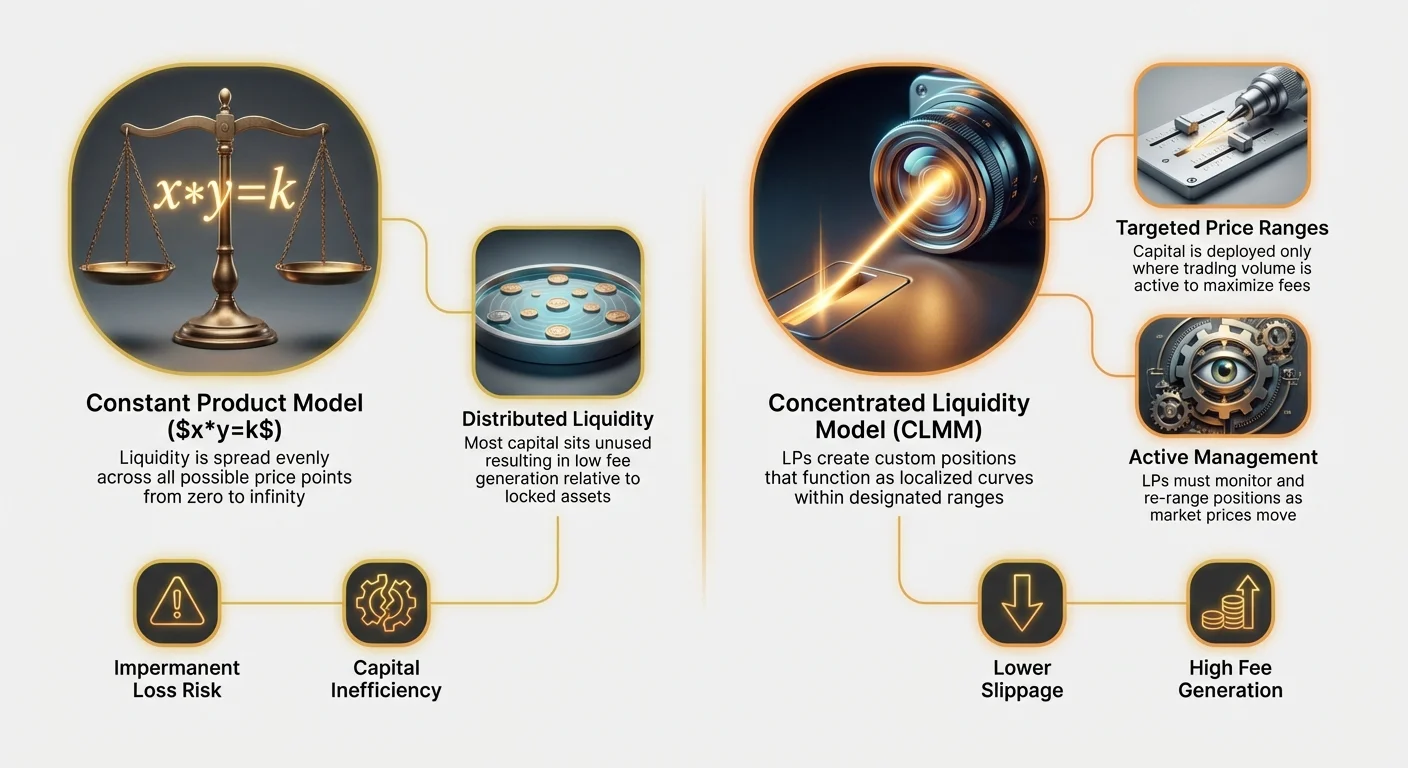
The geometric curve generated by the $x * y = k$ formula means that liquidity is distributed evenly across all possible price points, from $0 to infinity$.
- Smaller Trades: If the amounts being swapped are small relative to the size of the pool, the movement along the curve is minimal, and the trader gets a price close to the current market rate.
- Larger Trades (Slippage): If the trade involves a large amount, the pool ratio shifts dramatically, pushing the price far along the curve. This results in slippage—the difference between the expected price when the order is submitted and the executed price when the transaction is completed. Large CPMM pools are vulnerable to high slippage.
Understanding Impermanent Loss in CPMM
While providing liquidity sounds like a profitable endeavor, it introduces a major risk known as Impermanent Loss (IL). This is one of the most misunderstood concepts for new LPs.
Definition: Impermanent Loss is the temporary difference in value between simply holding two assets (HODLing) and depositing them into an AMM liquidity pool. It arises when the price ratio of the deposited tokens changes.
Why IL Occurs
When the price of one asset (say, ETH) rises dramatically outside the pool (on a centralized exchange), arbitrage traders step in. They buy the now relatively cheaper ETH from the liquidity pool until the price ratio inside the pool matches the external market price.
Because the pool maintains $x*y=k$, the arbitrage trader effectively removes some of the appreciating asset (ETH) and leaves more of the stable asset (DAI).
- If ETH price doubles, the pool algorithm requires LPs to end up with fewer ETH and more DAI than they started with.
- This results in a smaller total dollar value than if the LP had simply kept the original 50/50 portfolio in their wallet.
The loss is called "impermanent" because if the price ratio returns to the original deposit ratio, the loss vanishes. However, if the LP withdraws their liquidity before the price ratio reverts, the loss becomes permanent.
The Problem of Capital Inefficiency
The inherent design of the CPMM model—distributing liquidity across the full spectrum of possible prices ($0$ to )—is its greatest limitation.
Consider the ETH/USDC pool: ETH currently trades between $3,000 and $4,000. It is extremely unlikely that ETH will trade at $1 or $1,000,000 in the near future.
In a traditional CPMM pool, the liquidity provided is spread out across these virtually irrelevant price points.
Result: A vast majority of the capital provided by LPs sits unused, resulting in low fee generation relative to the total assets locked. This is known as capital inefficiency. LPs need to provide massive amounts of capital to make the trading experience smooth (i.e., reduce slippage) within the current price range.
Limitations and the Need for Evolution
While CPMM was a breakthrough, the capital inefficiency and high potential for slippage on highly correlated assets prompted DeFi builders to innovate, leading to specialized AMMs and, eventually, concentrated liquidity models.
High Slippage for Large Trades
Slippage is the enemy of high-volume traders. Because the CPMM curve is asymptotic (it approaches the axes but never touches them), moving along the curve becomes progressively more expensive as the pool becomes imbalanced.
If a fund wants to swap $10 million USDC for ETH, they would incur catastrophic slippage in a standard CPMM pool unless that pool had hundreds of millions of dollars of depth. To maintain a smooth trading experience, the system needed a way to put all available capital where the trades actually occur.
Wasted Capital (Liquidity Across All Prices)
As noted, liquidity deployed outside the current price range is functionally useless for current traders. LPs were tying up significant collateral that was generating zero fees.
This wastage became a major driving factor for creating a better model. LPs wanted to increase their return on investment (ROI) by maximizing fee generation on their deposited assets.
Specialized AMMs: Optimizing for Stablecoins
The inefficiencies of CPMM were particularly glaring for highly correlated assets, such as two stablecoins (USDC and DAI) or two wrapped Bitcoin tokens (WBTC and renBTC). Since the ideal price ratio for these assets is almost exactly 1:1, a CPMM curve is too volatile and expensive for swaps.
This led to the creation of specialized AMMs, such as the one popularized by Curve Finance, which use a StableSwap Invariant.
- StableSwap Function: This formula mixes the behavior of a standard AMM (to maintain reserves) with that of a traditional arithmetic mean (straight line) around the 1:1 peg.
- Result: Extremely low slippage for trades near the peg, allowing users to swap millions of dollars between stablecoins with minimal friction. However, this model only works for assets that are meant to be equal in value.
The success of these specialized AMMs demonstrated that liquidity efficiency was the key metric for the next generation of general-purpose AMMs.
Koncentrētas Likviditātes Ieviešana (Spēles Mainītājs)
Risinājums kapitāla neefektivitātes problēmai parādījās, ieviešot Koncentrētas Likviditātes Tirgus Uzturētājus (CLMM), ko visievērojamāk ieviesa Uniswap V3 2021. gadā.
Koncentrēta likviditāte būtiski maina to, kā LP izvieto savu kapitālu. Tā vietā, lai sadalītu līdzekļus visā cenu spektrā, LP var izvēlēties veltīt savu kapitālu tikai konkrētiem, noteiktiem cenu diapazoniem.
Kas ir Koncentrēta Likviditāte? (Uniswap V3 Modelis)
Tradicionālā CPMM ($xy=k$) likviditāte ir visur. CLMM LP rada pielāgotas, individuālas pozīcijas, kas darbojas kā lokalizētas $xy=k$ līknes noteiktā diapazonā.
Iedomājieties ETH/USDC fondu, kurā ETH pašlaik ir $3,500.
- CPMM: LP ir jānogulda likviditāte visā diapazonā ($0 līdz $\infty$).
- CLMM: LP var izvēlēties noguldīt likviditāti tikai starp $3,000 un $4,000.
Kad ETH cena atrodas šajā $3,000–$4,000 diapazonā, LP kapitāls ir aktīvs, pelnot maksas. Kad cena pārvietojas ārpus šī diapazona (piemēram, nokrītas līdz $2,900), LP kapitāls kļūst neaktīvs un pārtrauc ģenerēt maksas.
Cenu Diapazonu noteikšana: Kapitāla izvietošana tur, kur tas ir svarīgi
Iespēja pielāgot cenu diapazonus ļauj LP stratēģiski mērķēt savu kapitāla izvietošanu.
1. Šauri Diapazoni (Agresīva Stratēģija)
- Piemērs: LP nosaka diapazonu starp $3,400 un $3,600, kad ETH ir $3,500.
- Ieguvums: Tā kā šī likviditāte ir koncentrēta tieši tur, kur notiek tirdzniecības apjoms, tā ģenerē ievērojami vairāk maksu nekā tas pats kapitāla apjoms, kas izkliedēts plaši.
- Risks: Brīdī, kad ETH pārvietojas ārpus šīs šaurās $200 joslas, LP pozīcija kļūst pilnīgi neaktīva, un visi viņu līdzekļi pilnībā pārvēršas mazāk vērtīgajā aktīvā (realizēta nepastāvīgā zaudējuma veids).
2. Plati Diapazoni (Konservatīva Stratēģija)
- Piemērs: LP nosaka diapazonu starp $2,000 un $5,000.
- Ieguvums: Mazāka iespējamība, ka šī pozīcija kļūs neaktīva, samazinot nepieciešamību pēc pastāvīgas uzraudzības.
- Trūkums: Tā ģenerē mazāk maksu, salīdzinot ar šauru diapazonu, jo kapitāls ir izkliedēts plānāk. Tas vairāk līdzinās vecajam CPMM modelim.
Riska un Atlīdzības Pielāgošana (Aktīva Pārvaldība)
Koncentrēta likviditāte pārveido LP lomu no pasīva noguldītāja par aktīvu pārvaldnieku.
Uniswap V2 (CPMM) LP varēja "iestatīt un aizmirst" savu pozīciju. V3 (CLMM) LP ir aktīvi jāuzrauga tirgus. Ja aktīva cena atstāj viņu noteikto diapazonu, viņiem ir jāmaksā gāzes maksas, lai pārorientētu savu pozīciju (t.i., izņemtu neaktīvo kapitālu un pārvietotu to jaunā, atbilstošā diapazonā).
Šī maiņa būtiski palielināja sarežģītību LP, bet masveidā palielināja DEX ekosistēmas kapitāla efektivitāti kopumā.
Koncentrētas likviditātes mehānika padziļināti
Lai patiesi izprastu koncentrētas likviditātes spēku, mums jāizpēta, kā sistēma pārvalda aktīvus un izpilda darījumus noteiktā joslā.
Kā notiek maiņa noteiktā diapazonā
Kad tirgotājs veic maiņu koncentrētas likviditātes DEX, protokols aplūko visas pieejamās individuālās LP pozīcijas (vai "atzīmes"), lai atrastu visefektīvāko ceļu.
- Vairāki fondi vienā pārī: Atšķirībā no CPMM, kur ir viens fonds, CLMM pāris (ETH/USDC) sastāv no potenciāli tūkstošiem pārklājošos, individuālu likviditātes diapazonu, ko noteikuši dažādi LP.
- Dzinējs: Kad notiek maiņa, viedais līgums aprēķina nepieciešamo tirdzniecības apjomu, patērējot likviditāti, sākot no pozīcijas, kas ir vistuvāk pašreizējai cenai.
- Patēriņš: Tā kā darījums patērē likviditāti viena LP šaurajā diapazonā, cena mainās, līdz tā sasniedz šī diapazona robežu. Tiklīdz robeža ir sasniegta, šī konkrētā pozīcija tiek izsmelta (viens aktīvs tiek pilnībā izņemts), un darījums automātiski pāriet uz nākamo blakus esošo LP pozīciju/diapazonu, turpinot maiņu jaunajā cenu līmenī.
Šis mehānisms nodrošina, ka lielākie darījumi tiek izpildīti, slaukot vairākas šauras joslas, izmantojot maksimālu kapitāla efektivitāti, vienlaikus samazinot slīdēšanu tirgotājam, salīdzinājumā ar CPMM.
Pārorientēšanas jēdziens (likviditātes līmeņi)
Ja LP nosaka šauru diapazonu $3,400–$3,600, un cena nokrītas līdz $3,300, pozīcija vairs nav aktīva.
Kas notiek ar kapitālu?
Kad cena pazeminās zem $3,400:
- Viss sākotnējais ETH ir pārdots no fonda.
- LP kapitāls tagad 100% sastāv no USDC (aktīvs ar zemāku vērtību šajā lejupejošajā tendencē).
- Kapitāls stāv dīkstāvē, nepelnot nekādas tirdzniecības maksas, efektīvi darbojoties kā 100% ekspozīcija pret USDC šajā cenu punktā.
Lai atgrieztos spēlē, LP ir jāveic pārorientēšana:
- Izņem 100% USDC kapitālu.
- Ārēji apmaina pusi no USDC pret ETH (vai gaida, kad cena atjaunosies).
- Nogulda līdzekļus jaunā, zemākā aktīvajā diapazonā (piemēram, $3,200–$3,400).
Šī nepieciešamība pēc pastāvīgas pārvaldības un pārorientēšanas ir galvenās darbības izmaksas LP CLMM.
The Trade-Off: Increased Capital Efficiency vs. Increased Management Complexity
Koncentrēta likviditāte lieliski atrisināja kapitāla efektivitātes problēmu, taču radīja jaunus kompromisus:
| Iezīme | Koncentrēta Likviditāte (CLMM) | Konstantā Funkcija (CPMM) |
|---|---|---|
| Kapitāla Efektivitāte | Ļoti Augsta. Līdzekļi ģenerē maksimālas maksas par kapitāla vienību. | Zema. Lielākā daļa likviditātes netiek izmantota neatbilstošās cenās. |
| Sarežģītība LP | Augsta. Nepieciešama aktīva uzraudzība, gāzes maksas par pārorientēšanu un riska pārvaldība. | Zema. Iestatiet un aizmirstiet; apkope ir minimāla. |
| Nepastāvīgais Zaudējums (IL) | Potenciāli Augstāks. Šauri diapazoni spiež LP ātri pāriet uz vērtību zaudējošu aktīvu, ātrāk realizējot IL. | Zemāks/Lēnāks. IL ir izplatīts pa masīvu cenu līkni. |
| Slīdēšana Tirgotājiem | Zema. Lielāks dziļums tur, kur notiek cenu darbība. | Augsta. Zems dziļums pie pašreizējām cenām, ja vien fonds nav masīvs. |
Izsmalcinātiem lietotājiem palielinātais maksu ģenerēšanas potenciāls parasti atsver sarežģītību. Iesācējiem CPMM modelis joprojām ir drošāks un vieglāk lietojams, kas ir iemesls, kāpēc daudzi jaunāki, uz iesācējiem orientēti DEX izmanto hibrīdus modeļus vai piedāvā vienkāršotas LP stratēģijas.
AMM modeļu salīdzinājums: CPMM vs. Koncentrēto
Atšķirība starp pionieri CPMM modeli un moderno CLMM modeli ir noteicošais kontrasts mūsdienu decentralizētajās finansēs.
Kapitāla Efektivitāte: Līdzekļu Saprātīga Izmantošana
Kapitāla efektivitāte ir rādītājs, kas mēra, cik lielu apjomu (un līdz ar to cik daudz maksu) fonds var ģenerēt attiecībā pret kopējo bloķēto aktīvu vērtību (TVL).
CLMM sasniedz eksponenciāli augstāku efektivitāti. Dažos liela apjoma pāros Uniswap V3, $10 miljoni USD TVL var atbalstīt tādu pašu tirdzniecības apjomu ar tādu pašu minimālu slīdēšanu, kas varētu prasīt $100 miljonus USD TVL tradicionālā CPMM fondā.
Ietekme: Augstāka kapitāla efektivitāte nozīmē, ka tirgotāji saņem labākas izpildes cenas ar mazāku nepieciešamību pēc masīvas institucionālās likviditātes, padarot DeFi noturīgāku un pieejamāku.
Slīdēšanas ietekme un dziļums
Slīdēšana nosaka maiņas reālo cenu.
- CPMM: Slīdēšana vienmēr ir visa fonda $k$ funkcija. Ja fonds ir sekla, lieli darījumi izraisa masīvas cenu kustības.
- CLMM: Slīdēšanu nosaka kopējā apvienotā likviditāte konkrētajā cenu diapazonā darījumam. Tā kā LP koncentrē savus līdzekļus šeit, tirgotājam pieejamais efektīvais "dziļums" ir daudz lielāks, kā rezultātā ir mazāka slīdēšana tāda paša izmēra darījumam.
CLMM būtībā imitē tradicionālās rīkojumu grāmatas augsto dziļumu ap pašreizējo tirgus cenu, kā rezultātā līkne ir daudz plakanāka vietā, kur tirdzniecība ir visaktīvākā.
Pasīva pret Aktīvu Pārvaldības Prasības
Izvēle starp CPMM un CLMM bieži vien balstās uz LP vēlmi pārvaldīt savu ieguldījumu.
| Pārvaldības Stils | Ideāls Modelis | Lietotāja Profils |
|---|---|---|
| Pasīvs | CPMM (vai vienkāršoti CLMM ietvari) | Iesācēji, lietotāji ar augstu pārliecību par aktīviem, ilgtermiņa investori, tie, kas nevar pārbaudīt tirgu katru dienu. |
| Aktīvs | CLMM (Šauri Diapazoni) | Profesionāļi, bieži tirgotāji, lietotāji, kas vēlas maksimizēt ienesīgumu, izsmalcinātas stratēģijas. |
Daudziem jauniem lietotājiem risks un gāzes izmaksas, kas saistītas ar biežu pārorientēšanu CLMM, padara vecāku, vienkāršāku CPMM struktūru par pievilcīgāku sākumpunktu, neskatoties uz zemāku maksu ienesīgumu.
Maksu struktūras un LP atlīdzības
Lai gan abi modeļi atalgo LP ar tirdzniecības maksām, sadalījums ir dramatiski atšķirīgs.
CPMM fondā maksas tiek sadalītas vienmērīgi visā likviditātē, neatkarīgi no tā, vai šī likviditāte tika izmantota. Atlīdzība tiek atšķaidīta ar pasīvo, neapgūto kapitālu tālu cenu diapazonos.
CLMM fondā maksas tiek ģenerētas un sadalītas tikai tiem LP, kuru kapitāls bija aktīvs darījuma laikā. Gudrs LP, kurš uztur šauru, aktīvu diapazonu, nopelnīs nesamērīgi lielāku maksu daļu nekā LP ar ļoti plašu, pasīvu diapazonu, pat ja abi noguldīja vienādu kapitāla apjomu. Tas pastiprina nepieciešamību pēc aktīvas pārvaldības, lai maksimizētu peļņu.
Practical Tips for Interacting with AMMs
Understanding AMM mechanics is not just theoretical; it profoundly impacts how you swap tokens and how you earn income as a liquidity provider.
1. Why Understanding Slippage Limits is Crucial
Every time you execute a swap on a DEX, you set a slippage tolerance (e.g., 0.5%, 1%, or 3%). This is the maximum negative price deviation you are willing to accept before the transaction fails.
- Low Slippage (e.g., 0.1%): This ensures you get the best possible price, but your transaction is more likely to fail if network congestion causes the price to move slightly while the transaction is pending.
- High Slippage (e.g., 3%): Your transaction is much more likely to succeed, but you risk getting a significantly worse price if the liquidity is shallow or if a large, simultaneous transaction hits the pool first.
Rule of Thumb: Use low slippage for large, deep pools (like major ETH/USDC pairs) and slightly higher slippage (1% or more) for small-cap tokens with shallow liquidity. The structure of CLMMs generally allows you to use tighter slippage limits safely, due to the concentrated depth.
2. Best Practices for LPs in Concentrated Pools (Monitoring Ranges)
If you decide to become an LP in a CLMM, treat it like an active investment strategy, not a savings account.
- Choose Appropriate Tiers: Most CLMMs offer multiple fee tiers (e.g., 0.05%, 0.30%, 1.00%). High-volatility pairs (e.g., small altcoin/ETH) should use higher fee tiers to compensate for higher risk, while stablecoin pairs use lower tiers.
- Set Realistic Ranges: If you are conservative, set a wider range to minimize re-ranging frequency. If you are aggressive, monitor the market closely. Tools and services are available that alert LPs when their position is about to move out of range.
- Acknowledge IL: Always remember that fee profits must be weighed against impermanent loss. In a sharp bear market, LPs in concentrated pools may earn fees but lose overall dollar value because their position converted entirely into the depreciating asset.
3. How AMMs Power Complex Swap Routing
The ultimate power of the AMM model, especially the concentrated variety, lies in its integration with DEX Aggregators (like 1inch or Paraswap).
Since liquidity is no longer centralized in one place, these aggregators use algorithms to determine the most efficient swap path, often splitting a single trade across multiple pools and even multiple DEX protocols.
Example of Routing: You want to swap 10 ETH for $35,000 worth of Token Z.
- The aggregator determines the best route is to swap 5 ETH into USDC via Uniswap V3 (using a highly concentrated pool).
- The remaining 5 ETH is routed through a traditional CPMM pool on another DEX to get the final amount of Token Z.
- The USDC is then converted into the remainder of Token Z using a specialized stablecoin-based AMM.
This behind-the-scenes routing, built entirely on the mathematical structure of AMMs, ensures that the user always gets the optimal execution price by leveraging the capital efficiency and depth wherever it resides.
Secinājums
Automatizētie Tirgus Uzturētāji ir decentralizēto finanšu dzinējs, kas maina paradigmu no institucionālās tirgus uzturēšanas uz kopienas virzītu, algoritmisku likviditāti.
Evolūcija no pionieru Konstantā Produkta formulas ($x*y=k$) uz sarežģītiem Koncentrētas Likviditātes modeļiem atspoguļo DeFi straujo briedumu. Lai gan CPMM piedāvāja vienkāršību un uzticamību, koncentrētās likviditātes inovācija atrisināja kritisko kapitāla neefektivitātes problēmu, radot dziļākus fondus, zemāku slīdēšanu un daudz stabilāku tirdzniecības pieredzi ikvienam.
Iesācējiem galvenā atziņa ir tāda, ka apmaiņas "melnā kaste" ir matemātiska līkne, ko pārvalda viedais līgums. Izpratne par to, vai jūs tirgojaties pret konstanta produkta līkni vai pret augsti pārvaldītu, koncentrētu diapazonu kolekciju, ir būtiska, lai noteiktu pareizus slīdēšanas ierobežojumus un maksimizētu savu atdevi, neatkarīgi no tā, vai esat pasīvs tirgotājs vai aktīvs likviditātes nodrošinātājs. Tā kā DeFi turpina attīstīties, mēs, visticamāk, redzēsim vēl specializētākus AMM, taču nemainīgo funkciju un likviditātes dziļuma pamatkoncepcijas paliks uzticības neprasošas tirdzniecības pīlāri.