
Bitcoin tika radīts no vēlmes pēc vienaudžu starpā elektroniskā skaidras naudas, sistēmas, kas koncentrējas uz drošu, caurspīdīgu un nemaināmu vērtības pārnesi. Vairāk nekā desmit gadus Bitcoin blokķēdes galvenā funkcija — pamata 1. līmenis — bija gandrīz izņēmumā finansiāla: reģistrēt, kam kas pieder.
Tomēr Ordinals protokola ieviešana 2023. gada sākumā atzīmēja dziļu pārmaiņu. Ordinals un saistītās datu struktūras, ko sauc par Inscripcijām, fundamentāli pārorientēja Bitcoin bloka telpu. Tie ļāva ievietot patvaļīgus datus, piemēram, attēlus, tekstu un pat sarežģītus programmas, pastāvīgi iegravēt uz pasaules drošākās virsgrāmatas. Šī funkcionalitāte uzreiz pārveidoja Bitcoin no vienkārša naudas tīkla par platformu, kas spēj atbalstīt digitālos artefaktus, līdzīgus NFT (Non-Fungible Tokens).
Šī tehniskā inovācija uzreiz aizsāka masveida, notiekošu debates centru ekonomikā un filozofijā. Lai gan Ordinals atnesa nepiedzīvojamu interesi un attīstību ekosistēmai, tie arī radīja intensīvu konkurenci Bitcoin tīkla vērtīgākajam resursam: bloka telpa. Šī konkurence ir pacēlusi darījumu maksas līdz rekordiem augstumiem, ietekmējot vidējos lietotājus un piespiežot veikt kritisku Bitcoin likteņa pārskatīšanu — vai tas ir tīri retuma aktīvs un norēķinu līmenis, vai tas ir evolējoša platforma vispārīgām decentralizētām lietojumprogrammām? Šis raksts pārsniedz Ordinals tehnisko 'ko', lai analizētu ekonomisko un strukturālo 'kā' tie ir mainījuši pašas Bitcoin tīkla dinamiku.
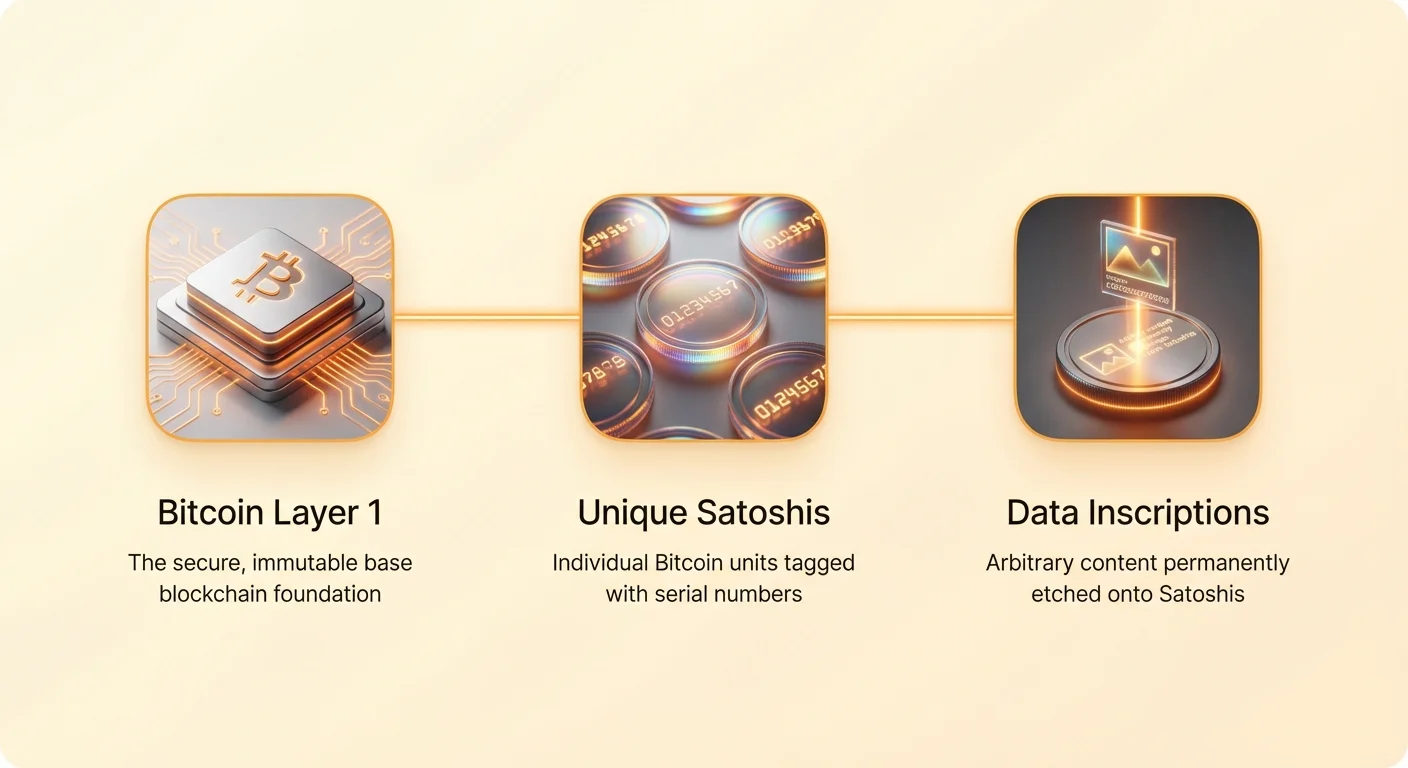
Decoding the Technical Mechanism of Inscriptions
To understand the economic contention Ordinals created, we must first understand the technical avenues used to introduce arbitrary data into the Bitcoin blockchain. This process leverages recent protocol upgrades, particularly SegWit and Taproot, which slightly expanded the network’s capacity for non-monetary information.
The Role of Satoshis and Ordinal Theory
At the heart of the Ordinals protocol is a simple but revolutionary idea known as Ordinal Theory. A Bitcoin, which is the base unit of value, is divisible into 100 million smaller units called Satoshis (Sats). Ordinal Theory is merely a proposed numbering scheme: it assigns a unique serial number to every single Satoshi, starting from the very first one ever mined.
This serial numbering system changes the perception of Satoshis from being completely interchangeable (fungible) to being unique entities (non-fungible).
- Fungible: One dollar bill is functionally identical to any other dollar bill.
- Non-Fungible (Unique): A specific Satoshi is now traceable and uniquely identified by its creation order.
While the Ordinal Theory provides the method for tracking unique Satoshis, Inscriptions are the actual digital content (the image, text, or code) permanently attached to that specific, numbered Satoshi.
Leveraging Witness Data and the Taproot Upgrade
The ability to write large amounts of data onto the blockchain became possible due to two key upgrades: Segregated Witness (SegWit, 2017) and Taproot (2021).
SegWit and Witness Data
Before SegWit, every part of a Bitcoin transaction counted equally toward the strict 1MB block size limit. SegWit changed how transaction data is weighted, separating the data needed to verify a transaction (the witness data, which includes digital signatures) from the core transaction details.
Crucially, witness data is given a lower weight in calculating the effective block size limit (around 4MB). This meant developers could include more witness data without violating the traditional 1MB rule, making transactions cheaper and increasing overall capacity. Inscriptions utilize this cheaper, expanded "witness data" area to store their content.
The Enabling Power of Taproot
The Taproot upgrade, implemented in 2021, was intended primarily to improve privacy and efficiency for complex transactions. However, it inadvertently provided the perfect technical loophole for Inscriptions.
Taproot simplified the way complex scripts (rules governing spending) appear on the blockchain. Because Taproot transactions can carry a significant amount of "script data," developers realized they could hide large amounts of arbitrary information (the inscription) within this data field. Essentially, the protocol treats the inscription data as part of the transaction’s execution requirements, even though it’s being used to store a picture or text.
In summary: Ordinals are the unique ID tags for Satoshis; Inscriptions are the data payload attached to those tags; and SegWit/Taproot provided the technical space (witness data) to store that payload cheaply and permanently on the Layer 1 chain.

The Economics of Scarcity: How Ordinals Drive Fee Contention
Bitcoin’s defining architectural limitation is its scarcity of space. Every block, which occurs roughly every 10 minutes, has a maximum practical capacity. Since demand for block space often exceeds supply, Bitcoin operates a competitive fee market. Ordinals activity, by consuming large chunks of this fixed resource, fundamentally alters this market dynamic.
Block Space: The Most Valuable Real Estate
Imagine a Bitcoin block as a limited cargo container that arrives every ten minutes. In a standard scenario, everyone puts their financial transactions (small packages) into the container, paying a shipping fee (transaction fee) based on how quickly they need their package delivered.
Before Ordinals, the main competition for this space was between standard financial transactions. With Ordinals, however, massive, high-data-volume inscriptions (like digital artworks or large text files) are now competing for the same space.
When an inscription is mined, it may take up the equivalent space of hundreds of simple financial transactions. Because the Ordinal creator is often willing to pay a premium to ensure their unique digital artifact is permanently etched into the most secure chain, they bid up the transaction fees significantly.
The Direct Impact on Average User Fees
The most noticeable economic effect of Ordinals is the dramatic rise in average transaction fees.
When demand for block space surges due to a rush of inscriptions (e.g., during the minting of a popular BRC-20 token standard), the queue of unconfirmed transactions (the mempool) swells. To get their transaction confirmed in the next block, users must outbid the ongoing inscription activity.
For a user sending a simple transaction (e.g., $50 worth of Bitcoin), the resulting high fee (sometimes $10, $20, or even $50) can make the transaction economically unviable. This creates a functional block space pricing crisis, especially for users in developing economies where low-cost P2P cash transfers are essential.
| Economic Scenario | Pre-Ordinals/Low Congestion | Post-Ordinals/High Congestion |
|---|---|---|
| Block Space Usage | Primarily financial transfers | Financial transfers + Large data payloads |
| Mempool Size | Small, transactions clear quickly | Large, backlog of transactions forms |
| Typical Fee | 1-5 sats/vbyte (Very low) | 50-300+ sats/vbyte (High, volatile) |
| Impact on Users | Accessible P2P cash for all | Prices out low-value transactions |
The Critical Role of Miner Revenue and Security
While high fees inconvenience standard users, they are a massive economic boon for Bitcoin miners. This is the positive counter-argument in the economic debate.
Bitcoin’s security model relies on miners expending computational power to secure the network. Miners are compensated in two ways:
- The Block Subsidy: Newly minted Bitcoin (which halves every four years).
- Transaction Fees: The sum of all fees from transactions included in the block.
As the block subsidy inevitably decreases over time, the long-term security of the Bitcoin network must increasingly rely on transaction fees. Ordinals provide a powerful, organic source of demand that drives fee volume.
When inscription demand is high, fees can temporarily eclipse the block subsidy, providing miners with huge profitability. This injection of revenue directly incentivizes more mining power, which increases the network’s hash rate and, consequently, its security against attacks.
The Economic Trade-off: Ordinals activity essentially transfers wealth from the Bitcoin network’s users (via higher fees) to its security providers (miners), fulfilling a crucial, long-term necessity for Bitcoin's economic stability post-halving, albeit at the cost of short-term usability for basic payments.
The Great Block Space Contention: Philosophical and Architectural Debate
The Ordinals phenomenon didn't just cause a technical surge; it ignited a philosophical conflict within the Bitcoin community that rivals the earlier "block size wars." The core of the debate is: What is the primary purpose of Bitcoin’s Layer 1 (the main blockchain)?
The Utility Argument: Bitcoin as a Data Layer
Proponents of Ordinals view the protocol as a vital expansion of Bitcoin's utility. They argue that the ability to store immutable data is inherently valuable and that this new use case strengthens the network overall.
- Innovation and Development: Ordinals attract new developers, capital, and cultural attention to the Bitcoin ecosystem, which historically lagged behind Ethereum and other chains in terms of programmability and decentralized applications (dApps).
- Market Efficiency: If people are willing to pay high fees to store data on the blockchain, then that usage is economically rational. Preventing this usage, proponents argue, is market manipulation and stunts Bitcoin's organic growth. The fee market should dictate the highest and best use of the scarce block space.
- Security Funding: As discussed, Ordinals provide necessary, robust, and unpredictable revenue streams that ensure the mining security model remains economically viable for decades to come, independent of the shrinking block subsidy. They see the occasional spike in high fees as a necessary "tax" on high-value activity that benefits the entire network.
The Block Spam Argument: Bitcoin as Pure P2P Cash
Critics of Inscriptions view the activity as "bloat," "spam," or a misuse of sacred space. They adhere strictly to the vision of Bitcoin as a simple, efficient, and cheap peer-to-peer electronic cash system.
- Erosion of Cash Use Case: High fees undermine Bitcoin’s role as a usable currency, making micro-payments and small transfers impractical. This disproportionately affects users who rely on Bitcoin for remittance or basic daily transactions where fiat alternatives are unavailable.
- Centralization Risk: When blocks are filled with large, opaque data inscriptions, running a full node—which is crucial for verifying the entire transaction history—becomes more resource-intensive due to increased storage and bandwidth requirements. Critics fear this high cost could lead to fewer individuals running nodes, thus increasing network centralization.
- Philosophical Purity: Some maximalists argue that the Layer 1 chain should be reserved exclusively for verifiable monetary transactions and settlement, not for arbitrary cultural artifacts like JPEGs, which they claim should reside on Layer 2 solutions or external storage layers.
Addressing Fungibility: The Taint of Uniqueness
A subtle but important philosophical challenge Ordinals raise relates to fungibility. Historically, all Satoshis were treated equally. Ordinals, by attaching unique IDs and permanent data to specific Satoshis, introduce a form of non-fungibility.
This raises concerns about "taint." If a specific Satoshi was used in an illicit transaction years ago, and is now identified as a "rare Satoshi" with a high market value because of its Ordinal number, its unique history might become economically relevant. This complicates the standard assumption that any Bitcoin can be exchanged for any other Bitcoin without affecting its value—a key property of sound money.
Savstarpējā ietekme ar mērogošanas risinājumiem (2. līmenis)
Ordinals uzplūde dramatiski izcēla nepieciešamību un ekonomisko dzīvotspēju 2. līmeņa (L2) risinājumiem, kas ir protokoli, kas būvēti uz Bitcoin galvenās ķēdes (1. līmeņa) augšas, lai apstrādātu lielapjoma, zemas vērtības darījumus lēti un ātri.
1. līmenis pret 2. līmeni: Lomu pārdefinēšana
Konkurence par bloka telpu piespiež skaidrāku arhitektūras atdalīšanu starp Bitcoin slāņiem:
1. līmenis (Galvenā ķēde)
1. līmeņa ķēde ir definēta ar savu nemaināmo drošību un decentralizāciju. Ordinals uzliktās augstās izmaksas nozīmē, ka L1 arvien vairāk tiek uzskatīta nevis par ikdienas maksājumu tīklu, bet par norēķinu līmeni — ultradrošām pamatnēm, kur augstas vērtības, kritiski svarīgi darījumi (piemēram, miljonu dolāru institucionālie pārskaitījumi vai L2 kanālu atvēršana/izslēgšana) tiek finalizēti. Ordinals klātbūtne nostiprina L1 kā prēmiju, augstas izmaksas preci.
2. līmenis (piemēram, Lightning Network)
2. līmeņa risinājumi kā Lightning Network tika izstrādāti, lai piedāvātu tūlītējus, gandrīz bezmaksas darījumus, pārejot aktivitāti ārpus ķēdes. Ordinals aktivitāte, izcenojot mazos lietotājus no 1. līmeņa, faktiski stiprina ekonomisko pamatojumu Lightning adopcijai.
Kad L1 maksas ir niecīgas, lietotāji var paciest lēnus apstiprinājuma laikus ērtības dēļ. Kad maksas ir 20 USD, aktīvu pārvietošana uz Lightning kļūst obligāts, izmaksu taupošs solis ikvienam, kas plāno izmantot Bitcoin ikdienas tirdzniecībai. Tādējādi Ordinals netīši paātrina adopciju un nepieciešamību pēc mērogošanas infrastruktūras, kas izstrādāta, lai atrisinātu pašu radīto sastrēgumu.
Ordinals kā L1 pieprasījuma virzītāji
Daži izstrādātāji apgalvo, ka Ordinals jāredz kā tīri pozitīvi mērogošanas virzītāji, nevis tikai sastrēguma cēloņi.
- L2 attīstības motivēšana: Ordinals radītais ekonomiskais spiediens liek attīstības komandām un maku sniedzējiem prioritizēt L2 integrāciju, virzot ekosistēmu uz daudzslāņu struktūru ātrāk.
- 1. līmeņa drošības atkarība: Ordinals pēc definīcijas prasa 1. līmeņa nemaināmību. Atšķirībā no tradicionālajām NFT, kas bieži uzglabā faktisko mākslas darba datus ārējos serveros (kā IPFS) un tikai saiti blokķēdē, Bitcoin Inscripcijas uzglabā veselu artefaktu tieši uz L1. Šī paļaušanās uz galveno ķēdi apstiprina augsto vērtību, ko piešķir L1 drošībai un cenzūras pretestībai.
BRC-20 un fungēto žetonu uzplaukums uz Bitcoin
Ordinals protokols neapstājās pie digitālās mākslas. Izstrādātāji ātri izmantoja inscripcijas mehānismu, lai izveidotu BRC-20 žetona standartu.
BRC-20 žetoni ir fungēti žetoni (līdzīgi Ethereum ERC-20 žetoniem, kas ir DeFi un lietderības žetonu pamats), kas pastāv pilnībā caur Ordinals Inscripcijām. Tie darbojas, izmantojot specifiskas teksta inscripcijas (JSON kodu), kas nosaka funkciju "deploy", "mint" vai "transfer" konkrētam žetona tickerim.
BRC-20 žetonu ieviešana eksponenciāli palielināja bloka telpas konkurenci:
- Sākotnējās kalšanas lēcieni: Jaunu BRC-20 žetonu izvietošana un sākotnējā kalšana prasa tūkstošiem individuālu inscripciju apstrādi, izraisot masīvus, pēkšņus maksas lēcienus.
- Decentralizēta tirdzniecība: Katrs turpmākais BRC-20 žetona pārskaitījums prasa jaunu inscripcijas darījumu uz 1. līmeņa. Šī aktivitāte nostiprina Bitcoin 1. līmeni ne tikai kā vērtības uzglabātāju, bet kā aktīvu, datiem intensīvu decentralizētu žetonu biržu saimnieku.
Ekonomiskā realitāte ir tāda, ka šī aktivitāte, visticamāk, ir pastāvīga. Cik ilgi tirgus dalībnieki augstu vērtē nemaināmību un drošību žetonu pārskaitījumiem un digitālās mākslas uzglabāšanai tieši uz Bitcoin 1. līmeņa, viņi būs gatavi pārsist finanšu darījumus par reto bloka telpu.
Actionable Insights and Future Implications
For newcomers navigating the world of Bitcoin, understanding the Ordinals phenomenon is crucial, as it dictates how you interact with the network, particularly concerning cost and speed.
Practical Tips for Interacting with the Bitcoin Network
- Prioritize Layer 2 for Payments: For daily use, coffee purchases, or moving smaller amounts of Bitcoin quickly and cheaply, always use the Lightning Network. Use Layer 1 only for final settlement, large storage transfers, or high-value activities.
- Monitor the Mempool: If you must use Layer 1, check the current mempool congestion (the queue of unconfirmed transactions). If the mempool is crowded due to high Ordinals activity, either wait for the congestion to clear (which can take hours or days) or be prepared to pay a significantly higher fee.
- Understand Fee Estimation: Use reliable wallet software that provides dynamic fee estimation. This helps you calculate the lowest fee required to ensure confirmation within a reasonable timeframe (e.g., 6 blocks). Never use a flat, low fee when congestion is high, or your transaction may be stuck indefinitely.
- Embrace Batching: When sending multiple transactions, check if your wallet supports transaction batching. This practice combines several outputs into a single transaction input, saving on overall transaction size and therefore fees—a critical strategy during periods of high contention.
The Future of Transaction Filtering
The community debate over "block spam" has led to discussions about how future network participants might categorize or filter block space usage.
Currently, Bitcoin is permissionless and politically neutral; all valid transactions that pay the required fee are treated equally by miners. Some critics have proposed technical mechanisms, like specialized fee markets or filtering options, to give priority to financial transactions over arbitrary data.
However, implementing such filtering mechanisms is fraught with difficulty because:
- Technical Ambiguity: Due to the complexity of Taproot transactions, it is almost impossible for a miner to definitively tell the difference between a high-value smart contract execution and a simple image inscription without interpreting the underlying script, which violates the principle of transaction neutrality.
- Censorship Risk: If nodes or miners begin implementing subjective filters, it introduces a dangerous precedent of censorship, where one type of use case is prioritized over another, potentially undermining Bitcoin’s core value of permissionless inclusion.
The prevailing view is that the market will solve this—Ordinals are an economic reality that must be managed through better scaling solutions (L2s) and efficient fee management, rather than through controversial protocol changes aimed at filtering specific transaction types.
Secinājums: Bitcoin evolūcija uz daudzpusējas izmantošanas platformu
Ordinals un Inscripciju parādīšanās ir nozīmīgs pavērsiens Bitcoin vēsturē, nostiprinot tā evolūciju tālāk par vienkāršu vienaudžu starpā skaidras naudas sistēmu. Šī kustība ir pārveidojusi bloka telpas retumu no tehniska pudeles kakla par augsti konkurējošu ekonomisko aktīvu.
Galvenais secinājums ir tāds, ka Ordinals nav tikai jauns digitālo kolekcionāru veids; tie ir pastāvīgs 1. līmeņa drošības pieprasījuma avots. Paaugstinot maksas, tie nodrošina tīkla ilgtermiņa ekonomisko dzīvotspēju, finansējot kalinātājus, pat kad bloka subsīdija samazinās.
Rezultējošā bloka telpas konkurence piespiež skaidru darba dalīšanu: Bitcoin 1. līmenis nostiprina savu lomu kā ultradrošu norēķinu līmeni augstas vērtības darījumiem un nemaināmai datu uzglabāšanai, kamēr ikdienas tirdzniecība un zemas vērtības pārskaitījumi arvien vairāk tiek nodoti ātrdarbīgiem, zemas izmaksas 2. līmeņa risinājumiem kā Lightning Network.
Bitcoin nākotnes navigēšana nozīmē šīs daudzslāņu arhitektūras pieņemšanu, izpratni, ka kodola blokķēde tagad ir prēmiju prece, un lietotāju uzvedības pielāgošanu, lai izmantotu pareizo līmeni pareizajam mērķim. Ordinals ir pierādījuši, ka tirgus ir gatavs maksāt augstas cenas par unikālo nemaināmību, ko piedāvā Bitcoin, nodrošinot tā lomas centralitāti decentralizētajā digitālajā ekonomikā, pat ja ikdienas pieejamība nāk ar augstāku cenu.