
The blockchain landscape has evolved significantly since the inception of Bitcoin, moving beyond simple peer-to-peer payments into complex ecosystems capable of hosting decentralized applications. Among the most prominent infrastructure layers in this space is BNB Smart Chain (BSC). Originally launched to address the scalability limitations of early smart contract networks, BSC has established itself as a high-performance Layer 1 blockchain. It operates as a base layer within the broader BNB Chain ecosystem, providing an environment where developers can build and deploy digital assets efficiently.
The network distinguishes itself through a unique relationship with a major centralized exchange, Binance, while maintaining a decentralized architecture for transaction processing. This hybrid positioning allows it to benefit from significant technical resources and user adoption channels. The platform focuses heavily on reducing barriers to entry for both users and developers. It achieves this primarily through a structural emphasis on speed and cost-effectiveness.
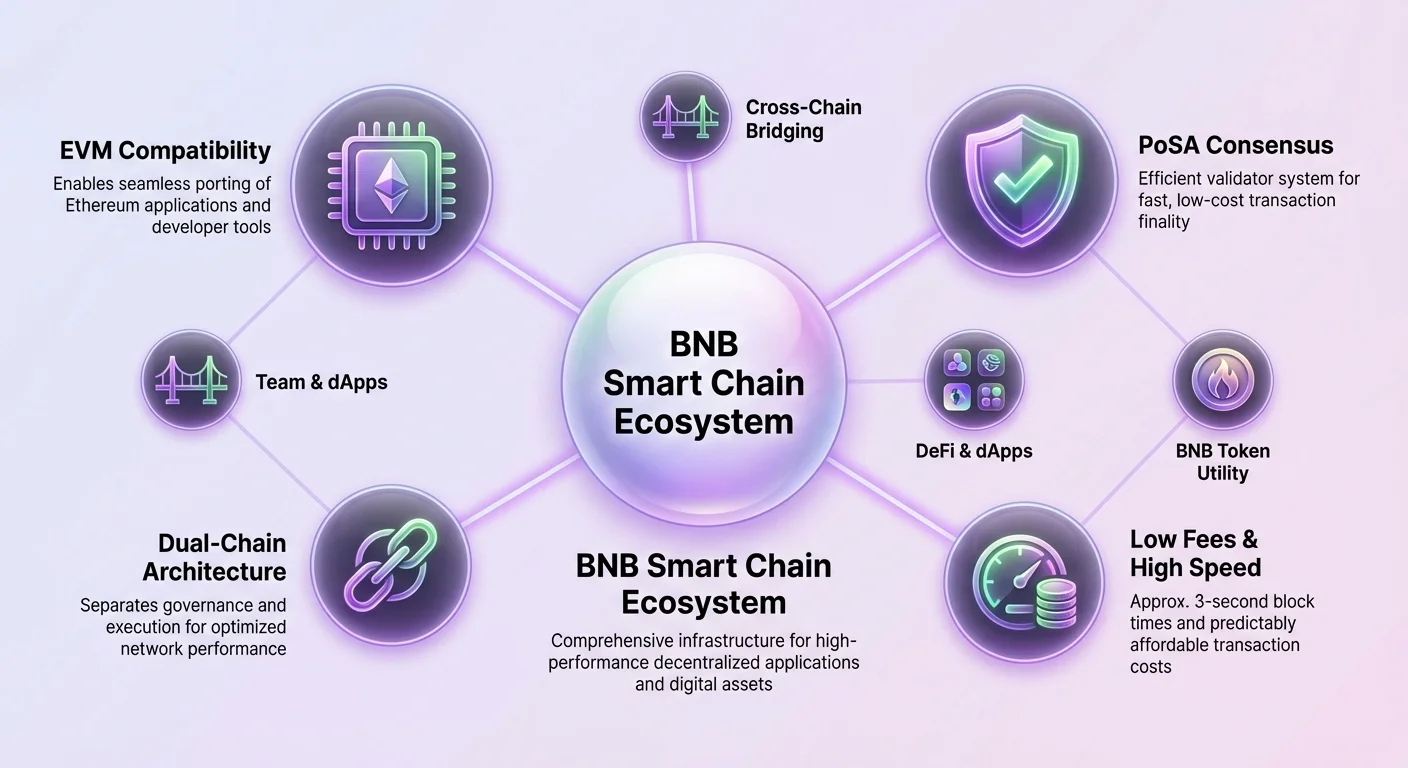
Unlike networks that rely on energy-intensive mining, BSC utilizes a consensus model designed for high throughput. This design choice results in transaction confirmation times of approximately three seconds. For users, this translates to a responsive experience similar to modern web applications. The network's native token, BNB, fuels these operations, serving as the primary medium for paying transaction fees and participating in network governance.
The Dual-Chain Architecture
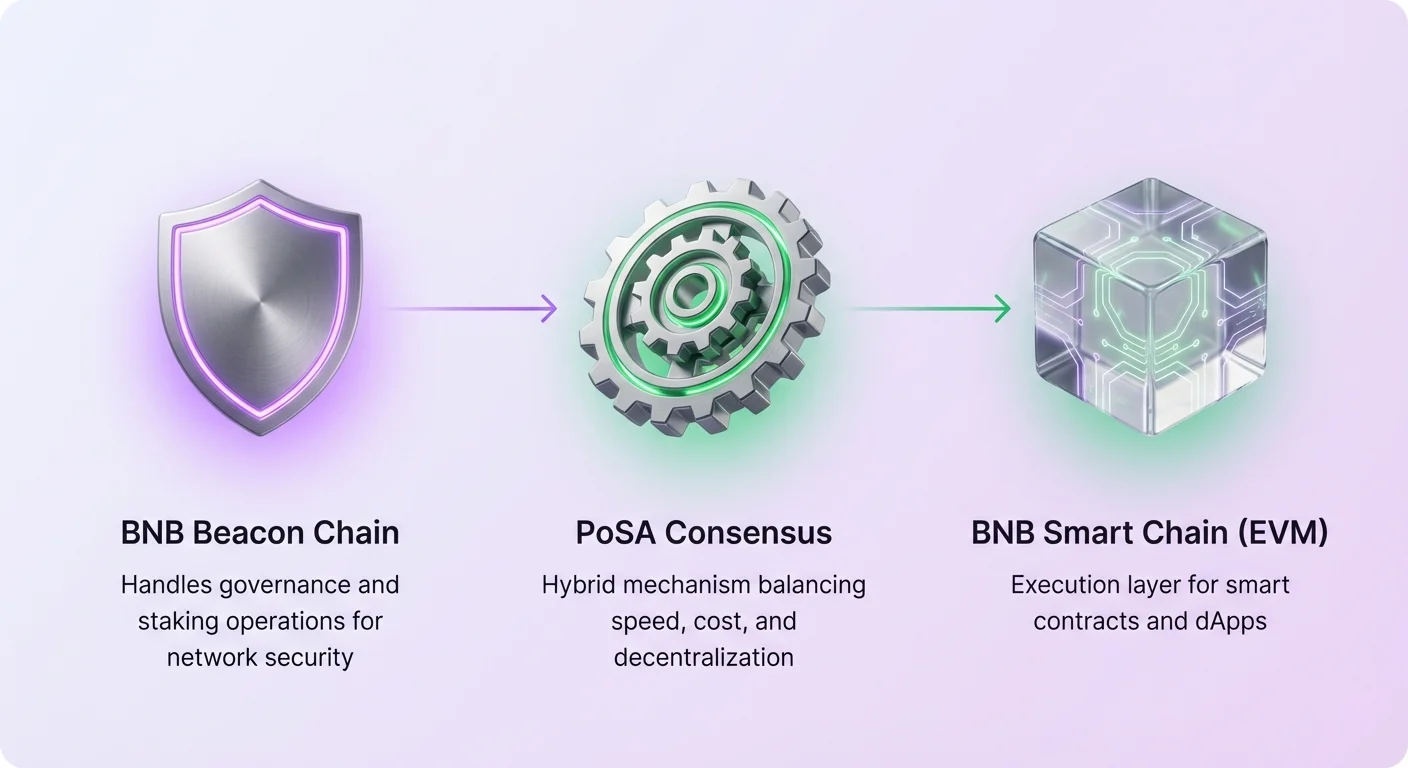
The BNB Chain ecosystem is not a single blockchain but rather a dual-chain structure. This architecture separates specific functions to optimize performance. The first component is the BNB Beacon Chain, previously known simply as Binance Chain. This layer is dedicated to governance and staking operations. It handles the voting logic and validator selection processes that secure the network. By isolating these management functions, the ecosystem ensures that governance decisions do not congest the execution layer.
The second component is the BNB Smart Chain itself. This is the execution layer where smart contracts run and transactions are processed. It is fully compatible with the Ethereum Virtual Machine (EVM). This compatibility is a strategic technical decision. It allows developers who have written code for Ethereum to port their applications to BSC with minimal changes. They can use the same tools, such as MetaMask and Remix, which significantly lowers the learning curve for migration.
This dual structure enables the network to balance security with functionality. While the Beacon Chain focuses on the stability and security of the consensus logic, the Smart Chain focuses on computing power and scalability. Communication between these two layers is seamless, allowing for the fluid movement of assets and data. This interconnected design supports a robust environment for decentralized finance protocols and other complex blockchain applications.
EVM Compatibility and Developer Access
Ethereum Virtual Machine compatibility is a cornerstone of the BSC strategy. The EVM is the standard computation engine used by Ethereum to execute smart contracts. By adopting this standard, BSC ensures interoperability with the largest developer community in the crypto space. Applications built using Solidity, the primary programming language for Ethereum, run natively on BSC. This eliminates the need for developers to learn new coding languages or rewrite their entire codebase.
This approach has fostered a rapid expansion of the ecosystem. Projects that face congestion or high costs on other networks can deploy parallel versions on BSC. This creates a multi-chain presence where the application logic remains consistent across different platforms. Users benefit from being able to interact with familiar interfaces and protocols while paying significantly lower transaction fees.
Furthermore, EVM compatibility extends to token standards. The network supports the BEP-20 standard, which functions similarly to Ethereum's ERC-20. This standardization allows for the easy creation and exchange of fungible tokens. It also supports non-fungible token (NFT) standards, enabling a diverse range of digital assets. The ability to mirror Ethereum's functionality while offering higher speed provides a compelling alternative for high-volume applications like gaming.
The Proof of Staked Authority Consensus
The engine powering BNB Smart Chain is the Proof of Staked Authority (PoSA) consensus mechanism. This model is a hybrid that combines elements of Delegated Proof of Stake (DPoS) and Proof of Authority (PoA). It is designed to achieve shorter block times and lower costs than traditional Proof of Work or standard Proof of Stake systems. In this system, network security is maintained by a limited set of validators.
Validators are responsible for producing blocks and validating transactions. To become a validator, participants must stake a significant amount of BNB. However, unlike open permissionless systems where anyone with hardware can mine, PoSA relies on a system of elected authority. Token holders delegate their BNB to trusted validators. The validators with the highest stake are selected to the active set, which takes turns proposing new blocks.
This limitation on the number of active validators is intentional. By keeping the validator set small, the network reduces the communication overhead required to reach consensus. There is less latency because fewer nodes need to propagate and verify the data before a block is finalized. This efficiency is what allows for the network's three-second block times.
Validator Selection and Incentives
The selection process for validators is dynamic and based on on-chain governance. This creates a competitive environment where validators must maintain a high reputation and reliability to attract delegations. If a validator acts maliciously or suffers from downtime, they risk losing their staked BNB and their position in the active set. This economic alignment ensures that the operators of the network infrastructure are financially motivated to act honestly.
Backup mechanisms are also built into the system. "Candidates" serve as standby validators. If an active validator fails or is removed, a candidate can step in to maintain network functionality. This redundancy ensures the blockchain remains operational even under stress or during maintenance events. The system prioritizes stability and uptime above all else.
In terms of compensation, the model differs significantly from inflationary blockchains. There is no block subsidy or inflation of the BNB token supply to pay validators. Instead, validators earn revenue strictly from the transaction fees generated by the network. This fee-based incentive structure encourages validators to process as many transactions as possible efficiently. It also aligns the success of the validators directly with the usage and adoption of the network.
Decentralization vs. Efficiency
The PoSA model represents a specific trade-off in the "blockchain trilemma" of security, scalability, and decentralization. By limiting the validator count, BSC achieves high scalability and speed. However, this approach is often critiqued for being more centralized than networks like Ethereum or Bitcoin, which have thousands of nodes. The reliance on a smaller group of validators means users place a higher degree of trust in a select few entities.
Proponents argue that this trade-off is necessary for certain use cases. High-frequency trading, real-time gaming, and micro-transactions require speed and low costs that highly decentralized networks often struggle to provide. The PoSA mechanism creates a middle ground. It offers more decentralization than a traditional database or private server but operates with greater efficiency than a fully decentralized Proof of Work chain.
Governance plays a crucial role in balancing this power. BNB holders have the right to vote on protocol parameters and upgrades. This on-chain governance allows the community to influence the direction of the network. While the validator set is small, the power to elect those validators is distributed among all token holders who choose to stake and delegate.
Mokesčių strategija ir defliacinė ekonomika
BNB Smart Chain įdiegia mokesčių strategiją, skirtą būti nuspėjama ir prieinama. Išmaniųjų sutarčių vykdymo kaina skaičiuojama „dujomis“, panašiai kaip Ethereum, bet vieneto kaina laikoma ženkliai žemesnė. Tai daro tinklą ypač patrauklų sudėtingiems sandoriams, kurie kitur būtų nepagrįstai brangūs. Gimtoji žetonas BNB veikia kaip šių sandorių „kurą“.
Pagrindinė tinklo ekonominė savybė yra infliacijos nebuvimas. Skirtingai nuo daugelio Layer 1 blokų grandinių, kurios kalia naujus žetonus kalnakasiams ar statytojams apmokėti, BSC turi fiksuotą ar mažėjančią pasiūlą. Kadangi validatoriai apmokami tik sandorių mokesčiais, protokolas neišskiedžia esamų investuotojų turto saugumui apmokėti. Tai sukuria išskirtinę ekonominę aplinką, kur žetonų vertė kyla iš naudingumo ir retumo.
Tinklas taip pat įtraukia deginimo mechanizmus, kad sumažintų pasiūlą laikui bėgant. Protokolo surinktų sandorių mokesčių dalis dažnai pašalinama iš apyvartos. Be to, automatiniai deginimo protokolai naudoja grandinės duomenis deginimo tempui reguliuoti. Šis defliacinis spaudimas siekia padidinti turto retumą, augant tinklo naudojimui. Naudingumo dujoms ir mažėjančios pasiūlos derinys sudaro BNB ekonominės tezės pagrindą.
Ecosystem Evolution and Expansion
The trajectory of the network has been defined by constant adaptation. The journey began with Binance Chain in 2019, which was primarily designed for fast trading but lacked smart contract capabilities. Recognizing the explosion of decentralized finance (DeFi), the team launched Binance Smart Chain in September 2020. This pivot allowed the ecosystem to capture a massive share of the DeFi market during periods when Ethereum suffered from chronic congestion.
In February 2022, a significant rebranding occurred. The network dropped the "Binance" name to become "BNB Smart Chain." The acronym BNB was redefined to mean "Build and Build." This change signaled a shift toward a more open, community-driven ecosystem, attempting to distance the blockchain layer from the centralized exchange entity. The goal was to emphasize the permissionless nature of the infrastructure.
The ecosystem has continued to expand beyond the base Layer 1. New developments include ZkBNB, a zero-knowledge proof rollup designed for scaling. This Layer 2 solution aims to bundle transactions off-chain for even greater speed and lower costs. Additionally, BNB Greenfield introduces decentralized data storage to the ecosystem. These expansions transform the network from a simple smart contract platform into a comprehensive web3 infrastructure suite.
Comparison of Blockchain Architectures
| Feature | BNB Smart Chain | Ethereum | Solana |
|---|---|---|---|
| Consensus | PoSA (Hybrid) | Proof of Stake | Proof of History |
| Throughput | High (~2k+ TPS) | Moderate (~15-30 TPS) | Very High (Thousands) |
| Fee Structure | Low, Stable | High, Variable | Very Low |
| Developer Language | Solidity (EVM) | Solidity (EVM) | Rust / C++ |
DeFi and Institutional Use Cases
Decentralized Finance remains the primary driver of activity on the chain. The low-fee environment enables high-frequency trading, yield farming, and algorithmic stablecoin protocols to operate efficiently. Retail users who are priced out of high-fee networks often find their entry point into DeFi through BSC. Lending and borrowing protocols have seen substantial liquidity inflows due to the ease of moving assets.
Beyond basic trading, the network supports complex financial instruments. These include synthetic assets, which track the value of real-world assets, and crypto derivatives. Prediction markets also thrive here, leveraging the fast block times for rapid settlement of binary outcomes. The infrastructure supports a high volume of interactions, which is essential for protocols that require frequent state updates.
Institutional interest has also grown, driven by the network's reliability and the support of the wider Binance ecosystem. While initially focused on retail, the development of compliant infrastructure and permissioned environments is attracting larger entities. The integration of stablecoins and the ability to tokenize assets provide the necessary rails for traditional finance to experiment with blockchain technology.
Tarpusavyje suderinamumas ir tiltai
Daugigrandiniame pasaulyje gebėjimas perkelti turtą tarp tinklų yra kritiškas. BNB Smart Chain buvo suprojektuota atsižvelgiant į junglumą. Kryžminiai grandinės tiltai leidžia vartotojams perkelti skaitmeninį turtą iš Ethereum, Solana ar kitų tinklų į BSC. Tai dažnai daroma siekiant prieigos prie žemesnių mokesčių ar specifinių programų, išskirtinių BNB ekosistemai.
Tiltų procesas paprastai apima turto užrakinimą šaltinio grandinėje ir „suvyniotos“ versijos kalimą paskirties grandinėje. Pavyzdžiui, vartotojas gali tiltuoti ETH į BSC, kad naudotų jį DeFi programose be Ethereum pagrindinio tinklo dujų mokesčių už kiekvieną sandorį. Oficialūs tiltai ir trečiųjų šalių protokolai kaip Celer cBridge palengvina šiuos perkėlimus.
Tačiau tiltavimas įveda specifines rizikas. Suvyniotų turtų saugumas priklauso nuo tilto, laikantis originalaus užstato, saugumo. BSC sutelkė dėmesį į tiltų saugumo standartų gerinimą, siekdama sumažinti šias rizikas. Ekosistema skatina naudoti patikimus tiltus ir teikia išteklius, padedančius vartotojams suprasti kryžminių grandinių perkėlimų mechaniką. Šis junglumas užtikrina, kad BSC liktų atvira stebėsenos vieta, o ne izoliuotas silosas.
Išmaniųjų sutarčių funkcionalumas
Tinklo vykdymo sluoksnis optimizuotas bendro tikslumo išmaniosioms sutartims. Šios savarankiškai vykdomos sutartys leidžia automatizuoti sudėtingus susitarimus be tarpininkų. Nuo paprastų žetonų keitimų iki sudėtingų decentralizuotų autonominių organizacijų (DAO), logika tvarkoma visiškai grandinėje.
EVM suderinamumas užtikrina, kad šių sutarčių elgsena būtų nuspėjama kūrėjams iš kitų EVM grandinių. Šis standartizavimas sumažina klaidų ar pažeidžiamumų atsiradimo tikimybę migracijos metu. Kūrėjai gali naudoti įsitvirtinusias audito firmas ir testavimo struktūras savo kodui apsaugoti.
Be to, tinklas palaiko atnaujinamas sutartis. Tai leidžia kūrėjams tobulinti savo programas laikui bėgant be vartotojų patirties trikdžių. Augant blokų grandinės erdvės brandai, gebėjimas iteruoti ir taisyti problemas tampa vis svarbesnis. BSC suteikia lankstumą, reikalingą šiuolaikiniams programinės įrangos kūrimo ciklais.
Palyginamas kraštovaizdis
Analizuojant platesnę rinką, BNB Smart Chain užima unikalią vidurinę poziciją. Ji siūlo balansą tarp Ethereum įsitvirtinusios dominavimo ir naujesnių alt-L1 greičio, kaip Solana ir Avalanche. Nors Ethereum išlieka lyderė pagal užrakintą bendrą vertę ir decentralizaciją, jos sandorių išlaidos gali būti nepagrįstos daugeliui vartotojų. BSC tai sprendžia tiesiogiai.
Palyginti su Solana, kuri naudoja Proof of History masiam pralaidumui pasiekti, BSC remiasi EVM suderinamumu kaip pagrindiniu diferencijuojančiu veiksniu. Kol Solana reikalauja iš kūrėjų mokytis Rust, BSC leidžia jiems likti prie Solidity. Tai sumažina trintį kūrėjų adopcijai. Tačiau Solana Arguably siūlo aukštesnes teorines sandorių greičio ribas.
Avalanche pristato kitą konkurentą su savo posistemų architektūra ir greitu finalumu. Kaip ir BSC, ji EVM suderinama. Konkurencija tarp šių grandinių dažnai sukasi apie paskatų programas ir bendruomenės įsitraukimą. BSC pasinaudoja masine Binance biržos vartotojų baze, kad palaikytų naujo vartotojų srautą, konkurencinį pranašumą, kurio grynos decentralizuotos grandinės sunkiai gali pakartoti.
Rizikos ir saugumo svarstymai
Nepaisant pranašumų, tinklas susiduria su išskirtiniais iššūkiais. Pagrindinė kritika sutelkta į validatorių skaičių. Su ribotu aktyvių mazgų rinkiniu, tinklas teoriškai jautresnis kolizijoms ar cenzūrai nei tinklai su tūkstančiais validatorių. Kritikai teigia, kad tai pažeidžia „be pasitikėjimo“ blokų grandinės technologijos prigimtį.
Tinklo užkimštimas taip pat gali būti problema. Per ekstremalaus rinkos volatilumui periodus, bloko erdvės paklausa gali šokinėti. Nors tinklas tvarko aukštą pralaidumą, jokia blokų grandinė nėra imunizuota nuo mastelio ribų. Šlamšto sandoriai gali pabloginti šią problemą, nors mokesčių struktūra sukurta atbaidyti piktybinius šlamštus.
Vartotojai taip pat turi būti sąmoningi rizikų, susijusių su dApps. Kadangi lengva ir pigiai diegti sutartis BSC, tinklas talpina daug eksperimentinių ir kartais piktybinių projektų. „Rug pulls“ ir sukčiavimai dažnesni žemos kainos aplinkose, kur žetonų kūrimas kainuoja labai mažai. Vartotojai turi atlikti deramą patikrinimą ir tyrinėti projektus prieš su jais bendraujant.
Išvada
BNB Smart Chain tvirtai įsitvirtino kaip kritinis globalios blokų grandinės infrastruktūros komponentas. Prioritetizuodama greitį, žemas išlaidas ir EVM suderinamumą, ji demokratizavo prieigą prie decentralizuotų finansų ir skaitmeninių turtų milijonams vartotojų. Unikalus jos Įrodymo pagal statytą autoritetą konsensuso modelis siūlo pragmatišką sprendimą mastelio dilemai, balansuodamas efektyvumą su struktūrizuota decentralizacijos forma.
Tinklas toliau evoliucionuoja, peržengdamas pradinę tapatybę link visapusiškos web3 kūrimo ekosistemos. Įdiegus Layer 2 mastelio sprendimus ir decentralizuotą saugojimą, platforma pozicionuoja save kitos interneto programų kartos kūrimui. Nors centralizacijos ir saugumo iššūkiai išlieka, tęstinė adopcija ir kūrimo aktyvumas rodo, kad BSC liks dominuojančia jėga kripto kraštovaizdyje.
Aukštų veiklos infrastruktūra, sujungta su žemais mokesčiais, sukuria prieinamiausią kelią masinei blokų grandinės adopcijai.