
디지털 자산 세계를 탐구할 때 "자체 보관"—자신의 은행이 되는 것—개념이 핵심입니다. 그러나 단일 비밀 구문(지갑의 개인 키)에 의존하면 엄청난 단일 실패 지점이 생깁니다. 그 키가 분실되거나 도난당하거나 손상되면 자금은 영원히 사라집니다.
개인에게는 이 위험을 철저한 보안 관행으로 관리합니다. 하지만 암호화폐가 한 사람이 아닌 기업, 가족 신탁 또는 커뮤니티 조직에 의해 보유되는 경우는 어떨까요? 이러한 상황에서는 강화된 보안만으로는 충분하지 않습니다. 강제 규칙, 검사 및 균형이 필요합니다.
여기서 다중 서명(multi-sig) 지갑이 보안 기능에서 강력한 거버넌스 도구로 전환됩니다. 다중 서명 지갑은 자금 이동 전에 여러 당사자의 승인을 요구함으로써 단일 실패 지점 문제를 해결합니다. 그룹이 금융 통제에 대한 명확한 규칙을 수립할 수 있게 하며, 공유 책임 보장, 일방적 행동 방지, 상당한 집단 재산 관리를 위한 정교한 신뢰 모델 구조화를 가능하게 합니다.
I. Foundations: Moving Beyond the Single-Key Wallet
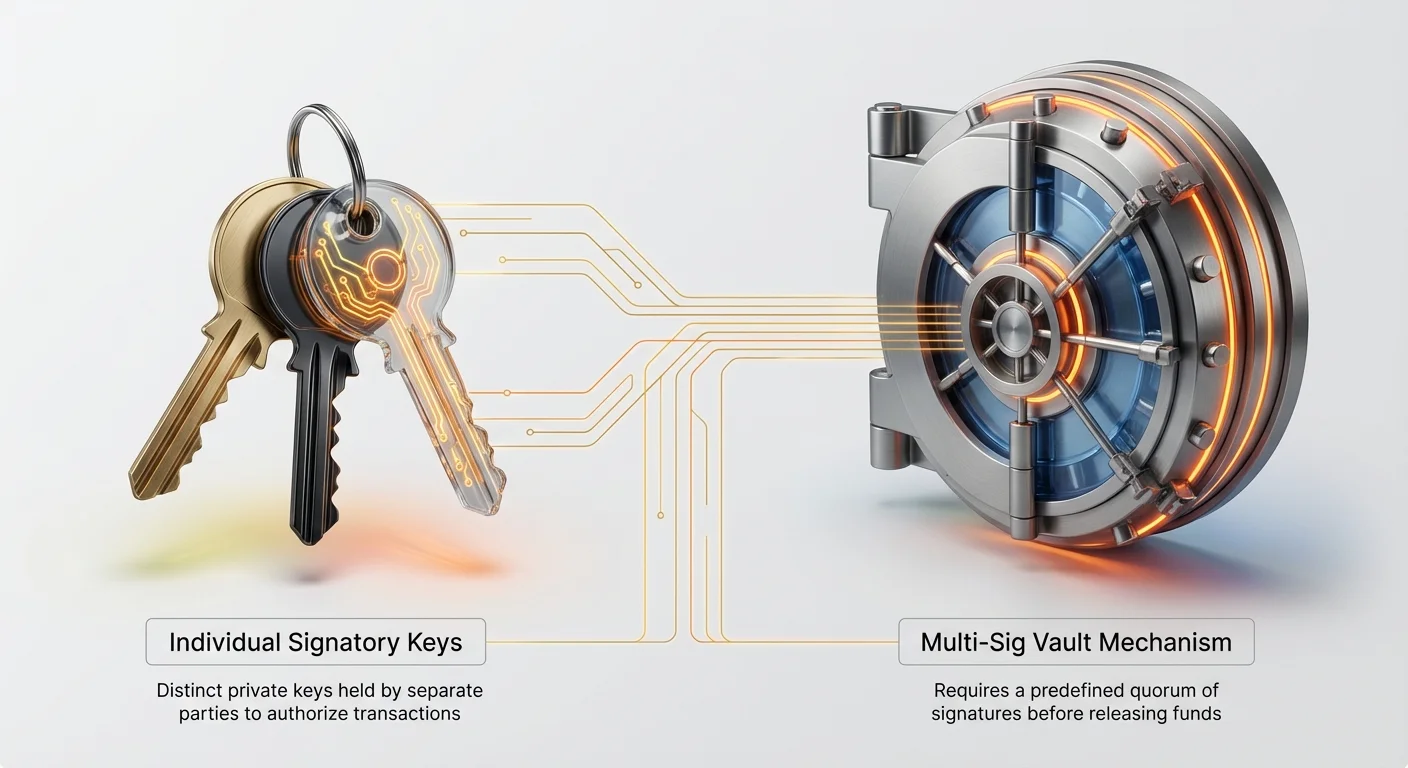
To understand the power of multi-sig, we must first recognize the structure of a standard crypto wallet. Most personal wallets are based on a single private key. This key acts as the master password, and anyone who possesses it can authorize any transaction instantly.
Multi-signature technology fundamentally changes this model. Instead of relying on one master key, a multi-sig wallet is defined by a specific set of rules written into the blockchain's smart contract.
The Mechanism of N-of-M Signature Schemes
A multi-signature scheme is often described using the formula "N-of-M."
- M (Maximum Keys): This represents the total number of private keys registered to control the wallet. These keys are held by separate individuals, devices, or entities (the custodians).
- N (Required Keys): This represents the minimum number of signatures (approvals) required from the M keys to authorize and execute a transaction.
For example, in a 3-of-5 multi-sig setup:
- M = 5 (There are five people/devices holding keys).
- N = 3 (Any three of those five people must sign the transaction for it to be valid and sent).
If only two people sign, the transaction remains unauthorized and pending. If four people sign, the transaction proceeds successfully, but only three signatures were necessary.
This architecture offers two immediate benefits: enhanced security (a hacker needs multiple keys, not just one) and enhanced governance (no single person can drain the funds).
Contrasting Security: Single-Key vs. Multi-Sig
| Feature | Single-Key Wallet (Standard) | Multi-Sig Wallet (N-of-M) |
|---|---|---|
| Control | Absolute control by one person/device. | Shared control distributed among several parties. |
| Security Risk | Single Point of Failure (SPOF). Key loss = funds lost; Key compromise = funds stolen. | Eliminates SPOF. Requires collusion or multiple simultaneous compromises. |
| Governance | None (funds move instantly upon the owner's command). | Formal, predefined governance rules (quorum required for action). |
| Best Used For | Everyday spending, small amounts, high-frequency transactions. | Organizational treasuries, cold storage for large sums, inheritance planning. |
Advanced Security Layer: Cold-Storage Multisig
For organizations managing vast amounts of crypto, the multi-sig structure is often paired with cold storage (keys kept offline, typically on hardware wallets).
A common enterprise setup might involve a 4-of-7 scheme where:
- Keys 1, 2, and 3 are held by key executives or directors.
- Key 4 is held by a designated legal counsel.
- Key 5 is held in a corporate safety deposit box (as an offline backup).
- Keys 6 and 7 are held geographically separate in different locations.
To move funds, four parties must physically retrieve their keys, assemble, and sign the transaction. This high friction level makes moving funds difficult for unauthorized parties while still providing redundancy if one or two key holders are unavailable (e.g., Keys 6 and 7 are unavailable, but 1, 2, 3, and 4 are present).
II. Multi-Signature as a Governance Framework
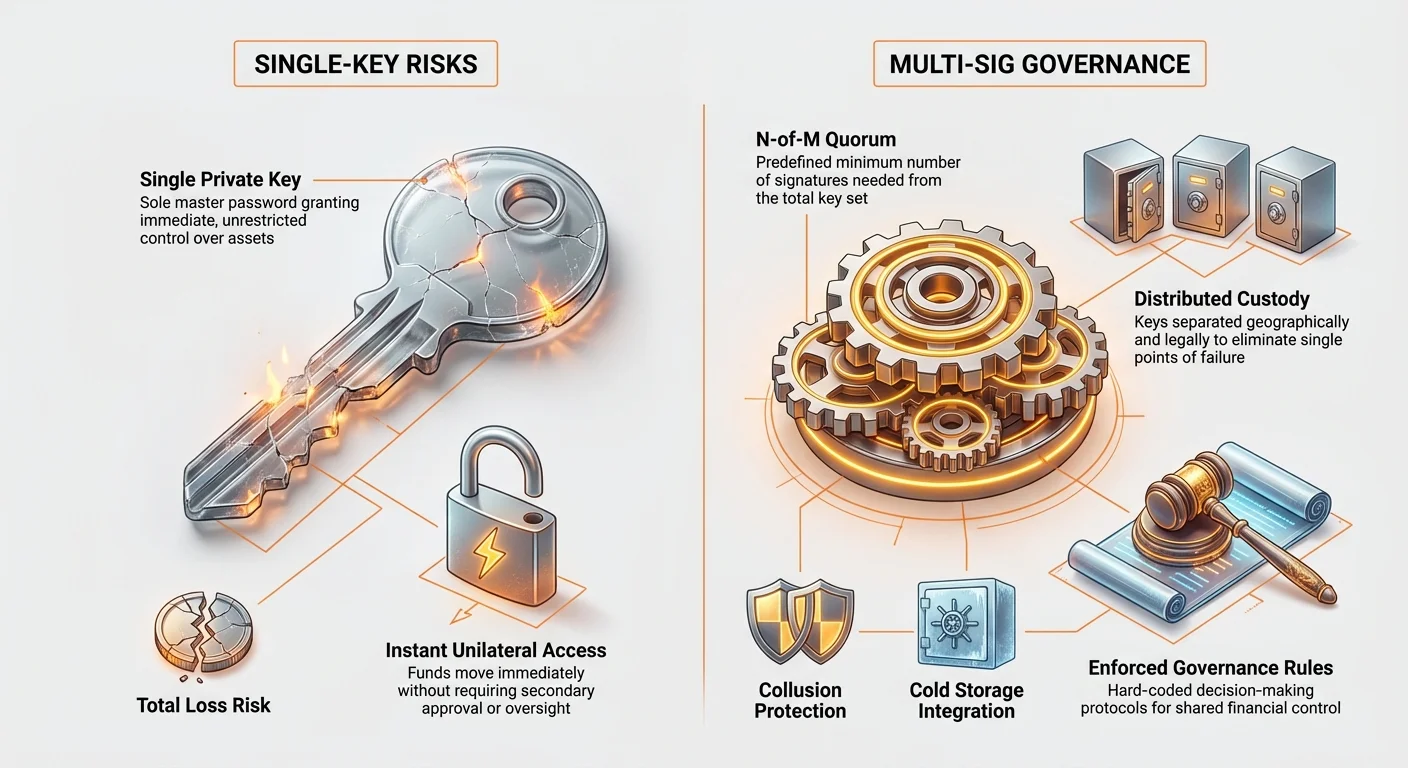
In traditional finance, governance relies on corporate charters, board resolutions, and legal contracts. In the decentralized world, multi-signature wallets allow these rules to be hard-coded into the asset itself. This is the essence of multi-signature wallet governance.
Governance, in this context, means establishing clear rules for decision-making regarding shared financial assets.
Defining Quorum Requirements and Trust Models
The ratio chosen for the N-of-M scheme is the core of your governance model. It dictates the level of trust, speed, and decentralization required for any action.
1. Majority Quorum (High Security, Balanced Trust)
This is the most common model, typically requiring more than half the keys to sign (e.g., 3-of-5 or 5-of-9).
- Utility: Ensures that a small, disgruntled minority cannot freeze the organization's funds, but also prevents any single person or small group from acting unilaterally. It necessitates consensus among the most active members.
- Example: A business board with 7 members uses a 4-of-7 multi-sig. This means four members (a simple majority) must agree to authorize the quarterly payroll payment or a major investment.
2. Supermajority Quorum (High Friction, Maximum Consensus)
This model requires a very high percentage of keys (e.g., 5-of-6 or 9-of-10).
- Utility: Best for extremely sensitive decisions, such as dissolving the organization, changing the entire multi-sig structure, or moving reserve funds. The high friction makes day-to-day operations slower but protects against swift, radical changes.
- Example: A community treasury managed by a Decentralized Autonomous Organization (DAO) might use a 9-of-10 scheme for moving the main capital reserves, ensuring near-unanimous agreement from the core management team.
3. Low Quorum (High Availability, Trust in a Few)
This model requires a small number of keys (e.g., 2-of-5 or 3-of-10).
- Utility: Prioritizes operational efficiency and rapid response. It assumes a higher level of trust among the key holders.
- Example: A non-profit organization might use a 2-of-5 setup for their operational funds, allowing the Treasurer and one other board member to quickly approve emergency aid disbursements without waiting for the full board.
Case Study: Managing a Corporate Treasury
For businesses holding crypto (from large public companies to small startups), multi-sig is essential for fiduciary duty and internal control.
Scenario: TechCorp Holdings (3-of-5 Scheme)
TechCorp decides to hold a portion of its corporate reserves in Bitcoin, managed by five key personnel:
- Key 1: CEO (Strategic oversight)
- Key 2: CFO (Financial authorization)
- Key 3: Head of Security (Technical custodian)
- Key 4: Head of Legal (Compliance and governance)
- Key 5: Independent Auditor (External check)
Governance Policy: A 3-of-5 scheme is implemented.
- Routine Spending (e.g., paying a vendor): Requires the CFO (Key 2), the Head of Security (Key 3), and one other party (Key 1 or Key 4) to sign. The Auditor (Key 5) remains inactive unless a dispute arises.
- Major Investments (e.g., buying more BTC): Requires the CEO (Key 1), the CFO (Key 2), and the Head of Legal (Key 4) to sign, ensuring strategic, financial, and legal due diligence.
- Key Loss/Replacement: If the Head of Security loses their hardware wallet (Key 3), the remaining four parties (1, 2, 4, 5) can execute a 3-of-4 transaction to migrate funds to a new 3-of-5 wallet, replacing Key 3 with a new signatory or device.
This structure enforces separation of duties, ensuring that the person controlling the tech (Key 3) cannot authorize spending alone, and the person authorizing spending (Key 2) cannot unilaterally move the funds without technical and strategic approval.
III. Practical Use Cases for Shared Crypto Wallet Utility
The governance flexibility provided by multi-sig makes it the superior choice for any scenario involving shared ownership, delayed access, or significant value that requires redundant protection.
1. Family Wealth and Inheritance Planning
Traditional inheritance planning for digital assets is notoriously difficult due to the fragility of seed phrases. If the account holder dies without providing the key, the funds may be inaccessible forever. Multi-sig creates a digital trust.
Scenario: The Digital Family Trust (2-of-3 Scheme)
A parent wants to ensure their children access the assets upon their passing, but also wants to maintain full control while alive.
- Key A: The Parent (Held on a primary device, typically the active key).
- Key B: The Child 1 (Held offline, securely stored, but known to the child).
- Key C: The Child 2 (Held offline, securely stored, but known to the child).
Governance Policy (2-of-3):
- While the Parent is Alive: The Parent uses Key A and Key B (or Key C) to move funds, maintaining full control.
- Upon the Parent's Death: Key A becomes permanently unavailable. The Parent's designated successor (often the executor or a lawyer) provides access to the secure physical locations of Key B and Key C. Since the two children possess the remaining necessary keys, they meet the 2-of-3 quorum requirement and can move the funds into a new, single-key wallet.
This method avoids relying on a single executor who must be trusted completely, ensuring shared access among heirs only when the primary key is permanently offline.
2. Safeguarding Personal Cold Storage
Even for individuals, multi-sig can dramatically increase security over a standard single-key hardware wallet. This shifts the security focus from protecting one secret phrase to managing the location and availability of several independent keys.
Scenario: The Distributed Personal Vault (2-of-3 Scheme)
A high-net-worth individual holds their long-term savings in a multi-sig vault.
- Key 1: Primary Hardware Wallet (Stored in the home safe).
- Key 2: Secondary Hardware Wallet (Stored in a geographically separate bank vault).
- Key 3: Mobile/Signing Key (A lightly protected key used primarily for confirming transactions, held on a mobile device or virtual server, used as the operational key).
To authorize a transaction, the user must combine Key 3 (for operational convenience) with either Key 1 or Key 2 (for security/verification). If Key 1 is lost in a fire, the user still has Key 2 and Key 3 to recover the funds. This provides powerful redundancy against physical disaster or theft.
3. Decentralized Autonomous Organizations (DAOs) and Community Funds
Multi-sig wallets are the foundational banking mechanism for most early DAOs and decentralized communities before they transition to more complex smart contract-based treasuries.
A DAO needs to pay developers, cover legal expenses, or distribute community grants. Multi-sig enables the elected or appointed council members to manage the treasury transparently.
Scenario: DAO Community Fund (5-of-9 Scheme)
Nine core contributors are elected to manage the fund. The 5-of-9 structure ensures that four members cannot unilaterally divert funds, and five members must actively participate to authorize spending. This forces debate and consensus for every outgoing transaction, reinforcing the decentralized nature of the community’s financial decisions.
IV. Designing Effective Multi-Sig Strategies
Implementing a multi-sig wallet requires thoughtful planning that balances security needs (high N) with operational reality (low M and reasonable N). The design process involves assessing organizational structure, risk appetite, and contingency plans.
Balancing Risk Tolerance vs. Operational Efficiency
The number of signatures required (N) directly correlates to operational friction. More required signatures mean greater security but slower transaction times.
| Scheme | Operational Profile | Trade-Off |
|---|---|---|
| 2-of-3 | High operational efficiency, quick transactions. | Low redundancy. If one key is compromised, or two key holders fall out of communication, the funds may be at risk or locked. |
| 3-of-5 | Balanced security and moderate efficiency. | Good redundancy (can lose two keys and still operate). Standard for small businesses and trusts. |
| 5-of-8 | High security, low operational speed. | Requires high coordination. Excellent for large, strategic reserve funds where transactions are infrequent. |
Actionable Tip: Always determine the quorum based on the velocity of the funds being managed. Use a high-friction scheme (e.g., 5-of-7) for long-term reserves and a lower-friction scheme (e.g., 2-of-3) for operational spending (if permissible by the organization's risk tolerance).
Strategic Separation of Keys
The resilience of a multi-sig setup depends entirely on the independence of the keys. If all keys are stored in the same physical location or controlled by parties subject to the same legal jurisdiction, the security benefit is diminished.
1. Geographic Separation
Keys should be stored in different cities, countries, or secure facilities (e.g., a bank vault, a remote office, a trusted attorney’s safe). This protects against single-location physical disasters (fire, flood, theft).
2. Legal Separation
If keys are held by individuals in different legal entities (e.g., CEO, independent counsel, corporate auditor), it complicates coercion. If a legal authority compels one key holder to sign, they still require cooperation from individuals under a different legal framework.
3. Technical Separation
Keys should be stored on different types of hardware and software. Avoid putting all M keys on the same brand of hardware wallet or managing all M keys from the same server architecture. Diversity mitigates against a potential software vulnerability in a single product line.
Incorporating Emergency Keys and Recovery Agents
For maximum resilience, some organizations designate specific keys that are only used in case of key loss or custodian unavailability.
- The Contingency Key (The M-key): In a 3-of-5 scheme, Key 5 might be designated the "contingency key." It is never used in routine operations. It is stored in the most secure location possible (e.g., encrypted on a stainless steel plate in a geographically separate vault). Its sole purpose is to sign a recovery transaction if one of the primary signers (Keys 1, 2, 3, or 4) loses access.
- The Recovery Agent: This is a trusted third party, often an attorney or a specialized escrow service, whose only duty is to safely store the key and confirm its release upon the verification of predetermined conditions (e.g., death certificates, notarized key loss declarations). The Recovery Agent should only hold a key, never the quorum majority.
V. 위험 완화: 멀티시그 실패 상태 이해
멀티시그는 표준 지갑의 내재된 단일 실패 지점을 제거하지만, 조정, 스마트 계약 취약성, 키 정치와 관련된 새로운 복잡한 위험을 도입합니다. 이러한 잠재적 멀티시그 실패 상태를 인식하는 것이 안전한 구현에 중요합니다.
1. 접근 불가 위험 (N 실패)
가장 일반적인 실패 상태는 키 분실 또는 보관자 이용 불가로 인해 필요한 N 서명에 도달하지 못하는 것입니다.
- 키 분실: 너무 많은 키(M - N + 1)가 영구 분실 또는 파괴되면 지갑은 "암호화폐 블랙홀"이 됩니다. 나머지 키가 쿼럼을 충족하지 못해 자산이 영구 잠기고 복구 불가능합니다.
- 완화: 높은 중복성 구현(M과 N 간 큰 차이, 예: 3-of-7, 네 키 분실 허용). 주요 장치 파괴 시에도 M 키의 시드 구문에 극도로 안전한 백업 유지.
- 보관자 이용 불가: 키 보유자가 도달 불가(질병, 여행, 갈등, 법적 얽힘)하면 거래가 지연될 수 있습니다. 자금은 손실되지 않지만 유동성이 상실됩니다.
- 완화: 조직 거버넌스 헌장에 명확한 대체자 또는 대안을 정의. 서명자가 지리적 및 시간적으로 분산(예: 24/7 커버를 위한 다른 시간대 서명자)되도록 보장.
2. 공모 위험 (신뢰 실패)
멀티시그는 방식에 대한 신뢰를 요구하며, 필요한 키 보유자 수(N)가 소수를 사기하지 않을 것이라는 신뢰를 의미합니다.
3-of-5 방식에서 세 개인이 비밀리에 조정하면 다른 두 키 보유자의 지식이나 승인 없이 모든 자금을 이동할 수 있습니다. 이는 의도적 설계 기능입니다—거버넌스는 필요한 쿼럼(N)이 조직의 정당한 의지를 대표한다고 가정합니다.
- 완화: 키 보유자 선택은 진정한 조직 직무 분리에 기반해야 합니다. 동일 관리자에게 직접 보고하거나 관련 당사자에게 쿼럼(N)을 할당하지 마세요(상속 또는 공동 소유 목적이 아닌 한). 서명자가 상충되는 인센티브를 가지도록(예: 내부 감사인, 운영 이사) 보장.
3. 스마트 계약 및 플랫폼 위험
단일 키 지갑과 달리 주로 기본 블록체인 암호화에 의존하는 것과 다르게, 멀티시그 지갑은 일반적으로 스마트 계약(특히 Ethereum과 같은 플랫폼 또는 전문 비트코인 멀티시그 솔루션)에 의해 관리됩니다.
기본 스마트 계약에 버그가 있거나 멀티시그 지갑 생성에 사용된 인터페이스 플랫폼이 실패하면 자금이 노출되거나 잠길 수 있습니다.
- 완화: 확립된, 철저히 감사된 멀티시그 플랫폼 및 스마트 계약만 사용. 플랫폼이 독립 검토 가능한 오픈소스 코드인지 확인. 상당 자금 커밋 전에 소액 테스트 거래 수행하고 멀티시그 매개변수(N 및 M)가 블록체인에 올바르게 배포되었는지 확인.
4. 키 관리 데이터 손실
멀티시그 설정은 키뿐만 아니라 지갑과 상호작용하는 데 필요한 관리 데이터(예: 지갑 주소, 지갑 구성 파일, 공개 키 M 목록)를 포함합니다. 이 정보를 잃으면 나머지 개인 키로 거래 서명 지갑 인터페이스를 올바르게 재구성하기에 충분하지 않을 수 있습니다.
- 완화: 지갑 구성 데이터(공개 키 M 목록 및 필요 N)를 개인 시드 구문과 별도의 중요 백업 문서로 취급. 이 데이터는 주요 운영 도구 실패 시 새 인터페이스 설정을 허용합니다.
결론: 공유 보관의 미래로서의 멀티시그
다중 서명 기술은 자산 보관을 기술적 문제에서 정교한 조직 솔루션으로 승화시킵니다. 단순 개인 통제 개념을 넘어 탈중앙화 세계에 엄격하고 자동화된 거버넌스를 도입합니다.
대규모 자금을 관리하는 암호화폐 초보자에게 멀티시그는 개인 위험을 줄이는 필수 도구입니다. 기업, 커뮤니티, 가족에게는 내부 통제 수립, 신탁 책임 강제, 공유 재무 기능 보장을 위한 주요 메커니즘입니다. 모든 행위에 여러 키를 요구함으로써 멀티시그 방식은 합의를 강제하고, 실패에 대한 중요한 중복성을 제공하며, 집단 디지털 재산을 안전하고 지속 가능하게 관리하는 데 필요한 신뢰 모델을 공식적으로 구조화합니다.
멀티시그 솔루션을 설계할 때 보안을 암호화만으로 생각하는 것을 멈추고 사람, 절차, 정치 측면에서 생각하세요. N-of-M 방식은 수학 공식이 아니라 조직의 공유 재무 주권 헌법입니다.