
The landscape of digital asset trading has evolved significantly since the inception of Bitcoin. While centralized platforms initially dominated the market due to their liquidity and ease of use, a shift in sentiment is occurring. Traders are increasingly seeking autonomy over their financial data and assets. This drive has led to the rise of non-custodial and privacy-focused trading solutions. These platforms align more closely with the original ethos of cryptocurrency, which prioritizes peer-to-peer interaction without intermediaries.
The demand for privacy in financial transactions is not solely about concealment. It is fundamentally about security and data sovereignty. Centralized entities collect vast amounts of personal information through Know Your Customer (KYC) protocols. This creates centralized honeypots of sensitive data that can be vulnerable to breaches. Privacy-focused solutions aim to mitigate this risk by minimizing data collection.
Non-custodial trading refers to a method where the trader retains full control of their private keys throughout the transaction process. The exchange or platform never takes possession of the funds. Instead, the platform acts merely as a facilitator or interface for the trade. This model effectively eliminates the risk of an exchange operator freezing funds or suffering a catastrophic insolvency event.
The Philosophy of Self-Sovereignty
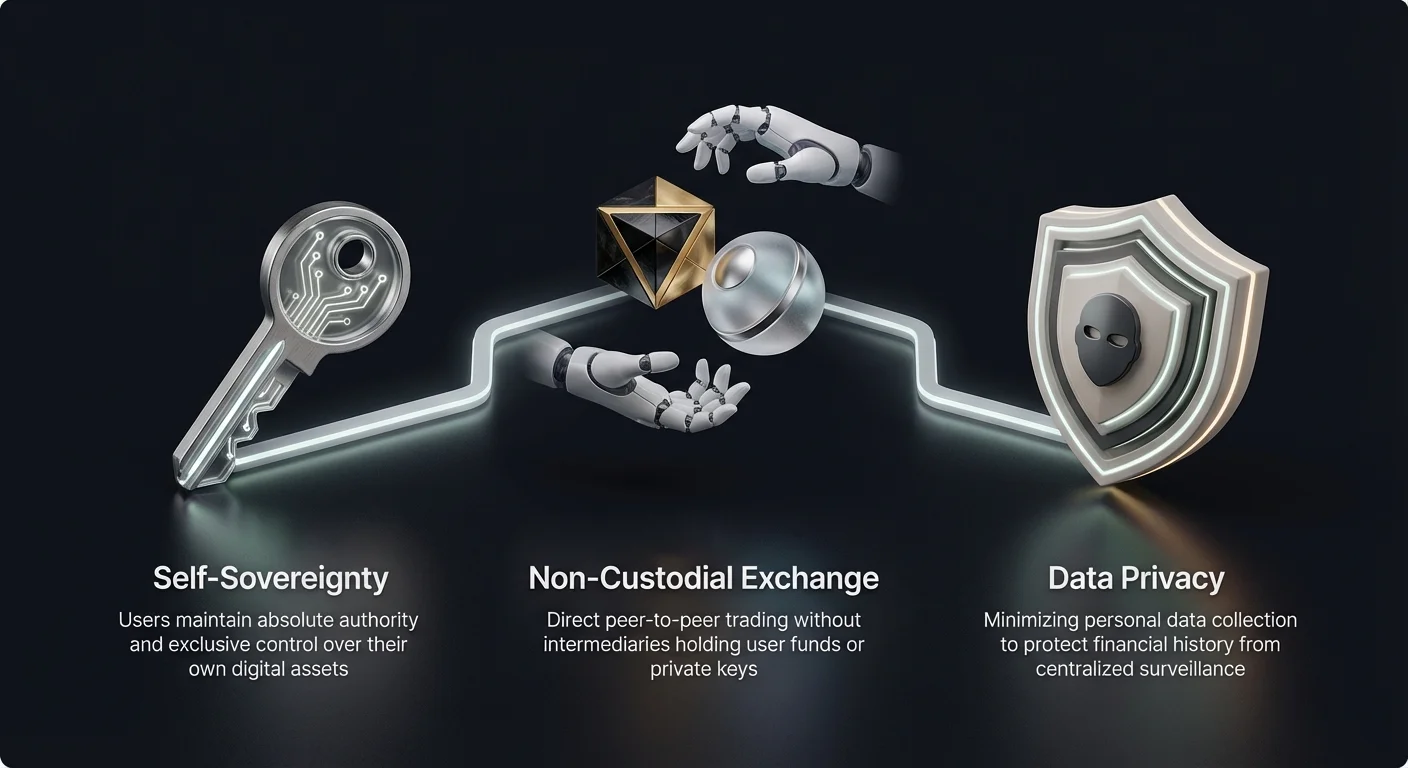
The core principle driving the adoption of non-custodial solutions is self-sovereignty. In the context of cryptocurrency, this means possessing absolute authority over one's assets. When a user relies on a custodial service, they are technically exchanging a digital asset for an IOU from the service provider. The provider holds the actual keys to the blockchain address. If the provider halts withdrawals, the user loses access to their capital.
Non-custodial platforms operate on the mantra of "not your keys, not your coins." By ensuring that users interact directly with the blockchain, these platforms remove the counterparty risk associated with centralized institutions. The user is the sole custodian. This responsibility comes with the requirement for greater technical awareness, but it provides unparalleled security against third-party failure.
Privacy extends this philosophy to identity. In a traditional financial system, every transaction is monitored and linked to a real-world identity. Privacy-focused trading solutions seek to sever or obscure this link. They allow individuals to transact based on cryptographic proof rather than identity verification. This ensures that financial history remains private and cannot be exploited by data brokers or malicious actors.
The Mechanics of Non-Custodial Wallets
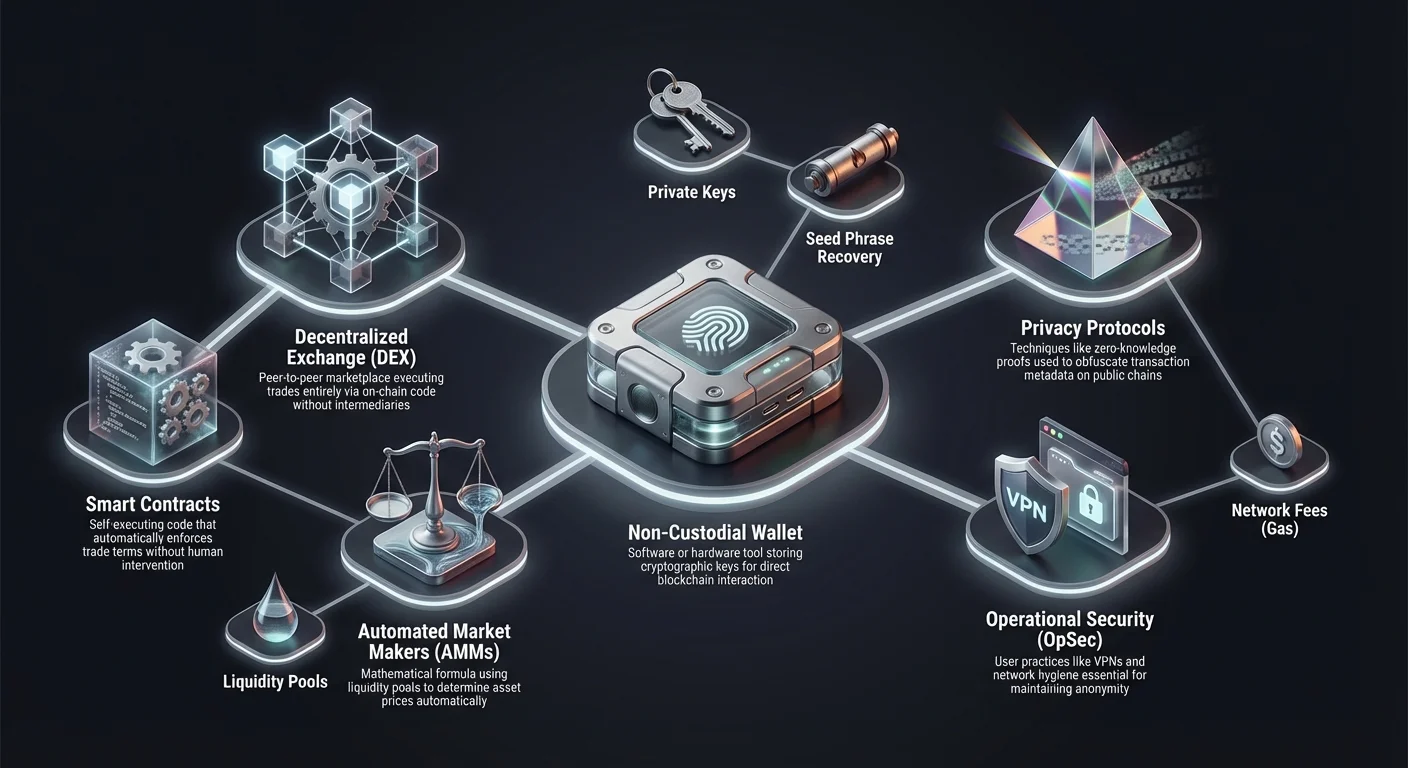
To engage with non-custodial trading, a user must first understand the tool that makes it possible: the non-custodial wallet. Unlike an account on a centralized exchange, a wallet is a piece of software or hardware that stores private keys. These keys are cryptographic signatures that authorize transactions on the blockchain.
When a user sets up a non-custodial wallet, they are generated a seed phrase. This is usually a sequence of 12 to 24 random words. This phrase is the master key to the funds. Anyone who possesses this phrase can access the assets, regardless of passwords or PIN codes. This highlights the critical importance of offline storage and physical security for seed phrases.
Software wallets, often installed as browser extensions or mobile apps, are considered "hot" wallets because they are connected to the internet. They offer convenience for frequent trading. However, they are more susceptible to malware and online attacks compared to offline alternatives.
Hardware wallets, or "cold" storage, are physical devices that store private keys offline. To sign a transaction, the device must be physically connected to a computer or phone. This air-gapped approach provides the highest level of security. For privacy-focused traders, using a hardware wallet in conjunction with non-custodial exchanges is the gold standard for asset protection.
Decentralized Exchanges (DEXs) Explained
Decentralized Exchanges, or DEXs, represent the primary infrastructure for non-custodial trading. Unlike centralized counterparts that rely on a company to match buy and sell orders on a private server, DEXs operate entirely on the blockchain. They utilize smart contracts to execute trades. These are self-executing lines of code that automatically enforce the terms of the trade without human intervention.
The architecture of a DEX eliminates the need for a central authority. There is no CEO, no headquarters, and crucially, no centralized database of user identities. Users connect their non-custodial wallets directly to the DEX interface. The smart contract verifies that the user has the necessary funds and executes the swap.
This direct interaction ensures that the exchange never holds user funds. The assets move directly from the user's wallet to the smart contract and then to the counterparty or liquidity pool. If the DEX interface were to go offline, the smart contracts would typically remain accessible on the blockchain. Users could still interact with them directly, ensuring that funds are never trapped by a website outage.
Automated Market Makers (AMMs)
Most modern DEXs utilize a system known as an Automated Market Maker (AMM). In traditional markets, order books are used where buyers and sellers list the prices they are willing to accept. A central engine matches these orders. AMMs replace this order book model with liquidity pools.
A liquidity pool is a smart contract that holds reserves of two or more tokens. For example, an Ethereum and USDC pool would contain quantities of both assets. Users, known as liquidity providers (LPs), deposit these assets into the pool. In return, they earn a portion of the trading fees generated by the platform.
When a trader wants to swap Ethereum for USDC, they do not trade against another person. They trade against the pool. The smart contract uses a mathematical formula to determine the price based on the ratio of assets in the pool. As tokens are removed from one side of the pool and added to the other, the price adjusts automatically to maintain balance.
This mechanism ensures that there is always liquidity available for trading, provided there are funds in the pool. It allows for continuous trading without the need for a counterparty to be online at the exact same moment. However, it introduces specific dynamics regarding pricing and slippage that traders must understand.
Order Book DEXs and Aggregators
While AMMs are popular, some decentralized exchanges seek to replicate the traditional order book experience on-chain. These platforms allow users to place limit orders, specifying the exact price at which they wish to buy or sell. This offers more control over trade execution compared to the immediate market swaps of AMMs.
Executing an order book on-chain can be computationally expensive and slow due to blockchain network congestion. To solve this, some platforms use off-chain matching engines. The orders are matched centrally for speed, but the actual settlement of the trade occurs on-chain via smart contracts. This hybrid approach maintains non-custodial security while improving performance.
DEX aggregators have also emerged as a vital tool for traders. With liquidity fragmented across dozens of different DEXs, finding the best price can be difficult. Aggregators scan multiple exchanges to find the most efficient route for a trade. They may split a single large trade across several pools to minimize price impact. This ensures that the user gets the best possible rate without needing to manually check every individual exchange.
Privacy-Centric Trading Infrastructure
Privacy in trading goes beyond just avoiding KYC. It involves protecting the metadata of transactions. On a public blockchain, every transaction is visible. If a wallet address is linked to a real-world identity, the entire financial history of that user is exposed. True privacy solutions employ technologies to obfuscate this data.
One method is the use of privacy coins. Unlike Bitcoin or Ethereum, where transaction details are public, privacy coins use advanced cryptography to hide the sender, receiver, and amount involved. Zero-knowledge proofs are a common technology used here. They allow the network to verify a transaction is valid without revealing the underlying data.
Atomic swaps are another technology facilitating private trading. An atomic swap allows two parties to exchange cryptocurrencies on different blockchains without an intermediary. For instance, swapping Bitcoin for Litecoin directly. The trade is enforced by a type of smart contract called a Hashed TimeLock Contract (HTLC). This ensures that either both parties receive their funds, or the transaction is cancelled and funds returned.
No-KYC Centralized Exchanges
A gray area exists in the form of centralized exchanges that do not require KYC verification. These platforms operate similarly to standard exchanges but often reside in jurisdictions with loose regulatory oversight. They allow users to sign up with just an email address and deposit cryptocurrency.
These platforms offer the speed and user experience of a centralized engine without the immediate identity intrusion. They often have higher liquidity than DEXs for certain altcoin pairs. Traders use them to access markets that might be geoblocked or restricted on fully compliant platforms.
However, these platforms carry significant risk. Because they are centralized, they hold custody of the funds. The lack of regulatory compliance means there is little legal recourse if the exchange disappears or freezes funds. Furthermore, "no KYC" policies can change overnight due to regulatory pressure. Users might find their funds locked until they provide identification, defeating the original purpose of using the platform.
Peer-to-Peer (P2P) Marketplaces
Peer-to-Peer (P2P) marketplaces offer a direct method of trading between individuals. Unlike a DEX which focuses on swapping one crypto for another, P2P platforms are often used to convert between fiat currency and cryptocurrency. They act as a bulletin board where users post advertisements to buy or sell assets.
The critical component of a P2P marketplace is the escrow service. When a trade is initiated, the seller's crypto is locked in an escrow account managed by the platform or a smart contract. The buyer then sends the fiat payment directly to the seller via bank transfer, digital wallet, or even cash.
Once the seller confirms receipt of the payment, the crypto is released from escrow to the buyer. This system allows for fiat on-ramps and off-ramps without the platform itself handling the fiat money. Because the payment occurs outside the platform, P2P trading can support a vast array of payment methods that traditional exchanges cannot.
Privacy on P2P platforms varies. Some require full identity verification to post ads, while others allow for pseudonymity. The direct nature of the transfer means that the buyer and seller may see each other's banking details, but the platform itself may not aggregate this data in the same way a centralized exchange does.
Operational Security (OpSec) for Privacy
Using a non-custodial or privacy-focused exchange is only one part of the equation. To maintain true privacy, a trader must practice strong operational security (OpSec). A lapse in OpSec can link a private wallet to a real identity, rendering other privacy measures useless.
Network hygiene is the first step. Accessing trading platforms from a standard home IP address leaves a digital footprint. Internet Service Providers (ISPs) can see that a user is connecting to a crypto exchange. To mitigate this, privacy-conscious traders often use Virtual Private Networks (VPNs) or the Tor network. These tools mask the user's IP address and encrypt their internet traffic.
Browser fingerprinting is another concern. Websites collect data about a user's device, screen resolution, installed fonts, and browser version to create a unique fingerprint. Using a privacy-hardened browser or disabling JavaScript can help reduce this tracking. However, disabling JavaScript may break the functionality of many web-based DEX interfaces.
Coin Control and Wallet Management
Wallet management strategies are essential for breaking the link between transactions. If a user receives funds from a KYC-compliant exchange into a private wallet, that link is permanent on the blockchain. To break this chain, users might utilize coin mixers or privacy-preserving protocols. These services mix a user's coins with those of others, making it difficult to trace the original source.
Coin control is a feature available in some advanced wallets. It allows the user to select exactly which unspent transaction outputs (UTXOs) to use for a new transaction. By carefully selecting outputs, a user can avoid combining clean funds with KYC-linked funds. This granular control prevents the accidental clustering of addresses that blockchain analysis firms use to de-anonymize users.
Generating a new address for every transaction is a basic but effective privacy habit. Reusing the same address for multiple deposits creates a comprehensive history that is easily analyzed. Most modern HD (Hierarchical Deterministic) wallets do this automatically, but users must be aware of it when sharing addresses for payments.
Risks of Non-Custodial Trading
While non-custodial solutions offer sovereignty and privacy, they introduce distinct risks that centralized platforms manage on behalf of the user. The most significant is the irreversibility of actions. In a self-sovereign system, there is no "forgot password" button and no customer support team that can reverse a transaction.
Smart contract risk is a major concern in the DEX ecosystem. The smart contracts that power these exchanges are complex pieces of code. If there is a bug or a vulnerability in the code, hackers can exploit it to drain the liquidity pools. Users interacting with these contracts could lose their deposited funds. Audits by security firms help mitigate this, but they are not a guarantee of safety.
Phishing attacks target non-custodial users aggressively. Attackers create fake websites that look identical to popular DEXs or wallet interfaces. If a user connects their wallet and signs a malicious transaction, they effectively grant the attacker permission to drain their assets. Vigilance in verifying URLs and contract addresses is mandatory.
Impermanent Loss Explained
For those who participate in AMMs as liquidity providers, impermanent loss is a unique financial risk. This occurs when the price of the deposited assets changes compared to when they were deposited. Because the AMM adjusts the ratio of assets to maintain a balance, a significant price divergence can result in the provider ending up with less value than if they had simply held the assets in a wallet.
The loss is termed "impermanent" because it only becomes realized if the liquidity is withdrawn while the prices are divergent. If the prices return to their original ratio, the loss disappears. However, in volatile crypto markets, prices rarely return to exact previous states, making the loss permanent upon withdrawal.
Liquidity providers must weigh the potential trading fee revenue against the risk of impermanent loss. In pairs with high volatility, the risk is greater. Stablecoin pairs, where both assets are pegged to the dollar, have minimal impermanent loss risk, making them a safer entry point for new providers.
Fee Structures and Network Costs
Trading on non-custodial platforms involves a different fee structure than centralized exchanges. Centralized platforms typically charge a percentage of the trade volume. In the non-custodial world, the user pays two types of fees: the protocol fee and the network fee.
The protocol fee is similar to a trading fee. It is a small percentage paid to the liquidity providers or the protocol treasury. This fee incentivizes users to supply the capital that makes the exchange work. These fees are often competitive and sometimes lower than centralized alternatives.
The network fee, often called "gas," is paid to the miners or validators of the blockchain to process the transaction. This fee is dynamic and depends on the congestion of the network. On popular networks like Ethereum, gas fees can become exorbitant during periods of high activity. A simple trade could cost huge sums in gas, regardless of the trade size.
Layer 2 Solutions and Sidechains
To combat high network fees, the industry has developed Layer 2 solutions and sidechains. Layer 2 protocols sit on top of the main blockchain (Layer 1) and handle the computation off-chain. They bundle hundreds of transactions into a single batch and settle them on the main chain. This drastically reduces the cost per transaction.
Sidechains are independent blockchains that run parallel to the main chain. They have their own consensus mechanisms and can offer faster, cheaper transactions. Users bridge their assets from the main chain to the sidechain to trade on DEXs located there.
These scaling solutions have made non-custodial trading accessible to smaller investors who were previously priced out by high gas fees. They maintain the non-custodial nature of the trade but often introduce different security assumptions. Users must trust the bridge mechanics and the security of the specific Layer 2 network.
The Role of Governance Tokens
Many non-custodial platforms are governed by decentralized autonomous organizations (DAOs). These protocols issue governance tokens to their users. Holders of these tokens have the right to vote on changes to the protocol. This can include decisions on fee structures, new feature implementations, or treasury spending.
Governance tokens align the incentives of the users with the platform. Active traders and liquidity providers earn ownership stakes in the infrastructure they use. This contrasts with centralized exchanges where users have no say in corporate operations.
However, governance can also introduce risks. If a malicious entity acquires a large percentage of the voting supply, they could potentially push through changes that harm the protocol or drain funds. This is known as a governance attack. Diversified token distribution and time-locks on voting execution are used to defend against this.
Comparison: CEX vs. DEX vs. P2P
Understanding the differences between the three main types of exchanges is helpful for selecting the right platform.
| Feature | Centralized Exchange (CEX) | Decentralized Exchange (DEX) | Peer-to-Peer (P2P) |
|---|---|---|---|
| Custody | Exchange holds funds | User holds funds | User/Escrow holds funds |
| Privacy | Low (KYC Required) | High (No KYC) | Variable (Depends on user) |
| Liquidity | Very High | Variable (High for major pairs) | Lower (Dependent on offers) |
Centralized exchanges offer speed and high liquidity but require trust and personal data. DEXs offer security and privacy but require technical know-how and can have higher network fees. P2P platforms offer fiat flexibility and censorship resistance but carry higher risks of interpersonal scams.
Regulatory Challenges and Geoblocking
The rise of privacy-focused and non-custodial trading has attracted the attention of global regulators. Governments are concerned about the potential for money laundering and the evasion of capital controls. As a result, regulatory bodies are increasing pressure on all entry points to the crypto ecosystem.
Some DEX interfaces have begun to implement geoblocking. This restricts users from certain sanctioned countries or jurisdictions with strict crypto laws from accessing the web interface. It is important to note that this usually only blocks the website, not the underlying smart contract. Technically proficient users can still interact with the blockchain directly, bypassing the frontend block.
The concept of "bypass" in this context often refers to using technical means to access these services despite geographical restrictions. While VPNs are commonly used for this purpose, users should be aware of the legal implications in their specific jurisdiction. The technology permits access, but local laws may prohibit it.
Conclusion
The ecosystem of non-custodial and privacy-focused trading solutions offers a powerful alternative to the traditional financial infrastructure. By prioritizing self-sovereignty, these platforms return control of assets and data to the individual. They utilize transparent code and cryptographic proofs to replace the need for blind trust in centralized intermediaries.
However, this freedom comes with substantial responsibility. The absence of safety nets means that traders must be their own security experts. Understanding wallet management, smart contract risks, and operational security is non-negotiable. For those willing to learn, the tools exist to trade with a level of autonomy and privacy that was previously impossible.
True financial ownership requires the courage to hold your own keys and the discipline to protect them.